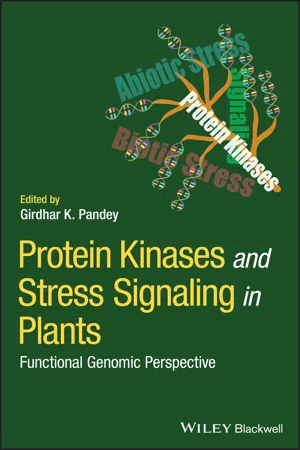
Protein Kinases and Stress Signaling in Plants
eBook - ePub

Protein Kinases and Stress Signaling in Plants

Functional Genomic Perspective

  1. English
  2. ePUB (mobile friendly)
  3. Available on iOS & Android
eBook - ePub

Protein Kinases and Stress Signaling in Plants

Functional Genomic Perspective

About this book

A comprehensive review of stress signaling in plants using genomics and functional genomic approaches

Improving agricultural production and meeting the needs of a rapidly growing global population requires crop systems capable of overcoming environmental stresses. Understanding the role of different signaling components in plant stress regulation is vital to developing crops which can withstand abiotic and biotic stresses without loss of crop yield and productivity. Emphasizing genomics and functional genomic approaches, Protein Kinases and Stress Signaling in Plants is a comprehensive review of cutting-edge research on stress perception, signal transduction, and stress response generation.

Detailed chapters cover a broad range of topics central to improving agricultural production developing crop systems capable of overcoming environmental stresses to meet the needs of a rapidly growing global population. This book describes the field of protein kinases and stress signaling with a special emphasis on functional genomics. It presents a highly valuable contribution in the field of stress perception, signal transduction and generation of responses against one or multiple stress signals.

This timely resource:

  • Summarizes the role of various kinases involved in stress management 
  • Enumerates the role of TOR, GSK3-like kinase, SnRK kinases in different physiological conditions
  • Examines mitogen-activated protein kinases (MAPKs) in different stresses
  • Describes the different aspects of calcium signaling under different stress conditions
  • Examines photo-activated kinases (PAPKs) in varying light conditions
  • Briefs the presence of tyrosine kinases in plants
  • Highlights the cellular functions of receptor]like protein kinases (RLKs)
  • Possible implication of these kinases in developing stress tolerant crops

Protein Kinases and Stress Signaling in Plants: Functional Genomic Perspective is an essential resource for researchers and students in the fields of plant molecular biology and signal transduction, plant responses to stress, plant cell signaling, plant protein kinases, plant biotechnology, transgenic plants and stress biology.

Trusted by 375,005 students

Access to over 1.5 million titles for a fair monthly price.

Study more efficiently using our study tools.

Information

Year
2020
Print ISBN
9781119541516
Edition
1
eBook ISBN
9781119541561

1
Two Component Mediated Stress Signaling in Plants : A Comparative Profiling in Monocots and Dicots

Priyanka Gupta1#, Chhaya Yadav1#, Deepti Singh1#, Ramsong Chantre Nongpiur1, Sneh Lata Singla‐Pareek2, and Ashwani Pareek1
1 Stress Physiology and Molecular Biology Laboratory, School of Life Sciences, Jawaharlal Nehru University, New Delhi, India
2 Plant Stress Biology, International Centre for Genetic Engineering and Biotechnology, Aruna Asaf Ali Marg, New Delhi, India
# Equal contribution

Introduction

Living organisms are constantly exposed to environmental changes. Different organisms adapt and respond differently to the adverse conditions (Bray 1997; Kozlowski 1997; Sakai and Larcher 2012; Bleuven and Landry 2016). One of the key features that distinguish plants from animals is that the former are sessile in nature and require more efficiently governed genetic regulation to cope with unfavorable environmental conditions. Hence, during evolution, plants have developed intricate mechanisms to face these environmental challenges to some extent. Plants’ responses toward environmental stresses are multigenic and are governed by complex signaling molecules working in an orchestrated manner (Nongpiur et al. 2012). Various ‐omics approaches, including genomics, transcriptomics, proteomics and metabolomics, have been utilized to understand the signaling machinery operative under abiotic stresses. These studies reveal that tolerant plants withstand the extremes of environment in an adaptive manner, by re‐adjusting the major signaling and metabolic pathways to maintain cellular homeostasis (Ward and Thompson 2012; Ding et al. 2013; Soni et al. 2015). The response toward stresses involves complex molecules, wisely regulated at distinct checkpoints. Environmental changes are perceived by receptors such as histidine kinases (HKs), hormone receptors, G‐protein coupled receptors (GPCR), receptor kinases, transporters, antiporters, and tyrosine or serine/threonine kinases (Kacperska 2004; Osakabe et al. 2013; Zargar 2018). These activated receptors trigger downstream cascade by activating signaling molecules like Ca2+, ROS (reactive oxygen species), and other adapter molecules, which ultimately leads to the initiation of a series of post‐translational protein modification events (Nishida and Gotoh 1993; Lee et al. 2007). These modifications can result in the activation of effector proteins, which function directly in the alleviation of the effects of the stress. The modifications can also stimulate the regulation of transcription factors, which modulates the expression of stress related genes to combat the detrimental effect of the environmental extremes (Jaspers and Kangasjärvi 2010; Sinha et al. 2011; Zhu 2016). Though a certain level of overlap does exist in the responses to different environmental constraints, these responses are usually distinct for each environmental stress (Zhu 2001; Fujita et al. 2006). More than one type of stress can turn “on” similar set of genes and thus participate in the crosstalk for stress signaling (Fujita et al. 2009; Gupta et al. 2016).
The two‐component system (TCS) is known to play a significant role in regulating various biological processes in both prokaryotes and eukaryotes, including higher plants. However, in eukaryotes, animals do not possess TCS regulatory system. TCS is a signal transduction pathway, which primarily evolved for the perception and transduction of extracellular signals. This signaling mechanism operates by the His‐Asp phosphorelay. As the name suggests, the simplest form of TCS involves two major components for signaling; one membrane bound sensory HK and the other ones is its cognate response regulator (RR). Signal is perceived by the HK, which auto‐phosphorylates at a conserved histidine residue and then transfers this phosphoryl group to a conserved aspartate residue on the RR, which in turn stimulates a response. This kind of TCS, designated as prototypical TCS, has been identified only in prokaryotes and has been shown to govern distinct cellular processes such as chemotaxis, quorum sensing, and osmotic response (Aizawa et al. 2000; Mitrophanov and Groisman 2008). Schematic diagram, for how the TCS signaling proceeds, is given in Figure 1.1. A more complex form of TCS, designated as the multistep phosphorelay (MSP), is found in both prokaryotes and eukaryotes. The MSP possesses an additional shuttle protein to communicate signal between HK to the RR. This additional shuttle/adapter molecule is known as HPT (histidine containing phosphotransfer protein). In addition to the HPTs, the HKs of MSP are more complex than the prototyp...

Table of contents

  1. Cover
  2. Table of Contents
  3. Title Page
  4. Copyright Page
  5. List of Contributors
  6. Editor Biography
  7. Preface
  8. 1 Two Component Mediated Stress Signaling in Plants
  9. 2 Lectin Receptor like Kinase
  10. 3 Photoactivated Protein Kinases in Green Algae and Their Functional Role in Abiotic Stress
  11. 4 Emerging Role of Plant GSK3/SHAGGY‐like Protein Kinases in Stress Signaling Pathways
  12. 5 Balancing Growth and Defense
  13. 6 SnRK2s
  14. 7 Lipid Mediated Regulation of Protein Kinases
  15. 8 Calcium Dependent Protein Kinases in Plants
  16. 9 Regulation of Stress Responses in Plants by Calcium Dependent Protein Kinases
  17. 10 Calmodulin‐Binding Kinases
  18. 11 Calcium/Calmodulin Activated Protein Kinases in Stress Signaling in Plants
  19. 12 Role of CBL‐Interacting Protein Kinases in Regulating Plant Stress Responses
  20. 13 Casein Kinase2 and Its Dynamism in Abiotic Stress Management
  21. 14 Cyclin‐Dependent Protein Kinases in the Control of Cell Cycle in Plants
  22. 15 MAP Kinase as Regulators for Stress Responses in Plants
  23. 16 A Network View of MAP Kinase Pathways in Plant Defense Regulation
  24. 17 Role of MAP Kinase Signaling in Xanthomonas Pathogen‐Rice Interaction
  25. 18 Role of MAPK Cascade in Local and Systemic Immunity of Plants
  26. 19 Role of Plant Kinases in Combined Stress
  27. 20 Protein Tyrosine Phosphorylation in Plants
  28. 21 Role of Kinases for Regulating K+ Homeostasis Under Salt and Drought Stress Conditions
  29. 22 Plant Peroxisomal Protein Kinases Implicated inStress‐Related Responses
  30. Index
  31. End User License Agreement

Frequently asked questions

Yes, you can cancel anytime from the Subscription tab in your account settings on the Perlego website. Your subscription will stay active until the end of your current billing period. Learn how to cancel your subscription
No, books cannot be downloaded as external files, such as PDFs, for use outside of Perlego. However, you can download books within the Perlego app for offline reading on mobile or tablet. Learn how to download books offline
Perlego offers two plans: Essential and Complete
  • Essential is ideal for learners and professionals who enjoy exploring a wide range of subjects. Access the Essential Library with 800,000+ trusted titles and best-sellers across business, personal growth, and the humanities. Includes unlimited reading time and Standard Read Aloud voice.
  • Complete: Perfect for advanced learners and researchers needing full, unrestricted access. Unlock 1.5M+ books across hundreds of subjects, including academic and specialized titles. The Complete Plan also includes advanced features like Premium Read Aloud and Research Assistant.
Both plans are available with monthly, semester, or annual billing cycles.
We are an online textbook subscription service, where you can get access to an entire online library for less than the price of a single book per month. With over 1.5 million books across 990+ topics, we’ve got you covered! Learn about our mission
Look out for the read-aloud symbol on your next book to see if you can listen to it. The read-aloud tool reads text aloud for you, highlighting the text as it is being read. You can pause it, speed it up and slow it down. Learn more about Read Aloud
Yes! You can use the Perlego app on both iOS and Android devices to read anytime, anywhere — even offline. Perfect for commutes or when you’re on the go.
Please note we cannot support devices running on iOS 13 and Android 7 or earlier. Learn more about using the app
Yes, you can access Protein Kinases and Stress Signaling in Plants by Girdhar K. Pandey in PDF and/or ePUB format, as well as other popular books in Biological Sciences & Biology. We have over 1.5 million books available in our catalogue for you to explore.