Basic Electrical and Instrumentation Engineering
eBook - ePub

Basic Electrical and Instrumentation Engineering

  1. English
  2. ePUB (mobile friendly)
  3. Available on iOS & Android
eBook - ePub

Basic Electrical and Instrumentation Engineering

About this book

Electrical and instrumentation engineering is changing rapidly, and it is important for the veteran engineer in the field not only to have a valuable and reliable reference work which he or she can consult for basic concepts, but also to be up to date on any changes to basic equipment or processes that might have occurred in the field. Covering all of the basic concepts, from three-phase power supply and its various types of connection and conversion, to power equation and discussions of the protection of power system, to transformers, voltage regulation, and many other concepts, this volume is the one-stop, "go to" for all of the engineer's questions on basic electrical and instrumentation engineering.

There are chapters covering the construction and working principle of the DC machine, all varieties of motors, fundamental concepts and operating principles of measuring, and instrumentation, both from a "high end" point of view and the point of view of developing countries, emphasizing low-cost methods.

A valuable reference for engineers, scientists, chemists, and students, this volume is applicable to many different fields, across many different industries, at all levels. It is a must-have for any library.
Frequently asked questions

Yes, you can cancel anytime from the Subscription tab in your account settings on the Perlego website. Your subscription will stay active until the end of your current billing period. Learn how to cancel your subscription.
No, books cannot be downloaded as external files, such as PDFs, for use outside of Perlego. However, you can download books within the Perlego app for offline reading on mobile or tablet. Learn more here.
Perlego offers two plans: Essential and Complete
  • Essential is ideal for learners and professionals who enjoy exploring a wide range of subjects. Access the Essential Library with 800,000+ trusted titles and best-sellers across business, personal growth, and the humanities. Includes unlimited reading time and Standard Read Aloud voice.
  • Complete: Perfect for advanced learners and researchers needing full, unrestricted access. Unlock 1.4M+ books across hundreds of subjects, including academic and specialized titles. The Complete Plan also includes advanced features like Premium Read Aloud and Research Assistant.
Both plans are available with monthly, semester, or annual billing cycles.
We are an online textbook subscription service, where you can get access to an entire online library for less than the price of a single book per month. With over 1 million books across 1000+ topics, we’ve got you covered! Learn more here.
Look out for the read-aloud symbol on your next book to see if you can listen to it. The read-aloud tool reads text aloud for you, highlighting the text as it is being read. You can pause it, speed it up and slow it down. Learn more here.
Yes! You can use the Perlego app on both iOS or Android devices to read anytime, anywhere — even offline. Perfect for commutes or when you’re on the go.
Please note we cannot support devices running on iOS 13 and Android 7 or earlier. Learn more about using the app.
Yes, you can access Basic Electrical and Instrumentation Engineering by C. Sharmeela,P. Sivaraman,R. Mahendran,A. Thaiyal Nayagi in PDF and/or ePUB format, as well as other popular books in Tecnología e ingeniería & Ingeniería eléctrica y telecomunicaciones. We have over one million books available in our catalogue for you to explore.

1
Introduction to Electric Power Systems

The main parameters in electrical systems are voltage and current. The product of voltage and current gives a third parameter called power, and power consumed over some time duration is called energy [1]. The electric power system consists of power generation, transmission and distribution system [2]. Power is generated from two main sources, namely conventional energy sources and non-conventional energy sources. The conventional energy sources are non-renewable which gets depleted over a period of time, while non-conventional energy sources are non-depleting sources [3, 10, 30]. Most large-scale power plants are located in areas where the raw materials are available locally and generated power is transmitted over long distances for distribution. An electrical conducting medium is required in order to transfer the power from generating station to load center. This conducting medium is called as transmission system. Transformers and transmission lines are the main components of the transmission system; they are used to transfer the power from generating station to consumers (customers) at various operating voltage levels. Generation voltage of the conventional power plant typically ranges from 6.6 kV to 22 kV, and transmission voltage typically ranges from 110 kV to 765 kV. High voltage is stepped down to various voltage levels for different consumers depending upon the requirements and installed capacity.

1.1 Introduction

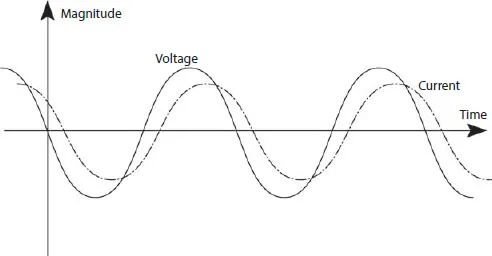
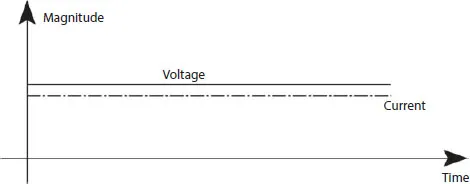
In general, electrical power used for commercial and residential purpose is mostly Alternating Current (AC). An AC voltage or current has the magnitude and direction which changes periodically with respect to time, unlike the Direct Current (DC) supply, which has constant magnitude with respect to time. Figure 1.1 shows the waveform of AC (voltage and current) and Figure 1.2 shows the waveform of DC (voltage and current).
Schematic illustration of the waveform of alternating current with respect to magnitude and time.
Figure 1.1 Waveform of AC.
Schematic illustration of the waveform of direct current with respect to magnitude and time.
Figure 1.2 Waveform of DC.
Types of AC supply system:
The AC supply system is classified into two types based on the number of phases:
  • • Single-phase power supply
  • • Three-phase power supply
A. The single phase supply
The single-phase power supply is used to power all the single-phase loads in the systems. Generally, single-phase power supply is derived from a three-phase, four-wire circuit. The single-phase voltage level varies from country to country. The general single-phase supply voltage is 220 V, 230 V, 240 V in low voltage systems (in Asian countries). Most of the single-phase supply systems are 2W systems as shown in Figure 1.11.
B. Three-Phase Power Supply
The three-phase power supply is used to power certain loads which need the poly-phase supply for their operation. Here phase means branch circuits or winding and poly means many. Such loads in any applicati...

Table of contents

  1. Cover
  2. Table of Contents
  3. Foreword
  4. Acknowledgements
  5. 1 Introduction to Electric Power Systems
  6. 2 Transformers
  7. 3 DC Machines
  8. 4 AC Machines
  9. 5 Measurement and Instrumentation
  10. Index
  11. End User License Agreement