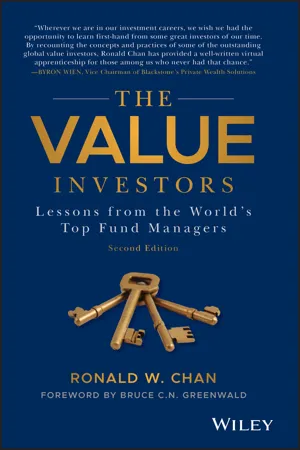
The latest edition of the popular collection of in-depth portraits of extraordinary value investors, featuring new profiles and updates
The second edition of The Value Investors presents a collection of investing legend profiles from around the world. Chapters explore the investors' backgrounds, cultures, and personal stories, and reveal how life experiences have shaped their investment strategies and mindsets. This fascinating book shows you that value investing is a dynamic, constantly-changing strategy which, when properly implemented, can provide significant, sustainable benefits. Although the investors profiled come from a diverse range of geographic regions and socio-economic, cultural, and educational backgrounds, they share similar personality traits, temperaments, and investment philosophes.
Thoroughly revised and expanded, the book provides relevant updates on the professional and personal experiences of the investors since the first edition's publication. Complementing the original profiles are several new chapters featuring established value investors including Howard Marks, as well as rising personalities and fund managers such as Álvaro Guzmán de Lázaro and Fernando Bernad Marrase. Author Ronald Chan, founder of Hong Kong-based investment management Chartwell Capital Limited, highlights how and why the value investors have consistently beaten the stock market through the years. This book:
Covers multiple generations, geographies, and value investing styles
Presents updated profiles of notable value investors such as Walter Schloss, Irving Kahn and Thomas Kahn, Jean-Marie Eveillard, Mark Mobius, and Teng Ngiek Lian
Profiles international fund and asset managers from the North America, Europe and Asia
Includes a chapter on the making of a successful value investor
The Value Investors: Lessons from the World's Top Fund Managers, 2nd Edition is a must-read for investors looking to diversify their portfolios across different asset classes or geographic areas, finance professionals and students, and general readers with interest in value investing.
Trusted by 375,005 students
Access to over 1.5 million titles for a fair monthly price.
Risk is a choice rather than a fate. The actions we dare to take, which depend on how free we are to make choices, are what the story of risk is all about.
—Peter L. Bernstein
Howard Marks is the co‐founder and co‐chairman of Oaktree Capital Management, an investment management firm founded in 1995 that specializes in alternative credit strategies, such as distressed debt, high yield bonds, convertible securities, real estate debt, and emerging markets. As of 2018, the company managed $120 billion for clients including public and pension funds, foundations, endowments, corporate and insurance companies, and sovereign wealth funds. The Los Angeles–headquartered firm has over 950 employees and offices in 18 cities worldwide.
In April 2012, Oaktree went public on the New York Stock Exchange, raising $380 billion. In March 2019, Brookfield Asset Management acquired a 62 percent stake in Oaktree, with Marks and his colleagues owning the remaining 38 percent of the company and maintaining full control of its day‐to‐day operations.
Marks is the author of Mastering the Market Cycle: Getting the Odds on Your Side and The Most Important Thing: Uncommon Sense for the Thoughtful Investor. Dividing his time between Los Angeles and New York, he is a trustee and chairman of the investment committee at the Metropolitan Museum of Art and also chairs the investment committee of the Royal Drawing School in London. He is an Emeritus Trustee of the University of Pennsylvania, whose investment board he chaired from 2000 to 2010. As of March 2020, Marks was ranked by Forbes as one of America's 400 wealthiest individuals, with an estimated net worth of $2.2 billion.
Marks runs a book club, but it's no leisurely pursuit: each title is chosen so that his team at Oaktree Capital Management can glean some kernel of wisdom and apply it to their profession. “We meet annually to discuss a book. This year, we read Kenneth Galbraith's A Short History of Financial Euphoria,” Howard Marks said during an interview in his New York office in late 2019.
Galbraith sums up the attributes of financial euphoria as follows: “The first is the extreme brevity of the financial memory … The second … is the specious association of money and intelligence.” Like Galbraith, Marks acknowledges that investor memory is often short‐lived. Investors forget the natural cycle of boom and bust and repeat the same mistakes from one cycle to the next. In a memo from 2005, Hindsight First, Please (or, What Were They Thinking?), Marks gave the following advice to investors: Don't dwell excessively on recent experience but look to the future instead. Consider today's developments after careful assessment of the past.
With a lifelong interest in financial market history, Marks happily shared a sampling of his favorite books on the topic: “Peter Bernstein's Against the Gods is all about risk and probabilities. I read Devil Take the Hindmost: A History of Financial Speculation by Edward Chancellor in 1999 and saw a lot of similarities with what was going on in the tech bubble, and I realized I could write a memo about it.”
Marks writes an investment memo a few times a year, a habit he formed in 1990 when he felt compelled to write about achieving superior investment performance. In his inaugural memo, The Route to Performance, he wrote that “the best foundation for above‐average long‐term performance is an absence of disasters. It is for this reason that a quest for consistency and protection, not single‐year greatness, is a common thread.”
“I don't know exactly why I started writing,” Marks explained. “I wasn't that purposeful or trying to attract a large audience. I wrote because the topics merited discussion. The memos never attracted much attention in the early days. And then, on the first day of 2000, I wrote a memo called bubble.com, which had two major elements going for it: accuracy and speed. Those are the two things necessary to attract readers—you must be correct, and what you say has to turn out to be correct quickly, because if it takes too long, then you look wrong. A lot of that memo was inspired by Devil Take the Hindmost.”
These days, investors flock to Oaktree's website to download Marks's missives. His writing process is deceptively simple: “I've been writing memos for over 30 years now and my writing has always been the same, which is to say that I try to write like I speak. I didn't have to develop a different writing style separate from my speaking style. The only challenge is to get it from my brain onto the piece of paper.”
When it comes to brainstorming for a topic, Marks turns to a trusty file rack brimming with inspirational news clippings and articles. “The topic is usually in my brain. When I'm ready to write the memo, I look at the clippings. Memos that have nothing to do with timeliness can take a month or two to complete. When there's an element of timeliness to the piece—such as the financial crisis—I can write one in less than a day. In general, I write a lot during the holidays because it's a form of recreation for me. There's usually a memo in September that I wrote over the summer and usually a memo in January that I wrote over Christmas.”
During the summer of 2015, Marks wrote It's Not Easy, a memo inspired by Warren Buffett's investment partner Charlie Munger, who summed up the essence of investing as: “It's not supposed to be easy. Anyone who finds it easy is stupid.” In his memo, Marks explained that “people who think it can be easy overlook substantial nuance and complexity.” To be a superior investor requires what Marks calls second‐level thinking—an ability to think beyond the obvious. First‐level thinking, Marks asserts, is superficial, and results in an investor merely regurgitating facts and providing an ill‐informed opinion of the future. Second‐level thinking requires an investor to consider complex potential scenarios and the consequences of each. As the title of his memo suggests, making this leap is not easy.
Marks wrote, “Remember your goal in investing isn't to earn average returns; you want to do better than average. Thus, your thinking has to be better than that of others—both more powerful and at a higher level. Since others may be smart, well‐informed, and highly computerized, you must find an edge they don't have. You must think of something they haven't thought of, see things they miss, or bring insight they don't possess. You have to react differently and behave differently. In short, being right may be a necessary condition for investment success, but it won't be sufficient. You must be more right than others … which by definition means your thinking has to be different.”
Marks continued by noting that the superior investor requires a better‐than‐average ability to approach risks differently: “No tactic or technique will lead to superior results in the absence of superior judgement and implementation.” Warren Buffett, meanwhile, provides the mechanism for doing just that: “The less prudence with which others conduct their affairs, the greater the prudence with which we should conduct our own affairs.” Marks learned the lessons taught by imprudent investors when he first entered the world of finance.
From Equity to Credit
After earning an undergraduate degree at the Wharton School of the University of Pennsylvania and an MBA from the Booth School of Business at the University of Chicago, Marks interned at First National City Bank of New York (now called Citibank) before joining the firm as a full‐time equity analyst.
“My first internship in 1967 wasn't in the investment department,” he recalled. “It was in what was called operations—back office work. I learned quickly that I didn't want to be in the back office. For my second internship in 1968, First National assigned me to the investment research department, and I discovered that I enjoyed thinking about companies. The bank was already a Nifty50 investor when I became a full‐time equity analyst in 1968. It was the opposite of value investing and, though it worked for a while, it was incredibly unsuccessful and then failed horribly in the 1970s.”
The Nifty50 were the 50 most popular large‐cap stocks in America during the 1960s and early 1970s. They were considered safe and stable with outstanding long‐term growth prospects, and investors bought them regardless of their high P/E multiples. However, as a German proverb states, “trees don't grow to the sky,” and these stocks were battered during the 1973 to 1974 bear market. Some have disappeared, but as of 2020, 29 of those companies still exist, including 3M, Eli Lily, IBM, McDonald's, Merck, and the Walt Disney Company.
Witnessing the Nifty50 flameout helped Marks develop his value‐oriented mindset. “If you bought these companies in 1968, on the first day of my summer job, and held them for five years, you would have lost almost all your money,” he recalled. “In other words, buying high quality can't be sufficient. You must consider the fairness of price, and that's what investing is all about.
“That's a period when I began to develop certain concepts in investing, and as I say, ‘good investing is a matter of not buying good things but buying things well.’ You must know the difference. It's not what you buy, it's what you pay. It's all about the fairness of price.”
Marks continued his career story: “The bank's performance was terrible in the 1970s, as was the performance of many other banks, because they were all Nifty50 investors. The bank brought in a new CIO and he wanted to bring in his own head of research. I was lucky I didn't get fired because our performance was so bad. In May 1978, the CIO asked me what I wanted to do next, and I said I would do anything other than spending the rest of my life choosing between Merck or Lily. So, he switched me to the bond department where I started a convertible bond fund.”
To better understand the bond world, Marks asked people at other banks and brokerage firms what they would look for in credit. With a street‐tested methodology in his back pocket, Marks entered the credit market, serving as portfolio manager for convertible and high‐yield securities at the bank.
Referring to some of the investments he made, Marks said that the credit world 40 years ago was hardly sophisticated. In fact, he considered that era to be “stupid” when it came to sound investing: “Today, thanks to smartphones and so forth, everyone knows everything. Back then, there were a lot of things that people didn't know. The world was a stupid place compared to today. Deals would come out that were simply too favorable to the investor. It still happens today from time to time, but not as often as before.”
Marks recalled one instance in 1984 when he discovered Eurobonds—bonds of American companies listed in non‐dollar currencies. “I remember one in particular from Honeywell. It had a small conversion premium with a three‐year maturity. Since Honeywell was creditworthy, meaning you couldn't lose money, you could buy it around par, make the 6 percent coupon, and then be repaid at par. But you could make more if the equity rose since it had a small conversion premium, so if the stock went up, it would go up just as much. That's too good a deal—upside but no downside.”
“I developed a liking for things I thought of as a ‘one‐way ratchet.’ In an intelligent market, you don't have the opportunity to buy things where you can make money without fear of losing because other people eventually figure it out and that changes the price. But, as I said, the market was a dumb place then, so you could find one‐way ratchets.”
In another example, Marks looked at a product developed by Merrill Lynch called LYON—Liquid Yield Option Notes. “These were zero‐coupon convertibles that might come out at a price of 40 cents on the dollar,” Marks explained. “They would mature in X years at 100 cents on the dollar. The path from 40 to 100 would provide a yield of Y. Again, you couldn't lose money, because on every third anniversary, you would have a put option [an opportunity to sell the security back to the issuer] at a price along the curve heading to par at maturity....
Table of contents
Cover
Title Page
Copyright
Table of Contents
Foreword
Preface
CHAPTER 1: Master of the Market Cycle
CHAPTER 2: Free to Choose in Value Land
CHAPTER 3: Once Upon a Time on Wall Street
CHAPTER 4: The Making of a Contrarian
CHAPTER 5: On the Shoulders of Value Giants
CHAPTER 6: A Journey to the Center ofValue
CHAPTER 7: The Self‐Taught Value Spaniard
CHAPTER 8: The Law of Value Attraction
CHAPTER 9: The Odyssey of a Value Broker
CHAPTER 10: The Income‐Conscious Englishman
CHAPTER 11: The Frequent Value Traveler
CHAPTER 12: The Value‐Oriented Businessman
CHAPTER 13: Value Investing in the Lost Decade
CHAPTER 14: Eternal Sunshine of the Value Mind
CHAPTER 15: The Formless Value Deal Maker
CHAPTER 16: The Accidental Value Investor
CHAPTER 17: The Making of a Value Investor
Acknowledgments
About the Author
Index
End User License Agreement
Frequently asked questions
Yes, you can cancel anytime from the Subscription tab in your account settings on the Perlego website. Your subscription will stay active until the end of your current billing period. Learn how to cancel your subscription
No, books cannot be downloaded as external files, such as PDFs, for use outside of Perlego. However, you can download books within the Perlego app for offline reading on mobile or tablet. Learn how to download books offline
Perlego offers two plans: Essential and Complete
Essential is ideal for learners and professionals who enjoy exploring a wide range of subjects. Access the Essential Library with 800,000+ trusted titles and best-sellers across business, personal growth, and the humanities. Includes unlimited reading time and Standard Read Aloud voice.
Complete: Perfect for advanced learners and researchers needing full, unrestricted access. Unlock 1.5M+ books across hundreds of subjects, including academic and specialized titles. The Complete Plan also includes advanced features like Premium Read Aloud and Research Assistant.
Both plans are available with monthly, semester, or annual billing cycles.
We are an online textbook subscription service, where you can get access to an entire online library for less than the price of a single book per month. With over 1.5 million books across 990+ topics, we’ve got you covered! Learn about our mission
Look out for the read-aloud symbol on your next book to see if you can listen to it. The read-aloud tool reads text aloud for you, highlighting the text as it is being read. You can pause it, speed it up and slow it down. Learn more about Read Aloud
Yes! You can use the Perlego app on both iOS and Android devices to read anytime, anywhere — even offline. Perfect for commutes or when you’re on the go. Please note we cannot support devices running on iOS 13 and Android 7 or earlier. Learn more about using the app
Yes, you can access The Value Investors by Ronald Chan in PDF and/or ePUB format, as well as other popular books in Business & Investments & Securities. We have over 1.5 million books available in our catalogue for you to explore.