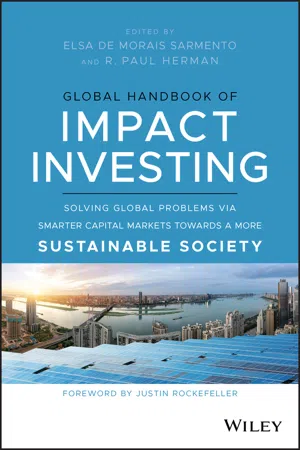
Global Handbook of Impact Investing
eBook - ePub

Global Handbook of Impact Investing

Solving Global Problems Via Smarter Capital Markets Towards A More Sustainable Society

  1. English
  2. ePUB (mobile friendly)
  3. Available on iOS & Android
eBook - ePub

Global Handbook of Impact Investing

Solving Global Problems Via Smarter Capital Markets Towards A More Sustainable Society

About this book

Discover how to invest your capital to achieve a powerful, lasting impact on the world.
The Global Handbook of Impact Investing: Solving Global Problems Via Smarter Capital Markets Towards A More Sustainable Society is an insightful guide to the growing world-wide movement of Impact Investing. Impact investors seek to realize lasting, beneficial improvements in society by allocating capital to sources of impactful and sustainable profit.

This Handbook is a how-to guide for institutional investors, including family offices, foundations, endowments, governments, and international organizations, as well as academics, students, and everyday investors globally. The HandbookÂŽs wide-ranging contributions from around the world make a powerful case for positive impact and profit to fund substantive, lasting solutions that solve critical problems across the world.

Edited by two experienced and distinguished professionals in the sustainable investing arena and authored by two dozen renowned experts from finance, academia, and multilateral organizations from around the world, the Global Handbook of Impact Investing educates, inspires, and spurs action towards more responsible investing across all asset classes, resulting in smarter capital markets, including how to:

·         Realize positive impact and profit

·         Integrate impact into investment decision-making and portfolio

·         Allocate impactful investments across all asset classes

·         Apply unique Impact Investing frameworks

·         Measure, evaluate and report on impact

·         Learn from case examples around the globe

·         Pursue Best Practices in Impact Investing and impact reporting

 While other resources may take a local or limited approach to the subject, this Handbook gathers global knowledge and results from public and private institutions spanning five continents. The authors also make a powerful case for the ability of Impact Investing to lead to substantive and lasting change that addresses critical problems across the world.

Trusted by 375,005 students

Access to over 1.5 million titles for a fair monthly price.

Study more efficiently using our study tools.

Information

Publisher
Wiley
Year
2020
Print ISBN
9781119690641
Edition
1
eBook ISBN
9781119691136

CHAPTER 1
Impact Investing: Innovation or Rebranding?

Haifa Ben Abid, MPhil

Abstract

In recent years, individuals and organizations in both private and public sectors at national and international levels have been seeking lasting solutions to daunting global challenges, from climate change to unprecedented levels of youth unemployment. In their search, many have embraced Impact Investing as a new investment strategy that brings together the worlds of profit-making and social and environmental problem-solving. Despite the increasing interest in Impact Investing, scholarly work in the field remains scarce. While a myriad of practitioner contributions exist, a dearth of academic research on Impact Investing persists. Yet bodies of literature that have emerged over the years focus on the broader trend of “positive” investment classes that closely resemble Impact Investing, including socially responsible investments (SRI), social entrepreneurship, sustainable investments (related to environmental, social, and governance investments (ESG); microfinance; and ethical investments. A consensus on Impact Investing's definition eludes scholars and practitioners alike; likewise, debates continue over how, and in what ways, Impact Investing represents a distinctive and innovative investment strategy that sets it apart from other forms of positive investment as well as institutional investment. This chapter intends to shed light on the concept of Impact Investing, providing greater conceptual clarity, encouraging the burgeoning interest in Impact Investing among scholars, and helping to foster research in this area by offering insights into Impact Investing's key features and actors, related practices, opportunities and challenges that together constitute the uniqueness of Impact Investing.
Keywords
Impact Investing; Social Impact Investment; Socially Responsible Investment; Microfinance; Social Entrepreneurship; Ethical Investment

INTRODUCTION

As a global community, we face daunting social and environmental problems, from persistently high levels of greenhouse gas emissions, deforestation, and pollution, to increasingly frequent epidemics and rising youth unemployment, inadequate access to clean water, sanitation, and health care. Addressing such problems sustainably—both immediately and over the long term—will require trillions of dollars of funding. Against a backdrop of economic turbulence, austerity measures on public budgets, and a burgeoning youth population, a new investment strategy that brings together the worlds of profit-making and social and environmental problem-solving is garnering global attention: Impact Investing.
Emerging on a global scale over the past 20 years (Ormiston et al. 2015), Impact Investing refers to an investment strategy that intentionally aims to achieve both financial returns and positive social and environmental impacts (O'Donohoe et al. 2010; Rodin and Brandenberg 2014; Vecchi et al. 2016). According to its proponents, Impact Investing promises to offer an innovative way to bring the resources of the world's financial markets to its seemingly intractable problems (Clarkin and Cangioni 2016).
For years, Impact Investing has been met with enthusiasm by practitioners who have produced a vast array of studies and reports on the subject (HöchstÀdter and Scheck 2015; Vecchi et al. 2016). Likewise, it has become a priority issue on the agendas of governments and international, bilateral, and multilateral institutions alike. Yet it has received scant attention among scholars, with few studies published in academic books and peer-reviewed journals (Emerson and Spitzer 2007; HöchstÀdter and Scheck 2015; Moore et al. 2012; Nicholls 2010). The limited scholarly literature has left the field of Impact Investing with a substantial degree of ambiguity and lack of consensus regarding its definitions and terminology. Consequently, Impact Investing's distinctiveness from related forms of investing remains unclear. Similarly, Impact Investing's unique strategies, principles, practices, and objectives are often muddled (Clarkin and Cangioni 2016; HöchstÀdter and Scheck 2015).
This lack of clarity prompts the research question that forms the scope of this chapter: Is Impact Investing truly a new concept and an innovative investment strategy, making its mark in a significant way? That is, does it merely represent a rebranding of similar forms of alternative, socially conscious investment, such as socially responsible investment (SRI), venture philanthropy, social enterprise investment, or microfinance practices?
This chapter aims to present a better understanding of the concept of Impact Investing with the purpose of contributing to the existing knowledge base, encouraging further academic research, and supporting practitioners. To that end, this chapter examines existing works of scholars and practitioners who have contributed to discussions and debates regarding the foundations of Impact Investing, its definition, framework, opportunities, constraints, and empirical research.
The next section of this chapter presents the methods used to conduct a comprehensive literature review that produced three thematic discussions. The following section provides an overview of Impact Investing's origins, philosophy, and practices, with the aim of clarifying the concept of Impact Investing. The next section traces the growth of Impact Investing and the response from the world of investment. The following section explores the key features of Impact Investing in greater detail, highlighting what it shares with other forms of positive investing and what sets it apart. The conclusion outlines suggestions for future research directions in the field of Impact Investing.

METHODOLOGY

To assess the current state of the field of Impact Investing, a comprehensive review of the existing literature relevant to Impact Investing was conducted, utilizing content analysis techniques. The literature review utilized the approach provided by Cooper (1988, 1998), Cooper and Hedges (1994), and Hedges and Cooper (1994), which emphasizes two main elements of the literature review: (i) report, describe, and clarify existing primary research on impact investing; and (ii) summarize research findings. Given that the term Impact Investing is relatively new, the dearth of academic research, and the fact that the Impact Investing discourse is primarily driven by practitioners, the present study draws upon both academic and practitioner contributions (HöchstÀdter and Scheck 2015).
Keyword searches were conducted in Google, Google Scholar, and major scholarly databases, including ProQuest, Web of Science, EBSCO, Academic Search Complete, and Business Source Complete. A variety of fields were considered in the searches, including management, finance, entrepreneurship, international development, and sociology. Keyword searches included “Impact Investing,” “impact investment,” “social entrepreneurship,” “social enterprise investment,” “social finance,” and “social impact investment.” Using the keyword “Impact Investing,” for example, yielded over 1.5 million results in Google, and 6,390 results in Google Scholar. Narrowing the keyword search in Google Scholar to titles of articles yielded 558 results. The term “Impact investment” yielded similar results (see Table 1.1). Practitioner contributions included various reports and case studies from government agencies, investment firms, foundations, and consulting firms. Furthermore, numerous reports appeared from organizations that provide services and resources to the social sector, such as the Global Impact Investing Network (GIIN), the Rockefeller Foundation, United Nations Development Program (UNDP), and JP Morgan.
This comprehensive review of existing literature addresses areas of similarities and inconsistencies in the diverse understandings of scholars and practitioners engaged in a critical analysis of the discourse, tracing noteworthy debates and prominent voices. It attempts to map the range of practices embrac...

Table of contents

  1. Cover
  2. Table of Contents
  3. Title Page
  4. Copyright
  5. Dedication
  6. Foreword
  7. Acknowledgments
  8. About the Contributors
  9. Acronyms and Abbreviations
  10. Introduction
  11. CHAPTER 1: Impact Investing: Innovation or Rebranding?
  12. CHAPTER 2: Investing for Impact: Socially Motivated Investors and Externalities
  13. CHAPTER 3: Place-Based Impact Investing: Local and Regional Assets for Local and Regional Impact in Globally Diversified Portfolios
  14. CHAPTER 4: How to Invest in Human Capital: Measuring and Integrating Human Capital Valuation to Realize Higher-Impact Portfolios
  15. CHAPTER 5: Leadership by Results for Impact Investors and Investees
  16. CHAPTER 6: Gender Lens Investing: Co-Creating Critical Knowledge to Build a Credible, Durable Field
  17. CHAPTER 7: Investing with a Gender Lens: Uncovering Alpha Previously Overlooked
  18. CHAPTER 8: Gender Lens Investing in the African Context
  19. CHAPTER 9: The Evolution from Gender-Focused Microfinance to Gender Lens Investing in Latin America: The Case of Pro Mujer
  20. CHAPTER 10: Inclusive Investing: Impact Meets Diversity, Equity, and Inclusion
  21. CHAPTER 11: Investing for Impact in Employee Retirement Plans
  22. CHAPTER 12: Fossil-Fuel-Free Investing: Weaving a New Investment Paradigm
  23. CHAPTER 13: The Role of Transition Finance Instruments in Bridging the Climate Finance Gap
  24. CHAPTER 14: Social Impact Bonds: Promises and Results
  25. CHAPTER 15: Climate and Money: Dealing with “Impact Washing” and a Case for Climate Impact Bonds
  26. CHAPTER 16: Measuring and Evaluating Social Impact in Impact Investing: An Overview of the Main Available Standards and Methods
  27. CHAPTER 17: Impact Measurement and Management Techniques to Achieve Powerful Results
  28. CHAPTER 18: Transformative Evaluation and Impact Investing: A Fruitful Marriage
  29. CHAPTER 19: Geospatial Analysis of Targeting of World Bank's Development Assistance in Mexico
  30. CHAPTER 20: Evaluating the Impact of Portfolio Allocations to Large Firms Along the Value Chain to Develop Small and Medium-Sized Enterprises
  31. CHAPTER 21: Two Decades of Front-Line Impact Investing
  32. CHAPTER 22: China's Rapidly Evolving Practice of Impact Investing: A Critical Perspective
  33. CHAPTER 23: Impact Investing Through Corporate Social Responsibility: The Indian Experience
  34. CHAPTER 24: What Drives Impact Investors? Benchmarking Developed and Developing Countries
  35. CHAPTER 25: Understanding the Demand for Impact Investments: Insights from the Italian Market
  36. CHAPTER 26: The Importance of Scale in Social Enterprises: The Indian Case
  37. CHAPTER 27: The Role of the Entrepreneurial University and Engaged Scholarship in Impact Investing Capacity Building
  38. CHAPTER 28: A Road Map for Implementing Impact Investing: The Case of Multinational Companies
  39. CHAPTER 29: Impact Investing and European Wealth Managers: Why Impact Investing Will Go Mainstream and Evolve to Suit European Investors
  40. CHAPTER 30: Fintech for Impact: How Can Financial Innovation Advance Inclusion?
  41. Index
  42. End User License Agreement

Frequently asked questions

Yes, you can cancel anytime from the Subscription tab in your account settings on the Perlego website. Your subscription will stay active until the end of your current billing period. Learn how to cancel your subscription
No, books cannot be downloaded as external files, such as PDFs, for use outside of Perlego. However, you can download books within the Perlego app for offline reading on mobile or tablet. Learn how to download books offline
Perlego offers two plans: Essential and Complete
  • Essential is ideal for learners and professionals who enjoy exploring a wide range of subjects. Access the Essential Library with 800,000+ trusted titles and best-sellers across business, personal growth, and the humanities. Includes unlimited reading time and Standard Read Aloud voice.
  • Complete: Perfect for advanced learners and researchers needing full, unrestricted access. Unlock 1.5M+ books across hundreds of subjects, including academic and specialized titles. The Complete Plan also includes advanced features like Premium Read Aloud and Research Assistant.
Both plans are available with monthly, semester, or annual billing cycles.
We are an online textbook subscription service, where you can get access to an entire online library for less than the price of a single book per month. With over 1.5 million books across 990+ topics, we’ve got you covered! Learn about our mission
Look out for the read-aloud symbol on your next book to see if you can listen to it. The read-aloud tool reads text aloud for you, highlighting the text as it is being read. You can pause it, speed it up and slow it down. Learn more about Read Aloud
Yes! You can use the Perlego app on both iOS and Android devices to read anytime, anywhere — even offline. Perfect for commutes or when you’re on the go.
Please note we cannot support devices running on iOS 13 and Android 7 or earlier. Learn more about using the app
Yes, you can access Global Handbook of Impact Investing by Elsa De Morais Sarmento, R. Paul Herman, Elsa De Morais Sarmento,R. Paul Herman, Elsa De Morais Sarmento , R. Paul Herman in PDF and/or ePUB format, as well as other popular books in Business & Investments & Securities. We have over 1.5 million books available in our catalogue for you to explore.