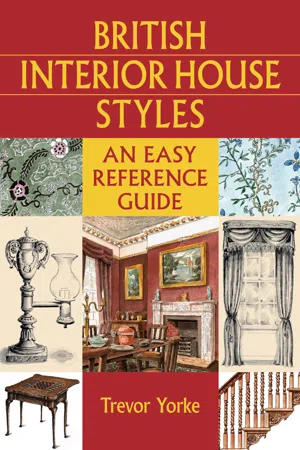
Here is a compact and easy reference guide, filled with original drawings and diagrams in full colour, which detail the changing uses of space within houses over the centuries. The book shows developments in fashion, decoration, and furniture within different rooms and how these have steadily evolved with the passage of time. The book covers an immense range of interior styles from 1500 to 1960. In addition, there is a glossary of terms and a historical time chart. The book will prove invaluable to those who visit period homes and, at the same time, will give useful pointers to those planning to restore their own home in a particular period style.
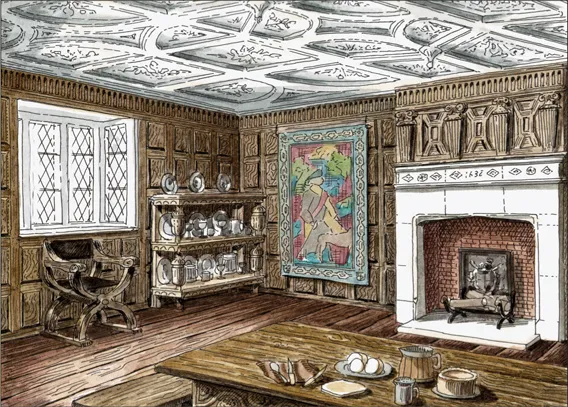
FIG 1.1:An Elizabethan interior from a luxurious urban house, with the owner’s wealth displayed in the oak wall panelling, elaborate fireplace and decorative plastered ceiling. Furniture was limited but wall hangings, bold fabrics and splashes of paint made the finest rooms colourful places.
Our journey through the history of English house interiors begins some 500 years ago when Henry VIII had recently ascended the throne. Over the following century and a half, up to the end of the Commonwealth in 1660, our domestic surroundings had begun a transformation from one based around a communal open hall to an arrangement of private rooms separated from the owner’s household. This key change was already underway at gentry level when we join the story and was still taking place lower down the social scale at the end of this period. A key element was the adoption of the fireplace and chimney set in a side wall, as opposed to the previous variety of arrangements where the hearth was within the body of the room. This change enabled a floor to be inserted above the old open hall, usually forming a great chamber in the largest houses where the family could take their meals and entertain guests; while the household who had formerly shared this daily routine were now relegated to the old hall below. In the smaller homes of the merchant or yeoman farmer this two-storey plan, with bedrooms above a living room and parlour, was widely adopted; in some wealthy areas like the wool rich Suffolk towns, this happened from the beginning of this period, whilst elsewhere it became common from the later 1500s as rising incomes sparked a ‘Great Rebuilding’ of houses.
The interior of Early Tudor houses was very much a continuation of late medieval themes, with little concern for the overall form of the room, and style being limited to decorative elements like tapestries. This was a time when the gentry regularly moved from one property to another, taking not only chests full of belongings but also removing the windows and taking these with them too. Glass was still a luxury product at this time and windows only became fixed from 1579 onwards. During this period, however, the Renaissance on the Continent began to influence our Gothic isle and houses at the top end of the market began to have symmetrical façades and rooms behind to match. Stair cases which had been little more than ladders to access upper rooms in the medieval period now became a more impressive feature of the house, although they were usually enclosed in a tower or to the side of the building. The exposed beams of the floor above began to be covered over and patterned ceilings formed in plaster. Walls, doorways and furniture could now be covered with patterns copied from illustrations of the latest Classical styles (often from the Protestant Netherlands), as columns, capitals and pediments began replacing the pointed arch as the key decorative components for the next 300 years. At this date masons and carpenters applied these details with little knowledge of the rules of Classical architecture so they can appear as rather clumsy, with deeply carved masses of detail, especially in the Elizabethan period (1559–1603).
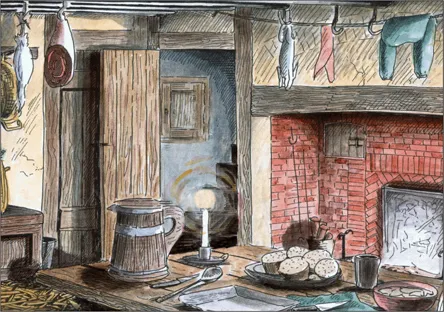
FIG 1.2:The vast majority of the population lived in the country and would have been familiar with interiors like this example from a 16th-century farmhouse. An inglenook fireplace, straw strewn on a beaten earth floor and low beamed ceilings were characteristic of this period. The cupboard to the left of the fire was built into the wall to store spices, salt or other valuables.
In the more modest middle-class home this transition took longer and, although owners did copy the fashions set by their social superiors, they were often adapted by local craftsmen into regional styles. Most farmhouses generally had ceilings which were beamed; walls panelled in the finest rooms or painted with decorative scenes, patterns or scripts; floors covered with rushes to gather up the dirt; and with an inglenook fireplace as the focal point of the living room and parlour. The houses of the wealthier merchant or farmer by the end of this period could have featured plastered ceilings, more extensive panelling and furniture carved in the latest Classical styles. One point worth making is that despite the rather plain appearance today of Tudor and Jacobean homes, they originally would have been more colourful places; the black and white treatment is a later Victorian interpretation.
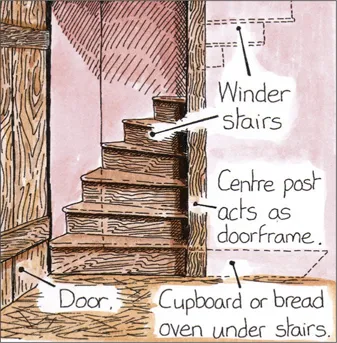
FIG 1.3: Winder stairs:As the better-off built themselves new houses of two or more storeys so they needed a staircase. In most Tudor homes these were simple types like this winder stair and were commonly found tucked into a corner beside a fire or in a separate tower attached to the exterior. These were plain utilitarian structures with little opportunity for decoration.
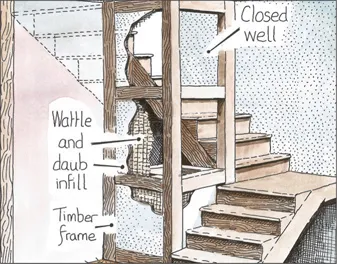
FIG 1.4: Closed well staircase:In larger houses the stairs could be more spacious and built around a central well which was closed off with wattle and daub or timber panelling. It was common for this otherwise wasted space to have cupboards inserted.
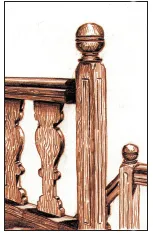
FIG 1.5: Splat balusters:In the early 17th century carved balusters became more common, a cheaper version being one cut from a flat plank of timber called a splat baluster. The acorn finial on top of the post was a popular form in the late Elizabethan and Jacobean periods.
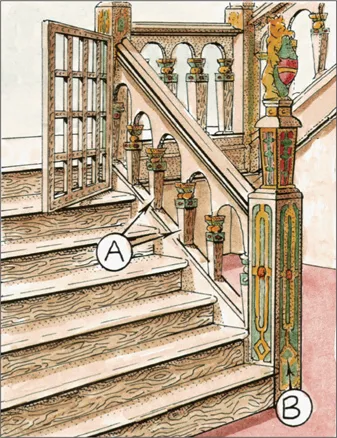
FIG 1.6: Open stairwell:In the finest houses of the Elizabethan and Jacobean period an open staircase with carved balusters (A) and newel posts (B) became a feature for display, albeit still enclosed off to the side of the principal rooms. Woodwork and furniture often had details picked out in bright colours as here.
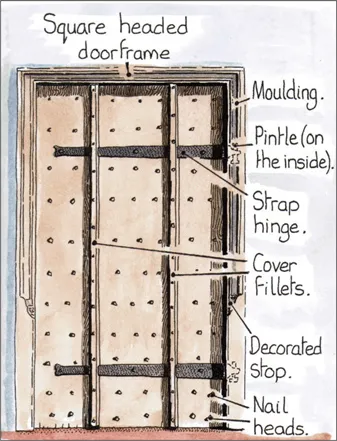
FIG 1.7: Doors:Most external and internal doors of the period were made from vertical planks of uneven width, held together with battens across their inner face (they closed flat onto the back of the doorway and were not recessed within it). The finest could have decorative ironwork and wooden fillets.
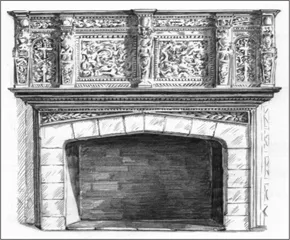
FIG 1.8: Fireplaces:These could range from simple timber beam lintels above a large opening (see Fig 1.2,) up to fine stone surrounds with shallow pointed arches and highly decorative wooden or plaster overmantels as in this example (see also Fig 1.1). Wood was the most common fuel although coal was imported to some cities.
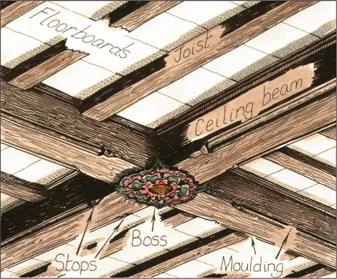
FIG 1.9: Ceilings:Tudor ceilings were usually no more than the exposed joists and central bridging beam of the floor above. The edges were usually chamfered (if found today with sharp edges, then it was probably originally intended to be covered) and, on the finest, moulded edges and decorative bosses were added for effect.
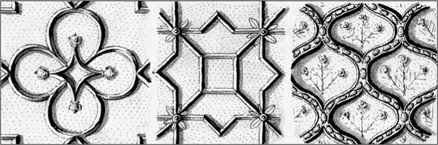
FIG 1.10: Plaster ceilings:From the late 16th century plaster ceilings with deep geometric patterns (as in these examples) and drooping pend...
Table of contents
Cover
Title
Copyright
Contents
Introduction
Chapter 1: Tudor and Jacobean Styles 1500–1660
Chapter 2: Restoration and Queen Anne Styles 1660–1720
Chapter 3: Early Georgian Styles 1720–1760
Chapter 4: Mid Georgian Styles 1760–1800
Chapter 5: Regency Styles 1800–1840
Chapter 6: Early Victorian Styles 1840–1880
Chapter 7: Late Victorian and Edwardian Styles 1880–1920
Chapter 8: Inter and Post War Styles 1920–1960
Glossary
Timechart
Index
Trusted by 375,005 students
Access to over 1.5 million titles for a fair monthly price.
Study more efficiently using our study tools.
Frequently asked questions
Yes, you can cancel anytime from the Subscription tab in your account settings on the Perlego website. Your subscription will stay active until the end of your current billing period. Learn how to cancel your subscription
No, books cannot be downloaded as external files, such as PDFs, for use outside of Perlego. However, you can download books within the Perlego app for offline reading on mobile or tablet. Learn how to download books offline
Perlego offers two plans: Essential and Complete
Essential is ideal for learners and professionals who enjoy exploring a wide range of subjects. Access the Essential Library with 800,000+ trusted titles and best-sellers across business, personal growth, and the humanities. Includes unlimited reading time and Standard Read Aloud voice.
Complete: Perfect for advanced learners and researchers needing full, unrestricted access. Unlock 1.5M+ books across hundreds of subjects, including academic and specialized titles. The Complete Plan also includes advanced features like Premium Read Aloud and Research Assistant.
Both plans are available with monthly, semester, or annual billing cycles.
We are an online textbook subscription service, where you can get access to an entire online library for less than the price of a single book per month. With over 1.5 million books across 990+ topics, we’ve got you covered! Learn about our mission
Look out for the read-aloud symbol on your next book to see if you can listen to it. The read-aloud tool reads text aloud for you, highlighting the text as it is being read. You can pause it, speed it up and slow it down. Learn more about Read Aloud
Yes! You can use the Perlego app on both iOS and Android devices to read anytime, anywhere — even offline. Perfect for commutes or when you’re on the go. Please note we cannot support devices running on iOS 13 and Android 7 or earlier. Learn more about using the app
Yes, you can access British Interior House Styles by Trevor Yorke in PDF and/or ePUB format, as well as other popular books in Architecture & Architecture General. We have over 1.5 million books available in our catalogue for you to explore.