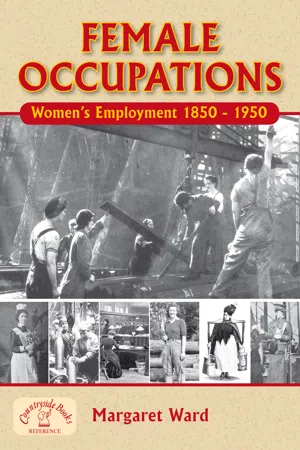
This is a carefully researched A-Z of women's employment, covering over 100 years of change. The entries are based on an encyclopaedic approach, each full of interest and information, as they chart the steadily evolving status of women and the historic struggle to broaden the job opportunities open to them.Early occupations that were considered socially suitable included dairymaid, fisherwoman, governess, and stone picker. The decline of domestic service and the effect of the two World Wars, gave way to the modern era of access for women to all categories and ranks of employment from accountants, army officers, and diplomats, to captains of industry and even prime minister.Female Occupations contains over 300 entries. Each of these has some explanation of what the job entailed, the historical setting, and examples or stories of women who were involved with it.
- 287 pages
- English
- ePUB (mobile friendly)
- Available on iOS & Android
eBook - ePub
About this book
Information
Subtopic
19th Century HistoryIndex
HistoryA
Accountant
The demand for accountants soared as new businesses and industries were created in the 19th century. There was nothing to stop women working as accountants, and they are recorded as such in the census (e.g. in 1881 Amelia Barrett, 47 years old, of Islington, or Isabella Brown, 29 years old, of Lambeth). The ‘world’s first professional body of accountants’ – the Institute of Chartered Accountants of Scotland (ICAS) – was awarded its royal charter in 1854; the first professional body in England, the Institute of Accountants in London, was formed in 1870 and in 1880 the Institute of Chartered Accountants in England and Wales (ICAEW) was also established by royal charter. However, there was determined resistance to admitting women as members, which it was thought would ‘lower the status of the profession’.
Mary Harris Smith (1847–1934) was obviously born with a love of figures and had worked as an accountant for some time before her first attempt to gain membership at the age of 41. By 1888 she had her own business in London and that year she applied to join the ICAEW but was refused admission because she was a woman. In 1889 and 1891 she was similarly turned down by the Society of Incorporated Accountants and Auditors (SIAA, formed in 1885, merged with the ICAEW in 1957) – in the 1891 census she is recorded as a ‘practising accountant’. Nearly 20 years later, in 1918, the SIAA changed their rules to allow the admission of women and voted to admit Mary Harris Smith as an Honorary Fellow. Mary, by now aged 72, renewed her application to the ICAEW and in 1919 became the first, and only, female chartered accountant in the world.
Although the professional gates were open, relatively few women followed in Mary Harris Smith’s footsteps (they still formed only 4% of the workforce by 1980).
After 1870 several professional societies were formed: a history and index can be found on the website of the ICAEW, which also has a searchable database of ‘Accountancy Ancestors’ – ‘Who was who in accountancy 1874–1965’ – which includes obituaries and photographs (Library and Information Service, Chartered Accountants’ Hall, PO Box 433, Moorgate Place, London EC2P 2BJ; telephone: 020 7920 8620; www.icaew.co.uk). The Guildhall Library has a useful leaflet guide to the records it holds relating to the ICAEW and the bodies that predated it; or consult Chartered Accountants in England and Wales: A Guide to Historical Records, Wendy Habgood (Manchester University Press, 1994). The website of ICAS is at www.icas.org.uk.
Actress, music hall artiste
In 1802 the Lady’s Magazine had warned: ‘The stage is a dangerous situation for a young woman of a lively temper and personal accomplishments.’ Over a century later, Noel Coward’s advice to Mrs Worthington not to put her daughter on the stage echoed the sentiment – the theatre was no place for a nice girl. Actresses were sought after, admired and envied, but very often they were outside the pale of respectable society and were sometimes considered little better than prostitutes.
The Victorian actress could only learn her trade by practice. Some, like Dame Ellen Terry (1848–1928), were the children of actors and appeared on stage from infancy but, as Charles Booth summarised in the 1880s: ‘The chief methods of obtaining engagements are (1) by advertising, (2) through an agent, (3) applying directly to the management.’ At the time, rates of pay could be anything from £1 10s to £4 or £5 a week, depending on the theatre and the actress’s place in the stage hierarchy: she might just be a ‘walking woman’ with little or nothing to say. Young actresses with promise might get the chance to understudy a part, or sometimes more established actors took pupils for paid tuition. Not until the establishment of the Academy of Dramatic Art in 1904 (the prefix ‘Royal’ was added in 1920) was there a school where the techniques of stage acting could be taught, but the profession remained one where chance could play as large a part as hard graft and experience in the making of a ‘star’.
An actress of the 19th century would have found employment within the ‘stock company system’, where she worked at a particular theatre performing a repertory of plays, which would be repeated in sequence. Subsequently that system gave way to touring companies or ‘long runs’, where the company of actors performed one play either at different locations or for a long period in one theatre.
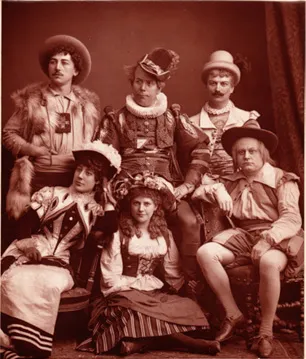
Violet Cameron (Violet Lydia Thompson, 1862–1919), centre, with Minnie Byron and other members of the cast of The Mascotte at the Royal Comedy Theatre in 1881. She made her fi rst stage appearance at the age of eight and was a popular performer in operettas, plays and music hall, but became notorious for a series of scandalous love affairs.
The ‘stock company’ routine was revived in the early 1900s as ‘repertory theatre’ or ‘rep’ and was a good training ground for young actresses. Wendy Hiller (1912–2003), who became a highly respected stage and film actress, went into rep at Manchester straight from school in the 1920s and, like many others, gained experience of the theatre as an assistant stage manager before working as an understudy and taking walk-on parts; her big break came in the 1930s with the lead in Love on the Dole, taken to London and then to New York. Since the 1910s more opportunities had been opening up for stage actresses in the rapidly expanding film industry, followed by radio and television, and many actresses moved from one medium to another. There were also women who went into management, such as Annie Horniman, who ran a repertory company after she bought the Gaiety Theatre in Manchester, from 1908 to 1917, and was influential in expanding the opportunities for actors in the early 20th century.
It can be difficult to categorise some individuals – were they actresses, dancers, singers, comediennes, or a combination of all four? The other side of the coin to ‘legitimate’ theatre was the music hall, beloved of the working classes. There had for some time been unlicensed ‘free and easies’ – small theatres, often in rooms attached to pubs, that put on short musical plays (burlettas), pantomimes and bills of variety including singers, dancers, speciality acts and comedians, but by the second half of the 19th century music hall was incredibly popular and had moved into the mainstream; there were literally hundreds of halls in London and provincial towns and cities by the 1870s. The last music hall to be purpose-built was the Chiswick Empire, in 1913, a ‘Palace of Variety’.
‘The great difference between an actor in a theatre and a music hall “artiste” is that whereas the first has his part provided for him, the second has to depend upon his own individual efforts and abilities,’ Charles Booth decided. ‘Music hall artistes bring their own company and their own piece and the manager of the hall has nothing to do but mount it in the matter of scenery.’
The stars were household names in their day – women like Vesta Tilley, Marie Lloyd, Bessie Bellwood, Jenny Hill and Nellie Power were some of those whose catch-phrases and songs were common currency. They were larger-than-life characters and they had to be, to make an immediate impression on an audience in a noisy, hot atmosphere where ‘turn’ followed ‘turn’ and the audience was free to move about – and walk out – at any time. But they were only the well-paid tip of the iceberg and the great majority of performers existed on low wages and uncertain contracts, and lived and died in poverty.
Tracing a woman who worked in the theatre is not easy. It was frequently a peripatetic and uncertain life, the use of stage names was very common, and actresses frequently lied about their age! See My Ancestor Worked in the Theatre, Alan Ruston (Society of Genealogists, 2005), for helpful information on research. The Theatre Museum collections, at Covent Garden until August 2007, have been moved to the Victoria and Albert Museum but see their website (www.peopleplayuk.org.uk) for a wealth of information on people from the worlds of theatre, music hall, pantomime, circus, dance etc. The National Archives has a leaflet on Sources for the History of Film, Television and the Performing Arts available there and elsewhere. An article entitled ‘Under the spotlight’ by Nicola Lisle (Ancestors magazine, June 2007) will also be helpful.
There is advice on tracing music hall and variety artistes at www.hissboo.co.uk/musichall_artistes.shtml. The website of the Scottish Music Hall Society (www.freeweb.com/scottishmusichallsociety/informationwanted.htm) has a page where people post queries on past artistes. See also ballet dancer; film, television and radio; ‘principal boy’.
Actuary
Dorothy Beatrice Spiers (née Davis, 1897–1977) was the first qualified woman actuary, a graduate of Newnham College, Cambridge who gained her degree in mathematics in 1918. She worked for the Guardian Insurance Company and studied for the examinations in her spare time, achieving qualification as a Fellow of the Institute of Actuaries in 1923. By 1960, there were still only eleven female fellows of the Institute.
It is a highly skilled, and highly paid, profession requiring advanced and accurate statistical and problem-solving abilities, usually in the world of insurance, pensions forecasts etc. And it required dedication from women like Dorothy, who refused initial offers of marriage from he...
Table of contents
- Cover
- Front Matter
- Occupations
- Back Matter
Trusted by 375,005 students
Access to over 1.5 million titles for a fair monthly price.
Study more efficiently using our study tools.
Frequently asked questions
Yes, you can cancel anytime from the Subscription tab in your account settings on the Perlego website. Your subscription will stay active until the end of your current billing period. Learn how to cancel your subscription
No, books cannot be downloaded as external files, such as PDFs, for use outside of Perlego. However, you can download books within the Perlego app for offline reading on mobile or tablet. Learn how to download books offline
Perlego offers two plans: Essential and Complete
- Essential is ideal for learners and professionals who enjoy exploring a wide range of subjects. Access the Essential Library with 800,000+ trusted titles and best-sellers across business, personal growth, and the humanities. Includes unlimited reading time and Standard Read Aloud voice.
- Complete: Perfect for advanced learners and researchers needing full, unrestricted access. Unlock 1.5M+ books across hundreds of subjects, including academic and specialized titles. The Complete Plan also includes advanced features like Premium Read Aloud and Research Assistant.
We are an online textbook subscription service, where you can get access to an entire online library for less than the price of a single book per month. With over 1.5 million books across 990+ topics, we’ve got you covered! Learn about our mission
Look out for the read-aloud symbol on your next book to see if you can listen to it. The read-aloud tool reads text aloud for you, highlighting the text as it is being read. You can pause it, speed it up and slow it down. Learn more about Read Aloud
Yes! You can use the Perlego app on both iOS and Android devices to read anytime, anywhere — even offline. Perfect for commutes or when you’re on the go.
Please note we cannot support devices running on iOS 13 and Android 7 or earlier. Learn more about using the app
Please note we cannot support devices running on iOS 13 and Android 7 or earlier. Learn more about using the app
Yes, you can access Female Occupations by Margaret Ward in PDF and/or ePUB format, as well as other popular books in History & 19th Century History. We have over 1.5 million books available in our catalogue for you to explore.