eBook - ePub
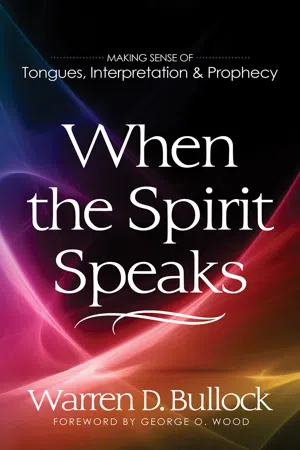
When the Spirit Speaks
Making Sense Out of Tongues, Interpretation, and Prophecy
- 87 pages
- English
- ePUB (mobile friendly)
- Available on iOS & Android
eBook - ePub
About this book
Tap into the power God wants to impart to congregations through spiritual vocal gifts: tongues, interpretations, and prophecy. This contemporary, relevant guide provides Pentecostal leadership for orderly functioning of the gifts in church services so pastors can encourage vocal gifts, maintain balance between structure and spontaneity, lead and instruct their congregations knowledgeably, deal with gift misues and abuses, and allow the Holy Spirit to empower their churches to reach people for Christ.
Information
Topic
Teologia e religioneSubtopic
Denominazioni cristiane1
A Crisis of Confusion
Rediscovering Our Pentecostal Identity
I was invited to speak on the work of the Holy Spirit by a bright young pastor of a relatively new congregation. I have met many young men and women in ministry just like him. Raised in a Pentecostal church, he had experienced his own personal baptism in the Spirit. Praying in tongues was a daily norm. On matters of the Spirit his doctrinal foundations were solid. He held ministerial credentials from a well-known and highly respected Pentecostal fellowship. Reaching lost people was his passion. He was quick to affirm the need of his church for the power of the Spirit.
And yet this new pastor was wrestling with an uneasiness about the manifestations of the Spirit. He had seen abuses, especially with vocal gifts, which had gone uncorrected on the premise that such correction would quench the Spirit. Excesses that claimed the Spirit’s authorship had embarrassed him at times. He was in the uncomfortable position of desiring the Spirit’s work while also fearing a repeat of fleshly aberrations.
Interestingly, his models for public worship and ministry were not Pentecostal, but were the pastors of some of America’s great evangelical megachurches. In those churches you would not find healing lines or vocal gifts or invitations to receive Spirit baptism. And yet as evangelicals, these pastors and their churches are reaching scores of people for Christ.
By contrast, many Pentecostal and Charismatic churches in America are on a growth plateau or are declining1 even though Pentecostals claim to be identified with spiritual harvest.2 So this young pastor wonders what advantage being Pentecostal provides. That he could even think in terms of an advantage disturbs him, because it implies a smug superiority he does not feel and suggests an attitude with which he refuses to identify. His negative experience with spiritual gifts has created the mind-set that most spiritual manifestations are obstacles, not helps, to bringing people to Christ. Yet he has experienced too much reality through the Spirit to be comfortable denying His supernatural power.
This pastor has a spiritual identity crisis, and, in my opinion, he represents a generation of young preachers in Pentecostal and Charismatic circles. Is he a Pentecostal or an Evangelical? And will he build a church that is Pentecostal in practice as well as doctrine, or will his church follow the patterns of ministry of the strong evangelical churches he admires?
Private vs. Public
One solution some have used to resolve this Evangelical/ Pentecostal dilemma is to receive the baptism in the Spirit and enjoy the benefits that flow from that blessing, but not publicly promote such spiritual experience. They opt to keep private use of tongues separate from public manifestations of the gifts of tongues and interpretation. They regularly pray in the Spirit as part of their devotional experience, as do many in their congregations. They value the personal edification that praying in tongues provides and acknowledge that proper public uses of the vocal gifts also bless the church. But fear of misuse eventually leads to disuse.
The church’s doctrinal statements may include written validation of the vocal gifts. Verbal affirmation of those doctrines may be given so that the congregation is tied firmly to its pneumatological moorings, its belief in the Holy Spirit and supernatural gifts. However, in practice supernatural vocal gifts are rare, and while they are not actively discouraged, neither are they specifically encouraged. In most services, Spirit-led opportunities for vocal gifts are not provided, and when these gifts are absent for prolonged periods, no one seems to miss them. Those who are uninitiated concerning supernatural gifts don’t know what they have missed because they have never experienced these gifts.
One is tempted to conclude that this is an issue of worship style. One style of worship would encourage the speaking gifts, but another style would not. There’s no denying the variety of styles of worship in churches. The Church of Jesus Christ is incredibly diverse. What a normal worship style is in Nigeria, Africa, might seem strange in Nome, Alaska. Latin styles of worship might seem foreign to Asians. Even worship in the Bible Belt, USA, could be unfamiliar in other parts of the country.
But the vocal gifts and their purposes remain the same. The decision to follow the “private/public” approach is not primarily an issue of worship style.
Believers Only
Other Spirit-filled pastors resolve this Evangelical/Pentecostal tension by affirming that vocal gifts are for believers’ services only. So in a prayer meeting or a small group setting, where non-believers are not present, the speaking gifts would be acceptable, even encouraged.3 But in the public services on Sunday where it is most likely that the unchurched would be present, they would not be allowed.
The rationale for this approach rests primarily on the “sign” passage of 1 Corinthians 14 (verses 20–25), and verse 23 in particular: “So if the whole church comes together and everyone speaks in tongues, and some who do not understand or some unbelievers come in, will they not say that you are out of your mind?” So to avoid the prospect of an unbeliever hearing someone speaking in tongues, this gift is consigned to “believers only” meetings. If we allow these vocal gifts in all worship services, so the argument goes, then visitors unversed in the things of the Spirit will think we are crazy.
Consigning the speaking gifts to believers’ only meetings seems to be “throwing the baby out with the bath water.” Based on shaky exegesis, the determination is made that no vocal gifts will be received in public services. But what if the sovereign Holy Spirit, who gives the gifts as He determines, prompts a believer to use a vocal gift? What if an unbeliever hears a powerful interpretation to speaking in tongues? Or what if a prophecy is given?
But if an unbeliever or someone who does not understand comes in while everybody is prophesying, he will be convinced by all that he is a sinner and will be judged by all, and the secrets of his heart will be laid bare. So he will fall down and worship God, exclaiming, ‘God is really among you!’ (1 Corinthians 14:24, 25).
The vocal gifts are designed by the Spirit to work in every community and in every church.
Is this not the kind of response that we pray for? Isn’t this part of the desired harvest? But it is not a possibility if the speaking gifts are relegated to believers’ services only.
Trying to select the services in which the Holy Spirit will work through vocal gifts confuses sovereignty and strategy. Every church wanting to reach those who are far from God will employ strategies designed for that purpose. That also means that other strategies will not be utilized. Strategic decisions will be made based on the demographics and culture of the community and related factors.
The Holy Spirit will never sponsor any vocal gift that will drive people away from Christ.
However, vocal gifts are not a strategy about which we can make a positive or negative determination. They are designed by the Spirit to work in every community and in every church to assist in reaching all kinds of people. The sovereignty of the Spirit determines the time and place of their usage. A pastoral meeting for strategic planning is not the place to decide that “As part of our strategy to reach the lost, we will have vocal gifts only in believers’ services.” That is a contradiction.
It seems evident that Paul preferred prophecy to tongues and interpretation. He decried the frequent Corinthian practice of speaking in tongues publicly without interpretation. Nevertheless he encouraged both prophecy and interpreted tongues in all services. His was not a decision based on developing a strategy, but on his understanding of the Spirit’s work and power. He did not talk about two different and separate services—one for believers in which vocal gifts were permissible, and one for believers and non-believers where they were not. His is a unified approach, but with an important emphasis on the need for tongues to be interpreted.
Pastors who arbitrarily decide where and when vocal gifts will be allowed do so without firm biblical basis. This is not to deny the need for strong pastoral leadership. But we must be cautious about making decisions that not only are not Spirit-led, but are in conflict with what the Spirit is trying to accomplish. The bottom line for the pastor, the church, and the Spirit is people finding Christ. The Holy Spirit will never sponsor any vocal gift that will drive people away from Christ.
Both/And
The positive benefits of balance in worship are inestimable.
What if these conflicted, Spirit-filled pastors did not argue either in favor of the successful Evangelical models or against their roots in Pentecostal theology? What if they acknowledged that positive models and deep roots are both important? What if they preserved the evangelistic fervor of the much-admired megachurches while acknowledging that the Holy Spirit and His gifts would never stifle that fervor? What if they accepted that to be Evangelical they did not have to be anti-Pentecostal? What if they resolved their pastoral identity crisis by recognizing that they are both Evangelical and Pentecostal? Rather than fall into the either/or trap, what if they embraced the reality of both/and?
Okay, let’s say that they did. So what? As it relates to the vocal gifts, what difference would it make? In addition to accepting the bedrock doctrines of evangelicalism, they would also have to take seriously the double imperatives given by the apostle Paul: “Do not forbid speaking in tongues” (1 Corinthians 14:39), and “Do not treat prophecies with contempt” (1 Thessalonians 5:20). These verses do not provide much wiggle room for the “private vs. public” pastor, or the “believers only” pastor. These imperatives do not suggest a variety of styles, strategies, or options to be considered. The most extensive biblical treatment of vocal gifts—1 Corinthians 14—assumes that those gifts, along with others, will be a normal part of corporate worship. They will not overbalance other aspects of worship in the way the Corinthian church was overemphasizing tongues. But neither will other forms of worship be so overbalanced that these gifts are excluded. The positive benefits of such balance in worship are inestimable.
But we must also ask what difference it will make if Spirit-filled pastors don’t buy into the both/and perspective. What if Pentecostal pastors withdraw from their roots to embrace an evangelicalism that ignores Paul’s double imperative? What happens to the pastor and the Spirit-filled church that forbid speaking in tongues and hold prophecy in contempt by disallowing it? Is the pastor indeed violating the Scripture and if so, what will be the result of that disobedience? What negative dynamics are released when reaching the seeker pushes the pastor to take a non- or anti-Pentecostal stance? What will happen to the church that fails to receive the positive benefits of the vocal gifts due to the pastor’s decision to forbid them?
For the Church
If I know the good that vocal gifts can do and deny my congregation those benefits, I stand responsible.
What will happen? In some cases, believe it or not, the church will thrive. Where the pastor has a true fervor to reach those far from God and develops strategies to reach them, people will indeed find Christ and the church will grow. The pastor’s passion, whether recognized or not, co...
Table of contents
- Cover
- Title
- Copyright
- Contents
- Dedication
- Foreword
- Introduction
- Chapter 1: A Crisis of Confusion
- Chapter 2: Shepherds on the Spot
- Chapter 3: Order in the Church
- Chapter 4: Everyday People and Supernatural Language
- Chapter 5: To Speak or Not to Speak
- Chapter 6: Can You Hear Me Now?
- Chapter 7: Testing, Discerning, and Spiritual Perception
- Chapter 8: Keeping the River in Its Banks
- Appendix
- Bibliography
Trusted by 375,005 students
Access to over 1.5 million titles for a fair monthly price.
Study more efficiently using our study tools.
Frequently asked questions
Yes, you can cancel anytime from the Subscription tab in your account settings on the Perlego website. Your subscription will stay active until the end of your current billing period. Learn how to cancel your subscription
No, books cannot be downloaded as external files, such as PDFs, for use outside of Perlego. However, you can download books within the Perlego app for offline reading on mobile or tablet. Learn how to download books offline
Perlego offers two plans: Essential and Complete
- Essential is ideal for learners and professionals who enjoy exploring a wide range of subjects. Access the Essential Library with 800,000+ trusted titles and best-sellers across business, personal growth, and the humanities. Includes unlimited reading time and Standard Read Aloud voice.
- Complete: Perfect for advanced learners and researchers needing full, unrestricted access. Unlock 1.5M+ books across hundreds of subjects, including academic and specialized titles. The Complete Plan also includes advanced features like Premium Read Aloud and Research Assistant.
We are an online textbook subscription service, where you can get access to an entire online library for less than the price of a single book per month. With over 1.5 million books across 990+ topics, we’ve got you covered! Learn about our mission
Look out for the read-aloud symbol on your next book to see if you can listen to it. The read-aloud tool reads text aloud for you, highlighting the text as it is being read. You can pause it, speed it up and slow it down. Learn more about Read Aloud
Yes! You can use the Perlego app on both iOS and Android devices to read anytime, anywhere — even offline. Perfect for commutes or when you’re on the go.
Please note we cannot support devices running on iOS 13 and Android 7 or earlier. Learn more about using the app
Please note we cannot support devices running on iOS 13 and Android 7 or earlier. Learn more about using the app
Yes, you can access When the Spirit Speaks by Warren D. Bullock in PDF and/or ePUB format, as well as other popular books in Teologia e religione & Denominazioni cristiane. We have over 1.5 million books available in our catalogue for you to explore.