- 208 pages
- English
- ePUB (mobile friendly)
- Available on iOS & Android
eBook - ePub
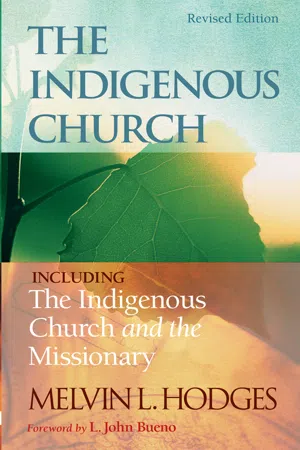
The Indigenous Church and the Indigenous Church and the Missionary
About this book
Early in his minstry in Central America, Hodges became firmly convinced that training national workers was the key to effectively evangelizing an country. The Central American church experienced rapid growth in the early 1950's. In 1953, Hodges was asked to expound on the church planting principles used, so he wrote The Indigenous Church. This new volume combines Hodges' book The Indigenous Church with a later work, The Indigenous Church and Missionary. These books have had incredible influence on missions worldwide. This new edition offers a fresh look at proven missions methodology for a new generation answering the call to reach the lost and to establish the Church worldwide.
Information
Subtopic
Ministère chrétienBook Two:
The Indigenous Church and the Missionary
Preface to the First Edition
The author’s book The Indigenous Church was first published in 1953. It was originally written for the purpose of offering assistance to the author’s coworkers on the mission field, particularly those connected with his own mission. The reception that this book enjoyed was far greater than anticipated, and a companion book, Build My Church, was produced that was intended to help national church leaders. This latter book also had wide acceptance around the world and has been translated into more than a dozen languages.
The Indigenous Church was republished by Moody Press under the title On the Mission Field: The Indigenous Church, and at a still later date after some revision, it was given a new title, Growing Young Churches.
More than twenty years have passed since The Indigenous Church was first published. Missionary co-laborers have suggested that now since indigenous churches are functioning in most of the countries in which we labor, something should be written to missionaries in their present situation. Thank God the national church has developed with its own officers and organizational structure. Of necessity, the role of the missionary has changed as the national church has come into its own.
To give some assistance to those who are already in missionary work and to those missionary candidates who are going to the field for the first time, this little volume, The Indigenous Church and the Missionary, is offered. In this volume the author attempts to deal with the problems the new situation has produced. However, the scope of the book is not limited to the solving of problems, but attempts to show the opportunities for ministry that exist in working in partnership with the national church and gives some guidelines as to how this task may be approached.
It is the author’s hope that this effort will prove a blessing to those engaged in missionary labors.
Melvin L. Hodges, 1978
1
The Church’s Mission to Today’s World
The terms missions and missionary are likely to bring widely differing mental images to different persons. Some will envision immediately a man in a pith helmet about to be devoured by cannibals. Some may see the same type of individual endeavoring to teach a group of naked children to read. Others will picture an austere spinster completely absorbed in civilizing and clothing primitive tribes. Still others see the missionary as a “do-gooder” engaged in philanthropic efforts of educational or medical institutions, striving to bring relief and betterment to underprivileged peoples. And then there are those who view the missionary as an anthropological nuisance who unnecessarily introduces changes into the cultural life of the noble and contented savage.
All such concepts, while perhaps having their roots in some real-life situations, nevertheless fail to include the one basic and essential element of missions. The missionary is above everything else a proclaimer of the good news of the kingdom of God.
In the first century of the Christian church, the Christian mission was not identifiable in terms of a wealthy nation taking material benefits to an underdeveloped people. Probably the people of Macedonia and Asia Minor were not underprivileged economically or culturally in relation to the sending churches of Antioch or Jerusalem. The mission of the apostles was to share the riches of the gospel of Jesus Christ with those who did not have this knowledge. Today, the cultural and economical facets of missions usually loom larger in the minds of the general public than does the spiritual task of the messenger of Jesus Christ. This confusion in the minds of the people, and often in the minds of missionaries themselves, has often dulled the sharp cutting edge of Christian missions.
We could well wish that the situation were different and that Christian missions could be defined simply as taking the gospel of Jesus Christ to people that did not have this knowledge. But like it or not, the mission of the evangelical church today is judged in the light of political and economic factors rather than evaluated solely on the basis of the message that the missionary brings. Nevertheless, we reaffirm that in a biblical sense, mission is not to be confused with cultural or economic factors but is rather the activity of those who know Jesus Christ simply sharing this knowledge with those who do not know Him.
The situation of the underdeveloped countries, especially since World War II, has radically changed. Radio, roads, and the airplane have all contributed to a communication explosion that has brought these areas closer to the rest of the world. Education is of highest priority. The development of national resources, the introduction of manufacturing, and increased traffic in commerce have all had their profound effect.
In the short span of the writer’s own missionary experience he has witnessed the effect of industrialization of far-removed places and peoples: a road opening up a new section of a country so that in two hours by car one can travel the distance that formerly required two days by horse; a transistor radio on the backpack of a Bolivian Highland Indian, providing music and bringing him into contact with the larger world, as he himself climbs laboriously the steep Andean road; crowds of people, young and old, thronging the streets of a large city at 10 p.m. as night schools finish another day of classes in adult education—all these are pungent indications of the changes that are taking place in underdeveloped countries.
Probably one of the greatest single factors is the emerging of former colonies as sovereign nations. Among these people, national pride runs high. These nations are no longer willing to meekly follow the leadership of the politically and economically more advanced nations. They want to occupy in their own right their place as a nation under the sun. Even in Latin America, where colonial domination has generally not been practiced since these nations overthrew the yoke of Spain and Portugal, the thrust for national identity is a powerful force. The United States is castigated for its “economic colonialism,” and nationalism often finds expression in anti-Yankee speeches and slogans.
Changes Affect Missionary Activity
All this could not but affect the position of the missionary from economically developed countries as he seeks to carry on his spiritual ministry. In those countries that were previously colonies of powerful nations, the missionary, because of his own nationality and race, was automatically identified with colonial rule. Often, if he had any difficulties with the local government, he could depend upon the help and backing from the colonial authorities. In Latin America, it was commonly the case that the U.S. citizen, including the missionary, was given preferential treatment. He was often served first in the store and in public office before others who had arrived before him. He was representative of the great and powerful country to the north; he was considered to be better educated, to have more know-how, and to be in many ways superior to the local population. All this has changed rapidly since World War II. Quite often the North American finds that he is the last one to go through immigrations and customs as he enters a country. His nationality, far from making him popular and respected by the local populous, may often prove to be a hindrance to him in establishing good relations.
The Missionary and the National Church
There is another element of change that particularly affects the missionary, and this is the development of the overseas church. When the pioneer missionaries went out, they found themselves alone and without a Christian community. Their principal work was that of evangelism and hopefully the establishing of a church. The missionary, as pioneer, was the “father” of the work. He was respected, and often his leadership and decisions were followed without question. In the course ...
Table of contents
- Cover
- Title Page
- Copyright
- Contents
- Foreword 2009
- Introduction 2009
- Book One: The Indigenous Church
- Book Two: The Indigenous Church and the Missionary
Trusted by 375,005 students
Access to over 1.5 million titles for a fair monthly price.
Study more efficiently using our study tools.
Frequently asked questions
Yes, you can cancel anytime from the Subscription tab in your account settings on the Perlego website. Your subscription will stay active until the end of your current billing period. Learn how to cancel your subscription
No, books cannot be downloaded as external files, such as PDFs, for use outside of Perlego. However, you can download books within the Perlego app for offline reading on mobile or tablet. Learn how to download books offline
Perlego offers two plans: Essential and Complete
- Essential is ideal for learners and professionals who enjoy exploring a wide range of subjects. Access the Essential Library with 800,000+ trusted titles and best-sellers across business, personal growth, and the humanities. Includes unlimited reading time and Standard Read Aloud voice.
- Complete: Perfect for advanced learners and researchers needing full, unrestricted access. Unlock 1.5M+ books across hundreds of subjects, including academic and specialized titles. The Complete Plan also includes advanced features like Premium Read Aloud and Research Assistant.
We are an online textbook subscription service, where you can get access to an entire online library for less than the price of a single book per month. With over 1.5 million books across 990+ topics, we’ve got you covered! Learn about our mission
Look out for the read-aloud symbol on your next book to see if you can listen to it. The read-aloud tool reads text aloud for you, highlighting the text as it is being read. You can pause it, speed it up and slow it down. Learn more about Read Aloud
Yes! You can use the Perlego app on both iOS and Android devices to read anytime, anywhere — even offline. Perfect for commutes or when you’re on the go.
Please note we cannot support devices running on iOS 13 and Android 7 or earlier. Learn more about using the app
Please note we cannot support devices running on iOS 13 and Android 7 or earlier. Learn more about using the app
Yes, you can access The Indigenous Church and the Indigenous Church and the Missionary by Melvin L. Hodges in PDF and/or ePUB format, as well as other popular books in Théologie et religion & Ministère chrétien. We have over 1.5 million books available in our catalogue for you to explore.