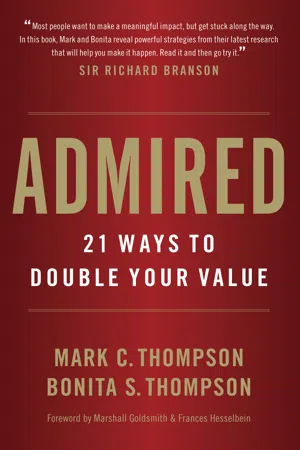
You deserve to be valued, respected, and admired for what matters to you. Here are twenty-one ways to make it happen. "Imagine how it would feel to be fully valued for what you do best. What if your boss, your customers, and your family really appreciated what you have to offer? How proud would you be if your organization won the top spot among Fortune Magazine's 'Most Admired Companies?' What if Jim Collins rated you a 'Level 5 leader?' In this book, you'll find 21 simple and powerful strategies that will help you become more valued in a crowded and competitive world-not in a superficial way or just for its own sake-but for what matters most to you and to the most valuable people (MVPs) in your life and work."- From the Foreword by Frances Hesselbein and Marshall Goldsmith
In your journey to offer more value to the most important people in your life, it’s essential to clarify your own goals and dig deeper into understanding your MVPs’ desires and definitions of success. The next step is to get started doing something about it. We’ve isolated six main strategies to being admired: Action, Develop, Measure, Innovate, Recruit, and Excite.
Each of these six strategies includes a number of tools that you can use to increase the value you give and receive. We’ll begin with Tool #1 and the first rule of taking action: Don’t wait to be asked. Tool #2 is about how to find your purpose and create more value for your MVPs. Tool #3 will explain why feeling guilty is a leadership trait and how you can put it to work for you. Tool #4 stresses the importance of gathering the right tools and creating a dedicated space to work on your goals.
TOOL #1:
Don’t Wait to Be Asked
She gasped and struggled as the thug grabbed her from behind, locking her arms to her sides and lifting her feet off the ground, preventing the young girl from breaking free or hitting her assailant. In one horrible moment, all of the fighting tactics she had learned in martial arts classes were useless. She screamed miserably as she lost hope and he dragged her into the back of the car.
The self-defense instructor called the practice session to a halt and asked for suggestions. “Okay, class,” she shouted. “She doesn’t have her arms or her legs to fight, so tell me, what does she have?”
“Teeth!” shouted one student. “Her head,” another called out.
Challenges don’t come neatly packaged the way we planned them. So when you’re taken by surprise—and you don’t have the tools or support that you’d counted on—the first thing to think about is not what you’ve lost, but what tools you still have. Start where you are. Figure out what you do have and use that to your advantage. When in doubt, take stock and then take action.
The most common reasons we freeze in a crisis—or simply procrastinate doing what we need to do to achieve our goals—is that we fear failure, don’t know what to do, or are emotionally overwhelmed by the tasks. The more innovative the goal or the greater the risks, the more reasons we find to stop us.
In Waking the Tiger: Healing Trauma, authors and therapists Peter Levine and Ann Frederick explain that people who are able to act during a crisis—even in the slightest way—are not as likely to experience post-traumatic stress syndrome. Action is what creates healing. By the same token, if we are overwhelmed by the size or difficulty of any task, taking some action toward the solution will mellow the overwhelm. We will be better equipped to manage our emotions after even a few small actions.
Lead, Even When Nobody’s Watching
Action is great (and cheap) therapy, and according to actor and producer Sally Field, it’s what saved her career and took her from the depths of depression to Academy and Emmy awards. Her early success brought her work on television, but it also came with a lightweight girl-next-door image that was hard to shake. But Field didn’t roll over and let her perky image limit her career. She worked on projects that mattered to her: first, the groundbreaking TV miniseries Sybil, for which she won an Emmy for her portrayal of a young woman suffering from multiple personalities after severe childhood abuse. (That’s a far cry from the Flying Nun!) Three years later came the film Norma Rae, with Field playing the title role of a single mother who helps unionize the cotton mill where she works. She won her first Academy Award for that film and proved her mettle once again.
The only thing you have power over is to get good at what you do.
Sally Field has been one of those rare women in Hollywood who has been a force for 40 years. But when we asked her how she decided to become a leader, Sally bristled. “That’s a non-thing! Who wakes up one day and says, ‘Hmm, should I go to school or should I be a leader? I think I’m going to go out and lead.’” She shook her head with sarcasm.
The only way to become a leader is to have something to give back . . . get off your rear end and do something.
“The only thing you have power over is to get good at what you do. And the only way to become a leader is to have something to give back. And the only way to have something to give back is to get off your rear end and do something.” You don’t need a lofty goal, Field stresses. You simply need to be willing to “work your tail off and achieve something for yourself—some specific thing. But be excellent at it. That’s the only way that you can be a leader.”
In fact, she says, becoming a leader is rarely the original objective. It happens, sometimes “by accident, after you’ve pursued and struggled and kicked yourself around the block a zillion times. One day you look out and see what you’ve done in your life and suddenly people begin turning to you and saying, ‘Lead us.’ Huh?” For Field, becoming a leader in her industry came just like that, as a surprise after years of dedication to her passions and goals.
You Won’t Regret Taking Initiative
In our 2012 national survey, the participants who were most engaged in their work said they wanted their leaders to be ambitious and hardworking. After 500 conversations, the highly accomplished people we’ve spoken to certainly fit that description. In fact, from all of them we heard only one real regret about their careers: If anything, they wished they had moved faster or sooner to take action. Sally Field didn’t wake up one morning and decide to be a leader, nor did she wait to be invited or ask permission to play at a higher level in her profession. She took action not by dwelling on what everyone thought of her or what box they tried to keep her in, but moving toward her goal of becoming an accomplished actress and a serious industry professional—someone to be admired for something that matters to her. And she has.
You Don’t Have to Be Perfect to Do Something Great
We’ve had the privilege of meeting some of the world’s most admired and valued people. In every case, it’s been very healing to learn that they are far from perfect, and none are admired or valued by everyone. I (Bonita) wish I had known when I started out that you don’t have to be perfect to do something great. Countless times I’ve gotten in my own way, thinking that perfection was required before launching an idea. And I spent too much of my youth feeling inadequate, routinely pulling the plug on my efforts before taking them public. In school, my papers would come back bloodied with red ink because I’m challenged by dyslexia. And that would reinforce just how imperfect I was. So I took it as a message that I had nothing to contribute or say.
When you meet and study the world’s highest achievers, you realize that most started out flawed in their thinking, lacking skills, and often humiliated by inadequacies. Worse yet, there is always a choir of critics delighted to trumpet their failures along the way. No one is perfect, and no one who has ever done anything worthwhile ever has been. High achievers focus on having impact and making a difference no matter how incomplete they are. The only thing you have control over is getting better every time you play.
Putting It to Work for You
1. Count your assets. What could you do this moment, with the skills and tools that you have, to move you forward toward your goal?
Post your best ideas for this lesson and we’ll give you credit and more valuable tools at:
www.LeaderPowertools.com/Admired
TOOL #2:
Take Action to Create Value
“I wasn’t too frightened about leaving college,” Bill Gates reflected on his first year in business when I interviewed him at the World Economic Forum in Davos. “What bothered me was when all these people I’d recruited to leave their secure jobs to come work for my little start-up were now actually expecting to get paid!”
Anyone who has created value—and eventually earned some respect and admiration for what they do—has had the realization that Gates did. The dream is free, but the journey is expensive. Whether you’re a homemaker starting a micro-business or an executive taking that next promotion, the weight of having to create value in a new way can prevent any of us from welcoming a positive new challenge.
Intimidated by the task, we oft...
Table of contents
Cover
Title
Copyright
Dedication
Contents
Foreword by Frances Hesselbein and Marshall Goldsmith
Acknowledgments
Section I: What You Want
Section II: What They Want
Section III: What to Do—ADMIRE
Epilogue
Appendix: Research for Admired
About the Authors
Trusted by 375,005 students
Access to over 1.5 million titles for a fair monthly price.
Study more efficiently using our study tools.
Frequently asked questions
Yes, you can cancel anytime from the Subscription tab in your account settings on the Perlego website. Your subscription will stay active until the end of your current billing period. Learn how to cancel your subscription
No, books cannot be downloaded as external files, such as PDFs, for use outside of Perlego. However, you can download books within the Perlego app for offline reading on mobile or tablet. Learn how to download books offline
Perlego offers two plans: Essential and Complete
Essential is ideal for learners and professionals who enjoy exploring a wide range of subjects. Access the Essential Library with 800,000+ trusted titles and best-sellers across business, personal growth, and the humanities. Includes unlimited reading time and Standard Read Aloud voice.
Complete: Perfect for advanced learners and researchers needing full, unrestricted access. Unlock 1.5M+ books across hundreds of subjects, including academic and specialized titles. The Complete Plan also includes advanced features like Premium Read Aloud and Research Assistant.
Both plans are available with monthly, semester, or annual billing cycles.
We are an online textbook subscription service, where you can get access to an entire online library for less than the price of a single book per month. With over 1.5 million books across 990+ topics, we’ve got you covered! Learn about our mission
Look out for the read-aloud symbol on your next book to see if you can listen to it. The read-aloud tool reads text aloud for you, highlighting the text as it is being read. You can pause it, speed it up and slow it down. Learn more about Read Aloud
Yes! You can use the Perlego app on both iOS and Android devices to read anytime, anywhere — even offline. Perfect for commutes or when you’re on the go. Please note we cannot support devices running on iOS 13 and Android 7 or earlier. Learn more about using the app
Yes, you can access Admired by Mark C. Thompson,Bonita S. Thompson in PDF and/or ePUB format, as well as other popular books in Personal Development & Personal Success. We have over 1.5 million books available in our catalogue for you to explore.