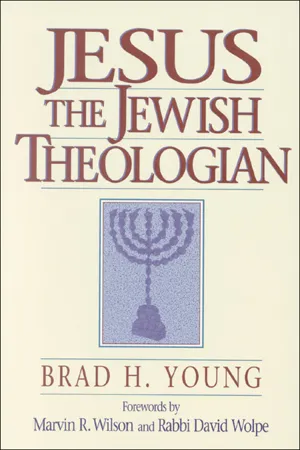
- 344 pages
- English
- ePUB (mobile friendly)
- Available on iOS & Android
eBook - ePub
Jesus the Jewish Theologian
About this book
Jesus the Jewish Theologian establishes Jesus firmly within the context of first-century Judaism and shows how understanding Jesus' Jewishness is crucial for interpreting the New Testament and for understanding the nature of Christian faith. Insights from Jewish literature, archeology, and tradition help modern readers place Jesus within his original context. Particular attention is given to the Jewish roots of Jesus' teaching concerning the kingdom of God.
Information
PART 1
THE MESSIANIC DRAMA OF JESUS’ LIFE EVENTS
One can no longer contrast belief in the Gospels themselves with belief in the Church, for the Gospels themselves came out of the Church. If they had their origins in the preaching and teaching of the Apostles and were constructed of units preserved and formed into shape by the local Christian churches, this means that he who bases his faith on the Christ of the Gospels is really basing his faith on what the early Church taught about Christ.
—Raymond E. Brown
1
The Birth of the Messiah and the Song of the Angels
The story of Jesus' birth in the gospels resonates with Jewish beliefs concerning God’s plan of salvation and the promised coming of the messianic deliverer. The birth of the Messiah is by no means an ordinary affair. The event is marked by prophecy and angelic visitations. The song of the angels as told in Luke 2:14 expresses the inward yearnings of the Jewish people concerning the Messiah. These words of praise and adoration which define the messianic task have a rich Jewish background.
The threefold structure of the angelic song in the King James Version of the Bible is well known and often quoted during the Christmas season: 1. “Glory to God in the highest” 2. “on earth peace” 3. “goodwill toward men.” Most modern translations, however, have a variant twofold version of the angelic song: 1. “Glory to God in the highest” 2. “Peace on earth toward men of goodwill.” The first version emphasizes the universal meaning of the coming of the Messiah. Goodwill is for all people. The second version indicates that his coming is reserved for people who are worthy, that is, “men of goodwill.” The difference between these two versions of the song is more significant than is often realized. David Flusser has argued strongly for the first version, that is, the three-part pronouncement of the angels.[1] Below we shall examine the Jewish background to the birth of the Messiah in the Gospels and the meaning of the song of the angels in order to understand the nature of the messianic task.
The texts of the Gospels are grounded in the rich diversity of Jewish messianic thought which characterized the late Second Temple period.[2] When studying the Gospels, one must seek to become aware of Jesus’ distinctive message about his task. Grounding this task in the expectations and traditions of first-century Judaism also includes certain distinct and innovative features. The song of the angels, “Glory to God in the highest, peace on earth, goodwill toward men” or as other translations have rendered it, “Glory to God in the highest, peace on earth toward men of goodwill,” has become a point of scholarly disagreement.[3] As we examine the meaning of the birth of the Messiah in the context of ancient Jewish thought, the better reading of the threefold blessing for the angelic song will become clear. First the background of the story of the birth of the Messiah must be viewed within its historical and cultural context.
Important biblical figures chosen by God to carry out special tasks in salvation history often have unusual circumstances surrounding their births. The profile of such personalities in the Bible usually includes an account of the individual’s miraculous birth. Frequently a miracle baby is considered to be destined for greatness in God’s higher purposes. Salvation and redemption are made possible because God sets apart an individual even from the womb to be anointed for the divine task.
For instance, the Old Testament contains a number of miracle births. Abraham and Sarah miraculously give birth to Isaac.[4] The Scripture teaches, “The LORD visited Sarah as he had said, and the LORD did to Sarah as he had promised. And Sarah conceived, and bore Abraham a son in his old age at the time of which God had spoken to him” (Gen 21:1–2). Isaac had a unique task to fulfill in the divine plan. In addition to Isaac’s birth, the births of Samson, who saved the people from the Philistines, and Samuel, who served as an anointed prophet, were also described as miraculous events (Judg 13:3, 24; 1 Sam 1:2, 20). Many rabbis felt that even Moses was a miracle baby.[5] Isaac, Samson, Samuel, and certainly Moses all played special roles in the divine plan.
According to the rabbis, prophecy and divine intervention accompanied the birth of Moses. Like the child Jesus, whose unique mission prophecies foretold,[6] Moses was the subject of a prophecy spoken by his sister Miriam. Before Moses was born, Miriam predicted the destiny of her baby brother. Moses became a model for the messianic idea. The Talmud tells about Miriam, who prophesied, saying, “In the future my mother will give birth to a son who will save Israel.” At the time when Moses was born, the whole house was filled with light. Her father stood up and kissed her on the head. He said to her, “My daughter, your prophecy has been fulfilled.”[7]
Miriam prophesied about the task before Moses. God would use her infant brother to save Israel. The struggles of the family to protect the child from the Egyptian Pharaoh, who desired to kill all the Hebrew children, served the higher purpose of redeeming the people of Israel from slavery.
The stories of Jesus’ birth are preceded in Luke’s Gospel by the account of John the Baptist’s family and his miraculous birth. John the Baptist also had a role to play. Perhaps Luke employed a source about the life and ministry of John for the record of these events.[8] In any case, the episodes in the Gospel of Luke indicate the manner in which God used the longings of an ordinary family like Elizabeth and Zechariah, the mother and father of John the Baptist, to fulfill the divine strategy. They wanted a baby. When they prayed, God supernaturally intervened, and John the Baptist was born. His mission was to prepare the way for Jesus. Amazingly, the personal anguish of a barren family hoping for the birth of a child gave way to the higher purpose in God’s divine plan to prepare for the coming of Jesus.
The shepherds who were watching their flocks by night were common Jewish laborers. One cannot be certain of their status in society but it seems that shepherds were not highly esteemed.[9] Some suggest they were tending some of the sacrificial animals for the temple, but this is not implied in any way by the text. Unlike the account of Matthew where great wise men from the East are told of the coming king, the humble shepherds experienced the manifestation of angels who sang a blessing that described the purpose of Jesus’ birth.[10] In light of the descriptions of supernatural happenings associated with important figures in Jewish history, the angels’ appearance and their hymn of praise are very much a part of the fabric of Hebrew thought for the messianic idea. The anticipation that the birth of the Messiah would be heralded by the angels of the divine presence was by no means foreign to popular thinking in the first century.
The difference between the two-part version of their song, “Glory to God in the highest and on earth peace toward men of goodwill,” and the threefold blessing, “Glory to God in the highest and on earth peace, goodwill toward men,” is of tremendous importance for the understanding of Jesus’ messianic task. In Greek the difference between the two translations is actually only one letter. The word for “goodwill” in Greek, eudokia, in the nominative case supports the threefold translation. The merciful goodwill of God is designated for all people. When the one Greek letter, sigma (ς pronounced like the s sound in English), is added to the end of the word, eudokia, it is put in the genitive case and would be translated, “toward men of goodwill.” The translation as a genitive, eudokias, accounts for the two-part version of the song. Reliable Greek manuscripts of Luke preserve both versions of the text, that is, with the sigma (in the genitive case) and without it (in the nominative case).[11] With the sigma, the text describes the nature of the people by the genitive case. Peace is promised only to people of goodwill, or as the Revised Standard Version translates, “among men with whom he [God] is pleased!” The word eudokia “goodwill” in Greek is a translation of the Hebrew term ratzon (e.g., in LXX 1 Chron 16:10; Ps 5:12).
The Dead Sea Scrolls use this term, ratzon, quite frequently. David Flusser has studied the word in the Dead Sea Scrolls and observed that it became a technical term for the sectarian theology of predestination in the community.[12] The elect are predestined to receive God’s goodwill. Only they receive his benevolent favor. This specialized meaning of ratzon “goodwill,” as Flusser has observed, departs from the sense of the word which occurs in the Hebrew Scriptures, where divine favor is more universal. At least traditional Jewish interpretations do not restrict the meaning of the word ratzon “goodwill” as does the Dead Sea community. Bruce Metzger comments in regard to the two-part text, “Prior to the discovery of the Dead Sea Scrolls it was sometimes argued that ‘men of [God’s] good pleasure’ is an unusual, if not impossible, expression in Hebrew.”[13] With the discovery of the Dead Sea Scrolls, however, the expression has been found in the Hebrew of the sect. Since both readings are possible in Hebrew and both texts have strong support in the textual tradition, the task of determining which one of these variants is the better reading is indeed difficult.
Here, the context in the Gospel of Luke and the background from Jewish liturgy provide strong support for the threefold text of Luke 2:14:
- “Glory to God in the highest”
- “On earth peace”
- “Goodwill toward men.”
The angel who appears to the humble shepherds says to them, “Fear not: for behold, I bring you good tidings of great joy which shall be to all people” (v. 10). The phrase “which shall be to all people” does not limit the message of peace to a select group.[14] In Flusser’s study of the theology of the Dead Sea sect, he has pointed out that this sectarian community understood God’s goodwill (ratzon) as restricted to the members of their elect group. God’s peace and goodwill could not be offered to anyone else. Everyone outside their limited number was predestined for eternal punishment. The concept of free will was not accepted by this group. They believed that an individual is not able to make the decision whether or not to follow the path of God. In their view, a person already possessed a spirit, either good or evil, which predetermined the individual’s relationship to God. Therefore, they used the expression “men of goodwill” as a technical term for members of their own religious order.[15] The wider Hebrew meaning of the term as found frequently in the Bible was ignored by the Dead Sea community. It is easy to understand how later Christian scribes may have been drawn to the genitive form of eudokia because it expressed their understanding of a limited salvation for those predestined for God’s goodness. The threefold text for the birth of the Messiah, which proclaims God’s goodwill to all people, however, most certainly is supported from the context in Luke 2:10. The glad tidings are for all people. Clearly the three-part version of the blessing in Luke 2:14 is the preferred translation. The King James Version renders a fine translation of the threefold text.
In the larger Jewish background of the text, Flusser has noticed also the strong similarities the threefold text of Luke shares with traditional liturgical blessings. For example, there is the description of the praise of the angels in Isaiah 6:3, when they cry out, “Holy, Holy, Holy is the LORD of hosts: the whole earth is filled with his glory.” The Lord is called holy three times. The three-part structure of blessings as well as the rule of threes in storytelling is a well-known characteristic of folktales and a familiar literary device.[16] In the praise of the angels who surround the heavenly throne, the word “holy” is used three times in Isaiah. The Aramaic Targum of this passage provides insight into the ancient Jewish understanding of the text of Isaiah. Moreover, it forms a remarkable parallel to Luke 2:14.[17] Again a three-part structure emerges from the song of the angels. The Targum of Isaiah says,
- “Holy in the highest heaven, the house of his Presence”
- “Holy upon the earth, the work of his might”
- “Holy for endless ages is the Lord of hosts: the whole earth is full of the brightness of his glory.”
The song of the angels to the shepherds concerning the birth of the Messiah reflects the three-part litany of the angels in Isaiah’s vision in Jewish tradition. The first blessing contains the strongest words of praise for God who is portrayed as the all-powerful king enthroned on high. “Glory to God in the highest” from Luke is parallel to “Holy in the highest heaven, the house of his Presence,” from the Targum of Isaiah. The second blessing in Luke, “On earth peace” is echoed in the next blessing in Isaiah, “Holy upon earth the work of his might.” The most important of the phrases in Luke, “goodwill toward men,” finds parallel in the third part of the angels’ song in the Targum of Isaiah, “the whole earth is full of the brightness of his glory.”
The message of the angels for the birth of the Messiah is universal. The all-powerful God of heaven seeks to establish peace on earth and express his merciful will for all people. His divine favor is provided for all humanity. To understand fully the good tidings of the angels, one must recall the Hebrew meaning of peace. It is wholeness and completeness. Jesus is said to be the Prince of Peace. The word “prince” could refer to an official in government. During Jesus’ day, governmental officials were in charge of war. Jesus, however, is not the minister of war. He is the Prince of Peace who brings wholeness and salvation for all the people. The goodwill of God is not restricted to those few who are predestined, but for all who receive God’s divine favor. According to Jeremias, “goodwill” (Heb. ratzon), appears 56 times in the Hebrew Old Testament. In at least 37 instances, it refers to God’s good pleasure.[18] It is his higher purpose for those he created. The word “goodwill” denotes God’s blessing and his divine favor. In Deuteronomy 33:24 “satisfied with goodwill” is paralleled by “full with the blessing of the LORD.” Goodwill is a blessing of the Lord.
The word “goodwill” possessed deep meaning for the Jewish people in the first century. Not only is the term used in Old Testament passages like Deuteronomy 33:24, but in the Jewish literature around the time of Jesus it signifies God’s desire to express his merciful benevolence to humanity. In the Psalms of Solomon, “goodwill” describes God’s goodness: “To us and to our children, O Lord our Savior, be your goodwill [eudokia] forever; we shall not be moved forever.”[19] Divine favor is expressed when God’s good pleasure is accomplished. His will is done. Thus in the Lord’s Prayer Jesus instructs his disciples to pray, “Thy will be done.” This word for will is the same term, ratzon, in Hebrew. It denotes God’s higher purpose and his good pleasure. It expresses what God truly desires. He wants people to experience his peace and salvation. The birth of the Messiah means that peace, divine wholeness, is made known to people. God’s merciful will is revealed for all of humanity in the coming of Jesus. His coming was for “all people” as indicated in Luke 2:10. The “goodwill” in the song of the angels refers to God’s divine favor which is being revealed in the birth of Jesus the Messiah. The mission of Jesus resonated with the song of the angels, “Glory to God in the highest, on earth peace, goodwill toward men!”
2
The Baptism of the Messiah
In one of the more famous and widely read books on the life of Christ, David Friedrich Strauss (1835) argued that Jesus was baptized because he had repented of his sins and felt the need for purification.[1] After all, the baptism of John was for repentance. Why else would Jesus seek baptism from John? On the other hand, by way of contrast to Strauss’ argument, New Testament teachings portray Jesus as the anointed one of God who did not commit a sin. In addition, the Gospel accounts of Jesus’ baptism concentrate on describing the surrounding events and the voice from heaven rather than treating the issue of why Jesus was baptized.[2] Now a study of the Dead Sea Scrolls, as well as a careful study of the rabbinic literature and the writings of the first-century Jewish historian Josephus, give us a fresh look at the story of Jesus’ baptism.[3] For a proper perspective we must view the episode through the eyes of first-century Jews.
JESUS AND THE SPIRIT
The true significance of the baptism emerges through the special description of the ...
Table of contents
- Cover
- Title Page
- Copyright Page
- Dedication
- Table of Contents
- Foreword: Rabbi David Wolpe
- Foreword: Marvin R. Wilson
- Preface: Jesus and His Religious Heritage
- Acknowledgments
- List of Abbreviations
- Transliterations
- Introduction: Jesus the Jewish Theologian
- Part 1: THE MESSIANIC DRAMA OF JESUS’ LIFE EVENTS
- Part 2: THE JEWISH ROOTS OF JESUS’ KINGDOM THEOLOGY
- Part 3: THE JEWISH THEOLOGY IN JESUS’ PARABLES
- Part 4: THE JEWISH MESSIAH AND THE POLITICS OF ROME
- Part 5: THE FUTURE MESSIAH
- EPILOGUE
- AFTERWORD
- Notes
- Back Cover
Trusted by 375,005 students
Access to over 1.5 million titles for a fair monthly price.
Study more efficiently using our study tools.
Frequently asked questions
Yes, you can cancel anytime from the Subscription tab in your account settings on the Perlego website. Your subscription will stay active until the end of your current billing period. Learn how to cancel your subscription
No, books cannot be downloaded as external files, such as PDFs, for use outside of Perlego. However, you can download books within the Perlego app for offline reading on mobile or tablet. Learn how to download books offline
Perlego offers two plans: Essential and Complete
- Essential is ideal for learners and professionals who enjoy exploring a wide range of subjects. Access the Essential Library with 800,000+ trusted titles and best-sellers across business, personal growth, and the humanities. Includes unlimited reading time and Standard Read Aloud voice.
- Complete: Perfect for advanced learners and researchers needing full, unrestricted access. Unlock 1.5M+ books across hundreds of subjects, including academic and specialized titles. The Complete Plan also includes advanced features like Premium Read Aloud and Research Assistant.
We are an online textbook subscription service, where you can get access to an entire online library for less than the price of a single book per month. With over 1.5 million books across 990+ topics, we’ve got you covered! Learn about our mission
Look out for the read-aloud symbol on your next book to see if you can listen to it. The read-aloud tool reads text aloud for you, highlighting the text as it is being read. You can pause it, speed it up and slow it down. Learn more about Read Aloud
Yes! You can use the Perlego app on both iOS and Android devices to read anytime, anywhere — even offline. Perfect for commutes or when you’re on the go.
Please note we cannot support devices running on iOS 13 and Android 7 or earlier. Learn more about using the app
Please note we cannot support devices running on iOS 13 and Android 7 or earlier. Learn more about using the app
Yes, you can access Jesus the Jewish Theologian by Brad H. Young in PDF and/or ePUB format, as well as other popular books in Theology & Religion & Biblical Criticism & Interpretation. We have over 1.5 million books available in our catalogue for you to explore.