- 192 pages
- English
- ePUB (mobile friendly)
- Available on iOS & Android
eBook - ePub
About this book
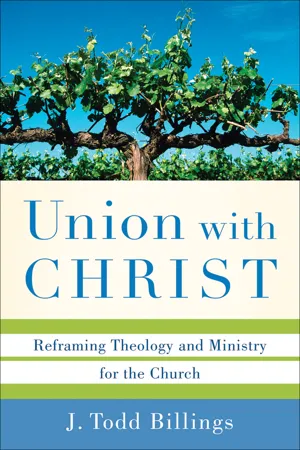
Accomplished theologian J. Todd Billings recovers the biblical theme of union with Christ for today's church, making a fresh contribution to the theological discussion with important applications for theology and ministry. Drawing on Scripture and the thought of figures such as Augustine, Calvin, Bavinck, and Barth, Billings shows how a theology of union with Christ can change the way believers approach worship, justice, mission, and the Christian life. He illuminates how union with Christ can change the theological conversation about thorny topics such as total depravity and the mystery of God. Billings also provides a critique and alternative to the widely accepted paradigm of incarnational ministry and explores a gospel-centered approach to social justice. Throughout, he offers a unique and lively exploration of what is so amazing about being united to the living Christ.
Information
Topic
Theology & ReligionSubtopic
Christian Theology
Adopted by the Triune God: A Biblical and Countercultural Account of Salvation
In the course of writing this chapter, my wife and I traveled to Ethiopia to adopt a lovely little girl. We know the country of Ethiopia relatively well, as we both taught in Ethiopia for five months in 2009, and I had spent nine months in Ethiopia earlier in my teaching career. We know that Ethiopia is a wonderful place with beautiful landscapes, welcoming people, and very strong coffee. But it also a country with over four million orphans, according to estimates.[20]
I do believe, as scripture tells us, that we should care for the orphans in the world. “Religion that is pure and undefiled before God, the Father, is this: to care for orphans and widows in their distress” (James 1:27a). Indeed, as chapter 4 in particular explores, Christians should display a special concern for and commitment to those in need. But lest pity be our only feeling toward orphans, we should consider that on a different level, all of us are orphans. The God of the Bible has no “natural” or “begotten” children apart from Jesus the Son; all the rest of us need to be adopted. Although there are important differences between the biblical metaphor of adoption and adoption practices today (which we explore below), we should not underestimate the extraordinary power of this biblical analogy: for all of God’s people are adopted, both in Israel and in the church (Rom. 9:4; Eph. 1:5). Thus it is good news when Jesus tells us in John’s Gospel, “I will not leave you orphaned; I am coming to you” (John 14:18). Instead, through the Spirit, we can be united to Jesus Christ, becoming daughters and sons of God through our union with the one perfect Son of God.
But what exactly is this adoption that we receive? Paul initiates us into this world of adoption in Romans 8. Although by our flesh, or our old self, we are slaves to “the law of sin,” the “Spirit of life in Christ Jesus has set you free” (Rom. 8:2). What does this freedom look like? It is freedom to be adopted children of the Triune God. We have been given the Spirit of God, and by the Spirit “Christ is in you.” And “all who are led by the Spirit of God are children of God. For you did not receive a spirit of slavery to fall back into fear, but you have received a spirit of adoption. When we cry, ‘Abba! Father!’ it is that very Spirit bearing witness with our spirit that we are children of God, and if children, then heirs, heirs of God and joint heirs with Christ” (Rom. 8:14–17). In this way, Paul speaks about the drama of adoption that we are caught up into. We are no longer slaves; we are children with an intimate relationship with God. In fact, we don’t even pray by ourselves, but the Spirit prays in us words of intimacy—“Abba! Father!”—as those who are in Christ, or “joint heirs with Christ” (8:15, 17).
This image of adoption is key for Paul in speaking about the life of salvation in Christ, as well as the new identity that we enter into in Christ. On the one hand, the Spirit assures Christians that they already belong to God—they can cry out to God as Father, as ones united to Jesus Christ. Yet, as Paul indicates later in the same chapter, this adoption is also a future reality for which “the creation waits with eager longing for the revealing of the children of God” (Rom. 8:19). For “not only the creation, but we ourselves, who have the first fruits of the Spirit, groan inwardly while we wait for adoption, the redemption of our bodies” (Rom. 8:23). We are adopted children of God, able to pray to the Father by the Spirit, yet even this is a foretaste of the consummation of adoption for which the creation groans and waits.
But maybe this just sounds like pious God-talk. What, really, is so significant about adoption? To get a sense of how radical the message of adoption is, I will adapt a parable from Danish philosopher and theologian Søren Kierkegaard.[21]
Imagine a day laborer living in a great kingdom. The day laborer “never dreamed . . . that the emperor knew he existed, who then would consider himself indescribably favored just to be permitted to see the emperor once, something he would relate to his children and grandchildren as the most important event in his life.” But suppose the emperor did something unexpected: “If the emperor sent for him and told him that he wanted him for his son-in-law: what then? Quite humanly, the day laborer would be more or less puzzled, self-conscious, and embarrassed by it; he would (and this is the humanness of it) humanly find it very strange and bizarre . . . that the emperor wanted to make a fool of him, make him the laughingstock of the whole city.”[22]
In this parable, the day laborer working in the countryside recognizes the high and exalted place of the emperor. An occasional encounter with the emperor would be delightful—enough so that the laborer could keep his own comfortable life, keep his friends, keep his identity, yet have it embellished by the honor of the emperor. “A little favor—that would make sense to the laborer.”[23] But what if the emperor wants to make him his own son? The prospect of adoption in this sense is an offense. It is too much closeness—it is the sort of closeness that requires giving up one’s own identity. Yes, it is a high and exalted place to be the child of the emperor, the king of the land. But it is too high and exalted—wouldn’t he be a laughingstock? Wouldn’t he lose all that is precious to him if he were to ascend to be the king’s son? In the words of Kierkegaard, the day laborer says, “Such a thing is too high for me, I cannot grasp it; to be perfectly blunt, to me it is a piece of folly.”[24] It would be wonderful if the king would send him some money or a letter to cherish as a relic. But the king is asking for so much more. The king is asking to be more than an accessory to his identity. The king wants his full identity, his entire life—wants him to be exalted, the child of the king.
And so it is with God, the King. Yet adoption by the King is such a radical notion, we resist it. We would rather have the occasional brush of God’s presence, or a relic of his solidarity with us, so that God can be an appendage of our identity. But God wants more than that; he wants our lives, our adopted identity. By bringing us into the new reality of the Spirit, we can call out to God—Abba, Father—as adopted children united to Christ. Yet there are few things more countercultural than this process of adoption—losing your life for the sake of Jesus Christ, to find it in communion with the Triune God.
Although Kierkegaard was not directly commenting on Paul’s metaphor of adoption, his parable provides a number of points of illumination. First, Kierkegaard doesn’t use the term “adoption,” but his parable—about an adult who is called to receive a new identity and inheritance—is similar to Paul’s metaphor. Paul only used the metaphor of adoption when he was addressing Christians who were living under Roman law and who thus were familiar with Roman adoption practices.[25] In this ancient Roman context, adoption was generally not about babies and childless couples finding a way to have children. Instead, the adoptees were usually adults, and adoption was first of all a legal arrangement to provide an heir who would receive an inheritance and enter into a new household with all its privileges and responsibilities.[26] (Kierkegaard’s day laborer feared both the privileges and the responsibilities of being a child of the king!) “Adoption,” or huiothesia (the term Paul uses), is a legal or forensic term in the sense that it refers to the transfer from one family into another. In the ancient world, this legal arrangement gave an adopted son all the rights of a natural son.[27] It was initiated by the head of the family, the paterfamilias, and it was customary for this father to affectionately receive the adopted son as a part of his new family.[28]
In light of this ancient background, biblical scholars have made the case for Paul using the term huiothesia as a metaphor for salvation with certain parallels to this ancient usage.[29] This does not mean that Paul uses the term in exactly the same way that it was used for the Roman family, however.[30] For starters, God has no inherent need to make heirs, but he chooses to adopt sinners into his family as a free, divine act of love. In addition, the metaphor takes on theological content in Paul’s hands. For Paul, on the most basic level, adoption is the act of being transferred “from an alien family (cf. Eph. 2:2, lit. ‘sons of disobedience’) into the family of God.”[31]
For Paul, the adoption metaphor is deeply trinitarian, for it is initiated by the Father, mediated by the Spirit, and grounded in the person and work of Jesus Christ. For example, in Galatians 4:4–7 Paul grounds the adoption of sons and daughters in the sonship of Jesus Christ, who is sent by the Father, which is testified to in believers by the Spirit. “God sent his Son . . . so that we might receive adoption as children,” Paul says. “And because you are children, God has sent the Spirit of his Son into our hearts, crying, ‘Abba! Father!’ So you are no longer a slave but a child, and if a child then also an heir, through God.” In this way, salvation as adoption is both christocentric—for adoption occurs only in Christ, as a subordinate sharing in his sonship—and trinitarian. The adopted child of God encounters a loving Father through the Spirit’s crying, “Abba! Father!” which all occurs in Christ—and so the adopted one is an “heir” of God, united to the Son.
While the metaphor of adoption begins as a legal act, it does not end there: it ends with membership in the household of God (Gal. 6:10; Eph. 2:19), with a calling to act into the reality of this new identity. God’s legal act of adopting into the family of God results in a new identity, in an eschatologically conditioned way. Thus, when we are given an identity in Christ, we are called to live into it. For example, the doxological opening of Ephesians 1 says that God “destined us for adoption as his children through Jesus Christ” (v. 5). As the blessings of being in Christ are unfolded in the following verses, Paul returns to the language of adoption and inheritance—that “in Christ we have also obtained an inheritance, having been destined according to the purpose of him who accomplishes all things according to his counsel and will, so that we, who were the first to set our hope on Christ, might live for the praise of his glory” (1:11–12, emphasis added). This new identity of one belonging to a new family in Christ is sealed by the Spirit in the verses that follow: “In him you also . . . were marked with the seal of the promised Holy Spirit; this is the pledge of our inheritance toward redemption as God’s own people, to the praise of his glory” (1:13–14). The adopted identity in Christ, sealed by the Spirit, leads to living “for the praise of his glory” (1:12), but also provides the ground for numerous ethical exhortations in Ephesians: the call to unity (4:13); to prayer (6:18); to speaking and living the truth in Christ (4:15, 21, 25; 6:14); to living in “love” rather than in anger, malice, and bitterness (4:21–5:1).[32] All of these exhortations are to reflect the behavior of those who have been conferred a new adopted identity in Christ and who seek to live into this inheritance received as children of God in Christ.
In contrast to some theologians who have associated adoption only with justification, Paul’s overall usage of the adoption metaphor describes both the legal dimension of being transferred into God’s family and the transformative dimension of growing in God’s family. By associating adoption only with justification, theologians have sometimes tended to emphasize the legal at the expense of the transformative side of adoption. Trevor Burke has criticized certain Reformed scholastic thinkers, in particular, for making adoption a subset or benefit of justification without recognizing its distinct meaning.[33] While Burke makes a good point, I suspect some of the reason for the confusion comes from the following: Theologians have often spoken about the act of becoming adopted as a forensic act, which is a valid point (as Burke agrees). But the forensic sense of becoming adopted does not exhaust the meaning of Paul’s metaphor, because the result of that act is that one is adopted to be a son or daughter of God, placed in the security of God’s family, and given a new identity to live into in an eschatologically conditioned way. Some theologians have thus been too quick to assume that the meaning of “adoption” is exhausted by the act of becoming adopted. Significantly for this chapter, however, this is not a mistake that John Calvin makes. Calvin uses the image of adoption as a way to describe the double grace of justification and sanctification received in union with Christ. Calvin understood that as an image for salvation, the act of becoming adopted is a legal, forensic action, but it has another dimension as well: as an image for the way Christians are to act as children of the Father who promises “to nourish us throughout the course of our life.”[34] Indeed, the Spirit gives new life, displayed in love of God and neighbor, which “shows that the Spirit of adoption has been given to us (cf. Romans 8:15).”[35]
In giving this exposition of Paul’s metaphor of adoption for salvation, I am not claiming that it is the only or the most significant soteriological term for Paul’s theology of union with Christ. But it is a metaphor that is important yet often neglected. In particular, it highlights the radical character of life in Christ as a change in identity, as being conferred a new identity in Christ as children of God—filled with the Spirit, united to Christ, and given access to the Father in God’s household. Like the day laborer in Kierkegaard’s parable, it is a biblical metaphor that shows us an astonishing state of affairs: the high King, the Lord of the universe, desires for us to be his adopted children. Thus, while God is holy and transcendent, he is not at a convenient distance. God’s gracious, loving call is, in fact, a threat to our autonomy, our deep and pervasive strategies to keep hold of our lives rather than losing them for the sake of Jesus Christ.
God at a Convenient Distance: Today’s Cultural Deism as a Contrast to Salvation as Adoption
Recently, a series of studies confirmed just how countercultural this notion of salvation as adoption is. The results of these studies are compiled in two books, Soul Searching and Souls in Transition.[36] These are the most comprehensive studies of the religious beliefs of American teens and young adults ever conducted. While all sorts of religious groups were surveyed, both statistical analysis and in-depth interviews revealed that a common theology was functional for the vast majority of American teens, regardless of their religious tradition. It is what we might call an “American theology” or a “cultural theology” that can be summed up by the phrase “moralistic therapeutic deism” (MTD) and the following creed:
- A God exists who created and orders the world and watches over human life on earth.
- God wants people to be good, nice, and fair to each other, as taught in the Bible and by most world religions.
- The central goal of life is to be happy and to feel good about oneself.
- God does not need to be particularly involved in one’s life except when God is needed to resolve a problem.
- Good people go to heaven when they die.[37]
What emerges from this functional creed? Tragically, it is not a biblical notion of salvation as adoption. Rather, to begin with the D of MTD, the God we encounter here is a deistic God. This God created and ordered the world but now stands back at a distance, except when there is a crisis. While some who were surveyed may believe that God gave us his Son and adopted us by his Spirit, these beliefs are not mentioned: they are crowded out, made unimportant in relation to the other convictions expressed in the MTD creed. Why? Because on a deeper level, they think we have no need for a mediator—our sin has not alienated us from God. Instead of forgiveness and communion with God, the purpose of religion is therapeutic (the T of MTD): religion should help us be happy and feel good about ourselves. How does it do this? By helping us make decisions, because God wants people to be good, nice, and fair (thus the M: moralistic). Note that there is no particular need for a holy God to bestow grace upon sinners since people are basically good already and will go to heaven if they play by the rules. We are not orphans; there is no need for a new identity in Christ. Such is the assumption of MTD.
In a major follow-up study to Soul Searching, Souls in Transition examined the beliefs of eighteen- to twenty-three-year-olds, labeled “emerging adults.” To a certain extent, we still see the characteristics of MTD. Most emerging adults assume that they are the master of their life, their identity...
Table of contents
- Cover
- Title Page
- Copyright Page
- Endorsements
- Dedication
- Contents
- Acknowledgments
- Abbreviations
- Introduction
- 1: Salvation as Adoption in Christ
- 2: Total Depravity in Sin, Total Communion in Christ
- 3: Encountering a Mystery in Union with Christ
- 4: The Gospel and Justice
- 5: Ministry in Union with Christ
- Conclusion
- Index
- Notes
- Back Cover
Trusted by 375,005 students
Access to over 1.5 million titles for a fair monthly price.
Study more efficiently using our study tools.
Frequently asked questions
Yes, you can cancel anytime from the Subscription tab in your account settings on the Perlego website. Your subscription will stay active until the end of your current billing period. Learn how to cancel your subscription
No, books cannot be downloaded as external files, such as PDFs, for use outside of Perlego. However, you can download books within the Perlego app for offline reading on mobile or tablet. Learn how to download books offline
Perlego offers two plans: Essential and Complete
- Essential is ideal for learners and professionals who enjoy exploring a wide range of subjects. Access the Essential Library with 800,000+ trusted titles and best-sellers across business, personal growth, and the humanities. Includes unlimited reading time and Standard Read Aloud voice.
- Complete: Perfect for advanced learners and researchers needing full, unrestricted access. Unlock 1.5M+ books across hundreds of subjects, including academic and specialized titles. The Complete Plan also includes advanced features like Premium Read Aloud and Research Assistant.
We are an online textbook subscription service, where you can get access to an entire online library for less than the price of a single book per month. With over 1.5 million books across 990+ topics, we’ve got you covered! Learn about our mission
Look out for the read-aloud symbol on your next book to see if you can listen to it. The read-aloud tool reads text aloud for you, highlighting the text as it is being read. You can pause it, speed it up and slow it down. Learn more about Read Aloud
Yes! You can use the Perlego app on both iOS and Android devices to read anytime, anywhere — even offline. Perfect for commutes or when you’re on the go.
Please note we cannot support devices running on iOS 13 and Android 7 or earlier. Learn more about using the app
Please note we cannot support devices running on iOS 13 and Android 7 or earlier. Learn more about using the app
Yes, you can access Union with Christ by J. Todd Billings in PDF and/or ePUB format, as well as other popular books in Theology & Religion & Christian Theology. We have over 1.5 million books available in our catalogue for you to explore.