- 112 pages
- English
- ePUB (mobile friendly)
- Available on iOS & Android
eBook - ePub
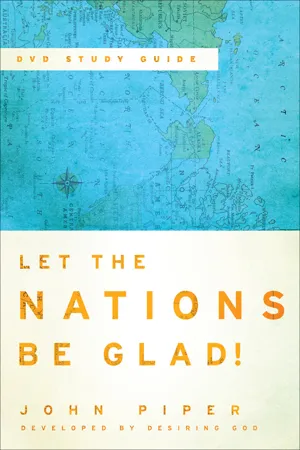
Let the Nations Be Glad! Study Guide to the DVD
About this book
This new study guide complements the Let the Nations Be Glad! DVD, further increasing comprehension of the book's themes. The eight lessons in the study guide correspond to the DVD's presentation topics. This resource is ideal for church and small group studies.
Information
Topic
Theology & ReligionSubtopic
Christian MinistryLesson 1
Introduction to
Let the Nations Be Glad!
Let the Nations Be Glad!
Lesson Objectives

It is our prayer that after you have finished this lesson…
• You will hear how others in your group approach the subject of missions.
• Your curiosity will be aroused and questions will come to mind.
• The Lord will begin to enlarge your heart for greater capacities of joy because of his desires for all peoples.
About Yourself
1. What is your name?
2. Tell the group something about yourself that they probably don’t already know.
3. Briefly explain why you are participating in this study.
A Preview of Let the Nations Be Glad!
1. Tell the group what you know about missions. What do Christians mean when they say “missions”? Is missions foreign, domestic, or both? Must it be cross-cultural? How does missions relate to other important tasks like evangelism, church-planting, and Bible translation?
2. Do you believe the Bible is concerned with missions? If so, why is it? Do you believe the Bible speaks extensively about missions or is it just limited to particular New Testament texts? If possible, use Scripture to support your answer.
A Companion Study to
Let the Nations Be Glad!
DVD, Session 1
Let the Nations Be Glad!
DVD, Session 1
Lesson 2
Defining Missions and Defining Peoples
Lesson Objectives
It is our prayer that after you have finished this lesson…
• You will have a better grasp on what biblical missions is.
• You will have a better grasp on defining peoples and nations.
• Your heart will begin to see the depth of God’s concern for the nations.
Before You Watch the DVD, Study and Prepare
Day 1—Defining Missions
Before beginning this study, we will do well to clarify certain common terms. Many arguments and debates would be settled more quickly if each party involved in the discussion were to clearly define their terms. This particular discussion on missions is no exception.
Question 1: Write down in your own words a clear definition of “missions” using biblical texts as your support.
Question 2: Interact with the following statement: “All Christians are missionaries.” Is this true or false? Should we make distinctions between foreign or cross-cultural missions and domestic ministry? Explain your answer and, if possible, incorporate biblical passages.
Day 2—Defining Peoples
Even after defining “missions” and the differences between frontier work and domestic evangelism, more clarifications must be made in regard to what qualifies as frontier missions. Is it geographical, ethnic, political, or linguistic? It is important that we derive our definitions from the Bible and not impose our own notions on it.
Look at Matthew 24:14; Revelation 5:9; and Genesis 12:2–3.
Matthew 24:14
And this gospel of the kingdom will be proclaimed throughout the whole world as a testimony to all nations, and then the end will come.
Revelation 5:9
And they sang a new song, saying, “Worthy are you to take the scroll and to open its seals, for you were slain, and by your blood you ransomed people for God from every tribe and language and people and nation.
Genesis 12:2–3
And I will make of you a great nation, and I will bless you and make your name great, so that you will be a blessing. I will bless those who bless you, and him who dishonors you I will curse, and in you all the families of the earth shall be blessed.
Question 3: What do you think each of these passages means by “nations” or “families of the earth”? How do these texts help to illuminate each other?
What we have found, in fact, is that a precise definition is probably not possible to give on the basis of what God has chosen to reveal in the Bible. God probably did not intend for us to use a precise definition of people groups. That way we can never stop doing pioneer missionary work just because we conclude that all the groups with our definition have been reached.
For example, the point of Matthew 24:14…is not that we should reach all the nations as we understand them and then stop. The point rather is that as long as the Lord has not returned, there must be more people groups to reach, and we should keep on reaching them.1
The hope at this point is that you begin to feel the difficulty in precisely defining the parameters of a people group. The Bible has not given us these clear-cut distinctions.
Missiologists often distinguish between “reached” people groups and “unreached” people groups. Moreover, the same could be said concerning “unreached” and “reached” people groups.
Question 4: What do you think is meant by these two classifications? How would you determine if a people group has been “reached”?
There is a difficulty with defining the specific task of missions as planting an indigenous church in every people group. The difficulty is that our biblical definition of people groups may be so small and so closely related to another group that such a church would be unnecessary. How large was the family or clan of Carmi in the tribe of Reuben, or the family of Achan in the tribe of Judah? And are we sure that the families in Genesis 12:3 are so distinct that each must have its own church? When Paul said that his special missionary work was completed from Jerusalem to Illyricum, had he in fact planted a church in every family or clan? 2
These questions show that there will always be some ambiguity in the definition of “reached” and in the aim of missionary work.
Day 3—Our Suffering and Our Song
Jesus promises a hard life for those who believe in him and follow him. But the Bible also gives promises of everlasting life and joy in the Lord.
Examine John 12:24–25; Matthew 16:24–25; Proverbs 4:18; and Psalm 96:1.
John 12:24–25
Truly, truly, I say to you, unless a grain of wheat falls into the earth and dies, it remains alone; but if it dies, it bears much fruit. Whoever loves his life loses it, and whoever hates his life in this world will keep it for eternal life.
Matthew 16:24–25
Then Jesus told his disciples, “If an...
Table of contents
- Cover Page
- Title Page
- Copyright Page
- Table of Contents
- Introduction to This Study Guide
- Lesson 1 Introduction to Let the Nations Be Glad!
- Lesson 2 Defining Missions and Defining Peoples
- Lesson 3 The Urgency of Missions: The Reality of Hell and the Work of Christ
- Lesson 4 The Urgency of Missions: Preaching, Hearing, and Believing
- Lesson 5 The Goal and the Fuel of Missions
- Lesson 6 Prayer: The Power of Missions
- Lesson 7 Suffering: The Cost of Missions
- Lesson 8 Review and Conclusion
- Leader’s Guide
- Appendix: Leading Productive Discussions
Trusted by 375,005 students
Access to over 1.5 million titles for a fair monthly price.
Study more efficiently using our study tools.
Frequently asked questions
Yes, you can cancel anytime from the Subscription tab in your account settings on the Perlego website. Your subscription will stay active until the end of your current billing period. Learn how to cancel your subscription
No, books cannot be downloaded as external files, such as PDFs, for use outside of Perlego. However, you can download books within the Perlego app for offline reading on mobile or tablet. Learn how to download books offline
Perlego offers two plans: Essential and Complete
- Essential is ideal for learners and professionals who enjoy exploring a wide range of subjects. Access the Essential Library with 800,000+ trusted titles and best-sellers across business, personal growth, and the humanities. Includes unlimited reading time and Standard Read Aloud voice.
- Complete: Perfect for advanced learners and researchers needing full, unrestricted access. Unlock 1.5M+ books across hundreds of subjects, including academic and specialized titles. The Complete Plan also includes advanced features like Premium Read Aloud and Research Assistant.
We are an online textbook subscription service, where you can get access to an entire online library for less than the price of a single book per month. With over 1.5 million books across 990+ topics, we’ve got you covered! Learn about our mission
Look out for the read-aloud symbol on your next book to see if you can listen to it. The read-aloud tool reads text aloud for you, highlighting the text as it is being read. You can pause it, speed it up and slow it down. Learn more about Read Aloud
Yes! You can use the Perlego app on both iOS and Android devices to read anytime, anywhere — even offline. Perfect for commutes or when you’re on the go.
Please note we cannot support devices running on iOS 13 and Android 7 or earlier. Learn more about using the app
Please note we cannot support devices running on iOS 13 and Android 7 or earlier. Learn more about using the app
Yes, you can access Let the Nations Be Glad! Study Guide to the DVD by John Piper in PDF and/or ePUB format, as well as other popular books in Theology & Religion & Christian Ministry. We have over 1.5 million books available in our catalogue for you to explore.