eBook - ePub
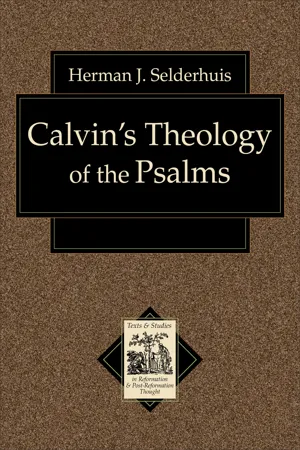
Calvin's Theology of the Psalms (Texts and Studies in Reformation and Post-Reformation Thought)
- 304 pages
- English
- ePUB (mobile friendly)
- Available on iOS & Android
eBook - ePub
Calvin's Theology of the Psalms (Texts and Studies in Reformation and Post-Reformation Thought)
About this book
In this intriguing book, Herman Selderhuis argues that John Calvin's biblical interpretation of the Psalms is fundamentally shaped by his doctrine of God. Selderhuis minimizes references to other Calvin studies and other works by Calvin, thus allowing Calvin's theology on the Psalms to speak for itself. The book is organized thematically according to divine attributes. Reformation and Calvin scholars as well as interested Reformed readers will value this resource.
Information
Topic
Theology & ReligionSubtopic
Christian Theology1
Calvin and the Psalms[1]
1. The Heart of Calvin
A general short summary of Luther’s view on the Psalms runs as follows: “In the Psalms we have a view of the inner heart of the faithful.”[2] Though Luther never went on to say that “In their commentaries on the Psalms we have a view of the inner heart of theologians,” the intensity with which Calvin devoted his attention to the exposition of the Psalms leads us to think that it would not be unfair to say this of the other great Reformer in Geneva. In short, the question is: Do we look into Calvin’s heart when we read his commentary on the Psalms? This question is necessarily preceded by another, namely, whether Calvin did have a heart at all—for no Reformer was pictured as more heartless than this Frenchman.[3] Indeed “hard” and “without heart” were the image that was created even during his own lifetime; later this image of Calvin was seen as a feature of Calvinism as well.
This caricature has flourished, firstly, because of a widespread ignorance of the work and person of Calvin and, secondly, because of a remarkable one-sidedness of research on Calvin. As regards the ignorance, evidence of Calvin’s heartless character is located in the part he played in the case against Michael Servet, a part which is still not yet sufficiently demythologized.[4] As for the one-sided research, for many years special attention was only given to one book—the Institutes—as if the whole Calvin and every facet of him could be found in it. The distortion is on par with a tourist who estimates the value of a city through merely a study of its ground plan. Fortunately, scholars of Calvin’s theology are now turning their attention more and more to his sermons, letters and commentaries.[5] His commentary on the Psalms, however, has not received its share of scholarly attention[6]—in spite of the fact that it is one of the most frequently translated and widely published biblical works of Calvin. An exception to this rule is the book by J. van der Haar[7] which provides a systematical synopsis of the Commentary on the Psalms. Because of this work’s meditative character, however, it is limited to but a description of Calvin’s view on personal religious life.
2. The Commentary on the Psalms in Historical Context
My research is directed to the theology of Calvin’s commentary on the Psalms. In order to arrive at a proper understanding of Calvin’s theology, however, it is necessary to relate it to his biography. Theology is never timeless, and it cannot be studied in a historical vacuum. Therefore, an astute theologian must not only have a thorough knowledge of the cultural, social, political and religious situation of his era, but he will also be conscious of the fact that these aspects of his time influence his own theological work. This truth applies of course to Calvin. The first part of the above-mentioned dictum is in any case applicable to him. His involvement in the European Reformation naturally roused in him a high degree of political interest and activity. His correspondence also reveals that Calvin was well informed about scientific and cultural developments. It is thus the influence of his historical context on Calvin’s theology which merits a closer investigation, and this study seeks to contribute to such an investigation.
Calvin’s high esteem for the Psalms is already visible in his preface to Louis Budé’s French translation of this biblical book in 1551.[8] There Calvin writes that the kindness of God as well as the encouragement to thank him for his benevolence are never better expressed than in this Old Testament book. Indeed, David is a God-given mirror in whom we can see what must incite us to prayer and what must move us to praise him when he answers our prayer. In this preface Calvin pens the memorable statement which he will repeat in the preface to his commentary: the Psalms are “an anatomy of all feelings of the soul.”[9] All emotions of the human heart—joy, anger, temptation and sorrow—can be found there. In stating this, Calvin repeats what Luther had said: that in the Psalms one can look into the inner heart of the faithful. Subsequently Calvin proceeds to give a lengthy exposition of things we can learn by reading the Psalms. Calvin’s emphasis on the teaching aspect of the Psalms is rather conspicuous. The Psalms uncover sins that would otherwise have remained hidden to us. They teach us how necessary it is to call on God’s help when we encounter trials. The Psalms teach us that Satan is our greatest enemy. In this book we learn how it is justified that God punishes our sins. By reading from the Psalter we are taught of both our own need and our duty to pray for our neighbor as well as for the whole church. Through the Psalms the Spirit instructs us to embrace God’s mercy in the midst of all difficulties. Calvin concludes that he who wants to make progress in the school of God needs the Psalms.[10]
The commentary on the Psalms appeared in 1557 during the last few years of Calvin’s life.[11] Thus he was able to draw from a lifetime of theological reflection in producing this book. This certainly would seem to be the case with the Psalter since this commentary emanated from his teaching at the Academy in Geneva. He started to lecture on the Psalms in 1552, and he began writing his commentary in 1553. It was, however, a few years earlier that he developed a great interest in the Psalms, for since 1549 he preached on the Psalms every Sunday afternoon almost continuously, finishing the series with the last Psalm in 1554.[12] Even afterwards he often preached from this book on Sunday afternoons. During these years, moreover, Calvin treated the Psalms every week in the Congrégations (the public Bible studies with his colleagues on Fridays).[13] Additionally, his high esteem for the Psalter is evident from the fact that this was the only Old Testament book from which he preached on Sundays.
In his preface to the commentary Calvin takes pains to explain that it was always other people who incited him to an exposition of the Psalms. Apparently Calvin here intends to deny the idea that the commentary was ever meant to increase his own fame.[14] On the contrary, it was not even Calvin’s choice to write,[15] but since it now exists, he says it must solely serve the edification of the church.[16] Indeed, initially Calvin did not intend to lecture on the Psalms either. He regarded Bucer’s commentary to be so excellent as to render his own exposition entirely superfluous.[17] When he, having been prompted by friends, decided to lecture on the exposition of the Psalms, though, there was an idea to publish his lectures. In order to have something available for his own people, Calvin planned to write on the Psalms in French.[18] Just before starting with this, however, he began to comment on one Psalm in Latin, and, seeing that it went so well, he simply continued in the same vein. Once more it was others who prompted him to comment, but now Calvin himself became convinced that while working on the exposition, he saw the possibility of helping people not so well versed in reading to understand this Bible book better. Therefore he avoided controversy as far as possible and treated dissenting views only when keeping silent about them would create unnecessary confusion among his readers.
Meanwhile, this was also a very eventful period in the history of the city of Geneva. Around the year 1550, the city had about 13,000 inhabitants. However, because of the immigration of Protestant refugees who came primarily from France and Italy, the population increased to more than 21,000 by 1560.[19] These numbers show that the group of people to whom Calvin preached and administered pastoral care consisted more and more of refugees. In addition in all his publications he kept in mind the needs of the persecuted refugees in his fatherland, France.
From a political and an ecclesiastical point of view the period during which Calvin wrote his commentary was a time of transition from intense struggle to peaceful labor in constructing an orderly ecclesiastical life. After an intense internal conflict during 1553 and 1554 the Council decided in January of 1555 to uphold the church order of 1541. To Calvin this came as a complete surprise. The results of the local elections during the following month were also favorable to Calvin’s policy—a fact to be taken into account when rating his exegesis since he writes out of a position of a winner.
Calvin’s commentary on the Psalms provides an excellent case study in the relation between theology and biography. The character of the Psalms leads to a clear expression of the theology and spirituality of the commentator not only in sermons but even more so in a commentary upon them. The choice for taking this commentary is confirmed by the value Calvin himself attributes to the Psalms. He writes:
Nowhere else can the favor of God towards his church and all his other works be found revealed more clearly. Nowhere else are so many deliverances by God recorded. Nowhere else do we find so many splendid evidences of the fatherly providence and solicitude of God towards us. In short, nowhere else are we more perfectly taught the right manner of praising God nor the reason by which we are most powerfully roused to the performance of this religious service.[20]
3. Biographical Aspects
Calvin expressed his motto of life in his personal emblem. The emblem shows an outstretched hand holding a large heart in such a way that the hand is evidently presenting the heart: “Cor meum tibi offero, prompte et sincere” (“My heart I give you, promptly and sincerely”). A question that has kept scholars busy for ages thus follows: What is embodied in that heart of Calvin? What are the thoughts and emotions within this man who preferred not to talk about himself?[21] It is the question about Calvin’s spirituality.
Much is known about his life and works, but the person behind the reformer is largely unknown.[22] Yet he reveals more about himself than is apparent at first sight. Precisely his statement that he dislikes to speak about himself shows the way to study Calvin’s spiritual biography. Sometimes research on Calvin assumed that Calvin stated that he had not said anything about himself. In reality, though, he merely said that he was not eager to do so.[23] So he does indeed speak about himself although it is infrequent and minimal because he disliked it. Therefore Calvin’s words need to be read very carefully, for only then can we discover that between the lines he tells us quite a lot about himself.[24]
Apart from the occasional remark in his letters or the information we receive from his contemporaries, we have a rich source of knowledge about the person of Calvin in his commentary on the Psalms, for it is particularly through David that Calvin makes himself known to us. In the preface of his commentary he says that the Psalms reveal to us all the stirrings of the heart.[25] From this typically short passage it is clear that Calvin speaks first and foremost about his own heart. William Bouwsma has presented these stirrings of Calvin’s heart in a refreshing new way. It took a non-theologian to help us see Calvin as a man, as a human being. But as soon as the non-theological viewpoint of Bouwsma is forgotten, there is the risk that Calvin, like formerly Luther, might fall prey to a primarily psychological interpretation.[26] Therefore Bouwsma’s results need to be assimilated and possibly corrected by a theological approach to Calvin.[27] Indeed, in his exposition of the Psalter Calvin opens his heart to us. However, when research on Calvin goes further than this, it can obscure Calvin’s purpose in writing this biblical commentary, which was to present people with a view of the very heart of God.
In any case, the unveiling of Calvin’s heart in this commentary offers an intimate picture of the Reformer. Calvin himself writes in the preface: “I must confess that by nature I have not much courage and that I am timid, faint-hearted and weak.”[28] In reading the text of this commentary on the Psalms the truth of this self-evaluation is confirmed. Taking note of Calvin’s life experiences, it is no wonder that he found the Psalms intriguing. His child died shortly after birth. His wife, Idelette van Buren, passed away only eight short years after they were married. Moreover, Calvin’s exceptionally weak health throughout his adult life caused him to suffer from various ailments, bringing with them constant pain and fatigue.[29] Add to this the attempts on his life, the incessant slander from his critics, the endless hard work, the political intrigues, and—not to be forgotten—the enduring pains of homesickness.[30] It is telling of the Frenchman’s experience when, having said that the Psalms describe the whole spectrum of human feelings, he only enumerates the negative ones: “pain, depression, fear, doubt, hope, worries, anxieties, confusion—in short, all the feelings that swing man’s inner being to and fro.”[31] Although the Psalter also describes many feelings of joy, certitude, and thankfulness, Calvin’s remark is somewhat characteristic of his personality. While many in the Reformed tradition consider Calvin to be, as the title of one book on him puts it, “the giant of Noyon,”[32] we instead find in the commentary on the Psalms someone who seems more like Tom Thumb.
To better understand this commentary, it is important to notice the time at which it was written. In a letter to Bullinger dated March 27, 1557, Beza remarks that Calvin is often forced to endure injustice and that he finds consolation in his work commenting on the Psalms.[33] Having endured many things, Calvin finds events in the Psalms comparable to his own experience. Because he views these events from the perspective of the Psalms, Calvin’s interpretation sometimes reflects more his own experience than the historical facts.[34] The notion of identification is strengthened by the fact that Calvin also experienced the world in which he lived as completely chaotic. It is a world in which everything turns...
Table of contents
- Cover
- Series Information
- Title Page
- Copyright Page
- Contents
- Series Preface
- Acknowledgments
- Introduction
- 1 Calvin and the Psalms
- 2 God the Triune
- 3 God the Creator
- 4 God the Caring
- 5 God the Speaking
- 6 God the King
- 7 God the Judge
- 8 God the Hidden
- 9 God the Holy One
- 10 God the God of the Covenant
- 11 God the Father
- Conclusion
- Bibliography
- Index
- Notes
- Back Cover
Trusted by 375,005 students
Access to over 1.5 million titles for a fair monthly price.
Study more efficiently using our study tools.
Frequently asked questions
Yes, you can cancel anytime from the Subscription tab in your account settings on the Perlego website. Your subscription will stay active until the end of your current billing period. Learn how to cancel your subscription
No, books cannot be downloaded as external files, such as PDFs, for use outside of Perlego. However, you can download books within the Perlego app for offline reading on mobile or tablet. Learn how to download books offline
Perlego offers two plans: Essential and Complete
- Essential is ideal for learners and professionals who enjoy exploring a wide range of subjects. Access the Essential Library with 800,000+ trusted titles and best-sellers across business, personal growth, and the humanities. Includes unlimited reading time and Standard Read Aloud voice.
- Complete: Perfect for advanced learners and researchers needing full, unrestricted access. Unlock 1.5M+ books across hundreds of subjects, including academic and specialized titles. The Complete Plan also includes advanced features like Premium Read Aloud and Research Assistant.
We are an online textbook subscription service, where you can get access to an entire online library for less than the price of a single book per month. With over 1.5 million books across 990+ topics, we’ve got you covered! Learn about our mission
Look out for the read-aloud symbol on your next book to see if you can listen to it. The read-aloud tool reads text aloud for you, highlighting the text as it is being read. You can pause it, speed it up and slow it down. Learn more about Read Aloud
Yes! You can use the Perlego app on both iOS and Android devices to read anytime, anywhere — even offline. Perfect for commutes or when you’re on the go.
Please note we cannot support devices running on iOS 13 and Android 7 or earlier. Learn more about using the app
Please note we cannot support devices running on iOS 13 and Android 7 or earlier. Learn more about using the app
Yes, you can access Calvin's Theology of the Psalms (Texts and Studies in Reformation and Post-Reformation Thought) by Herman J. Selderhuis in PDF and/or ePUB format, as well as other popular books in Theology & Religion & Christian Theology. We have over 1.5 million books available in our catalogue for you to explore.