Delve Deeper into God's Word
In this verse-by-verse commentary, Robert Gundry offers a fresh, literal translation and a reliable exposition of Scripture for today's readers.
The Gospel of Matthew highlights Jesus' messiahship and divine sonship. Matthew defines faithfulness in terms of Christian behavior and verbal testimony and warns against unfaithfulness by accenting its eternal consequences.
Pastors, Sunday school teachers, small group leaders, and laypeople will welcome Gundry's nontechnical explanations and clarifications. And Bible students at all levels will appreciate his sparkling interpretations.
This selection is from Gundry's Commentary on the New Testament.
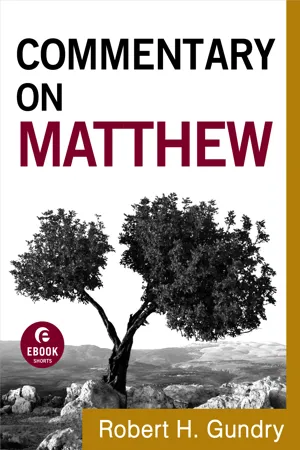
- 136 pages
- English
- ePUB (mobile friendly)
- Available on iOS & Android
eBook - ePub
Commentary on Matthew (Commentary on the New Testament Book #1)
About this book
Information
Topic
Theology & ReligionSubtopic
Biblical CommentaryMatthew
Very early church tradition attributes the writing of this Gospel to the apostle Matthew, also called Levi (compare Matthew 9:9 with Mark 2:14; Luke 5:27). The Gospel has in view persecution that exposes a rift between Christians who remain faithful to their Christian profession despite the persecution and those who because of it are proving themselves unfaithful. Matthew encourages faithfulness by highlighting Jesus’ messiahship and divine sonship, defines faithfulness in terms of Christian behavior and verbal testimony, and warns against unfaithfulness by accenting its eternally dreadful consequence.
THE GENEALOGY OF JESUS CHRIST
Matthew 1:1–17
This passage divides into a heading for Jesus’ genealogy (1:1), the genealogy proper (1:2–16), and a numerical summary of the genealogy (1:17). The genealogy proper subdivides into generations from Abraham to David (1:2–6a), from David to Jeconiah and his brothers (1:6b–11), and from Jeconiah to Jesus (1:12–16).
1:1: The record of the genesis of Jesus Christ, the son [= descendant] of David the son [= descendant] of Abraham. “The genesis of Jesus Christ” will consist in his genealogy. In Genesis 5:1, whose phraseology Matthew echoes in part, a genealogy takes its name after the first on the following list (“Adam”). But Matthew titles this genealogy after the last on the following list (“Jesus”). This reversal and the borrowing of Old Testament phraseology make the genealogy portray Jesus as the goal and fulfillment of the Old Testament. Matthew designs the portrayal to confirm in their Christian faith his audience of Jewish Christians, who are suffering persecution and tempted to save their necks by recanting. Strengthening this portrayal of Jesus are Matthew’s additions of (1) “Christ,” the Greek equivalent of the Hebrew “Messiah,” which refers to the one God has “anointed” to bring salvation to his people; (2) “the son of David,” David being the prototype of the messianic king; and (3) “the son of Abraham,” father of the Jewish nation. This last phrase probably refers to David rather than Jesus as Abraham’s descendant, though of course Jesus too descended from Abraham. The omission of all ancestors prior to Abraham suits the coming identification of Jesus as “the king of the Jews” (2:2; contrast the tracing of Jesus’ genealogy as far back as Adam, father of the whole human race, in Luke 3:38). In the following genealogical list “fathered” has to do solely with impregnating the mother of the next male or males on the list.
1:2–6a: Abraham fathered Isaac, and Isaac fathered Jacob, and Jacob fathered Judah and his brothers, 3and Judah fathered Perez and Zerah by Tamar, and Perez fathered Hezron, and Hezron fathered Aram, 4and Aram fathered Amminadab, and Amminadab fathered Nahshon, and Nahshon fathered Salmon, 5and Salmon fathered Boaz by Rahab, and Boaz fathered Obed by Ruth, and Obed fathered Jesse, 6aand Jesse fathered David the king [compare 1 Chronicles 1:34; 2:1–2, 4–5, 9–12, 15; Ruth 4:18–22]. Since Davidic kings came from the tribe of Judah, Jesus’ descent from Judah prepares for the presentation of Jesus as the messianic king in David’s line. Mention of Judah’s brothers, unnecessary in a purely genealogical list, portrays the old people of God as a brotherhood in anticipation of Matthew’s portrayal of the church, God’s new people, as also a brotherhood (5:22–24, 47; 7:3–5; 18:15, 21, 35; 23:8; 25:40). The mention of Tamar, emphasized by the inclusion of her son Zerah despite his falling outside Jesus’ lineage, brings a Gentile into the genealogy. For she was probably a Gentile (see Genesis 38) and was certainly thought to be so by many Jews in the New Testament era. Thus she becomes for Matthew a prototype of Gentiles who convert to Jesus the Messiah and whose conversion Jesus will promote in 28:18–20. Two other women, Rahab and Ruth (both of them Gentiles without question and celebrated by Jewish rabbis as converts to Judaism), join Tamar as further prototypes of Gentile converts to the church (see Joshua 2, 6; Ruth 1–4). The introduction of Rahab is especially striking in that the Old Testament contains no indication of Salmon’s fathering Boaz by her. The designation of David as “the king” adopts a designation of him that’s frequent in the Old Testament and prepares for Matthew’s portrayal of Jesus as the messianic king after the likeness of David and in fulfillment of God’s promise to David (2 Samuel 7:1–17).
1:6b–11: And David fathered Solomon by the [wife] of Uriah, 7and Solomon fathered Rehoboam, and Rehoboam fathered Abijah, and Abijah fathered Asaph, 8and Asaph fathered Jehoshaphat, and Jehoshaphat fathered Joram, and Joram fathered Uzziah, 9and Uzziah fathered Jotham, and Jotham fathered Ahaz, and Ahaz fathered Hezekiah, 10and Hezekiah fathered Manasseh, and Manasseh fathered Amos, and Amos fathered Josiah, 11and Josiah fathered Jeconiah and his brothers during the period of the deportation to Babylon [compare 1 Chronicles 3:5, 10–16]. Here we have a list of Jewish kings in David’s line, so that the list foreshadows Jesus as the Davidic king of the Jews. Again, however, a woman comes into the list. Unlike the previously mentioned women, however, she isn’t named, though in fact she was named Bathsheba (2 Samuel 11:3; 12:24). Matthew omits her name and leaves “wife” to be inferred so as to center attention on her husband Uriah. Though she was a Jewess so far as we can tell from her father’s name (2 Samuel 11:3; compare 2 Samuel 23:34), she was—so to speak—a Gentile by marriage. For Uriah was well known to be a Gentile, as indicated by his repeatedly being called “the Hittite” in 2 Samuel 11–12. Thus “the [wife] of Uriah” joins the previously mentioned women as vanguards of the Gentiles who’ll convert to Christ and whose conversion he will promote (see 28:18–20 again). The Old Testament speaks of a king named Asa. Despite English translations to the contrary, Matthew adds “-ph” to “Asa-” for a reference to the psalmist Asaph, part of whose Psalm 78 he’ll quote as fulfilled prophecy and whom he’ll call “the prophet” (13:35). With this massaging of the name, then, the king himself becomes a kind of prophecy concerning Jesus the king of the Jews. Similarly, the Old Testament speaks of a king named Amon. And again despite English translations to the contrary, Matthew replaces “-n” with “-s” to get a reference to the prophet Amos, to whose prophecy in Amos 3:5 Matthew’s quotation of Jesus’ saying in 10:29 will conform. With the massaging of his name, this king too becomes a kind of prophecy concerning Jesus the king of the Jews. Just as Matthew mentioned Judah’s brothers as well as Judah himself, he mentions the brothers of Jeconiah. But the Old Testament, which also calls him Jehoiachin, registers only one brother of Jeconiah (1 Chronicles 3:16; 2 Chronicles 36:10). So Matthew’s ascribing to him brothers, perhaps in the sense of his fellow Jews deported with him to Babylon (2 Kings 24:10–16), puts renewed, extra emphasis on the old people of God as a brotherhood in anticipation of the church, God’s new people, as also a brotherhood (compare the comments on 1:2).
Matthew omits the three successive kings Ahaziah, Joash, and Amaziah (for whom see 1 Chronicles 3:11–12), all of them belonging to the line of Athaliah, daughter of the infamous King Ahab in the northern kingdom of Israel and each of them suffering a violent death because of their wickedness (2 Chronicles 22:1–9; 24:20–27; 25:14–28). So even though the three omitted kings descended on their father’s side from David, Matthew’s omitting them conforms to the Lord’s visiting the iniquity of Ahab up through the third and fourth generations of his children, here through his daughter’s line (Exodus 20:5; Numbers 14:18 [compare 1 Kings 21:21; 2 Kings 10:30]). But a more important reason for these omissions will come out in 1:17; and to make that reason viable, Matthew now omits a fourth king, Jehoiakim (for whom see 1 Chronicles 3:15). As the addition of “the king” to “David” brought the first subdivision of the genealogy to a close, so the addition of “during the period of the deportation to Babylon” brings the second subdivision to a close. This deportation also spelled the end of rule by David and his descendants and therefore paves the way for its revival in Jesus.
1:12–16: And after the deportation to Babylon Jeconiah fathered Shealtiel, and Shealtiel fathered Zerubbabel, 13and Zerubbabel fathered Abiud, and Abiud fathered Eliakim, and Eliakim fathered Azor, 14and Azor fathered Zadok, and Zadok fathered Achim, and Achim fathered Eliud, 15and Eliud fathered Eleazar, and Eleazar fathered Matthan, and Matthan fathered Jacob, 16and Jacob fathered Joseph the husband of Mary, by whom [referring to Mary] Jesus who is called Christ was born [compare 1 Chronicles 3:17–19a]. The Lord disqualified Jeconiah’s sons (Jeremiah 22:24–30) but restored to favor Jeconiah’s grandson Zerubbabel (Haggai 2:23). So Luke’s saying that Neri fathered Shealtiel has to do with biological lineage, whereas Matthew’s saying—with an eye on the Lord’s disqualification of Jeconiah’s sons—that Jeconiah fathered Shealtiel has to do with legal lineage, Shealtiel belonging to another branch of David’s family (so also 1 Chronicles 3:17). In Zerubbabel the biological and legal lines reunite (compare Ezra 3:2). By taking “Abiud” as meaning “my father [is] Judah,” Matthew points again to Jesus’ belonging to the tribe from which the Davidic Messiah was to come. “Eliakim” likewise points to Jesus’ Davidic messiahship in that according to Isaiah 22:20–24, a passage Matthew will echo in 16:19, this name belongs to a man who’ll receive “the key of the house of David.” “Azor” is a shortened form of “Azariah,” an alternate name of the Davidic king Uzziah, already listed in 1:8–9, and therefore another pointer to Jesus’ Davidic ancestry. There was an earlier Zadok who ministered as high priest during David’s reign, so that “Zadok” here in Jesus’ genealogy points yet again to Davidic royalty. As a shortened form of Ahimaaz, “Achim” does the same since Ahimaaz was a son of David’s high priest Zadok. Matthew presents “Eliud” as meaning “God of Judah” to connote the royal tribe to which Jesus belongs as the king of the Jews. So these names, differing from those we find in reverse order in Luke 3:24b–27b, symbolize Jesus’ qualification as a descendant of David to inherit David’s throne.
Except for a slight difference in spelling, Matthew agrees with Luke 3:24 in “Matthan.” But instead of “Heli” (Luke 3:23) he writes “Jacob,” so that this Jacob fathered Jesus’ foster father Joseph just as the Old Testament Jacob fathered as one of his twelve sons the Joseph who was sold into Egypt (compare Matthew’s writing “Joseph” in 13:55 instead of the “Joses” of Mark 6:3 and often conforming the wording of this Gospel elsewhere to that of the Old Testament). The addition of “the husband of Mary” to “Joseph” shows that Jesus, though not fathered biologically by Joseph, belonged legally to David’s line. For legal rights came through the father even though he was only a foster father, and Joseph took Mary to wife before Jesus’ birth (1:20–25). “By whom [referring to Mary] Jesus . . . was born” prepares for divine action in the conception and birth of Jesus, for Matthew has carefully avoided saying that Joseph fathered Jesus. “Who is called Christ” draws the conclusion that so far as legal ancestry is concerned, Jesus is qualified to be the messianic king.
1:17: Therefore [drawing a conclusion from the foregoing list] all the generations from Abraham to David [are] fourteen generations, and from David to the deportation to Babylon [are] fourteen generations, and from the deportation to Babylon to the Christ [are] fourteen generations. 1 Chronicles 1:34; 2:1–15 provided fourteen generations from Abraham through David. But why does Matthew divide the rest of the genealogy into two more sets of fourteen generations each, and do so at the cost of omitting four Davidic kings in the second set and listing eight fewer generations than Luke does in the third set? He wants to say numerically what the listed names have already said genealogically, which is that in Jesus the Davidic Messiah has come. For the numerical values of the Hebrew consonants in David’s name add up to fourteen: D (4) + V (6) + D (4) = 14. (Before the introduction of Arabic numerals, letters of the alphabet stood for numbers; and Hebrew was written without vowels.) The omissions mean that for the second and third sets “all the generations” refers to the generations listed by Matthew, not to all the generations found in the Old Testament. That Matthew constructs three sets of fourteen also corresponds to the spelling of David’s name in Hebrew with three consonants and puts a triple emphasis on Jesus’ Davidic ancestry. So the first set ended with royal power (“David the king”), the second with loss of royal power (“the deportation to Babylon”), and the third with a revival of royal power (“the Christ”). But to get his third set of fourteen Matthew counts Mary as well as Joseph. In other words, the one chronological generation represented by them carries within it two other kinds of generation, a legal (Joseph’s) and a physical (Mary’s). Otherwise we have only thirteen, since Jeconiah belonged to the second set of fourteen just as David belonged to the first. The counting of Mary harmonizes with Matthew’s distinguishing between Jesus’ royal lineage through Joseph (compare Joseph’s being addressed with “so...
Table of contents
- Cover
- Title Page
- Copyright Page
- Contents
- Acknowledgments
- Introduction
- Matthew
- Back Cover
Trusted by 375,005 students
Access to over 1.5 million titles for a fair monthly price.
Study more efficiently using our study tools.
Frequently asked questions
Yes, you can cancel anytime from the Subscription tab in your account settings on the Perlego website. Your subscription will stay active until the end of your current billing period. Learn how to cancel your subscription
No, books cannot be downloaded as external files, such as PDFs, for use outside of Perlego. However, you can download books within the Perlego app for offline reading on mobile or tablet. Learn how to download books offline
Perlego offers two plans: Essential and Complete
- Essential is ideal for learners and professionals who enjoy exploring a wide range of subjects. Access the Essential Library with 800,000+ trusted titles and best-sellers across business, personal growth, and the humanities. Includes unlimited reading time and Standard Read Aloud voice.
- Complete: Perfect for advanced learners and researchers needing full, unrestricted access. Unlock 1.5M+ books across hundreds of subjects, including academic and specialized titles. The Complete Plan also includes advanced features like Premium Read Aloud and Research Assistant.
We are an online textbook subscription service, where you can get access to an entire online library for less than the price of a single book per month. With over 1.5 million books across 990+ topics, we’ve got you covered! Learn about our mission
Look out for the read-aloud symbol on your next book to see if you can listen to it. The read-aloud tool reads text aloud for you, highlighting the text as it is being read. You can pause it, speed it up and slow it down. Learn more about Read Aloud
Yes! You can use the Perlego app on both iOS and Android devices to read anytime, anywhere — even offline. Perfect for commutes or when you’re on the go.
Please note we cannot support devices running on iOS 13 and Android 7 or earlier. Learn more about using the app
Please note we cannot support devices running on iOS 13 and Android 7 or earlier. Learn more about using the app
Yes, you can access Commentary on Matthew (Commentary on the New Testament Book #1) by Robert H. Gundry in PDF and/or ePUB format, as well as other popular books in Theology & Religion & Biblical Commentary. We have over 1.5 million books available in our catalogue for you to explore.