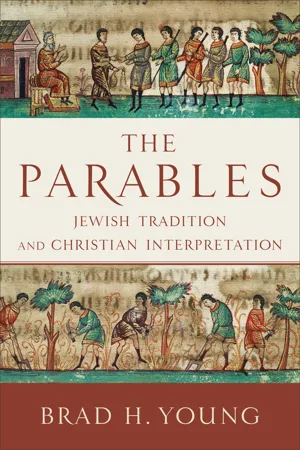
- 348 pages
- English
- ePUB (mobile friendly)
- Available on iOS & Android
eBook - ePub
About this book
Fully one-third of Jesus' words in the Synoptic Gospels occur in parables. It could be said that knowing the parables is essential for understanding the person of Christ. In this work, Brad Young displays his unique perspective as a scholar steeped in both Jewish and Christian studies. While parables have timeless messages, reinterpretations in new contexts throughout the centuries have distorted the original meanings and undermined the essence of what Jesus intended for his initial listeners. Young examines the parables that best illustrate the parallels between the rabbinic and Gospel parables. He challenges readers to remember that first-century Judaism was not merely the backdrop for Jesus' teachings but the very stage from which Jesus delivered the message of the kingdom. Jesus' ethics and theology can be properly understood only in the light of first-century Jewish teachings. Young focuses on the historical development and theological significance of parables in both traditions and examines five theological subjects that are dealt with in parables: prayer, grace, reconciliation, calling, and sovereignty.
Information
Topic
Theology & ReligionSubtopic
Biblical Studies

PARABLES
The reality of God is revealed in the word-pictures of a parable. Jesus and the rabbis of old taught about God by using concrete illustrations that reach the heart through the imagination. They challenged the mind on the highest intellectual level by using simple stories that made common sense out of the complexities of religious faith and human experience. On the one hand, in finite terms God is beyond human comprehension, but on the other, his infinite majesty may be captured in vivid stories of daily life.
The Hebrew parable, mashal (משל), has a wide range of meanings. The word is stretched from its basic meaning of similarity or resemblance to cover any type of illustration, from a proverbial saying to a fictitious story. It may refer to a proverb, riddle, anecdote, fable, or allegory. A mashal defines the unknown by using what is known. The mashal begins where the listener is, but then pushes beyond into a new realm of discovery. The rabbinic parable illustrates its point by redescribing, in drama, the nature of God and human responses to his love.
The Greek parable, parabolē (παραβολή), refers to what is cast alongside. The dramatic image of a story illustration is thrown out as a comparison of the reality of the source with its fictional representation in words. It may refer to a saying or story example. The idea of resemblance is not quite as pronounced in the Greek word parabolē as it is in the Hebrew term mashal, but both terms show a likeness between the images of an illustration and the object being portrayed. The Jesus of the Synoptic Gospels loves to use miniature plays to communicate his message. The word-picture of the parable creates a drama that redescribes in clear terms the reality being illustrated. The resemblance between the reality and the illustration makes an instructive comparison.
The genre of story parables, however, seems to be independent of the terms selected to designate them. Jesus and the rabbis of old created these illustrations, and their stories became known as parables. Jewish teachers seem to have developed the classic form of the parable from their religious heritage and cultural experience. The method of teaching developed first, then the term parable (mashal or parabolē) was used to describe the story illustrations that resulted. In this book we will pursue an inductive study of the parables, as mini-dramas designed to teach a message by illustrating a resemblance between the source of the word-picture and its redescription in metaphor. Moreover, we will look at the background of the story in Jewish culture and religion, as A. M. Hunter has already suggested in his fine, popular book on the parables: “The word itself, parabole, is of course Greek, and means a comparison or analogy. Aristotle discusses it in his Rhetoric. But the antecedents of Christ’s parable must be sought not in Hellas but in Israel; not in the Greek orators but in the Old Testament prophets and the Jewish Fathers.”[1]
The way the parables speak about God is deeply rooted in the historical and cultural background of the Hebrew Bible. The rich imagery used to describe God is similar to that of the Bible. The differences between the East and the West have been perceptively brought out by John Donahue when he describes biblical statements about God:
Biblical statements about God and God’s actions in the world are expressed in a language of images that moves in the rhythmic cadences of Hebrew poetry. God is not simply powerful but one who “kills and brings to life; he brings down to sheol and raises up” (1 Sam. 2:6). God does not simply free a people but leads them out of a house of bondage “with a mighty hand and an outstretched arm” (Deut. 5:15). The Hebrew Bible images a God who lays the foundations of the earth and shuts in the sea with doors (Job 38:4, 8), who seeks an unfaithful people with the longing of a rejected lover (Hosea 2) and remembers a people with a mother’s love (Isa. 49:14–15). The biblical God speaks through images that touch hidden depths of human experience and cover the whole gamut of human emotion.[2]
Parables are like that. God’s redemptive work is redefined in vivid images of strength and force. The Eastern mind tended to conceive of God in dynamic metaphors; God is known through his mighty acts. Parables describe God in similar images. This type of language is appropriate for the later rabbinic meshalim (parables). Jesus knew well this medium of communication. Hunter boldly asserts, “Doubtless it was in the synagogue that Jesus first heard men talking in parables.”[3] Jesus used the parable to drive home his message about God and God’s relationship to every human being. Each person has supreme value for the parable teacher of the Gospels. The stress on human relationships emerges from the interaction among the stock characters within the drama of the Gospel parables.
The Gospel parables of Jesus, moreover, are full of everyday ordinariness along with a God-consciousness. The unexpected usually enters into the drama with a surprise action by one of the leading characters or an unanticipated change of events. The stage of daily life becomes the scene for viewing the world from God’s perspective. By putting God and his ways on open display for all to ponder, the parables create a new dimension. God enters the world of humanity with the challenge of religious conviction and corresponding action. The listener catches a glimpse of the divine character and the spiritual realities of life. Parables use rich imagery of language to catch the listener unaware. At first it all seems so familiar, and then a shift develops in the plot of the story. The ordinariness of the parable is transformed by a surprising twist. A consciousness of God and his way of viewing the world enters the commonplace scene to communicate the divine message. The familiar setting of the parable allows each person to understand God’s will. The local color of the story is changed for a special purpose. This storytelling methodology is present in both rabbinic and Gospel parables. They share many common motifs and literary types in this dynamic process, which demands interaction from every listener.
Parables are a shadow of the substance. The physical reality of the parable reveals the natural affinity between the world in which we live and the spiritual dimension. The theological presuppositions of the parables undergird the descriptive elements of a dramatic presentation. The drama comes alive in meaning because of the theological significance of the parables.
In the creative genius of the parable teacher’s imagination, the listener is catching glimpses of the divine character. The shadow is an inexact representation of the substance. But in the shadow one discovers a clear outline of many features of the reality. In many ways, God is the ultimate reality, providing the substance for the shadow in the word-pictures of a parable. In fact, the old root word behind the Hebrew term mashal refers to shadow. In one early Semitic proverb, the king is the shadow or resemblance of God, and a common person is the likeness of the royal ruler. J. Heintz has stressed this point in his discussion of this ancient saying that compares the king to God. Heintz believes that the comparison (mashal) is based on an earlier tradition. The comparison itself is made in an official address to the king Asarhaddon or Assurbanipal between 680 and 627 B.C.E.[4] It has far-reaching ramifications for the meaning of parables in ancient Semitic thought.
As it is said, “The [human] king is the shadow of the god, and man [the human being] is the shadow of the [human] king.” Thus the king himself is the perfect resemblance of the god![5] (=LAS, no. 145)
The word for parable is instructive here as highlighting the likeness between divine majesty and human royalty. The human king is the “perfect resemblance” or the shadow of the god. Heintz observes, “This important text, though difficult to interpret, presents the interesting citation of an archaic proverb very relevant to the theme that qualifies the king as ‘the image of god.’ ”[6] Rabbinic and Gospel parables first and foremost tell us about God. They are stamped with the image of God, who is the substance of the shadow. Through comparative language, they teach the listener about the divine character by showing what God is like. The listener moves from what is known in his or her experience unto the unknowable in human understanding. God is like a generous householder or a compassionate father. The likeness of the parable is the shadow of the object.
“Above all else,” says David Stern, one of the foremost authorities on rabbinic parables, “the mashal represents the greatest effort to imagine God in all Rabbinic literature.”[7] The rabbis talked about God in parables. The creative process of conceptual thought brings life to simple stories about kings, householders, or fathers who resemble some aspect of God’s character. How can one imagine what God almighty is like? In Stern’s eyes, rabbinic parables constitute the strongest effort to reveal his nature. Community leaders and old rabbis tried to communicate the divine character and sought to comprehend God’s will by telling stories about daily living. They recognized the affinity between the natural realm and the ways of God. So it is with Jesus and his Jewish parables.
PARABLES AS GOSPEL
One-third of the recorded sayings of Jesus in the Synoptic Gospels are in parables. If we do not understand the parables, we miss what may be known about the historical Jesus. One must understand parables to know Jesus. But the approaches advanced to study the Gospel parables are in conflict with one another. In this study we will seek to find common ground among the positive elements of the various approaches that have been advanced to understand the teachings of Jesus. The historical and critical method is the starting point. Recent advances in textual study, archaeology, Greek studies, epigraphy, literary analysis, folklore, the Dead Sea Scrolls research, rabbinic thought, and Jewish religious movements have provided fresh insights into the parabolic instruction of the Gospels.[8] After all, Jesus was a Jew, and his parables represent a form of Judaism from his time.
The Semitisms of the Synoptic Gospels reveal the rich heritage of Jews and Judaism during the days when the temple was a reality. The Greek elements of the texts, however, also show the editorial process and the reinterpretation of the parables for a new setting beyond the ministry of Jesus within the life of the early church. The Christian interpretation of the parables at the close of the first and the beginning of the second centuries infused new meaning into the Gospels. While the parables have a message that transcends time, the reinterpretation of the illustrations in a new context often has distorted the authentic meaning. Far-fetched allegories and teachings directly opposed to Jesus and his Judaism have undermined the force of the parabolic messages that the original audiences heard. Because every interpreter of the parables is limited by time and place as well as by a different religious and cultural orientation, historical research promises to discover more about Jesus and his methods of teaching. Jesus’ Jewish culture and his devotion to Torah open up much of the deeper meaning of the parables for us. Ancient Judaism is the backdrop for Jesus and his parables.
The Gospels make one thing clear: Jesus is fond of teaching in parables. Moreover, the stories of God and people that Jesus used to illustrate his message called for a decision from everyone who listened. Parables are works of art in the discipline of communication. In fact, Jesus’ parables are prime examples of Jewish haggadah.
Parables as Haggadah
First and foremost, both the parables of Jesus and the parables of the rabbis must be studied as Jewish haggadah. Haggadah, or storytelling with a message, has its own dynamic within the parameters of religious and ethical teaching. Often designed to be entertaining or even captivating, the haggadah proclaims a powerful message that usually demands a decision. A good story can drive home the point better than a sermon. Often an earthy illustration says so much more than a lofty homily. But haggadah is more than entertaining stories because it serves a higher purpose, centering on God’s way among people whom he loves. After all, the focus of haggadah is to understand the divine nature. Regarding the purpose of haggadah, the rabbis teach us, “If your desire is to know Him who spoke and the world came into being, then study Haggadah and from this study you will know Him who spoke the world into being and you will cleave to His ways.”[9] One who seeks to know God must listen to the stories from haggadah and learn its message. Such illumination precedes obedience. The haggadah makes a path for the earnest student who loves God and seeks his ways.
Of course, haggadah embraces a much wider genre of Jewish literature than parables. Generally speaking, whatever is not halakah (legal lore) or midrash (Bible exposition) may be called haggadah. Haggadah is found in abundance in midrash as well as in some halakic texts. Haggadah bridged the gap between the common people and the highly educated. By focusing on the heart and the imagination, haggadah reaches people on all levels, from the learned to the untutored, in the ways of Torah. The Jewish theologian Abraham Joshua Heschel proclaimed the distinctives of haggadah in comparison with halakah in this way: “Halacha deals with subjects that can be expressed literally; agada introduces us to a realm which lies beyond the range of expression. Halacha teaches us how to participate in the eternal drama. Halacha gives knowledge; agada gives us aspiration. Halacha gives us the norms for action; agada, the vision of the ends of living.”[10] In Heschel’s thinking, haggadah inspires the people while halakah deals more with details. Both disciplines of study have significant roles, but haggadah captures the heart through the imagination. It reaches out and takes hold of the spiritual qualities of the human heart. It reveals God’s presence in personal experience. The world of haggadah often soared high above to reach ordinary people below. It communicated God’s love in a meaningful way to the most erudite scholar as well as to the common folk.
A fine example of haggadah is found in the story of R. Eleazer’s encounter with the exceedingly ugly man. Unlike the exceedingly ugly man, who probably had labored menially throughout the day, R. Eleazer had the privilege of devoting himself entirely to the study of Torah. His master was R. Meir, and perhaps R. Eleazer and his beloved teacher had spent the day learning the deeper things of God.
The Rabbi and the Exceedingly Ugly Man
On one occasion Rabbi Eleazer son of Rabbi Simeon was coming from Migdal Gedor, from the house of his teacher. He was riding leisurely on his donkey by the riverside and was feeling happy and elated because he had studied much Torah. There he chanced to meet an exceedingly ugly man who greeted him, “Peace be upon you, rabbi.” He, however, did not return his greeting but instead said to him, “Raca [‘Empty one’ or ‘Good for nothing’] how ugly you are! Is everyone in your town as ugly as you are?” The man replied; “I do not know, but go and tell the craftsman who made me, ‘How ugly is the vessel which you have made.’” When R. Eleazer realized that he had sinned he dismounted from the donkey and prostrated himself before the man and said to him, “I submit myself to you, forgive me!”[11]
Rabbi Eleazar could not hold his tongue. When he encountered the exceedingly ugly man, all he could think about was that ugliness. When he made his stinging insult, he failed to see each person as created in the image of God. The ugly man, on the other hand, perhaps because of life experience, had come to realize the deeper significance of the story of creation—every human being, attractive or otherwise, has the divine image superimposed. Each person is crafted according to plan by the master designer. In the world of haggadah, one discovers the healthy tension between a scholar and an unlearned man. In this case, the lofty scholar, who had the privilege of studying all day, crossed paths with the ignorant day laborer. The scholar rides a donkey. The ugly man walks. The scholar’s opportunities in education and superior financial standing far exceed that of the day laborer, who had to work hard to survive. But who has greater wisdom?
The incident described teaches more about the love of others who are created in the divine image than exhortations from the pulpits of churches or synagogues. The haggadah reaches the heart and challenges the mind. It inspires the people to see God’s image—even in the face of another human being with a wretched, uncomely appearance. The intellect grasps the meaning of the biblical text. But haggadah penetrates the heart with the message that every human being is created in the image of God. According to the exceedingly ugly man, a parable-like comparison may be made between a human craftsman who forms a vessel and the divine creator who formed each person out of the dust. The story illustrates, moreover, the deep Jewish roots of Jesus’ teachings on love. Like Jesus, ma...
Table of contents
- Cover
- Title Page
- Copyright Page
- Dedication
- Table of Contents
- Foreword: David Flusser
- Acknowledgments
- PART I: The Historical Development and the Theological Significance of Parables in Judaism and Christianity
- PART II: Jewish Prayer and the Parables of Jesus
- PART III: Parables of Grace in the Gospels and Their Theological Foundations in Ancient Judaism
- PART IV: Teaching in Parables: The Theology of Reconciliation between God and Humanity in Both Judaism and Christianity
- PART V: The Disciple’s Call: A Life of Learning and Doing
- PART VI: Torah Learning and God’s Reign
- Epilogue
- Bibliography
- Index of Parables and Illustrations
- Index of Names and Subjects
- Index of Ancient Sources
- Notes
- Back Cover
Trusted by 375,005 students
Access to over 1.5 million titles for a fair monthly price.
Study more efficiently using our study tools.
Frequently asked questions
Yes, you can cancel anytime from the Subscription tab in your account settings on the Perlego website. Your subscription will stay active until the end of your current billing period. Learn how to cancel your subscription
No, books cannot be downloaded as external files, such as PDFs, for use outside of Perlego. However, you can download books within the Perlego app for offline reading on mobile or tablet. Learn how to download books offline
Perlego offers two plans: Essential and Complete
- Essential is ideal for learners and professionals who enjoy exploring a wide range of subjects. Access the Essential Library with 800,000+ trusted titles and best-sellers across business, personal growth, and the humanities. Includes unlimited reading time and Standard Read Aloud voice.
- Complete: Perfect for advanced learners and researchers needing full, unrestricted access. Unlock 1.5M+ books across hundreds of subjects, including academic and specialized titles. The Complete Plan also includes advanced features like Premium Read Aloud and Research Assistant.
We are an online textbook subscription service, where you can get access to an entire online library for less than the price of a single book per month. With over 1.5 million books across 990+ topics, we’ve got you covered! Learn about our mission
Look out for the read-aloud symbol on your next book to see if you can listen to it. The read-aloud tool reads text aloud for you, highlighting the text as it is being read. You can pause it, speed it up and slow it down. Learn more about Read Aloud
Yes! You can use the Perlego app on both iOS and Android devices to read anytime, anywhere — even offline. Perfect for commutes or when you’re on the go.
Please note we cannot support devices running on iOS 13 and Android 7 or earlier. Learn more about using the app
Please note we cannot support devices running on iOS 13 and Android 7 or earlier. Learn more about using the app
Yes, you can access The Parables by Brad H. Young in PDF and/or ePUB format, as well as other popular books in Theology & Religion & Biblical Studies. We have over 1.5 million books available in our catalogue for you to explore.