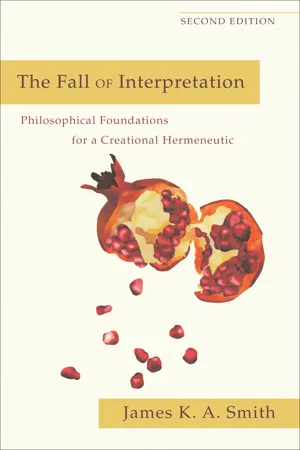
eBook - ePub
The Fall of Interpretation
Philosophical Foundations for a Creational Hermeneutic
- 256 pages
- English
- ePUB (mobile friendly)
- Available on iOS & Android
eBook - ePub
About this book
In this provocative book James K. A. Smith, one of the most engaging Christian scholars of our day, offers an innovative approach to hermeneutics. The second edition of Smith's well-received debut book provides updated interaction with contemporary hermeneutical discussions and responds to criticisms.
Information
Topic
Theology & ReligionSubtopic
Biblical Studies
1
Paradise Regained
For a certain “traditional” evangelical theology,[65] the Fall was a fall from immediacy to mediation, from understanding to distortion, from reading to interpretation. Eden, for such theologians, was a paradise of perpetual connection: a hermeneutical paradise precisely because of the absence of hermeneutics. As American evangelical theologian Richard Lints tells the story:
In the beginning, Adam and Eve enjoyed perfect clarity in their comprehension of the purposes and presence of God. The creatures and the Creator understood each other. But the fall destroyed this clarity and Adam and Eve immediately sought to cover their nakedness, to find shelter from God, to hide from him.[66]
The Fall, then, destroyed the pristine perspicuity (clarity) of Edenic immediacy, where “knowing” was not hindered by the space of interpretation.[67] Of course, the story doesn’t end there: redemption is a restoration of this interpretive paradise (at least for these evangelical readers)[68] by the illumination of the Spirit coupled with the perspicuity of Scripture. Hermeneutics is a curse, but it is one from which we can be redeemed in the here and now; we can return from mediation to immediacy, from distortion to “perfect clarity,” and from interpretation to “pure reading.”
Permit me one illustration of this kind of evangelical “interpretation of interpretation”: part of the Friday ritual in our home was to pack up the kids, drag the playpen and pajamas for everyone out to the car, and head to one of our friends’ homes to enjoy a potluck dinner and then a Bible study discussion. After enjoying a time of “fellowship” (evangelical code word for food), we put the children to sleep in various rooms and closets in the house and then opened our Bibles for discussion.
Leadership for the study was shared by all in a rotating fashion, and each leader was free to choose a passage or narrative to consider and reflect upon. We devoted our time to discussion and participation, welcoming the input of all involved. The group was rather eclectic; the people who gathered represented a plurality of traditions and denominations, such as Plymouth Brethren, Presbyterian, Baptist, and Pentecostal, and a few were from nondenominational churches. Each person had a unique narrative and testimony that made every individual’s contribution different. In sum, this was a wonderful place to see the role of hermeneutics at work and to see how people understood interpretation within the evangelical tradition.
Of course, not every interpretation is a good interpretation.[69] My favorite, offered by one of the more, let’s say, “traditional” men in the group, suggested that Jesus first appeared to women after the resurrection in order to guarantee that word would spread quickly. After all, he concluded (citing specific data), we all know women say an average of twelve thousand words per day and men only five thousand; his “gossip theory” suggested that Jesus had this in mind when appearing to the women at the tomb.
Now, apart from my wife’s rather ferocious response to such an interpretation, the general dynamics of such a reading, and such a group in general, illustrate an interesting point. While a myriad of groups such as this meet every night across the country—and while just as many “readings” or “interpretations” are offered—in the end many of these Bible students tend to think that interpretation is an inconvenience, that interpretation is somehow “our fault” and that God helps us to overcome it. When, for instance, I offer an interpretation that might suggest something contrary to a traditional reading, I am often met with the response, “Well, that might be your interpretation, but my Bible clearly says women are to be silent in church!” I am complicating matters by interpretation, my interlocutor suggests (another product of my academic corruption, I’m usually told); he, on the other hand, is simply reading what God’s Word clearly says in black and white.
This general “interpretation of interpretation” was captured very well by a recent advertisement in a leading evangelical periodical: “God’s Word. Today’s Bible translation that says what it means,” the dust cover boldly proclaimed. Underneath the photograph, in large bold letters, the publisher heralded “NO INTERPRETATION NEEDED.”
Issues of a general hermeneutical nature have finally come to the fore in recent evangelical discussions, as have a number of new contributions on theological method.[70] In their attempts to engage recent philosophical and theological developments such as existentialism, philosophical hermeneutics, and deconstruction, evangelicals are increasingly attentive to questions of tradition, historicality, contextuality, and cultural conditioning. However, all of these elements and conditions are construed as inextricably linked with hermeneutics and, further, as conditions that must somehow be overcome. While many pay heed to the influence of sociolinguistic and historical conditioning, in the end much recent work in evangelical theology continues to assert that it is somehow possible to surmount these conditions and attain a pure reading that delivers the “explicit teaching of Scripture.”
In looking at two of these proposals in this chapter, I will attempt to demonstrate that this penchant for overcoming historical and linguistic conditioning unwittingly ends up being an attempt to overcome our humanity and that, as such, it is a devaluing of creation, which evangelicals seek to honor. I am suspicious that underlying this claim to immediacy and objectivity there is an unconscious (and likely, unintended) drive to escape interpretation and to overcome creaturehood, a drive that is itself reminiscent of the Edenic Fall and the trespass of the sign, for it is fundamentally a striving to be like God (Gen. 3:5).
It seems to be but another (“Christian”) chapter in a long history of metaphysics, in which we are seduced by the erotic pull of the Infinite and determined to ascend to such pristine heights. In much the same way that Dennis Schmidt describes the history of philosophy, this stream of evangelical theology is resolute in its quest “to see beyond the captivity of finite perspectives and prejudices of every sort—national, historical, egoistic, linguistic, physical—to a perceived or simply promised metaphysical region of free and abstract generality which is said to first grant thought its mandate to speak intelligibly about the world in which we find ourselves.”[71] (As such, modern philosophers such as René Descartes and John Locke could be included in the immediacy model explored in this chapter, inasmuch as both posit a model of knowing that claims to deliver the world as it “really” is in a correspondence theory of truth.)[72]
I have chosen to consider two recent proposals from American evangelicals Rex Koivisto and Richard Lints as paradigmatic examples of this “interpretation of interpretation” because they provide very explicit examples of my thesis; further, they represent a range on the evangelical spectrum: Koivisto comes from a low-ecclesiology, Baptist-revivalist tradition and Lints comes from a Presbyterian, classical-Reformed paradigm. My project is to show the continuity of their proposals and critique their base assumption regarding the fallenness of hermeneutics.
Reading with Dante’s Adam: Koivisto
Koivisto’s interpretation of interpretation is uncovered in his book One Lord, One Faith, which is a sustained call for restoration of Christian unity in a manner rarely heard from evangelicals. Although I appreciate his attempt to forge a “theology for cross-denominational renewal” (the subtitle of the book), I think this project is marred by a hermeneutical framework that centers on immediacy. To demonstrate this, I must first outline his proposal for renewed “catholicity.”
Koivisto takes denominational distinctives that are understood as divine imperatives to be the main barrier to Christian unity. To overcome this situation, Christians must be able to distinguish between “the core orthodoxy, which they warmly share with other believers, and their own peculiar distinctives”;[73] these denominational distinctives are what Koivisto describes as “tradition,” or more specifically, “microtradition.” By making this distinction, he is trying to point out to evangelicals that much of what they consider to be “explicit biblical teaching” is only “tradition,” that is (for Koivisto), interpretation, a kind of “style” (OLOF 135). Much of what evangelicals of differing stripes consider to be a divine imperative is actually a highly mediated interpretation.
On one level, Koivisto is exposing the myth of unbiased interpretation: “None of us,” he argues, “interprets the Bible in a vacuum. We interpret out of a cultural, historical context, through an ecclesiastical context, looking for the Bible’s relevance to cultural problems” (OLOF 136). He explicitly rejects any “leapfrog” model of interpretation that claims to go directly to the Bible, uninfluenced by tradition; instead, interpretive traditions are unavoidable.
However, Koivisto’s text deconstructs itself[74] in the next paragraph where he restores just such a model of bias-free interpretation on another level by asserting that we must distinguish our (micro)traditions from “the clear teachings of Scripture.” Our denominational distinctives are interpretations (microtradition) and as such must be stated with a “hermeneutical humility.” In order for Christians to be united (which is Koivisto’s overall project), microtradition must be relativized, which is to say that these distinctives must be seen as interpretations and therefore fallible. But the constructive part of Koivisto’s proposal is found in his notion of “core orthodoxy,” which is what all (true) Christians share in common. It is this core orthodoxy that is the “explicit teaching of Scripture”—explicit because it is not interpreted but simply read.
Thus microtradition is composed of “those traditions which make up the unique interpretive distinctives of a congregation, denomination, or stream within the whole church” (OLOF 342n6). It can further be classified as “interpretive” or “external”: as external, tradition involves practices and doctrines that are based not on “explicit biblical support” but rather on ancient or denominational founding practice (OLOF 146–47). Macrotradition, on the other hand, “is the interpretive tradition of the church as a whole” (OLOF 342n6) and is to be identified with the core orthodoxy shared by the entire church (OLOF 182).
In order to construct a cross-denominational theology, Koivisto argues, it is imperative that these two levels be distinguished: those beliefs that are explicit biblical teaching (macrotradition) and those beliefs that are the result of interpretation (microtradition). “Only when we have separated out what is traditional,” he continues, “can we be allowed to hear the crisp, unadorned voice of God ringing out from Scripture alone” (OLOF 140).
But here we stumble upon an interesting aporia in Koivisto’s text: denominational distinctives are interpretations influenced by tradition; thus Koivisto categorizes them as microtradition. Core orthodoxy, or macrotradition, however, represents the “clear teaching of Scripture.” May we not legitimately ask, at this juncture, whether Koivisto’s core orthodoxy—the clear teachings of Scripture—is not also influenced by tradition? Does not Koivisto himself concede such when he describes this core orthodoxy as macrotradition? As macrotradition, can it ever deliver the crisp, unadorned voice of God?
In this framework, interpretation is relegated to the level of denominational distinctives and secondary matters. Too many Christians have proclaimed their denominational practices as the “clear teaching of Scripture,” whereas Koivisto is unveiling the fact that these matters are “clear” only because of the colored glasses of one’s interpretive tradition. But Koivisto fails to recognize that interpretive glasses are “cemented to our face” (Abraham Kuyper). That is, he is still holding out a group of teachings that are “clear teachings of Scripture”—not the product of interpretation but rather delivered immediately, unhampered by the space of hermeneutics. But do we ever possess the crisp, unadorned voice of God? If, as Koivisto asserts, we never interpret the Bible in a vacuum but always through the lens of a cultural, historical, and linguistic context (OLOF 136), can there be any such thing as “explicit biblical teaching”?[75]
In a conservative critique of Koivisto’s proposal, John Fish hits on precisely this point (though he takes a different direction than I will). Fish, offering criticism of Koivisto from a Brethren standpoint, correctly perceives the implications of the relativization of microtradition. But it is precisely for this reason that Fish rejects the interpreted status of these denominational distinctives. What Koivisto describes as matters of interpretation and tradition, Fish understands to be “New Testament Church Truth”—as though uninterpreted and untraditioned, simply uncovered by reading.
When Koivisto concludes that these distinctives are “tradition,” he means to say that they are without “clear Scriptural mandate”—which for him means that they are matters of interpretation. But such a distinction cuts at the very heart of Brethren theology, as Fish realizes: “For those in the assemblies of Christian Brethren (sometimes called Plymouth Brethren) the subject of church truth has always meant those truths concerning the church which are taught and practised in the New Testament and are normative for today.”[76] Fish’s project is to demonstrate that these distinctives are not matters of “preference, practicality, or expediency”—that is, they are not matters of interpretation—but rather are “essentials” from Scripture.[77]
Commenting on Koivisto’s notion of interpretive tradition, Fish rightly perceives (while Koivisto does not) that “we now shift the neutral attitude toward tradition in the earlier sense [of external tradition] toward anything which is a matter of interpretation.” But Fish continues:
Are we not in danger here of nullifying the Word of God by what we are calling tradition? Once everything which is disputed becomes a matter of interpretive tradition, then the Bible is unclear in every area because every teaching of the Bible has been disputed. Everything is a matter of tradition and therefore may not be held as intrinsically biblical. Everything is simply a matter of “perspective” or “preference.” In fact, we will n...
Table of contents
- Cover
- Title Page
- Copyright Page
- Dedication
- Epigraph
- Contents
- Preface to the Second Edition
- Preface to the First Edition
- Acknowledgments
- Abbreviations
- Reconsiderations
- Introduction
- Part 1: The Fallenness of Hermeneutics
- Part 2: A Hermeneutics of Fallenness
- Part 3: Toward a Creational Hermeneutic
- Name Index
- Subject Index
- Notes
- Back Cover
Trusted by 375,005 students
Access to over 1.5 million titles for a fair monthly price.
Study more efficiently using our study tools.
Frequently asked questions
Yes, you can cancel anytime from the Subscription tab in your account settings on the Perlego website. Your subscription will stay active until the end of your current billing period. Learn how to cancel your subscription
No, books cannot be downloaded as external files, such as PDFs, for use outside of Perlego. However, you can download books within the Perlego app for offline reading on mobile or tablet. Learn how to download books offline
Perlego offers two plans: Essential and Complete
- Essential is ideal for learners and professionals who enjoy exploring a wide range of subjects. Access the Essential Library with 800,000+ trusted titles and best-sellers across business, personal growth, and the humanities. Includes unlimited reading time and Standard Read Aloud voice.
- Complete: Perfect for advanced learners and researchers needing full, unrestricted access. Unlock 1.5M+ books across hundreds of subjects, including academic and specialized titles. The Complete Plan also includes advanced features like Premium Read Aloud and Research Assistant.
We are an online textbook subscription service, where you can get access to an entire online library for less than the price of a single book per month. With over 1.5 million books across 990+ topics, we’ve got you covered! Learn about our mission
Look out for the read-aloud symbol on your next book to see if you can listen to it. The read-aloud tool reads text aloud for you, highlighting the text as it is being read. You can pause it, speed it up and slow it down. Learn more about Read Aloud
Yes! You can use the Perlego app on both iOS and Android devices to read anytime, anywhere — even offline. Perfect for commutes or when you’re on the go.
Please note we cannot support devices running on iOS 13 and Android 7 or earlier. Learn more about using the app
Please note we cannot support devices running on iOS 13 and Android 7 or earlier. Learn more about using the app
Yes, you can access The Fall of Interpretation by James K. A. Smith in PDF and/or ePUB format, as well as other popular books in Theology & Religion & Biblical Studies. We have over 1.5 million books available in our catalogue for you to explore.