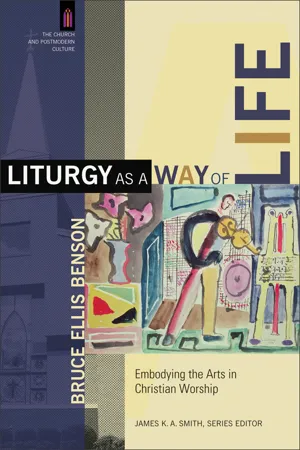
eBook - ePub
Liturgy as a Way of Life (The Church and Postmodern Culture)
Embodying the Arts in Christian Worship
- 160 pages
- English
- ePUB (mobile friendly)
- Available on iOS & Android
eBook - ePub
Liturgy as a Way of Life (The Church and Postmodern Culture)
Embodying the Arts in Christian Worship
About this book
How do the arts inform and cultivate our service to God? In this addition to an award-winning series, distinguished philosopher Bruce Ellis Benson rethinks what it means to be artistic. Rather than viewing art as practiced by the few, he recovers the ancient Christian idea of presenting ourselves to God as works of art, reenvisioning art as the very core of our being: God calls us to improvise as living works of art. Benson also examines the nature of liturgy and connects art and liturgy in a new way. This book will appeal to philosophy, worship/liturgy, art, music, and theology students as well as readers interested in engaging issues of worship and aesthetics in a postmodern context, including Christian artists and worship leaders.
Information
Topic
Theology & ReligionSubtopic
Christian Rituals & Practice1
The Call and the Response
Heeding the Call
Upon waiting for the service to begin at Saint Sabina’s on the south side of Chicago, I was pleased to hear a lovely buzz of warm fellowship. Suddenly, a voice boomed out: “I was glad when they said, ‘Let us go into the house of the Lord.’” A hush fell over the congregation, though there were scattered responses of “Amen” and “Praise the Lord.” To put all of this in context, I should mention that the service was on the Sunday after the Friday night on which three children were shot just outside the church. Not surprisingly, virtually the entire service was connected in some way with that event. Cameras from all the local television networks were there. And everyone was waiting to hear what the rather controversial Father Michael Pfleger was going to say.
When Father Pfleger pointed out that it is when we are being particularly effective as Christ’s followers that the devil is most likely to “come for us,” there were shouts of affirmation. The church had recently started Friday night events designed precisely to keep children from the parish off the street and thus safe. So the shootings were particularly disturbing. Father Pfleger called for all of the children to come forward and stand around the altar. A prayer for protection was said for them. Then, each child was asked to turn to another, make the sign of the cross on the other child’s forehead, and say, “I cover you with his blood.” Toward the end of the service, all of the men were asked to come forward and were led to chant “It’s On”—that is, the fight against the powers of evil was “on,” and the parish was being called upon to take part. The continued response was the sign of willingness to take on this weighty responsibility.
As is typical of African American worship, the entire service had the structure of call and response. Consider simply the things that I mentioned in the paragraph above: the call to worship, the children coming forward and marking one another with the sign of the cross, and the men chanting, “It’s On.” Although Pfleger is white, he has thoroughly absorbed the rhythm and style of black preaching. For instance, at one point he said, “Somebody shout out, ‘This is our time.’” And he expected a vigorous response. Of course, there were constant responses to what he had to say, as well as continuous calls that demanded responses. But it was one of the songs that particularly exemplified this call and response structure, titled “Here I Am to Worship”: “Here I am to worship, here I am to bow down, here I am to say that you’re my God.” It is this “here I am” that is important.
In the introduction, we noted that the call and response structure is basic to human existence. We also saw that the very nature of the call constitutes the warp and woof of Scripture. We noted that the world comes into existence by way of God’s call. But the pattern does not end there: it continues on into all of God’s dealings with the world, whether it is God calling to Adam and Eve in the garden or calling to Abraham to go to a foreign land or calling to Moses from a burning bush. We are constantly being called by God to give the reply hinneni—here I am, at your disposal, waiting for your command. The call calls out for a response.
African American spirituals are particularly illustrative of the call and response structure of improvisation. Spirituals such as “Hush! Somebody’s Calling My Name” speak of a call that demands a response. Both artist and audience need to see themselves as involved in this call and response. Worship is one way this call and response is played out, and artistic improvising is also inherently a “call” to an audience that seeks for a “response.” Artistically, our response is that we become improvisers with God and with each other. Yet the response is often not just back to God but also out to others. We are called and, in turn, we call out to others. Unlike the modern conception of the artwork as “finished,” improvisational art is constantly open to being performed anew. Because artistic improvisation is a continual development of what we have been given, there is a sense in which it constantly grows and moves beyond itself. Or, put differently, we grow and move beyond ourselves as constantly improvised works of art.
In what follows, we will examine what I take to be reflections of God’s beauty in creation. If all beauty originates from God, then all beauty found in the world is a reflected beauty. Rather than attempting to define beauty, to provide the “essence” of beauty, or even to reflect on beautiful things per se, I will consider beauty by way of the call. Here we will be following the call of Jean-Louis Chrétien as laid out in his book The Call and the Response.[26] There Chrétien reminds us of just how central this structure of call and response is to creaturely existence, and how intimately connected to goodness and beauty it is. Then we will unpack Chrétien’s analysis of the call, likewise turning to Hans Urs von Balthasar. Finally, we will consider how we might work out the call and response in black spirituals and jazz, and then reflect upon how they likewise provide an example of beauty.
It is, I think, appropriate to consider music that originates from the margins, from those oppressed and considered the least. For Jesus—whom Paul terms the “icon” of God (see 2 Cor. 4:4)—self identifies with the hungry, the thirsty, the stranger, the naked, and the prisoner, saying, “Just as you did it to one of the least of these who are members of my family, you did it to me” (Matt. 25:40). The beauty that is reflected by the marginalized is a broken beauty, one that reflects a God who not only takes a stand with the oppressed and broken but also becomes oppressed and broken himself. And yet that broken beauty likewise points to the eschatological beauty of the risen, reigning Lord.
Beauty as the Call
There is absolutely no sense of “beauty for beauty’s sake” in Chrétien: as he says, “things and forms do not beckon us because they are beautiful in themselves, for their own sake, as it were. Rather, we call them beautiful precisely because they call us and recall us.”[27] Here we have a surprising reversal. Chrétien is clear regarding the relation of call, beauty, and goodness. But it is the order of them that he puts into question. “Beautiful, kalon, is what comes from a call, kalein,” he says.[28] So the call is what constitutes the beautiful, rather than the other way around. Things are beautiful precisely because they call out to us. Or we might put this the other way around: God’s call precedes the pronouncement of beauty. “Let there be light,” says God, and only after calling it into being does he then reflect on its goodness (Gen. 1:3–4). In this sense, kaleō (to call) is more primordial than kalon. As Chrétien puts it, “The word ‘beautiful’ is not primary, but responds and corresponds to the first call, which is the call sent by thought construed as a power to call and to name.”[29]
Yet the creation of light lacks the dimension of a human call. Light may “respond” by illuminating, but a person called by God responds by both a readiness to hear and a readiness to act. What takes place in the human call and response is a crucial reversal. Emmanuel Levinas puts it as follows: “Here I am (me voici)! The accusative here is remarkable: here I am, under your eyes, at your service, your obedient servant.”[30] In other words, the subject is now truly subject to the other, the one who calls, and so stands in the accusative case. Similarly, Balthasar, influenced by the famed writer on acting Konstantin Stanislavsky, speaks of a disponibilité in which “the whole human system is made available.”[31] In being called, we are at the other’s disposal.[32]
Yet how does beauty call, and what is its attraction? While the Hebraic priority of the voice has often been contrasted with the Hellenic priority of sight, the “call” can come in either form, or another form altogether. Relating his enlightenment from Diotima in the Symposium, Socrates speaks of moving from an eros for the body to an eros for the soul to an eros for beauty itself.[33] Ultimately, this eros for—or, we might well say, call to—beauty is disconnected from both sight and sound. So it would seem that the call may be delivered through sight or sound, or even something else. However, Chrétien points out that, even in the Socratic dialogue Symposium, “vision, at every step, produces speech in response [e.g., the very speech that Socrates is making at the banquet]” and so concludes that “visible beauty calls for spoken beauty.”[34] What exactly, though, is beauty’s allure? In commenting on Plato, the neo-Platonist philosopher Proclus makes the insightful etymological observation that beauty calls “because it enchants and charms [kalein].”[35] Chrétien concludes that the charm beauty exerts results in “voice, speech, and music.”[36] Of course, Chrétien is overstating the case. No doubt beauty often results in speech and music, but it can likewise move us to paint or sculpt (though one can also see these as “giving voice” to a kind of speech).
Yet Proclus does more than define beauty in terms of enchantment and charm, for he likewise connects this enchantment with God. In his Platonic Theology, he writes, “Beauty converts all things to itself, sets them in motion, causes them to be possessed by the divine, and recalls them to itself through the intermediary of love.”[37] We find this same connection between beauty and God in Dionysius—or Pseudo-Dionysius—again by way of the call: “Beauty ‘calls’ all things to itself (whence it is called ‘beauty’),” writes Dionysius, who makes it clear that “Beauty” here is another name for God (in his text titled The Divine Names).[38]
So beauty enchants and this enchantment comes from God. But, once moved, how do we forward the call on to others? The answer to that question can best be found in analyzing the initial call itself. And here I turn to Balthasar. For, although the language of call and response is not central to Balthasar’s thought to the degree that it is in Chrétien, his description of how beauty charms us is remarkably in line with Chrétien. Yet Balthasar adds at least three elements that help clarify the call. All three of these elements can be found in the following passage from the Theological Aesthetics:
The form as it appears to us is beautiful only because the delight that it arouses in us is founded upon the fact that, in it, the truth and goodness of the depths of reality itself are manifested and bestowed, and this manifestation and bestowal reveal themselves to us as being something infinitely and inexhaustibly valuable and fascinating.[39]
Let me enumerate these elements. First, whereas secular liberalism/modernism (particularly as exemplified by Immanuel Kant) disconnects the traditional transcendentals of the good, the true, and the beautiful, Balthasar reconnects them and makes them truly part of the created order.[40] Classically, of course, the ancient Greeks took the good, the true, and the beautiful to be very closely interconnected. That is, whatever is good is also beautiful, and whatever is beautiful is true. Further, for the Greeks, speaking of something as being beautiful is not simply a way of describing one’s own feelings but actually identifies a characteristic in the object itself. Balthasar revives both this connection and the belief that goodness, truth, and beauty really exist. Second, and closely related, in Balthasar “the beauty of the world” and “theological beauty” are once again connected, as they were in Thomas Aquinas.[41] This reconnection is why Balthasar insists that his is a “theological aesthetics” rather than an “aesthetic theology.” This means that God’s call to us is very much connected to the beauty of the earth, even while surpassing and pointing beyond that earthly beauty. Third, the possibility of the call is due to what Balthasar calls a “double and reciprocal ekstasis [going out of oneself]—God’s ‘venturing forth’ to man and man’s to God.”[42] Balthasar goes so far as to speak of the “elevation of man to participate in [God’s] glory.”[43]
In both Chrétien’s and Balthasar’s accounts of the call, then, participation is central. But how do we participate in the call? In one sense, that participation is possible because God both transcends the world and yet is reflected by it. One can—on this point—agree with the theologian John Milbank, who writes that “participation can be extended also to language, history and culture: the whole realm of human making” precisely because “human making participates in a God who is infinite poetic utterance.”[44] While it seems to me that Milbank here unduly limits participation to poiēsis (which, as we have seen, is the ancient Greek term for artistic making)—and I would want to broaden it to include phronēsis (i.e., the ancient Greek term for practical wisdom, knowing how to act in practical situations)—the context for these reflections certainly makes poiēsis an appropriate way in which to participate in the divine beauty. Of course, there are different ways to think of poiēsis. The notion of artistic “creation” has been a guiding one in the arts. As we noted in the introduction, “creation” tends to carry certain problematic overtones. Given that the call always precedes us—and is what makes it possible for us to call in response—I have suggested replacing it with “improvisation” (a suggestion I develop at greater length in chapter 3). Here I will develop that notion in terms of black spirituals and jazz.
Improvising the Response
Black spirituals and jazz illuminate well what takes place in the call and response. At least two things are worth noting: (1) the call always precedes me, and (2) the improvised response is always a repetition and an improvisation.
The first point, then, is that the call always precedes me. It is not just that the response is a response to a prior call; it is that even the call in these songs echoes yet a prior call. That call can be spelled out in terms of the previous performance of these pieces. But it can likewise be traced back to earlier calls. For these songs are, in effect, echoes of echoes—going back to the call from God at the beginning of the world. Or, in the case of spirituals, to Jesus’s call to his disciples. Jesus says to Peter and Andrew, “Follow me, and I will make you fish for people” (Matt. 4:19). That call is, in turn, broadened by the Great Commission, in which the disciples—and, by extension, we—are called to “go therefore and make disciples of all nations.” Here we become explicit messengers of God’s call to the world. We do not call in our name, but “in the name of the Father and of the Son and of the Holy Spirit” (Matt. 28:19). This is why Chrétien speaks of it being “always too late already for there to be an origin,”[45] for the origin of the present call far precedes it. Thus, the responding is both to a present call—one here and now—and to the calls that have preceded it. Scripture echoes ...
Table of contents
- Cover
- Series Page
- Title Page
- Copyright Page
- Contents
- Series Preface
- Series Editor’s Foreword
- Preface
- Introduction
- 1 The Call and the Response
- 2 Deconstructing the Discourse of Art
- 3 Improvising like Jazz
- 4 On Not Being an Artistic Whore
- 5 Becoming Living Works of Art[205]
- Notes
- Index
- Back Cover
Trusted by 375,005 students
Access to over 1.5 million titles for a fair monthly price.
Study more efficiently using our study tools.
Frequently asked questions
Yes, you can cancel anytime from the Subscription tab in your account settings on the Perlego website. Your subscription will stay active until the end of your current billing period. Learn how to cancel your subscription
No, books cannot be downloaded as external files, such as PDFs, for use outside of Perlego. However, you can download books within the Perlego app for offline reading on mobile or tablet. Learn how to download books offline
Perlego offers two plans: Essential and Complete
- Essential is ideal for learners and professionals who enjoy exploring a wide range of subjects. Access the Essential Library with 800,000+ trusted titles and best-sellers across business, personal growth, and the humanities. Includes unlimited reading time and Standard Read Aloud voice.
- Complete: Perfect for advanced learners and researchers needing full, unrestricted access. Unlock 1.5M+ books across hundreds of subjects, including academic and specialized titles. The Complete Plan also includes advanced features like Premium Read Aloud and Research Assistant.
We are an online textbook subscription service, where you can get access to an entire online library for less than the price of a single book per month. With over 1.5 million books across 990+ topics, we’ve got you covered! Learn about our mission
Look out for the read-aloud symbol on your next book to see if you can listen to it. The read-aloud tool reads text aloud for you, highlighting the text as it is being read. You can pause it, speed it up and slow it down. Learn more about Read Aloud
Yes! You can use the Perlego app on both iOS and Android devices to read anytime, anywhere — even offline. Perfect for commutes or when you’re on the go.
Please note we cannot support devices running on iOS 13 and Android 7 or earlier. Learn more about using the app
Please note we cannot support devices running on iOS 13 and Android 7 or earlier. Learn more about using the app
Yes, you can access Liturgy as a Way of Life (The Church and Postmodern Culture) by Bruce Ellis Benson, Smith, James K. A., James K. A. Smith in PDF and/or ePUB format, as well as other popular books in Theology & Religion & Christian Rituals & Practice. We have over 1.5 million books available in our catalogue for you to explore.