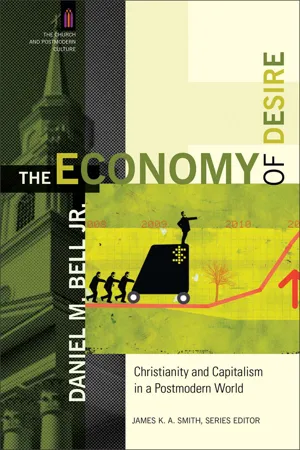
In this addition to the award-winning Church and Postmodern Culture series, respected theologian Daniel Bell compares and contrasts capitalism and Christianity, showing how Christianity provides resources for faithfully navigating the postmodern global economy.
Bell approaches capitalism and Christianity as alternative visions of humanity, God, and the good life. Considering faith and economics in terms of how desire is shaped, he casts the conflict as one between different disciplines of desire. He engages the work of two important postmodern philosophers, Deleuze and Foucault, to illuminate the nature of the postmodern world that the church currently inhabits. Bell then considers how the global economy deforms desire in a manner that distorts human relations with God and one another. In contrast, he presents Christianity and the tradition of the works of mercy as a way beyond capitalism and socialism, beyond philanthropy and welfare. Christianity heals desire, renewing human relations and enabling communion with God.
It is dark, except for the dim orange glow of the sodium-vapor street lamps reflected off pavement damp from the ubiquitous drizzle; the sun has not yet begun its climb over the horizon. The stillness of the early morning is broken by a solitary shape moving along the sidewalk. A few minutes later another shape appears, then another, and another. A few more minutes pass and a small cluster of nondescript shapes emerges from an alley and moves along the same sidewalk. They converge at the intersection. The same thing happens at another intersection and then another, all across the area. As the sun rises in sync with increasing din of the hustle and bustle of a busy modern metropolis, flows of people join these clusters, now no longer concealed by the darkness but still nondescript, anonymous, dressed in black, wearing goggles, scarves, and masks, some with their arms joined together by concrete and plastic tubing to form giant human chains. A swarm of young people join from the north, while from the south comes a multitude of people from third-world countries. They are joined by the young and old, rich and poor, by different nationalities and ethnicities. There are stages, speakers, singers. There are parades of steelworkers, environmentalists, anarchists, laborers, students, veterans, academics, carpenters, feminists, Native Americans, machinists, farmers, Protestants, Catholics, Muslims, and Jews. Among them are police, journalists, private security agents, television crews, politicians, diplomats, vigilantes, soldiers, bystanders and onlookers, imaginary ninjas armed with Molotov cocktails. Mingling too in this human potpourri are permanent residents of such urban environs—the homeless, panhandlers, local youths looking for a thrill, street venders hawking souvenirs of this event-in-the-making. The sound of drums rises above the dull roar of city life; then horns, trumpets, bullhorns, whistles, horses, rattles, diesel engines, guitars, shattered glass, cow bells, copper kettles, a band, a mobile rapper, and at least one conch shell add to the mix, as do the songs (“The Star-Spangled Banner,” “Jingle Bells,” “We Shall Overcome”), the chants and shouts (“What do we want? Less war,” “Don’t consume their TV,” “Go home,” “Die, die, die,” “This is a peaceful protest—do not retaliate,” “Disperse!” “Shame! Shame!” “Tonight we’re gonna f—k s—t up!” “No violence!” “Power to the people,” “This is what democracy looks like”), and the noise that accompanies tens of thousands jumbled together in the narrow valleys between glass skyscrapers that amplify the cacophony. Banners and signs and placards of all shapes and sizes and colors are unfurled and uncovered and hoisted in the air. They are festooned with vampires sinking their teeth into the globe, ghostlike men in suits, fish skeletons, butterflies, boot prints, flowers, doves, fists and chains. They proclaim “Sea Turtles and Teamsters: United at Last,” “Insurrection,” “Awaken,” “Don’t Trade on Me,” “¡Basta Ya!” “Trade with Cuba,” “Vegan Resistance,” “No Sweatshops,” “Free Tibet,” “Make Globalization Work for Working Families,” “Yeshua,” “Revolution,” “Drop the Debt,” “Chiapas,” “No Pollution,” “God Is Angry,” “Free Leonard Peltier,” “Dykes Revolt,” “Jesus Died for Your Sins,” “Raging Grannies,” “Support Hemp,” “No WTO.” Complementing them are the posters with similar slogans papering the walls and light posts along with colorful tags and graffiti declaring “no sweatshops,” or “WTO” with a line through it on windows, cars, and buildings. There are earth flags, flags with the anarchists’ symbol, upside down American flags, American flags with the stars replaced by corporate logos, rainbow flags, Canadian flags, plain black flags. In the midst of these, floating on the surface of this sea of humanity, are balloons, a giant earth beach ball, a banana, half a dozen coffins with “sovereignty” or “clean air” or “biodiversity” painted on their sides, enormous yellow or orange butterflies, at least one giant green condom that reads “WTO: Practice Safe Trade.” In the crowds are people with painted faces, devil masks, purple hair, clerical collars, Dr. Seuss hats, stilts and sheets, Groucho Marx glasses, or little at all, as topless women transform their torsos into poster boards for freedom or against bovine growth hormone or Nike. People are costumed as giant corn cobs, long-horned beetles, sea turtles, Santa Claus, wolves in business suits, small children dressed as yellow and red butterflies with enormous paper wings. A group of giant gagged heads floats by as does an enormous Grim Reaper. A masked and shirtless man runs while twirling a hula hoop around his waist. A hand puppet mimics the riot-gear-clad police. The trees lining the streets glimmer and sparkle festively with the colored lights of the Christmas season. People are dancing, arguing, fighting. A burlesque dancer gyrates in front of a line of the riot-gear-clad police. Someone else attempts to hand them flowers. A sea turtle with a bullhorn is locked in an intense conversation with a police officer also using a bullhorn standing a foot away.
Newspaper vending boxes are overturned; dumpsters are rolled into the streets. The concussion of rubber bullets, stun grenades, pepper spray, and tear gas canisters joins this city symphony. Batons swing through the air. Windows are broken, shops looted. A fire starts. Someone yells, “You are not burning anything recyclable are you?” A young father stands atop an overturned dumpster with his infant child strapped to his back as tear gas and smoke mingle around him. A young man on a skateboard wearing a gasmask scoots by, grinding on a curb. In the middle of the street, amid the clouds of pepper spray and tear gas, a woman kneels in prayer. And everything goes on as before: the drums and horns and bells and dancing and singing do not miss a beat. The banners, balloons, puppets, beach ball, and hula hoops continue with barely a pause.
What’s Going On?
Such was the scene for nearly a week in late November and early December of 1999 in the area around the Washington State Convention and Trade Center in Seattle, site of the third World Trade Organization ministerial conference. What was going on? Was it a riot? A rally? A carnival? A protest? A parade? Was this just the reactionary and rather pointless acting out of immature and self-centered malcontents? The mindless mischief and vandalism of loopy, doped-up, and unwashed new-agers? One more opportunity for all-purpose agitators, whom Thomas Friedman of the New York Times memorably called a “Noah’s ark of flat-earth advocates,” to push into the limelight for a few minutes of fame?
An onlooker in downtown Seattle observed that there were just too many opinions expressed on the streets during those days for there to be one clear message.[25] A Seattle headline declared simply that chaos had enveloped the downtown area.[26] Yet participants regularly suggested that whatever it was, it was the beginning of something new. The beginning of a new order, an upsurge of a dynamic power constituted by a network of alliances and affiliations that would lead to the formation of a more open and participatory world order, a democratic order where people (re)gained control of their own lives. The anarchists whose tactics included breaking the windows of select businesses couched it in terms of “breaking the spell” of corporate domination. Describing the freedom they sought, one says: “There is nothing in the world like running with a group of two hundred people, all wearing black, and realizing each of you is anonymous, each of you can liberate your desires, each of you can make a difference.”[27]
The sights and sounds on the streets of Seattle did not fit neatly in any ordinary social or political vocabulary. Indeed, it seemed to most closely resemble all of the things mentioned above, but not blended together into something that if spread across a canvas would display a consistent hue and texture. Rather, it was all these different things at the same time: a riot, rally, carnival, protest, and parade, as if each were a transparency laid atop the others, like one of those human body transparency books that so fascinate children. But when the pages of this transparency are stacked together they do not resemble anything, at least anything in the social-political lexicon of modernity.
The Multitude
“Multitude” is the name that the postmodern political theorists Michael Hardt and Antonio Negri give to the novel reality on display in Seattle.[28] By this they mean a newly emerging social subject composed of irreducibly different singularities that, notwithstanding their differences and without losing those differences in a kind of melting pot, come together in a common project. There is no unified vision or all-encompassing purpose that would make these singularities “one.” They retain their differences, a fact on display in many colors and words—some of them heated, as when, for example, some of the protestors attempted to prevent the destruction of property. Likewise, the common is not so much a shared goal or purpose as it is the process of all these expressive singularities collaborating, communicating, and creating relations. As the bystander cited above noted, there were too many opinions expressed to be reducible to a single shared axiom. Nevertheless, those diverse persons with an array of visions and voices were able to collaborate in drawing the attention of the WTO and the world. And Hardt and Negri agree with those who were chanting, “This is what democracy looks like.” Which is to say, the communicative, collaborative interaction of the diverse desires on display in Seattle is what they call “democracy.”
I begin this first chapter with the events in Seattle and the interpretation of those events offered by Hardt and Negri because they so adeptly mark the parameters of the first two chapters: economy, desire, and resistance. Moreover, they bring to the fore economy, desire, and resistance in a distinctly postmodern manner, highlighting how the Multitude defies the political forms of modernity, which were clearly definable by party, class, nationality, and ideology (like capitalism or socialism), as well as the moral forms of modernity, captured as they are in transcendent, unifying ideals and values, like “justice” and “rights.”[29] Indeed, it is not insignificant that “mindless chaos” is such a tempting label for that event, precisely because the expressiveness, the desire, on display there in manifold ways refused to be neatly contained in the grand ideals of modern political morality. “People power” is both real and difficult to get a handle on, much like the unfolding events in Seattle, as the police and politicians belatedly discovered. For different reasons and to different ends, the people who converged on Seattle, and not only on Seattle but at various similar meetings around the globe in the years that followed, discovered a common project of resisting the current form of the global economic order, and they did it not simply in the name of justice or for the sake of ending poverty but also for the sake of “liberating desire,” as the young anarchist put it, freeing desire by means of an in-the-process-of-being-discovered form of open and participatory politics.
Beginning with the events of Seattle viewed through the lens of Hardt and Negri is salutary as well, simply for the fact that Seattle puts faces, flesh, color, and sound to the political economy of desire articulated in very abstract language by Deleuze and Foucault. It is to their account of the postmodern political economy of desire that we now turn, beginning in this chapter with desire.
Who Are Deleuze and Foucault?
Before Michel Foucault died in 1984 and Gilles Deleuze in 1995, they were leading French philosophers who between them published hundreds of books and articles. More than this, they were political philosophers. This is to say they consciously did philosophy as part and parcel of a political struggle. At first glance, this may strike us as odd, insofar as what we know of the discipline of philosophy, with its focus on abstract questions like the nature of being and what is real and problems of logic, suggests it is the most apolitical, if not downright irrelevant of disciplines. Yet at the very core of Deleuze’s philosophy is the claim that “politics precedes being,”[30] which means that philosophy is always already political, from the very start of its deliberations. This is the case because every social or political order is built upon (perhaps unconscious or implicit) philosophical convictions, presuppositions about the nature of reality, about what is real, about what people are and how they relate to one another. And different philosophical visions result in the construction of different social, political, and economic orders. For instance, if one believes that matter is an illusion or a corruption of spirit, the body and the material world will be valued and treated differently than a social order erected on the presumption that this material realm is all there is and that matter has its own immanent power or force. Likewise, the philosophical presupposition that being is fundamentally peaceful will result in very different social and political orders than a philosophy that begins with the presupposition that being is fundamentally violent and conflictual. The importance of the recognition of philosophy as intrinsically political will become clearer as we proceed.
Not only were Deleuze and Foucault self-consciously political philosophers, but they were Marxists as well. Since it is commonplace in the West to think that with the pulling down of the Berlin Wall and the collapse of the Soviet Union Marxism has been unequivocally judged as utterly devoid of insight or usefulness, it is worth spending a moment to consider their relation to Marxism. To begin with, Marxism is not one unchanging thing. Rather, it is a tradition, and like any tradition, it contains within it different schools and strands of belief and practice. In this regard, it is not unlike Christianity. Christianity is a tradition that contains within its boundaries Catholics, Baptists, Methodists, and so forth. The same holds for Marxism. Moreover, again like Christianity, there are debates and disagreements within Marxism over just about everything.
Therefore, although many of us may indeed be convinced on both historical and theological grounds that Marxism is not a vision that holds out much promise for the future, that does not mean that all Marxists were (or are) without any insights that may be of use to Christians. Indeed, even as Marxism was dealt a harsh blow in the last decades of the last century, there were Marxists who foresaw that crisis and argued for changes within the Marxist tradition in the hope that it would make the most of the social, political, and economic transformations they saw occurring around the world. Deleuze and Foucault were two such Marxists. In the 1960s and 1970s, when the world economy was undergoing transformation into the globalized order that it is today, both Deleuze and Foucault challenged Marxists to rethink how the economic order both advances and how it might be overcome. Perceiving the bankruptcy of both social democracy and Soviet state socialism as forms of resistance to and liberation from the advancing global capitalist order, they began an effort to “think otherwise,” to explore new ways of conceiving human relations and revolutionary practice.[31] Central to this rethinking was Deleuze’s treatment of desire and capitalism and Foucault’s treatment of power, technologies of the self, and governmentality.
Together, their work sheds light on the postmodern economy of desire. Specifically, their work suggests that the contemporary global economic order is not merely economic. The global capitalist order is not only a matter of straightforwardly economic things like modes of production, the efficient manipulation of labor, and the creation of wealth—but rather is also ontological, which is to say that capitalism has to do with the very order of being, the arrangement of the basic stuff and power of reality. Capitalism’s global extension hinges on its successful capture and discipline of the constitutive human power that is desire. In other words, capitalism is not merely an economic order but also a discipline of desire.
The questions immediately before us are, what do Deleuze and Foucault mean by desire, and how does capitalism capture and shape it? We begin with Deleuze.
Beyond Statecraft: Micropolitics
The philosophical point of departure for Deleuze’s work is the claim that “politics precedes being.” This enigmatic statement was partially explained above by suggesting that philosophical reflection is always already endowed with political significance. Beyond recognizing that there is no such thing as political neutrality, even in a discipline as seemingly abstract and immaterial as philosophy can be, for Deleuze this statement functions as the foundation of his critique of the would-be revolutionaries of his day. It was tantamount to saying to them that if they wanted to resist capitalism, they would have to dig deeper into thought than they were accustomed to doing. Specifically, he was challenging them to move beyond the standard way of thinking about social and political change that was simply taken for granted. For those whom Deleuze was challenging, the standard way of thinking about revolution and social change involved what is called “statecraft” or “politics as statecraft.”
The modern vision of “politics as statecraft” was given its classic articulation by the famous late-nineteenth- and early-twentieth-century sociologist Max Weber, when he defined politics as “the leadership, or the influencing of the leadership, of a political association, hence ...
Table of contents
Cover
Series Page
Title Page
Copyright Page
Contents
Series Preface
Series Editor’s Foreword
Preface
Introduction
1 The Multitude
2 Capital Desire
3 What Is Wrong with Capitalism?
4 Capitalist Theology
5 Is Another Economy Possible?
6 The Economy of Salvation
7 Christian Economics
8 The Work of Mercy
Conclusion
Notes
Index
Back Cover
Trusted by 375,005 students
Access to over 1.5 million titles for a fair monthly price.
Study more efficiently using our study tools.
Frequently asked questions
Yes, you can cancel anytime from the Subscription tab in your account settings on the Perlego website. Your subscription will stay active until the end of your current billing period. Learn how to cancel your subscription
No, books cannot be downloaded as external files, such as PDFs, for use outside of Perlego. However, you can download books within the Perlego app for offline reading on mobile or tablet. Learn how to download books offline
Perlego offers two plans: Essential and Complete
Essential is ideal for learners and professionals who enjoy exploring a wide range of subjects. Access the Essential Library with 800,000+ trusted titles and best-sellers across business, personal growth, and the humanities. Includes unlimited reading time and Standard Read Aloud voice.
Complete: Perfect for advanced learners and researchers needing full, unrestricted access. Unlock 1.5M+ books across hundreds of subjects, including academic and specialized titles. The Complete Plan also includes advanced features like Premium Read Aloud and Research Assistant.
Both plans are available with monthly, semester, or annual billing cycles.
We are an online textbook subscription service, where you can get access to an entire online library for less than the price of a single book per month. With over 1.5 million books across 990+ topics, we’ve got you covered! Learn about our mission
Look out for the read-aloud symbol on your next book to see if you can listen to it. The read-aloud tool reads text aloud for you, highlighting the text as it is being read. You can pause it, speed it up and slow it down. Learn more about Read Aloud
Yes! You can use the Perlego app on both iOS and Android devices to read anytime, anywhere — even offline. Perfect for commutes or when you’re on the go. Please note we cannot support devices running on iOS 13 and Android 7 or earlier. Learn more about using the app
Yes, you can access The Economy of Desire (The Church and Postmodern Culture) by Daniel M. Bell, Smith, James K. A., James K. A. Smith in PDF and/or ePUB format, as well as other popular books in Theology & Religion & Christian Theology. We have over 1.5 million books available in our catalogue for you to explore.