Christians talk frequently about the Bible, yet they do not always have an informed and wide-ranging understanding of varied Christian views about its nature. Don Thorsen and Keith Reeves combine their biblical and theological knowledge to create such a unique introduction to the Bible.
This book not only provides an introduction to the interpretation of the Bible but also to the history and theological understanding behind it, equipping students to think critically about their own tradition's approach to Scripture. It is perfect as a supplemental textbook in both introductory biblical studies and theology courses, but it will also be of interest to adult education classes.
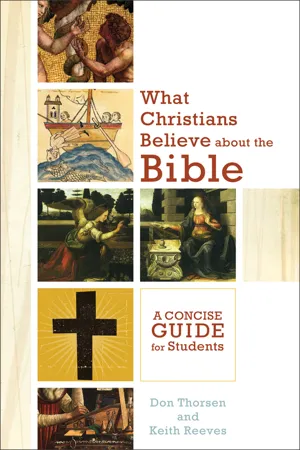
eBook - ePub
What Christians Believe about the Bible
A Concise Guide for Students
- 224 pages
- English
- ePUB (mobile friendly)
- Available on iOS & Android
eBook - ePub
About this book
Information
Topic
Theology & ReligionSubtopic
Biblical StudiesAppendix 1
Books of the Hebrew Bible
The Law
Genesis, Exodus, Leviticus, Numbers, Deuteronomy
The Prophets
Former Prophets: Joshua, Judges, Samuel (1 and 2), Kings (1 and 2)
Latter Prophets: Isaiah, Jeremiah, Ezekiel, and the Twelve (Hosea, Joel, Amos, Obadiah, Jonah, Micah, Nahum, Habakkuk, Zephaniah, Haggai, Zechariah, Malachi)
The Writings
Psalms, Proverbs, Job, Song of Solomon, Ruth, Lamentations, Ecclesiastes, Esther, Daniel, Ezra-Nehemiah, Chronicles (1 and 2)
Appendix 2
Books of the Protestant Old Testament
The Pentateuch
Genesis, Exodus, Leviticus, Numbers, Deuteronomy
The Historical Books
Joshua, Judges, Ruth, 1 Samuel, 2 Samuel, 1 Kings, 2 Kings, 1 Chronicles, 2 Chronicles, Ezra, Nehemiah, Esther
The Poetical and Wisdom Books
Job, Psalms, Proverbs, Ecclesiastes, Song of Solomon
The Prophetic Books
Isaiah, Jeremiah, Lamentations, Ezekiel, Daniel, Hosea, Joel, Amos, Obadiah, Jonah, Micah, Nahum, Habakkuk, Zephaniah, Haggai, Zechariah, Malachi
Appendix 3
Books of the Apocryphal/Deuterocanonical Writings
Books included by the Roman Catholic, Greek Orthodox, and Russian Orthodox Churches, and Protestant Apocrypha
Tobit, Judith, Additions to Esther, Wisdom of Solomon, Ecclesiasticus, Baruch, Additions to Daniel, 1 Maccabees, 2 Maccabees
Books included by the Greek Orthodox and Russian Orthodox Churches, Protestant Apocrypha, and Appendix of the Latin Vulgate
1 Esdras and the Prayer of Manasseh
Books included by the Greek and Russian Orthodox Churches
Psalm 151 and 3 Maccabees
Books included by the Greek and Russian Orthodox Churches and Protestant Apocrypha
3 Esdras
Appendix 4
Books of the New Testament
Gospels
Matthew, Mark, Luke, John
The Acts of the Apostles
The Letters of Paul
Romans, 1 Corinthians, 2 Corinthians, Galatians, Ephesians, Philippians, Colossians, 1 Thessalonians, 2 Thessalonians, 1 Timothy, 2 Timothy, Titus, Philemon
The General Letters
Hebrews, James, 1 Peter, 2 Peter, 1 John, 2 John, 3 John, Jude
Revelation
Notes
Chapter 1 We Are All Students of the Bible
[1]. In the King James Version, 2 Timothy 2:15 says, “rightly dividing the word of truth”—a common phrase among Christians, emphasizing the need for proper interpretation of the Bible.
Chapter 2 A Brief History of the Bible
[1]. See Eusebius Pamphillus, The Ecclesiastical History, trans. Christian F. Cruse (Grand Rapids: Guardian Press, 1976), 110.
[2]. James I. Packer, “Scripture,” in New Dictionary of Theology, ed. Sinclair B. Ferguson and David F. Wright (Downers Grove, IL: InterVarsity, 1988), 627–31.
Chapter 3 Genre
[1]. For example, see David R. Bauer and Robert A. Traina, Inductive Bible Study: A Comprehensive Guide to the Practice of Hermeneutics (Grand Rapids: Baker Academic, 2011); N. Clayton Croy, Prima Scriptura: An Introduction to New Testament Interpretation (Grand Rapids: Baker Academic, 2011); Gordon Fee and Douglas Stuart, How to Read the Bible for All Its Worth, 3rd ed. (Grand Rapids: Zondervan, 2003); see also the select bibliography at the end of this book.
[2]. Thucydides, History of the Peloponnesian War 1.22, trans. Rex Warner (Baltimore: Viking Penguin, 1980), 47.
[3]. Bruce M. Metzger, The New Testament: Its Background, Growth, and Content, 2nd ed. (Nashville: Abingdon, 1990), 177.
Chapter 4 Historical Context
[1]. Pliny the Younger, “Gaius Pliny to the Emperor Trajan” X.96, in Complete Letters, trans. P. G. Walsh, Oxford World’s Classics (Oxford: Oxford University Press, 2006), 278.
Chapter 5 Literary Context
[1]. Dictionary.com, “agape,” http://dictionary.reference.com/browse/agape, accessed July 27, 2011.
[2]. Joseph A. Fitzmyer, The Gospel according to Luke I–IX: Introduction, Translation, and Notes, The Anchor Bible 28 (New York: Doubleday, 1982), 15, 287–98.
Chapter 6 Religious Authority
[1]. One may say that such inconsistencies are due to sin rather than to a lack of intellectual consistency or other behavioral scientific explanations. Speaking as Christians, we certainly must consider the pervasiveness of sin when discussing any topic theologically. But our present focus is on the intellectual, rather than spiritual and moral, challenges to how the Bible is understood. We want to talk about how people think differently about the Bible, not speculate about why they differ.
[2]. Martin Luther, quoted by Roland Herbert Bainton, Here I Stand: A Life of Martin Luther, A Hendrickson Classic Biography (1950; repr., Peabody, MA: Hendrickson, 2009), 180.
[3]. The Declaration of Independence of the United States was written primarily by Thomas Jefferson and edited by Benjamin Franklin. It mentions a “Creator” and “Nature’s God,” but these probably refer more to a deistic conception of God than to a more biblical, historic Christian understanding. As such the Declaration of Independence relies more upon the Enlightenment authority of reason, for example, as found in its references to “self-evident” truths and “unalienable rights,” than to a traditional Christian understanding of God and religious authority. See the Declaration of Independence...
Table of contents
- Cover
- Title Page
- Copyright Page
- Dedication
- Contents
- Preface
- Acknowledgments
- Abbreviations
- Introduction
- Interpretation of the Bible
- Theology of the Bible
- Conclusion
- Appendix 1 Books of the Hebrew Bible
- Appendix 2 Books of the Protestant Old Testament
- Appendix 3 Books of the Apocryphal/Deuterocanonical Writings
- Appendix 4 Books of the New Testament
- Notes
- Select Bibliography
- Subject Index
- Scripture Index
- Back Cover
Trusted by 375,005 students
Access to over 1.5 million titles for a fair monthly price.
Study more efficiently using our study tools.
Frequently asked questions
Yes, you can cancel anytime from the Subscription tab in your account settings on the Perlego website. Your subscription will stay active until the end of your current billing period. Learn how to cancel your subscription
No, books cannot be downloaded as external files, such as PDFs, for use outside of Perlego. However, you can download books within the Perlego app for offline reading on mobile or tablet. Learn how to download books offline
Perlego offers two plans: Essential and Complete
- Essential is ideal for learners and professionals who enjoy exploring a wide range of subjects. Access the Essential Library with 800,000+ trusted titles and best-sellers across business, personal growth, and the humanities. Includes unlimited reading time and Standard Read Aloud voice.
- Complete: Perfect for advanced learners and researchers needing full, unrestricted access. Unlock 1.5M+ books across hundreds of subjects, including academic and specialized titles. The Complete Plan also includes advanced features like Premium Read Aloud and Research Assistant.
We are an online textbook subscription service, where you can get access to an entire online library for less than the price of a single book per month. With over 1.5 million books across 990+ topics, we’ve got you covered! Learn about our mission
Look out for the read-aloud symbol on your next book to see if you can listen to it. The read-aloud tool reads text aloud for you, highlighting the text as it is being read. You can pause it, speed it up and slow it down. Learn more about Read Aloud
Yes! You can use the Perlego app on both iOS and Android devices to read anytime, anywhere — even offline. Perfect for commutes or when you’re on the go.
Please note we cannot support devices running on iOS 13 and Android 7 or earlier. Learn more about using the app
Please note we cannot support devices running on iOS 13 and Android 7 or earlier. Learn more about using the app
Yes, you can access What Christians Believe about the Bible by Don Thorsen,Keith H. Reeves in PDF and/or ePUB format, as well as other popular books in Theology & Religion & Biblical Studies. We have over 1.5 million books available in our catalogue for you to explore.