In God the Father Almighty Erickson develops a sturdy exposition of the doctrine of God. He interacts with criticism brought against the traditional view of God and offers a fresh analysis of the attributes of God in light of Scripture and the contemporary scene.
God the Father Almighty is a companion volume to Erickson's other theological monographs (God in Three Persons and The Word Became Flesh).
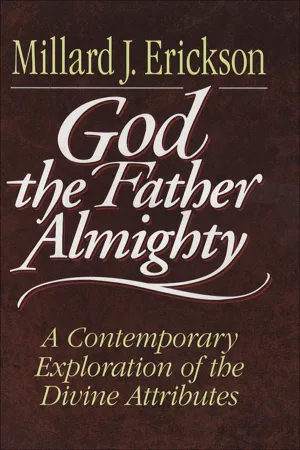
eBook - ePub
God the Father Almighty
A Contemporary Exploration of the Divine Attributes
- 304 pages
- English
- ePUB (mobile friendly)
- Available on iOS & Android
eBook - ePub
About this book
Information
Topic
Theology & ReligionSubtopic
Christian Theology
1
The Importance of the Doctrine of God Today
At the beginning of the twentieth century, the Scottish theologian James Orr pointed out that various doctrines have received special attention at different points in the history of the church.[1] In part, this was because different cultural, practical, and ecclesial influences made that particular doctrine of prime importance at that time. Thus, in the fourth and fifth centuries, the focus was successively on the Trinity, the person of Christ, and the integrity or sinfulness of human nature. In the eleventh and twelfth centuries, major attention was given to the doctrine of atonement, and in the sixteenth century, to the doctrines of the church and salvation. In the twentieth century, the doctrines of eschatology, revelation and Scripture, and the Holy Spirit have been especially prominent. And today the doctrine of God is of great importance. There are a number of reasons for this, some of which are not restricted to our time, but speak of the importance of the doctrine of God for the church at all times. Some, of course, have special pertinence to the time in which we live.
Foundational Character of the Doctrine of God
One of these considerations is the fact that the doctrine of God is, in many ways, the first and most basic element of Christian belief. In that respect Christianity shares much with other world religions, for what makes each of these a religion is its conception of God, the fact that it maintains that there is some superhuman or supernatural reality, in this case, a person. If one does not believe in a God, and in the case of Christianity, the Christian God, then the other topics of belief are generally not present either.
That the early Christians recognized this is seen by virtue of the place they gave to their understanding of God. The Apostles’ Creed, one of the most ancient Christian confessions of faith, begins with the statement, “I believe in God the Father Almighty, maker of heaven and earth.” This is the most basic of doctrines, without which the others crumble. It might, of course, be argued that the doctrine of revelation is more basic, since it supplies us with the authority and basis for our belief, and we draw all our other understandings from it. Yet even revelation assumes God, since it is the revelation of God and by God. Without God, there would be no revelation, no one to do the revealing.
This is what separates religious faith from all nonreligious views. It is the most basic issue of worldviews. This unites Christianity with a number of other religions, in some ways. On the other hand, it distinguishes it from naturalism and even materialism. It responds to the question, Is there anything other than this observable system of nature?
God the Framework for the Rest of Theology
The doctrine of God is also most basic, because it serves as the framework for the rest of theology. Indeed, the generic term “theology” means the study or the science of God. It is often defined in some fashion as “the study of the person and work of God and of his relationship to the creation.” This is a major factor in what is sometimes referred to as the organic character of theology.[2] The position taken on one doctrine greatly affects our conclusions about other doctrines as well. This effect can be seen by observing an organism, such as a human being. The functioning of one organ affects that of other organs. So, if one’s kidneys are not functioning properly, for example, the heart is eventually strained. In fact, different systems or aspects of the person are affected. That we are psychosomatic unities can be seen by observing what happens to our emotions when we are tired or ill. Parallels can even be seen in mechanical realms, where the correct functioning of the brake system of a car affects its steering efficiency, which is why antilock brakes were invented. In the Apollo 13 crisis, as one system failed or went awry, others were affected. Even in teams of humans, this interconnectedness is essential. If a football team’s offense has little success, the defense will eventually also lose its effectiveness as a result of being on the field too long.
This organic character of theology is particularly true of the doctrine of God, which serves as the starting point or presupposition for the Christian’s understanding of the other realities. It may be possible in some of the behavioral sciences to study humans independently of other creatures, or even, to some extent, of other persons. That cannot be the case in theology, however. It is not possible to define the human apart from God, for the basic and most important truth about human beings is that they have been made by God, in his own image and likeness. Any attempt to discuss humanity apart from this reference is not theology at all, but simply psychology or anthropology. Similarly, one cannot develop a theological understanding of the human predicament and what must be done to rectify it apart from consideration of God, for the most basic fact about humanity is that it is separated from and in rebellion against its Creator. All other human problems are secondary to this fact and, in a sense, derived from it. This is true of the church as well. If one attempts to develop a doctrine of the church apart from God as the reference point, what results is not theology, but sociology of religion or something similar. In short, one cannot have theology, even any of its parts, without first considering the nature of God and what he does. Thus, there is no such thing as changing the understanding of God without, sooner or later, also changing the doctrines of humanity, sin, and salvation. The extent of God’s holiness and justice affects the seriousness of the human situation, the radicalism of the solution needed, and even the type of mediator needed to resolve the problem.
This organicism of theology can be seen in the effect of a shift in the doctrine of God on the doctrine of salvation. One of the tendencies in recent years is to emphasize the passibility of God. God definitely has emotions, and is not unaffected by the plight of humans. He is frequently depicted, in fact, as suffering with them.
If this is so, however, then there are implications for both eschatology and salvation. For this means that it brings pain to God to know that there are persons who are lost, who will, in other words, be eternally separated from him. In some versions of this doctrine, these individuals are sent to hell, a place of endless and intense suffering and anguish. If this is the case, however, and if God knows their condition, does this not mean that God will, at the very least, be eternally grieving and perhaps even eternally suffer through his sympathetic identification with his creatures? But this would seem to make God an inferior or at least a less than supremely blissful being.
Those who have recognized this problem have struggled to give some answer. Richard Creel, for example, holds to a rather traditional view of impassibility, but contends that to fail to do so would lead one toward a view of God in which his suffering simply increases.[3] It is interesting to note that a theologian like Clark Pinnock, who holds that God is not impassible,[4] has also made some adjustments in his doctrine of salvation and personal eschatology. So, for example, he has argued for a “wider hope” on the basis of the idea of implicit faith, whereby, through God’s general revelation, a person without special revelation is able to exercise sufficient faith to be saved.[5] He also believes that the Bible teaches that there is an opportunity to hear and believe the gospel after death for those who have not heard it during their lifetimes.[6] Finally, he holds that those who do not accept the offer of salvation even after such opportunities will be annihilated, so that no one suffers everlastingly.[7] Is not some such expedient as these, or perhaps even universalism, a necessity in light of the understanding of passibility?
Influence of the Doctrine of God on the Practical Christian Life
The study of the doctrine of God is of great importance because the conclusions reached here greatly influence our understanding and practice of the Christian life. God is basic to our whole theology, and theology, held either consciously or implicitly, does eventually affect our behavior as Christians. Basic to the conduct of the Christian life is the question “Who is God?” or “What is God like?”
The way this happens is seen in J. B. Phillips’ little book, Your God Is Too Small. He shows how we form various pictures of the nature of God, based at least in part on taking only part of the biblical picture of God and amplifying it. One is God as the resident police officer, a severe, demanding God who delights in catching his people in violations of the law and finding them guilty.[8] Another picture, common in our time and in some ways the opposite of this view, is God as the heavenly grandfather. This God is permissive, indulgent, always willing to look the other way, to smile when human beings misbehave, not really being too strict a disciplinarian.
These conceptions of God, if understood and responded to consistently, produce different types of religious experience. These may not function on the conscious level, but they do affect our attitudes and actions. The person or the congregation who see God as the heavenly police officer will frequently be people whose Christian lives are characterized by fear and by judgment, directed both toward themselves and others. There may be a considerable legalism, of measuring spirituality by conformity to the teachings of Scripture, and even a tendency toward Phariseeism, of thinking of oneself as superior to others who do not follow these teachings as closely. On the other hand, a church or individual Christian who thinks of God on the model of the celestial grandfather may turn out to be rather casual about spirituality, and not too sensitive to sin since God does not hold it against us.
Currently there is considerable emphasis on Christian lifestyle. Indeed, there is more talk and concern about this than there is about specific Christian beliefs. “Don’t tell me what to believe, just show me how to live” would summarize this view for many. Yet attempting to deal with lifestyle issues, apart from doctrinal questions, will ultimately fail. There is both a general and a specific reason for this. The general reason is that attitudes and actions cannot be sustained indefinitely, apart from some underlying basis of belief. Part of human nature, part of the image of God in which we were created, is rationality, and what is true will eventually have its impact on how we feel and live. One characteristic of the present time is its irrationalism, its tendency to experience and to believe independently of factual considerations. Yet this cannot, in the long run, be maintained. For example, when a close loved one dies, denial of the reality of death is a common reaction, especially at a particular stage of the process. Eventually, however, this cannot be maintained, at least if the person is to remain sane (or in touch with reality, as is sometimes said). Indeed, the very concept of sanity suggests that society is built on the idea of some sort of objectivity of truth. Those who recognize these truths are sane; those who do not are insane. Sooner or later, the fact that the missing one never appears, cannot be communicated with, and so on, becomes overwhelming. Optimism about the progress of the person in his or her struggle with the disease that resulted in death cannot be maintained after one has been to the funeral. The practice of displaying the body (or the “remains,” as frequently referred to now) is intended to serve this purpose of bringing about acceptance of the reality of the person’s death. So our theology will sooner or later be affected by the facts we accept, and our lifestyle will have to be adjusted accordingly.
There is, however, a reverse flow as well. Our lifestyle can also affect our theology. The reason is that if we are committed to a given lifestyle and unwilling to alter that, then we will find a way to rationalize our theology so that it fits with how we want to live. I once served as interim pastor of an evangelical inner-city church. Just about four blocks from our church building was a church comprised of persons who practiced an “alternative lifestyle” with respect to sexual practice. One day as I drove past this church building, I thought about their beliefs and practices. With respect to the usual doctrines of the Christian faith, these people held an orthodox set of beliefs based on a conservative conception and interpretation of the Bible. Yet when one approaches the Bible with that sort of understanding, one finds that it speaks rather clearly in opposition to the type of sexual ethics these people considered acceptable for Christians. Only by contrived and convoluted interpretations would one be able to justify such practices by Scripture. I asked myself, “How can this be, that such interpretations would be accepted?” and realized the answer was probably that having determined that they were going to practice what they did, they had come to Scripture and rationalized that practice by what they found there. Rather than conforming their lifestyle to their theology, they had adjusted their theology to fit their lifestyle.
This effect on our lifestyle can be seen quite clearly with respect to our understanding of God’s knowledge and providence. Does God know everything? If not, is there any meaningful sense in which we can pray for him to guide us in our planning, choosing, and acting with respect to that future? Further, is God really able to control all that occurs, or are there limitations on what he can do? If so, perhaps it is possible for me or another human being actually to frustrate God and his purposes. To take this a step further, is the outcome of the struggle with evil assured? Will God definitely be victorious over evil, or is it possible that he will never gain victory over it? If so, my hope for the future and my own choice of values may be affected. And what about my freedom and consequent responsibility? To what extent am I really the sole determiner of my actions? These are questions that have a very definite bearing on my actions, and they stem directly from the beliefs I hold regarding God, his nature, and his actions.
This Doctrine an Intersection of Theology with Other Disciplines
Another major reason why the doctrine of God is important is also inherent in the nature of the doctrine, but is perhaps more acute in our present time than at some points in the past. It is because this doctrine forms a point of intersection of theology with some other disciplines.
Philosophy
The first is obviously philosophy. Traditionally, philosophy was concerned with God. Western philosophy, in the form of the Pre-Socratic Greek thinkers, began asking metaphysical questions, such as “What is ultimately real?” Sooner or later that way of questioning was bound to lead to the idea that there was a supreme being, or god, who had planned and created all that is. So, some sort of supernaturalism and even theism was a major answer given by philosophers. As such, this could be a challenge or alternative to the Christian biblical answer, a support for it, or a modifier of the tradition.
Eventually, however, the theistic tradition in philosophy began to fade. One major objection came from Immanuel Kant’s critical philosophy. Kant was concerned to understand the several varieties of cognitive experience, and wrote three massive Critiques, dealing respectively with the domains of epistemology or theoretical knowledge, ethics, and aesthetics. The first of these, The Critique of Pure Reason, had the greatest direct effect on Christian theology. Kant argued that all genuine knowledge must have two components. There must be the content, supplied entirely by sense perception, and there must be form or structure, supplied by the knowing mechanism of the person’s mind. Without both components, there cannot be genuine knowledge. “Percepts without concepts are blind, but concepts without percepts are empty” became the rallying cry of those who adopted this epistemology. If it were somehow possible to have sense perception without having the structuring effect of such categories as quantity and cause, for example, there would not be true knowledge, but simply a blur of confusion, as bits of sense data pour in.[9] Conversely, when we try to apply our concepts of causation, for example, to the ideas that go beyond our experience, we run into difficulty. This comes in the form of antinomies, or mutually possible alternatives. So for example, the ideas that the world has a point of beginning in time and that it has no beginning are equally plausible. This is similarly true of the ideas that there is freedom and that all things are caused.[10]
The impact of this approach to epistemology on theology or the philosophy of religion was obvious and severe. For these disciplines claim to deal with a transcendent object, God, lying beyond human experience. Consequently, although we may have ideas about such a purported object, these ideas can have no real content. The existence of God and his nonexistence are equally plausible. As a result, we can say nothing about him.
If, then, religion is not a matter of the pure or speculative reason, what is it? Here Kant suggested an alternative to the traditional position. There are two other domains of human experience besides the theoretical: the ethical and the aesthetic. Kant proposed that religion be understood as a question of the ethical.[11] Albrecht Ritschl picked up this idea and elaborated on it, contending that religion is a question of value-judgments rather than truth-judgments.[12] Friedrich Schleiermacher followed yet a different path, relating his understanding of religion to the third of Kant’s domains and making it a matter of feeling.[13]
This general hostility to metaphysics and with it to theology was accentuated in the twentieth century. Logical positivists were concerned not so much with the question of truth ...
Table of contents
- Cover
- Title Page
- Copyright Page
- Dedication
- Contents
- Preface
- Part 1: Introduction
- Part 2: Challenges to the Traditional Understanding of God
- Part 3: The Attributes of God
- Part 4: Conclusion
- Scripture Index
- Subject Index
- About the Author
- Other Books by Author
- Notes
Trusted by 375,005 students
Access to over 1.5 million titles for a fair monthly price.
Study more efficiently using our study tools.
Frequently asked questions
Yes, you can cancel anytime from the Subscription tab in your account settings on the Perlego website. Your subscription will stay active until the end of your current billing period. Learn how to cancel your subscription
No, books cannot be downloaded as external files, such as PDFs, for use outside of Perlego. However, you can download books within the Perlego app for offline reading on mobile or tablet. Learn how to download books offline
Perlego offers two plans: Essential and Complete
- Essential is ideal for learners and professionals who enjoy exploring a wide range of subjects. Access the Essential Library with 800,000+ trusted titles and best-sellers across business, personal growth, and the humanities. Includes unlimited reading time and Standard Read Aloud voice.
- Complete: Perfect for advanced learners and researchers needing full, unrestricted access. Unlock 1.5M+ books across hundreds of subjects, including academic and specialized titles. The Complete Plan also includes advanced features like Premium Read Aloud and Research Assistant.
We are an online textbook subscription service, where you can get access to an entire online library for less than the price of a single book per month. With over 1.5 million books across 990+ topics, we’ve got you covered! Learn about our mission
Look out for the read-aloud symbol on your next book to see if you can listen to it. The read-aloud tool reads text aloud for you, highlighting the text as it is being read. You can pause it, speed it up and slow it down. Learn more about Read Aloud
Yes! You can use the Perlego app on both iOS and Android devices to read anytime, anywhere — even offline. Perfect for commutes or when you’re on the go.
Please note we cannot support devices running on iOS 13 and Android 7 or earlier. Learn more about using the app
Please note we cannot support devices running on iOS 13 and Android 7 or earlier. Learn more about using the app
Yes, you can access God the Father Almighty by Millard J. Erickson in PDF and/or ePUB format, as well as other popular books in Theology & Religion & Christian Theology. We have over 1.5 million books available in our catalogue for you to explore.