In this addition to the well-received Paideia series, a respected senior New Testament scholar examines cultural context and theological meaning in Second Corinthians. Paideia commentaries explore how New Testament texts form Christian readers by
∙ attending to the ancient narrative and rhetorical strategies the text employs
∙ showing how the text shapes theological convictions and moral habits
∙ commenting on the final, canonical form of each New Testament book
∙ focusing on the cultural, literary, and theological settings of the text
∙ making judicious use of maps, photos, and sidebars in a reader-friendly format
Students, pastors, and other readers will appreciate the historical, literary, and theological insight offered in this practical commentary.
eBook - ePub
Second Corinthians (Paideia: Commentaries on the New Testament)
- 320 pages
- English
- ePUB (mobile friendly)
- Available on iOS & Android
eBook - ePub
Second Corinthians (Paideia: Commentaries on the New Testament)
About this book
Information
Topic
Theology & ReligionSubtopic
Biblical Commentary2 Corinthians 1:1–2
The Letter Opening

Introductory Matters
In Paul’s Hellenistic world, letters generally began with an identification of the sender, a designation of the recipient(s), and a stereotypical greeting. Identifying the writer and the recipient at the beginning of a letter was particularly useful when letters were written on scrolls. The first words to be read as the scroll was unrolled identified both the person who had written the letter and the person for whom it was intended. Paul follows the custom of his day, beginning not only 2 Corinthians in classic fashion but all of his other letters as well.
Ancient letter writers sometimes added further information to the names of the sender and/or the recipient. When added to the name of the sender, this additional information was roughly equivalent to the signature block in a modern letter. Such information, called “titling” or “entitlement” (intitulatio), identified the relationship between the sender and the recipient and established the basis of the authority of the writer (ēthos) vis-à-vis those to whom he or she was writing (on ēthos, see the sidebar “Rhetorical Argument”).
2 Corinthians 1:1–2 in the Rhetorical Flow
►The letter opening (1:1–2)
The senders of the letter (1:1a)
The recipients of the letter (1:1b)
The greetings (1:2)
In the event that canonical 2 Corinthians is a composite document and thus an artificial letter, the editor responsible for compiling the text avoided repetition and saved valuable space on the papyrus or codex by transcribing a single salutation. The chosen salutation identifies Paul as the author responsible for the content that follows and indicates that he has sent all of this material to the Christian community at Corinth. It does not necessarily follow that the salutations of the compiled texts were absolutely identical. The editor would have chosen a salutation that he considered appropriate, and in the case of 2 Corinthians, one similar to the salutation of 1 Corinthians.
Rhetorical Argument
Rhetoric, the art of persuasion, was well known in the ancient world. Rhetorical handbooks were written to help students of rhetoric. Works by Aristotle, Cicero, and Quintilian are among the most important of the surviving rhetorical manuals. These handbooks distinguish three kinds of rhetorical arguments, those from ēthos, pathos, and logos. An argument from ēthos is based on the authority of the speaker/writer vis-à-vis the addressee(s). The argument from pathos appeals to the addressee’s self-interest or emotions. The argument from logos is rational, consisting of many different techniques that are spelled out in the manuals.
Tracing the Train of Thought
The Senders of the Letter (1:1a)
1:1a. Paul identifies himself as an apostle of Christ Jesus through the will of God (1:1). In 1 Corinthians Paul wrote about the apostolate as the first of the Spirit’s gifts to the church (1 Cor. 12:28). He identified himself as an apostle to the Corinthians, if not to others (1 Cor. 9:2). He is an apostle (apostolos, derived from apostellein, “send”) to the Corinthians because he has been sent to preach the gospel to them. Paul is convinced that it is according to God’s will that he was sent to the Corinthians. His language also suggests that he was sent to the Corinthians as the emissary of Christ Jesus.
The salutations and opening thanksgivings of Paul’s Letters often anticipate some of the major themes of the correspondence. Second Corinthians is an apology for (i.e., defense of) and an extended disquisition on Paul’s ministry to the Corinthians, his apostolate. Paul places the matter squarely before the Corinthians by introducing himself to them as an apostle of Christ Jesus, designated for this task by the highest possible authority, God himself.
Our brother Timothy joins Paul in greeting the Corinthians. Timothy is associated with Paul in the salutations of Philemon and 1 Thessalonians as well as 2 Corinthians. Together with Paul and Silvanus, Timothy has proclaimed the gospel to the Corinthians (2 Cor. 1:19). Identified in 1 Cor. 4:17 as Paul’s beloved and faithful child, Timothy was sent to the Corinthians to remind them about how Paul had comported himself when he was among them. Since Silvanus is not named in the salutation of 2 Corinthians, it is likely that Silvanus was not with Paul when the letter was written.
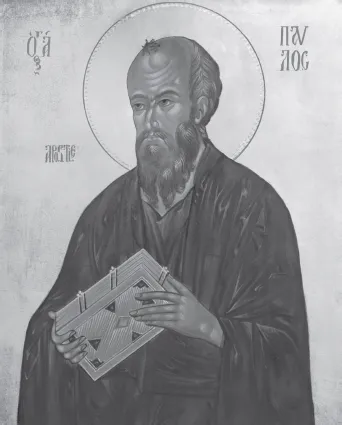
Figure 1. Icon of the Apostle Paul.
Kinship language plays an important role in the rhetoric of several of Paul’s Letters, especially 1 Corinthians, Galatians, 1 Thessalonians, and Philemon, but it plays a lesser role in 2 Corinthians—apart from 2 Cor. 8–9, where Paul takes up the matter of the collection on behalf of God’s holy people in Jerusalem. Fully half of the occurrences of sibling language in 2 Corinthians appear in the context of this appeal (2 Cor. 8:1, 18, 22, 23; 9:3, 5).
Most English-language translations identify Timothy as “our” brother, but the pronoun hēmōn (usually translated “our”) is not found in the Greek text (cf. 1 Cor. 1:1; 1 Thess. 1:1; Philem. 1). Paul is judicious in his use of pronouns. The absence of a pronoun in reference to Timothy suggests that Timothy is to be considered not only as brother to Paul but also as brother to the Corinthians.
Timothy as Coauthor
Second Corinthians can be described as what Jerome Murphy-O’Connor has called a “we-letter” (Murphy-O’Connor 1993). Paul’s use of the first-person plural, especially in the first eight chapters of the letter, indicates that it is essentially a joint letter sent by Paul and Timothy to the Corinthians. Timothy shared with Paul many of the experiences recounted in the letter. Timothy’s coresponsibility for the content and composition of the letter appears quite clearly in 1:13, where Paul begins to reflect on the fact that he is writing a letter and says, “We write.” Obviously only one voice could dictate the words to the scribe who worked at the transcription of the text. The voice was that of Paul, but the contents came from Paul and Timothy. Thus it seems appropriate to speak of Timothy as the coauthor of this letter, at least until 9:1, when Paul begins to speak in the first-person singular.
The Recipients of the Letter (1:1b)
1:1b. Using the same formula that he employed in the salutation o...
Table of contents
- Cover
- Series Page
- Title Page
- Copyright Page
- Dedication
- Contents
- List of Figures
- Foreword
- Preface
- Abbreviations
- Introduction
- 2 Corinthians 1:1–2 The Letter Opening
- 2 Corinthians 1:3–2:13 Part 1: Ministerial Crises
- 2 Corinthians 2:14–7:4 Part 2: Paul Explains and Defends His Apostolic Ministry
- 2 Corinthians 7:5–16 Part 3: The Arrival and Report of Titus
- 2 Corinthians 8:1–9:15 Part 4: Service to God’s Holy People
- 2 Corinthians 10:1–13:10 Part 5: An Aggressive Taskmaster
- Bibliography
- Index of Subjects
- Index of Modern Authors
- Index of Scripture and Ancient Sources
- Back Cover
Trusted by 375,005 students
Access to over 1.5 million titles for a fair monthly price.
Study more efficiently using our study tools.
Frequently asked questions
Yes, you can cancel anytime from the Subscription tab in your account settings on the Perlego website. Your subscription will stay active until the end of your current billing period. Learn how to cancel your subscription
No, books cannot be downloaded as external files, such as PDFs, for use outside of Perlego. However, you can download books within the Perlego app for offline reading on mobile or tablet. Learn how to download books offline
Perlego offers two plans: Essential and Complete
- Essential is ideal for learners and professionals who enjoy exploring a wide range of subjects. Access the Essential Library with 800,000+ trusted titles and best-sellers across business, personal growth, and the humanities. Includes unlimited reading time and Standard Read Aloud voice.
- Complete: Perfect for advanced learners and researchers needing full, unrestricted access. Unlock 1.5M+ books across hundreds of subjects, including academic and specialized titles. The Complete Plan also includes advanced features like Premium Read Aloud and Research Assistant.
We are an online textbook subscription service, where you can get access to an entire online library for less than the price of a single book per month. With over 1.5 million books across 990+ topics, we’ve got you covered! Learn about our mission
Look out for the read-aloud symbol on your next book to see if you can listen to it. The read-aloud tool reads text aloud for you, highlighting the text as it is being read. You can pause it, speed it up and slow it down. Learn more about Read Aloud
Yes! You can use the Perlego app on both iOS and Android devices to read anytime, anywhere — even offline. Perfect for commutes or when you’re on the go.
Please note we cannot support devices running on iOS 13 and Android 7 or earlier. Learn more about using the app
Please note we cannot support devices running on iOS 13 and Android 7 or earlier. Learn more about using the app
Yes, you can access Second Corinthians (Paideia: Commentaries on the New Testament) by Raymond F. Collins, Parsons, Mikeal C., Talbert, Charles, Mikeal C. Parsons,Charles Talbert in PDF and/or ePUB format, as well as other popular books in Theology & Religion & Biblical Commentary. We have over 1.5 million books available in our catalogue for you to explore.