This is a collection of pivotal essays by E. A. Judge, who initiated many important discussions in the establishment of social scientific criticism of the Bible.
What is it that made the work of Judge in 1960 and in subsequent years so important? Judge was the first in scholarship after the mid-twentieth century to clarify early Christian ideals about society by defining what the social institutions of the broader cultural context were and how they influenced the social institutions of the early Christian communities. Judge points out that earlier scholars had entered into this field of inquiry, but that, in general, they failed due to the lack of careful definitions of the Greco-Roman social institutions at the time based on a thorough use of the primary sources.
Thus, Judge was the "new founder" ( a turning point in scholarship) of what came to be called social-scientific criticism of the New Testament. Social-scientific criticism is the term in scholarship that refers to the use of social realities (e.g. institutions, class, factors of community organization) in the critical study of literary sources available (this is an advance over "merely" literary and traditional historical questions).
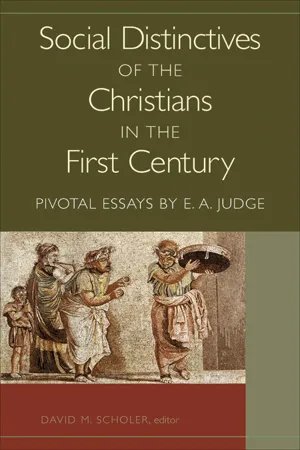
eBook - ePub
Social Distinctives of the Christians in the First Century
Pivotal Essays by E. A. Judge
- 248 pages
- English
- ePUB (mobile friendly)
- Available on iOS & Android
eBook - ePub
Social Distinctives of the Christians in the First Century
Pivotal Essays by E. A. Judge
About this book
Information
Topic
Theology & ReligionSubtopic
Biblical Studies1
The Social Pattern of the Christian Groups in the First Century
PREFACE
THIS ESSAY OFFERS a new approach to a familiar topic. It is an attempt to clarify certain early Christian ideas about society by defining the particular social institutions that are presupposed, and showing how the behaviour of the Christians was related to them. At first it was thought that an analysis of the social stratification of the Christian groups would suffice, but on investigation the conception of society as a series of strata seemed increasingly anachronistic. Instead it became apparent that the contemporary writers were thinking in terms of a series of overlapping but not systematically related circles. The description of these circles occupies the main body of the essay.
For a topic of this kind the primary material is mostly well known, and the interpretation of many of the points is under constant discussion. The present study however is not pieced together from modern works. Many of these are referred to where they are relevant, for comparison or elaboration, so that the footnotes constitute a partial bibliography of recent work on some aspects of the subject. Inevitably in a field where so much is common ground, ideas that are in fact adopted tend to be thought one’s own. It would be hard to trace the debt, and in the present case the means are not to hand. But it must be emphasized that whether or not any details here presented as new have been anticipated elsewhere, the study may claim a substantial originality in the design and formulation of the whole. The pattern emerged from an examination of the primary sources which began, as stated above, along somewhat different lines; it must be judged therefore on its correspondence with the documents, and to this end full internal references have been provided.
In origin this is a by-product of studies undertaken through the generosity of the Trustees of the late Sir James Knott at King’s College, Newcastle upon Tyne, in the University of Durham. It is indebted generally to teachers in New Zealand and at Cambridge, and in its present form to discussions with the many enthusiastic students of ancient history in the University of Sydney.
The essay is based on the 1957 Tyndale New Testament Lecture, and was awarded the 1958 Hulsean Prize by the University of Cambridge. In the original publication it was subtitled, “Some Prolegomena to the Study of New Testament Ideas of Social Obligation.” It appeared in German translation (with a new introduction) as Christliche Gruppen in nichtchristlicher Gesellschaft: Die Sozialstruktur christlicher Gruppen im ersten Jahrhundert (Wuppertal, 1964). The first section, “Interpreting New Testament Ideas,” was reproduced in B. S. Rosner, ed., Understanding Paul’s Ethics: Twentieth-Century Approaches (Grand Rapids: Eerdmans, 1995), 75–84.
I. INTERPRETING NEW TESTAMENT IDEAS
A generation ago the attempt to discover the principles of social obligation held by the early Christians was still common. Since then interest has largely petered out. This need not necessarily mean that there were no such principles to be found; it may simply have been that the enquiry itself was misdirected. It is the object of this study to support a revival of the issue by opening up some new lines of interpretation.
Earlier writers, failing to define adequately the social institutions assumed in the New Testament, often formulated the problems in anachronistic terms. Indeed one is still confronted with discussions of ‘Church’ and ‘State’ in the New Testament,[1] or with tirades against slavery and the enormities of Imperial Rome.[2] We are still the victims of Tacitean cynicism, it seems. But the New Testament writers would have found much of this puzzling. They were not thinking in such terms. Modern students have thus created for themselves the problems of New Testament acquiescence and inconsistency, through neglecting to identify the situation to which the New Testament writings were actually addressed. This lack will perhaps justify an ancient historian’s trespassing on New Testament ground. For while the religious background to the New Testament has been thoroughly searched, the political and social material summed up here does not seem to be familiar enough to students of theology.[3] Ancient historians, too, it is hoped, will not find the reassessment useless.
Although interest in the social ideas of the New Testament writers has waned, the new appreciation of their eschatological views will inevitably reopen the question. We already have new treatments of their idea of history,[4] but more needs to be done in applying the recovered eschatology to government and society.[5] Obviously if the New Testament groups saw themselves standing at the climax of the ages, and anticipated an imminent end, this must have profoundly affected their view of their obligation to society. The old search has thus been unexpectedly provided with a new and revolutionary starting-point. There still remains however the lack of definition that partly stultified earlier efforts.
It may be asserted that ideas are never satisfactorily explained merely by discovering their philosophical connections. They must be pinned down in relation to the particular circumstances in which they were expressed. The meaning is fixed at this point, and cannot be certainly ascertained until it is identified. This view has presumably been axiomatic in earlier New Testament criticism, but it seems to be implicitly called in question by certain modern methods of interpretation. Demythologizing may result in looking for the meaning not primarily in terms of the situation in which the ideas were originally expressed, but in the existential realization of the truth concerned.[6] The eliciting of patterns of symbolism may also lead to a neglect of the historical situation.[7] However illuminating these approaches may seem to be, they are misleading if they attract attention away from the original situation. At the very least this ought to be properly explored before it is abandoned in favour of other modes of interpreting the meaning.
In accepting this as its method, however, New Testament criticism encounters a notorious difficulty. While Christianity originated in Galilee, it flourished in the great cosmopolitan cities of the eastern Mediterranean. The New Testament is itself the product of this shift. Its writers are mainly Jews of Palestinian associations; their readers the Greek-speaking members of Hellenistic communities. It interprets the religious significance of certain events in Judaea to a public unfamiliar with that situation. It applies ideas derived from it to their own situation.
This tension between Hebraic origins and Hellenic application can be resolved in strikingly different ways. The tendency in recent years has been to stress the Hebraic as primary, and to regard the Hellenic as incidental.[8] But the material is also being reassembled for a detailed review of the Hellenic affinities of early Christianity.[9] The greatest progress towards a balanced appraisal of this duality has been in lexicography.[10] Here the most painstaking classification of word usage in the New Testament and related literatures has demonstrated what ought in any case to be obvious, that the meaning of a word is not ultimately determined by antecedent, parallel, or derived instances, but by its situation in its own context. A word means whatever its writer meant it to mean.
In the interpretation of the ideas the same standard should be applied. They must not be treated simply as stages in a system of thought. The New Testament is not an orderly statement of dogma, but a heterogeneous collection of writings addressed to various occasions. While the affiliation of the ideas will generally govern their content, there will normally be a particular construction to be placed on them in relation to the particular situation. Neglect of this may result in imprecision or even error.
Thus the present study concentrates not on the writers, but on the readers. We must know who they were and what they thought if we are to understand completely what was being said to them. The teaching of Jesus is therefore not the starting-point. We do not possess the teaching of Jesus, tout court. We possess the teaching of Jesus, an itinerant Aramaic preacher, as collated and formulated in Greek for the information of religious societies in Hellenistic cities. If it is to be understood properly, it must be understood from their point of view. The only meaning that can be certainly recovered from the Gospels in their present form is the meaning they were intended to convey to their original readers. We must therefore begin with the readers, and explain their social situation as it is shown in the Acts and Epistles. It was very different from that of Jesus, which may now be summed up in order to clear the ground for this central enquiry.
The region to which Jesus belonged was notoriously backward by the standards of contemporary civilization. Its population was economically rural, and resident in villages or small towns. Jesus himself thought in terms of this circumscribed manner of life—witness the parables. His followers, if not he himself, were thoroughly out of sympathy with the sophisticated classes of the cities. Financial, legal, and religious professionals (the publicans, scribes, and Pharisees) were mistrusted by them, and retorted with open contempt. It was the same with intellectuals (the Sadducees) and the administration (the rulers and chief priests).
The form of government the disciples most readily understood was monarchy. The sayings of Jesus make this plain. The social distinctions involved are accepted. ‘Behold, they which are gorgeously apparelled, and live delicately, are in kings’ courts’ (Luke 7:25). International affairs can still be talked of in terms of rival kingdoms. ‘What king, going to make war against another king, sitteth not down first, and consulteth whether he be able with ten thousand to meet him that cometh against him with twenty thousand? Or else, while the other is yet a great way off, he sendeth an ambassage, and desireth conditions of peace’ (Luke 14:31, 32). Royal methods of internal administration are sufficiently familiar to be used in depicting the character of the kingdom of God. A nobleman ‘went into a far country to receive for himself a kingdom, and to return’ (cf. the dependence of the Herods on Roman approval for legitimacy). He was hated by his subjects, and took reprisals on them for their insubordination, selecting governors of tested loyalty for the administration of groups of cities (Luke 19:11–27).
Now the evangelist himself shows by his careful dating (Luke 3:1) that the old royal government of Judaea was in commission at the beginning of the ministry of Jesus, though the Galilaean tetrarch still lived in sufficient state to impress the popular mind and keep tongues wagging (Mark 6:21–28). The disciples of course belonged to this principality, but their political interests ran beyond it. Their thinking was still dominated by the idea of a national monarchy established in Judaea proper, which had now been administered for a generation by the priestly authorities under Roman supervision. One of the things that appealed to them most about Jesus was that he promised the inauguration of a new kingdom which looked like fulfilling their wildest dreams. ‘I appoint unto you a kingdom, as my Father hath appointed unto me; that ye may eat and drink at my table in my kingdom, and sit on thrones judging the twelve tribes of Israel’ (Luke 22:29, 30). They clung persistently to their ambition. ‘Lord, wilt thou at this time restore again the kingdom to Israel?’ (Acts 1:6). They thought of themselves then in nationalistic terms, and the rest of the world was similarly lumped together as ‘the nations’.
The eschatological fervour that motivated the disciples was of course not unparalleled among the non-Hellenized Palestinians of the day, as the discovery of the Qumran community has emphasized.[11] A similar mood of expectation governed most of the early Christian groups. But while the fundamental conviction that the end is being realized is common to all three cases, its expression took remarkably different forms. The covenanters of Qumran, withdrawn and fastidious, must have abhorred the vulgarity and opportunism of the disciples. But a narrow provincial outlook distinguishes both of them from the first Christian societies. The peculiar orientation of Palestinian political thought (‘councils’, ‘synagogues’, ‘rulers’, ‘kings’, ‘nations’, Mark 13:9, 10) was thoroughly alien to the Hellenized peoples of the rest of the eastern Mediterranean.
Even the original Christian group at Jerusalem, though certainly not typical of early Christianity, is to be sharply marked off from other Palestinian religious movements. As will be shown later (section V), it was drawn from a population with broad international links, imposing social conditions on it that were very different from those governing either the Galilaean peasantry or the secluded community in the Dead Sea hills. Qumran is only a few miles away from Jerusalem as the crow flies, but from a social point of view its inhabitants lived in another world. Much the same could be said of Galilee.
Nevertheless Jerusalem must also be distinguished from the Hellenistic cities abroad. Sophisticated and cosmopolitan though its population was, it remained Jewish in faith and was administered under peculiar local arrangements.[12] Apart from the Jerusalem group, however, the Christians known from the New Testament were practically all drawn from communities living under civil institutions of the republican kind. The thirty or more places from Caesarea to Rome for which such groups are specifically attested are all republican. Moreover since they are widely distributed across areas where this was regarded as the normal constitution of society, such other groups as are implied for these parts by a number of general references in the Acts and Epistles may safely be placed in the same category. Other forms of public organization were only retained in backward areas where penetration by Christianity is likely for that very reason to have been delayed.
The only clear exceptions to this occur in certain parts of Palestine itself where, as in Jerusalem, republican institutions had not yet been introduced. For Judaea proper neither the topographical references nor the evidences for Christianity are very explicit. The early apostolic activities attracted ‘a multitude out of the cities round about unto Jerusalem’ (Acts 5:16), and refugees were later ‘scattered abroad throughout the regions of Judaea and Samaria’ (Acts 8:1). It is not at all certain what places are meant,[13] and in the first instance it cannot be asserted that they became Christians, nor in the second that they remained in these parts. General references, such as that to Judaea in Acts 9:31, need imply no more than Jerusalem itself. We do know however that the coastal towns were visited by Christian preachers (e.g. Acts 8:40), and there were certainly Christians at Lydda and Joppa (Acts 9:32, 36), which did not enjoy republican constitutions at this period.[14] The Christians in Galilee and Samaria (Acts 9:31) could have been members of the republics of Tiberias and Sebaste respectively, but in so far as they were the former adherents of Jesus this is unlikely. Although he frequented the region around the sea of Tiberias, it is not recorded that he visited the city itself. Its peculiarly heterogeneous population (Josephus, Ant. 18.2.3) was perhaps uncongenial. Sebaste may have been the place where Philip preached (Acts 8:5), but the text is uncertain,[15] and the rest of the terminology (Acts 8:9, 25) does not support the idea. Both cities in any case controlled only small territories.[16] The Galilaean and Samaritan Christians may therefore safely be left in the non-republican category.
But the situation that was to become characteristic is already found in the case of Caesarea, which appears in the Acts as the most important Palestinian centre of Christianity after Jerusalem. It is not surprising that the first conversion of a non-Jew, an event to which the writer pays great attention, should take place here. Caesarea was a republic, and the seat of the Roman administration. Cornelius himself was an officer of the occupation forces (Acts 10:1). Even earlier than this (Acts 11:19) the new cult had spread northwards up the Phoenician coast, and a series of seaport republics each had its group of Christians, Ptolemais (Acts 21:7), Tyre (Acts 21:3, 4), and Sidon (Acts 27:3). They were drawn however from the Jewish population (Acts 11:19); it was not till the Syrian metropolis of Antioch was reached that there was a mass conversion of non-Jews sufficient to excite the alarm of the original group in Jerusalem (Acts 11:20–22), and the curiosity of the local public (Acts 11:26). Success in Antioch established Christianity socially on a new footing. From here the lines of communication run westwards to the other great cities of the Mediterranean. ‘Syrus in Tiberim defluxit Orontes’ (Juvenal, Sat. 3.62). What is heard today on the Orontes, is repeated tomorrow on the Tiber.
Thus once the sect is established beyond the homeland of its parent religion, at least within the Roman area, which is as far as our records go, it belongs inevitably, as a social phenomenon, to the Hellenistic republics. Its thinking and behaviour naturally reflect the social institutions of these states. In political terminology it is not now so much a matter of rulers, kings, and nations, as of republics, assemblies, and magistrates.
The word polis is of course regularly used in the New Testament as a general term for a town or city. That this is sometimes inconsistent with its republican connotation reflects the fact that parts of the New Testament, as already pointed out, deal with an area that was peculiar, in that its population was not yet incorporated on a republican basis. It only emphasizes the extent to which republican government was taken for granted in the Hellenistic area, that when writing in Greek the standard terms should have been applied indiscriminately. Where the Hellenistic cities proper are referred to, the technical sense is naturally apparent in constitutional connections (e.g. Acts 13:50; 16:12, 20; 19:35; 21:39; 26:11; Rom 16:23; Tit 1:5). It will be noticed that the one blanket term covers Roman colonies, too; the distinction did not affect their basically republican character. Contrary to what has usually been thought, the word demos is not used except in its technical sense of the assembly of a citizen body (cf. Acts 12:22 [at Caesarea, as is stated in Josephus 19.8.2], 17:5; 19:30, 33). The various magistrates referred to[17] need not be enumerated here; the terminology reflects the variety of local traditions; but it ought not to obscure the fact that the communities concerned had long been assimilated to a broadly uniform pattern of society.
How narrow a backwater, on the other hand, Galilee and the other unincorporated regions were may be seen from the fact that even the itinerary of Jesus frequently took him into the territories of neighbouring republican centres. But it is obviously in the Aramaic-speaking rural communities dependent on them, and not in the Hellenized urban centres themselves, that his interests lie. He passes through ‘the coasts (namely, territory) of Tyre and Sidon’, and ‘the midst of the coasts of Decapolis’ (Mark 7:31). He visits ‘the towns (namely, villages) of Caesarea Philippi’ (Mark 8:27). To these villagers republicanism was presumably as foreign as it was to Jesus himself. They were after all the subjects of the republic, not its citizens.
This distinction is also implied in the Gospels. Jesus performed a sensational exorcism across the sea of Tiberias, in ‘the country (namely, the region of administration) of the Gadarenes’ (Mark 5:1). The variant reading ‘Gerasenes’ is geographically improbable, but does not affect the present point in any case: both communities were constituted as republics, and grouped together with a number of others as the Decapolis (Mark 5:20). The exorcist was not welcomed for his feat. ‘The whole city came out to meet Jesus: and when they saw him, they besought him that he would depart out of their coasts’ (Matt 8:34). The reaction was mutual. To the plea of a woman who was ‘a Greek, a Syrophenician by nation’ (namely, a member of the Hellenized citizen class of one of the Phoenician republics, Tyre or Sidon), the retort was ‘it is not meet to take the children’s bread, and to cast it unto the dogs’ (Mark 7:27).
Thus though the non-republican area was geographically very limited, emotionally the gulf between it and the civilized world was profound. The real division was of course cultural. When a communi...
Table of contents
- Cover
- Title Page
- Copyright Page
- Table of Contents
- Permissions
- Abbreviations
- Introduction, by David M. Scholer
- 1. The Social Pattern of the Christian Groups in the First Century
- 2. Paul’s Boasting in Relation to Contemporary Professional Practice
- 3. St Paul and Classical Society
- 4. St Paul as a Radical Critic of Society
- 5. The Social Identity of the First Christians: A Question of Method in Religious History
- 6. Rank and Status in the World of the Caesars and St Paul
- 7. Cultural Conformity and Innovation in Paul: Some Clues from Contemporary Documents
- 8. The Teacher as Moral Exemplar in Paul and in the Inscriptions of Ephesus
- A Comprehensive Bibliography of the Publications of Edwin A. Judge
- Index of Modern Authors
- Index of Subjects
- Index of Ancient Sources
- Notes
Trusted by 375,005 students
Access to over 1.5 million titles for a fair monthly price.
Study more efficiently using our study tools.
Frequently asked questions
Yes, you can cancel anytime from the Subscription tab in your account settings on the Perlego website. Your subscription will stay active until the end of your current billing period. Learn how to cancel your subscription
No, books cannot be downloaded as external files, such as PDFs, for use outside of Perlego. However, you can download books within the Perlego app for offline reading on mobile or tablet. Learn how to download books offline
Perlego offers two plans: Essential and Complete
- Essential is ideal for learners and professionals who enjoy exploring a wide range of subjects. Access the Essential Library with 800,000+ trusted titles and best-sellers across business, personal growth, and the humanities. Includes unlimited reading time and Standard Read Aloud voice.
- Complete: Perfect for advanced learners and researchers needing full, unrestricted access. Unlock 1.5M+ books across hundreds of subjects, including academic and specialized titles. The Complete Plan also includes advanced features like Premium Read Aloud and Research Assistant.
We are an online textbook subscription service, where you can get access to an entire online library for less than the price of a single book per month. With over 1.5 million books across 990+ topics, we’ve got you covered! Learn about our mission
Look out for the read-aloud symbol on your next book to see if you can listen to it. The read-aloud tool reads text aloud for you, highlighting the text as it is being read. You can pause it, speed it up and slow it down. Learn more about Read Aloud
Yes! You can use the Perlego app on both iOS and Android devices to read anytime, anywhere — even offline. Perfect for commutes or when you’re on the go.
Please note we cannot support devices running on iOS 13 and Android 7 or earlier. Learn more about using the app
Please note we cannot support devices running on iOS 13 and Android 7 or earlier. Learn more about using the app
Yes, you can access Social Distinctives of the Christians in the First Century by Edwin A. Judge, David M. Scholer in PDF and/or ePUB format, as well as other popular books in Theology & Religion & Biblical Studies. We have over 1.5 million books available in our catalogue for you to explore.