John Calvin has been the subject of numerous studies, but most have focused on one aspect of his thought or a limited selection of his writings. This study of Calvin adopts a uniquely holistic approach.
Randall Zachman begins with a brief biography and considers Calvin's own understanding of his ministry as a teacher and pastor. From this perspective, he surveys Calvin's writings and their place in the work of reforming the church--both through the training of clergy and the instruction of the laity. Zachman then considers Calvin as a theologian. In contrast to Martin Luther, Calvin sought to balance the verbal proclamation of the Word with an emphasis on the visible manifestation of God--both in creation and in Christ.
This study will be of great interest to Reformed clergy and to students of the Reformation and Calvinism.
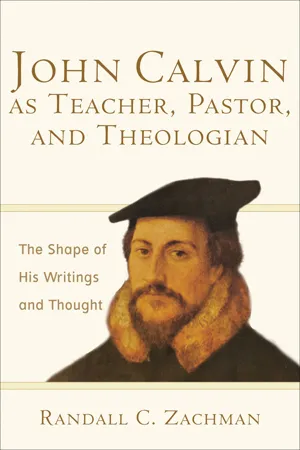
eBook - ePub
John Calvin as Teacher, Pastor, and Theologian
The Shape of His Writings and Thought
- 278 pages
- English
- ePUB (mobile friendly)
- Available on iOS & Android
eBook - ePub
John Calvin as Teacher, Pastor, and Theologian
The Shape of His Writings and Thought
About this book
Information
Topic
Theologie & ReligionSubtopic
Christliche KonfessionenPART 1
CALVIN AS TEACHER AND PASTOR
John Calvin lived during a time when many Christians, both Roman and evangelical, recognized that the ministry of the church was in crisis. It is difficult for us to imagine what the training of ministers must have been like before seminaries were created precisely to address the lack of adequate ministerial formation during this period. John Calvin was well aware of the dire consequences of this lack of ministerial formation. According to Calvin, neither bishops nor priests were skilled in the interpretation of Scripture or particularly adept at teaching the summary of the doctrine that leads to genuine piety. “Those who were regarded as the leaders of faith neither understood thy Word, nor greatly cared for it. They drove unhappy people to and fro with strange doctrines, and deluded them with I know not what follies.”[1] Due to the neglect of Scripture and its teaching by the leaders of the church, Calvin thought that the ordinary people in the church were liable to believe anything that their pastors told them, leading to the superstitious worship of God. “Among the people themselves, the highest veneration paid to thy Word was to revere it at a distance, as a thing inaccessible, and abstain from all investigation of it. Owing to this supine state of the pastors, and this stupidity of the people, every place was filled with pernicious errors, falsehoods, and superstition.”[2] The neglect of Scripture was compounded by the lack of adequate catechesis for ordinary Christians. “Then, the rudiments in which I had been instructed were of a kind which could neither properly train me for the legitimate worship of thy Deity, nor train me aright for the duties of the Christian life.”[3] Ordinary Christians were turned away from Scripture to human-made images, statues, and pictures in the churches, which were understood to be the “books of the unlearned.” Thus, the neglect of Scripture by the ministers of the church led directly to the superstitious adoration of images, and the confinement of God to those images.
From the time of his “sudden conversion to teachableness” between 1532 and 1535, Calvin dedicated all of his efforts to addressing the neglect of the summary of godly doctrine and the interpretation of Scripture by both the pastors and the ordinary people in the church. The astonishing literary production of Calvin between 1535 and 1564 bears witness to the tremendous energy and dedication he gave to this effort. During this time he produced five different editions of the Institutes, as well as commentaries on the entire New Testament, with the exception of 2 and 3 John and Revelation, the “five books of Moses,” Joshua, the entire Psalter, and all of the prophets except for Ezek. 21–48. He also produced three editions of his Catechism, and preached sermons through entire books of Scripture, including Genesis, Deuteronomy, 1 and 2 Samuel, Job, Galatians, and Ephesians, to name but a few. Calvin dedicated all of these efforts to the restoration of the sum of godly doctrine and the proper interpretation of Scripture to the future pastors of the church, so that they might teach the rudiments of the faith and apply the genuine meaning of Scripture to their congregations.
The work of Calvin scholars over the past decades has drawn attention to the full scope of Calvin’s contribution to restoring the ministry of the church. For years, the interpretation of Calvin had been dominated by considerations of the doctrine taught by Calvin in the final edition of the Institutes. Ever since T. H. L. Parker called our attention to the importance of the commentaries of Calvin, however, a number of scholars, among them David Steinmetz and his students, have provided detailed analyses of Calvin’s work as a biblical interpreter, in light of his predecessors and contemporaries. The further work done on the sermons of Calvin in the Supplementa Calviniana has greatly enhanced our understanding of Calvin as a preacher, again first highlighted by T. H. L. Parker in his book The Oracles of God and developed more fully by the work of Richard Stauffer, Wilhelmus Moehn, and Max Engammare.[4] Our understanding of Calvin’s work as a pastor has been further clarified by the research of Robert Kingdon and his students on the Consistory records of Geneva during Calvin’s time in that city.[5] Building on the work of these scholars, this book argues that all of these efforts are best understood in light of Calvin’s attempt to revive the ministry of the church by restoring the summary of pious doctrine and the genuine interpretation of Scripture to pastors and their congregations.
Calvin understood himself to be called to two distinct offices: the office of teacher, and the office of pastor. The teacher has as his audience future pastors of the church, not only in Geneva but also throughout Christendom, as well as educated and theologically interested laity, especially magistrates. The office of teacher entails both the teaching of the summary of the doctrine of piety, as in Melanchthon’s Loci or Calvin’s Institutes, and the exposition of Scripture in commentaries. The office of pastor has as its audience ordinary Christians in a particular congregation, who may know only a vernacular language and may even be unable to read. The pastor teaches the young the rudiments of the doctrine of piety in the Catechism, and then expounds Scripture and applies it to the life of the congregation, not only in public worship, but also in private visitation.
The first part of the book addresses Calvin’s understanding of his work as a teacher and pastor, as well as the objectives he had for each aspect of his work. We begin by examining the life of Calvin, with particular emphasis on those figures who most decisively shaped his own work as a teacher and pastor. Since Calvin regarded Philip Melanchthon to be the greatest teacher of the evangelical church, who directly influenced the development of Calvin’s Institutes, we will highlight the distinctiveness of Calvin’s understanding of the office of teacher by comparing him and Melanchthon on the proper method of teaching in the evangelical church. We then turn to the programmatic chapter of this section, which lays out the offices of teacher and pastor, and the works Calvin produced in light of each office. The following chapters examine each of these works in greater detail, showing how the Institutes and biblical commentaries were meant to train future pastors in the summary of godly doctrine and the genuine interpretation of Scripture. We then turn to Calvin’s educational efforts as a pastor, beginning with his efforts to develop a clear and compelling summary of the rudiments of the faith in a catechism. This section ends with a consideration of Calvin’s objectives as a preacher, using the sermons on Ephesians as an example. As we shall see, all of these efforts culminate with the restoration of the reading of Scripture by unlearned and ordinary Christians, women and men, children and adults, servants and masters, under the guidance of their pastors, who themselves are guided by their teachers.
1
THE LIFE AND WORK OF JOHN CALVIN
In order to understand Calvin as a teacher, pastor, and theologian, it is necessary first of all to set him in the context of those scholars and theologians who most influenced his own development. John Calvin (1509–64) was deeply committed to two movements that emerged at the beginning of the sixteenth century: the recovery of classical and patristic literature, best exemplified by Guillaume Budé and Desiderius Erasmus; and the recovery of the gospel in the midst of the Roman Church, best exemplified by Martin Luther and Philip Melanchthon. Calvin used the skills and insights gained by the recovery of the liberal arts in his day to teach the gospel and interpret the Scriptures with clarity and integrity.
Calvin was initially educated in Noyon in the home of Charles de Hangest, a local aristocrat, and then at the College de Montaigue at the University of Paris. While at Paris, Calvin had the opportunity of studying with one of the finest Latinists there, Mathurin Cordier, who was himself part of the recovery of classical Latin in the sixteenth century, and who first awakened in Calvin a love for good letters and refined Ciceronian Latin. “When my father sent me as a boy to Paris I had done only the rudiments of Latin. For a short time, however, you were an instructor sent to me by God to teach me the true method of learning, so that I might afterwards be a little more proficient.”[1] Throughout his life, Calvin sought to write in a refined, clear, and vivid style of Latin. Calvin then pursued the study of law at the request of his father, first at Orleans, and then at Bourges. While at Orleans, Calvin studied classical Greek with the German Hellenist Melchior Wolmar, who reinforced Calvin’s love of classical arts and letters, and who taught Calvin Greek. “The first time my father sent me to study civil law, it was at your instigation and under your tuition that I also took up the study of Greek, of which you were at that time a most distinguished teacher.” Even though Calvin was not able to complete his studies with Wolmar due to his father’s death, he nonetheless acknowledges that he gave him “a good grounding in the rudiments of the language and that was of great help to [him] later on.”[2] Indeed, so deeply committed was Calvin to the study of classical Latin and Greek literature that he may have ruined his health studying both law and literature during his time as a law student. Calvin continued to study the writings of classical authors for the rest of his life, especially Plato, whom he deemed to be the most sober and religious of the philosophers, as well as Cicero, Seneca, and Aristotle. Indeed, like Erasmus, Calvin thought that it was impossible to interpret Scripture properly without a thorough knowledge of classical literature.
After his father’s death in 1531, Calvin directed the whole of his attention to classical literature, studying at the newly founded College of Royal Readers in Paris. There Calvin came under the influence of the two great philologists of his day, Guillaume Budé and Desiderius Erasmus. Calvin may have come across the work of Budé in his study of law, especially his Annotationes in Pandectas (1508), which was intended as a commentary on Roman civil law and contained a tremendous amount of lexical information and learning.[3] He certainly became familiar with Budé’s philological work in his massive Greek lexicon, the Commentarii linguae Graecae (1529), which he used for the rest of his life with high appreciation for the learning of its author. Calvin also came to appreciate the labors of Erasmus in the recovery of Greek and Latin literature, especially in his critical editions of the classical authors and church fathers, and also in his collections in the Adagia (1508).
Calvin learned from Budé and Erasmus the importance of establishing reliable critical editions, and of interpreting texts in light of their literary, linguistic, and cultural contexts, so that their genuine meaning would emerge from that context. He first applied this method to Seneca’s treatise De clementia, in a work published at his own expense in April 1532. The work itself was an attempt to restore Seneca to his rightful place of honor in the world of the most learned, over against the critical comments of Quintilian about Seneca’s inferior Latin style. In the work, Calvin’s clear preference for Budé over Erasmus comes to light, a preference that would remain in evidence to the end of his life. Calvin refers to Budé as “the first ornament and pillar in literature, on account of whom our France today claims for itself the palm of learning.”[4] Erasmus, on the other hand, is referred to as “the second glory and darling of literature,”[5] who missed certain things in Seneca’s treatise even though he published two works on it. This deference to the learning and erudition of Budé and critical independence over against Erasmus are tendencies Calvin will display throughout his life, even after he turns from restoring Seneca to his rightful place in the reading of the most learned in the world of letters, to concentrate on restoring Scripture to its rightful place in the reading of the unlearned in the church.
John Calvin first appears to have come to an appreciation of the writings of Martin Luther in the years 1533–34, during which time he most likely experienced his “sudden conversion to teachableness” detailed in his preface to his Psalms Commentary. “First, when I was too firmly addicted to the papal superstitions to be drawn easily out of such a deep mire, by a sudden conversion He brought my mind (already more rigid than suited my age) to submission.”[6] In the only letter written directly to Luther (not actually delivered), Calvin addresses him as “the very excellent pastor of the Christian Church, my much respected father.”[7] It is quite likely that Calvin viewed Luther as his father in the faith, as the one who brought him to faith in the gospel, most likely through his own reading of Luther’s 1520 treatises The Freedom of a Christian and The Babylonian Captivity of the Christian Church.[8] Calvin had the highest praise for the role of Luther in restoring the church of his day, viewing him as an apostle raised up miraculously by God to free the church from the papacy. “Concerning Luther there is no reason . . . to be in any doubt when . . . we openly bear witness that we consider him a distinguished apostle of Christ whose labour and ministry have done most in these times to bring back the purity of the gospel.”[9] Because of Luther’s role in restoring the gospel, Calvin was willing to acknowledge that the evangelical churches were in fact founded on his ministry, as the divine restoration of apostolic doctrine. “God raised up Luther and others, who held forth a torch to light us into the way of salva...
Table of contents
- Cover
- Title Page
- Copyright Page
- Contents
- Preface
- Abbreviations
- Part 1: Calvin as Teacher and Pastor
- Part 2: Calvin as Theologian
- Conclusion
- Scripture Index
- Subject Index
- Notes
Trusted by 375,005 students
Access to over 1.5 million titles for a fair monthly price.
Study more efficiently using our study tools.
Frequently asked questions
Yes, you can cancel anytime from the Subscription tab in your account settings on the Perlego website. Your subscription will stay active until the end of your current billing period. Learn how to cancel your subscription
No, books cannot be downloaded as external files, such as PDFs, for use outside of Perlego. However, you can download books within the Perlego app for offline reading on mobile or tablet. Learn how to download books offline
Perlego offers two plans: Essential and Complete
- Essential is ideal for learners and professionals who enjoy exploring a wide range of subjects. Access the Essential Library with 800,000+ trusted titles and best-sellers across business, personal growth, and the humanities. Includes unlimited reading time and Standard Read Aloud voice.
- Complete: Perfect for advanced learners and researchers needing full, unrestricted access. Unlock 1.5M+ books across hundreds of subjects, including academic and specialized titles. The Complete Plan also includes advanced features like Premium Read Aloud and Research Assistant.
We are an online textbook subscription service, where you can get access to an entire online library for less than the price of a single book per month. With over 1.5 million books across 990+ topics, we’ve got you covered! Learn about our mission
Look out for the read-aloud symbol on your next book to see if you can listen to it. The read-aloud tool reads text aloud for you, highlighting the text as it is being read. You can pause it, speed it up and slow it down. Learn more about Read Aloud
Yes! You can use the Perlego app on both iOS and Android devices to read anytime, anywhere — even offline. Perfect for commutes or when you’re on the go.
Please note we cannot support devices running on iOS 13 and Android 7 or earlier. Learn more about using the app
Please note we cannot support devices running on iOS 13 and Android 7 or earlier. Learn more about using the app
Yes, you can access John Calvin as Teacher, Pastor, and Theologian by Randall C. Zachman in PDF and/or ePUB format, as well as other popular books in Theologie & Religion & Christliche Konfessionen. We have over 1.5 million books available in our catalogue for you to explore.