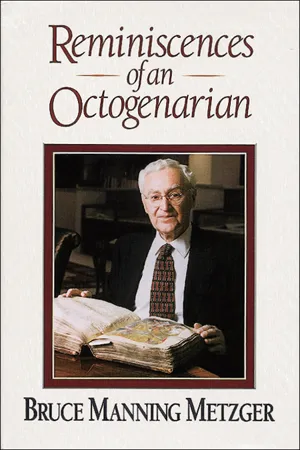
Bruce Manning Metzger's memoirs trace his life from his childhood in the Pennsylvania Dutch country and his student years at Princeton through his distinguished career of teaching, writing, lecturing, and editing. Professor Metzger's work has won him the gratitude of both biblical scholars and the larger Bible-reading public. His text-critical work on the New Testament is reflected in the standard Greek text now used and appreciated by scholars worldwide. His efforts on the Revised Standard and New Revised Standard versions of the Bible helped produce the readable, accurate English translations used for study and devotion by so many. His work on The Reader's Digest Bible and The Oxford Companion to the Bible has made the Bible more accessible for an untold number of readers.
In these memoirs, Professor Metzger's own words put a human face on his monumental scholarly achievements. The wide array of stories and vignettes--from Senator Joseph McCarthy's attack on RSV committee members and Metzger's audiences with the pope to the time Professor Metzger and other members of the NRSV committee had to crawl out of a library window to get to their dinner--offer the reader a personal insight into some of the twentieth century's crucial developments in the text and translation of the Bible.
- 256 pages
- English
- ePUB (mobile friendly)
- Available on iOS & Android
eBook - ePub
Reminiscences of an Octogenarian
About this book
Information
Topic
Theology & ReligionSubtopic
Biblical Studies
MY PENNSYLVANIA DUTCH HERITAGE
THE rolling hills of Lancaster County, Pennsylvania, and portions of adjacent counties, including Dauphin, Lebanon, and Berks, are dotted with prosperous and well-kept farms. Those who originally developed these homesteads had responded to William Penn’s invitation to settle in the New World. They came from areas along the Rhine, and from Alsace, Bavaria, and German Switzerland. Between 1727 and 1775 some sixty-eight thousand newcomers arrived.
The English whom they met when they got off the ship at Philadelphia ridiculed their outlandish dialect and their preposterous customs. Writers and historians have marveled over the tenacity with which these people we now call the Pennsylvania Dutch[1] have clung to their language and their customs. The Quakers, already secure in their political and economic domination of the state, soon found this great tide of immigration threatening and formidable. By the time of the American Revolution, the population of Pennsylvania, according to Benjamin Franklin, was one-third German.
Among the Pennsylvania Dutch were several different religious groups. The largest number were Lutheran and Reformed in their church affiliation. Others belonged to one or another group of Anabaptists, a comprehensive modern designation of those who denounced the baptism of infants and insisted that only adult baptism of believers was valid. This so-called left wing of the Reformation, firmly opposed to formalism and ritual in religion, had been severely persecuted in Europe by Roman Catholics and Protestants alike. Those put to death probably exceeded ten thousand.
The earliest Anabaptists to come to America were Mennonites, followers of Menno Simons. They stressed the idea of the community of believers (with no marriage outside the community) and required extreme plainness of dress, avoidance of legal oaths and military service, and simplicity of church organization (clergy received no salary). Large numbers of Mennonites settled in Lancaster County, where today they own the greatest part of this rich farmland, one of the most fertile and productive counties in the United States.
The Amish, whose extreme peculiarities of dress and custom set them apart, followed Jacob Amman and broke from the Mennonite Church because they were convinced that even more strictness should be observed in their everyday life. The “Hook and Eye Amish,” for example, wear no buttons on their clothes, for in the old days buttons were the insignia of the military. The “House Amish” have no church buildings but worship in the houses or barns of members of the congregation. “Old Order Amish” ride only in buggies or wagons and have no telephones, electricity, or other modern conveniences in their homes.
Not all of the German immigrants were farmers. There were ministers, scholars, physicians, scientists; there were carpenters, weavers, potters, blacksmiths, printers, stone-cutters, saddlers, and butchers (a German word for “butcher” is Metzger). Many of those who had trades farmed as well, carrying on their crafts in the spare time that farming left them, especially during the winter season. Most of them kept their individual dialect because it was for them the most expressive way of saying something. Remnants of these dialects still persist. Those who still use Pennsylvania Dutch in Berks County refer to potatoes as Gardoffeln (from High German Kartoffeln), whereas in Lancaster County potatoes are called Grumbiere (from Low German Grundbirne, meaning “ground pears”).
More than eighty years ago I was born on February 9, 1914, at Middletown, in Dauphin County, Pennsylvania. This town of about six thousand inhabitants is located on the Susquehanna River ten miles southeast of Harrisburg, the capital of the state. It had gained its name during stagecoach days, for it was the midpoint between Lancaster and Carlisle, and the horses were changed there. I was the first of two children of Maurice R. Metzger (1884–1980) and Anna Manning Metzger (1889–1985). According to my father’s investigation of genealogical records, the American branch of his family began in the middle of the eighteenth century when his great-great-grandfather, Jacob Metzger, a resident of the Rhine Valley where it enters Holland, came to the United States. Here he settled on a tract of land that came to be known as “Metzger’s Choice” in Lancaster County, a few miles south of Middletown, bordering the Susquehanna River. He and his immediate descendants were farmers by occupation and Mennonites by conviction. As members of a “peace church,” and with memories of religious persecution in Europe, they were opposed to warfare and did not participate in the War for Independence.
George Manning, my mother’s great-grandfather, had come from England toward the end of the eighteenth century. A shipbuilder in his own country, he seems to have become a farmer in his new homeland. Here he and his descendants intermarried with Pennsylvania German settlers in Lancaster County.
My father’s early schooling was in a one-room country schoolhouse. Not satisfied with having completed the prescribed eight grades of study there, he wished to pursue further education. Consequently, in addition to assisting his parents with chores on the farm, he walked or rode his bicycle three miles to Middletown in order to attend the high school there. He would study Latin grammar while plowing—having burned a hole with a red-hot poker through the margin of the book so it could be tied to the cross-beam of the plow. In 1903 he was graduated as valedictorian of his class, but for some reason his parents did not attend the graduation ceremony. After two years of teaching in a newly established one-room country school not far from where had begun his own schooling, he enrolled in Lebanon Valley College; by accelerating his studies, he was graduated with the Bachelor of Arts degree in 1907. Following a year of teaching Latin and German in the Middletown High School, he attended the Law School of the University of Pennsylvania. In 1911 he was admitted to the Dauphin County Bar Association, and the following year he became a member of the Harrisburg firm of Wickersham & Metzger, in which association he continued until 1920 when his partner was appointed judge. In 1924 he formed a partnership with F. Brewster Wickersham, a son of his former partner.

Maurice R. Metzger

Anna Manning Metzger
For fifty-five years my father practiced law, going by train in the morning, six days a week, to his office in Harrisburg, and in evenings seeing clients in his office at our home in Middletown. Besides his law practice, he also was elected to serve for two terms as a Republican representative of Dauphin County in the Pennsylvania state legislature.
As a child I was rather frail and subject to respiratory troubles. An operation for appendicitis when I was six years old was followed by a long period of recuperation. During the rest of that year my mother taught me at home. Some years later, and partly to encourage me to be involved in out-of-doors physical exercise, my father arranged for part of the garden lying beyond the garage to be made into a tennis court. He and I dug the holes for the poles, and a local carpenter put up the wire netting. Although the court was a few feet short of regulation length, it was a popular gathering place for young people of the age of my sister Edith and myself.
Besides tennis my hobbies included making ship models of various sizes as well as one-tube, battery-operated radio sets. As a novelty, I built a radio set inside a quart jar; the variable condenser for tuning the set was made from metal I cut from a tin can. Another project on which I spent hours and hours was putting together a ship model inside a bottle, the neck of which was too narrow to allow the passage of a five-cent piece. Much easier was the production of a similar curiosity when, one springtime, I inserted the blossom of a gourd plant in our garden into the neck of a Listerine bottle and allowed nature to take its course.
After Charles Lindberg made his solo flight across the Atlantic in May of 1927 I constructed a wooden model of his airplane, the Spirit of St. Louis. For some weeks the threefoot-long replica hung on display in the window of Raymond’s Hardware Store in the downtown business district of Middletown. During those years I also made several more useful objects, such as a large cedar chest and a banjo clock case in which I installed an electric clock movement. The clock is still in use, hanging on the wall of our dining room at Princeton, and the chest is in the attic, containing woolen blankets and other materials.

Bruce, thirteen years old
It was, of course, natural that my father hoped to see on the shingle, as he put it, “Metzger and Son” as the title of his law firm. With this in mind, he suggested that I begin to read Sir William Blackstone’s classic work, Commentaries on the Laws of England. I was, however, more interested in the pure English style of the author than in the subject matter itself. Although my father was, I am sure, disappointed with my rather negative reaction to the volume, he generously commented that, inasmuch as he had not remained on the farm in accord with his father’s wishes, he would not urge me to undertake a type of study in which I had no real interest.
After graduation in 1931 from Middletown High School, where I had followed the academic course of study involving four years of Latin, I set off for college, choosing my father’s alma mater, Lebanon Valley College. First-year students were expected to enroll for a foreign language, and for some reason I chose the elementary course in classical Greek grammar. Perhaps my choice was based, to some extent, on my recollection of a remark that I had heard a visiting minister make one Sunday, to the effect that the meaning of the original Greek of the text for his sermon that morning was not fully brought out in translations commonly available. Although I am doubtful now whether he was entirely correct in his understanding of the Greek of that text (1 Peter 2:7), at any rate I had never before realized that the New Testament was written originally in Greek. In any case, having elected in my freshman year to study Greek, I developed a liking for the language, and the following year I decided to enroll for the second course, during which we reviewed the elements of White’s classical Greek grammar that we had used the previous year and translated sections of Xenophon’s Anabasis.
My professor of Greek, Gustavus A. Richie, had taken an M.A. degree under George A. Barton at the University of Pennsylvania. Included in his graduate work was the study of New Testament textual criticism. Consequently, during my third year of Greek, when we read part of the book of Acts in Greek, Richie introduced us to James Hardy Ropes’s magisterial work, The Text of Acts,[2] and had us make a comparison of a section of the Greek text of Acts preserved in two divergent manuscripts, Codex Vaticanus and Codex Bezae. Observing my interest in the subject, he lent me his copy of A. T. Robertson’s Introduction to the Textual Criticism of the New Testament,[3] as well as Westcott and Hort’s volume 2,[4] where the principles of textual criticism are set forth in great detail—most of which I certainly did not comprehend at that time.
In reading Robertson’s volume I noticed that one of the books he frequently quoted was E. Jacquier’s Texte du Nouveau Testament (Paris, 1913). Since I had begun the study of French the previous year, I thought that with Jacquier’s book I could extend my interest in textual criticism as well as diversify my reading in French during my second-year course in that language. A letter to Robertson at Louisville Baptist Theological Seminary brought information as to the name and address of the publisher in Paris, and I ordered a copy of Jacquier. In due time the volume arrived. The cost in 1934 for this book of 535 pages was the equivalent of forty cents—and for another forty cents I had it bound partly in leather! Since there was no index in the volume, I entered on the blank pages at the end of the volume the page references to several hundred New Testament passages about which the author had text-critical comments.
Besides taking a fourth year of Greek under Professor Richie, when we read several of the epistles in the New Testament, I was fortunate that the professor of Latin, Alvin H. M. Stonecipher, kindly agreed to offer two semesters of Greek. Stonecipher, who had taken his Ph.D. degree at Vanderbilt University with a dissertation on Graeco-Persian proper names, was interested in many things and proposed that during one semester we translate Plato’s Euthyphro, and during the other semester several of the Apostolic Fathers. (I was the only student who enrolled for these courses.) Using the editio minor of the Patrum Apostolicorum Opera, edited by Gebhardt, Harnack, and Zahn,[5] I thus became acquainted with the Greek text of the Didache, several epistles of Ignatius and of Polycarp, as well as the Martyrdom of Polycarp.
In addition to these courses in Greek, I had continued the study of Latin for three years and also enrolled for three years of German. Along with the usual courses in English literature, a semester’s course on the history of the development of the English language caught my fancy. All in all, as I look back now, I feel that I was particularly fortunate in the scope and kinds of instruction made available on the campus of a small liberal arts college with an enrollment of about six hundred students. The quality of the instruction is perhaps indicated in the following. Before being graduated in the spring of 1935 I entered the competition Bimillennium Horatianum that had been organized among the fifty-some colleges and universities throughout Pennsylvania in order to commemorate the two-thousandth anniversary of the birth of the Roman poet Horace (65–8 BC). The competition involved submitting an original translation of Horace’s famous Carmen Saeculare, written in celebration of the Secular Games held in 17 BC. For my metrical translation the judges awarded me third prize, a copy of Wickham’s Oxford edition of selected odes of Horace.
Other forays that I made into the field of Latin literature involved translating and annotating passages in the writings of two pagan authors who had commented briefly on the early Christians. One was Tacitus’s account in his Annals (15.44) concerning Nero’s persecution of Christians following the great fire at Rome in AD 64. The other was Pliny the Younger’s epistle (10.96) asking the emperor Trajan how he, as...
Table of contents
- Cover
- Title Page
- Copyright Page
- Dedication
- Table of Contents
- List of Illustrations
- Preface
- Chapter 1 My Pennsylvania Dutch Heritage
- Chapter 2 Moving On to Princeton
- Chapter 3 Expanding Horizons
- Chapter 4 Ordination and Vocation in Church and Seminary
- Chapter 5 The International Greek New Testament Project
- Chapter 6 The Bible Societies’ Greek New Testament
- Chapter 7 Translating the Bible: The Revised Standard Version
- Chapter 8 Translating the Bible: The New Revised Standard Version
- Chapter 9 The Saga of the Yonan Codex
- Chapter 10 Condensing the Bible
- Chapter 11 Literary Forgeries
- Chapter 12 Vexations of an Author
- Chapter 13 Projects and Missions
- Chapter 14 Sabbatical Leaves from Teaching
- Chapter 15 The Oxford Companion to the Bible
- Chapter 16 On the Lecture Circuit at Home and Abroad
- Chapter 17 Prizes, Awards, and Honors
- Chapter 18 Interesting People I Have Known
- Postscript
- Index
- Notes
Trusted by 375,005 students
Access to over 1.5 million titles for a fair monthly price.
Study more efficiently using our study tools.
Frequently asked questions
Yes, you can cancel anytime from the Subscription tab in your account settings on the Perlego website. Your subscription will stay active until the end of your current billing period. Learn how to cancel your subscription
No, books cannot be downloaded as external files, such as PDFs, for use outside of Perlego. However, you can download books within the Perlego app for offline reading on mobile or tablet. Learn how to download books offline
Perlego offers two plans: Essential and Complete
- Essential is ideal for learners and professionals who enjoy exploring a wide range of subjects. Access the Essential Library with 800,000+ trusted titles and best-sellers across business, personal growth, and the humanities. Includes unlimited reading time and Standard Read Aloud voice.
- Complete: Perfect for advanced learners and researchers needing full, unrestricted access. Unlock 1.5M+ books across hundreds of subjects, including academic and specialized titles. The Complete Plan also includes advanced features like Premium Read Aloud and Research Assistant.
We are an online textbook subscription service, where you can get access to an entire online library for less than the price of a single book per month. With over 1.5 million books across 990+ topics, we’ve got you covered! Learn about our mission
Look out for the read-aloud symbol on your next book to see if you can listen to it. The read-aloud tool reads text aloud for you, highlighting the text as it is being read. You can pause it, speed it up and slow it down. Learn more about Read Aloud
Yes! You can use the Perlego app on both iOS and Android devices to read anytime, anywhere — even offline. Perfect for commutes or when you’re on the go.
Please note we cannot support devices running on iOS 13 and Android 7 or earlier. Learn more about using the app
Please note we cannot support devices running on iOS 13 and Android 7 or earlier. Learn more about using the app
Yes, you can access Reminiscences of an Octogenarian by Bruce M. Metzger in PDF and/or ePUB format, as well as other popular books in Theology & Religion & Biblical Studies. We have over 1.5 million books available in our catalogue for you to explore.