- 256 pages
- English
- ePUB (mobile friendly)
- Available on iOS & Android
eBook - ePub
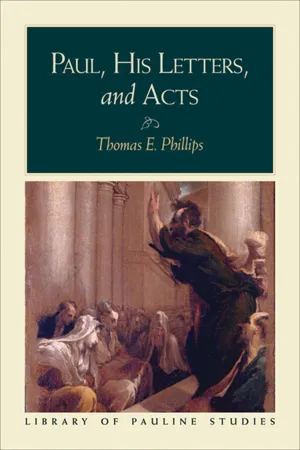
Paul, His Letters, and Acts (Library of Pauline Studies)
About this book
Aside from Jesus, the Apostle Paul had the greatest formative influence on the early Christian movement. Yet who was this passionate missionary who carried the message of Christ throughout the Mediterranean world? The New Testament writings give us not one but two portraits of Paul. We read numerous details of Paul's life and relationships in the Book of Acts and we also find an additional set of details about Paul's activities in his letters. Yet how consistent are these two portraits? And which one gives us the most accurate picture of the historical Paul? In this volume Thomas E. Phillips examines the portrayals of Paul in recent biblical scholarship in the light of these two major NT portraits. Believing the apostolic conference at Jerusalem to be a watershed event, Phillips draws conclusions that help contemporary readers get a more accurate picture of Paul.
Information
Topic
Theology & ReligionSubtopic
Biblical Studies
THE PLURALITY OF PLAUSIBLE PAULS
WHILE THE vineyard of biblical scholarship has seen many good years for Pauline studies, 2004 was an exceptionally good year for Paul. It produced two books with extraordinary bouquet and flavor, Rabbi Paul by Bruce Chilton[1] and In Search of Paul by John Dominic Crossan and Jonathan Reed.[2] Both books follow on the heels of the same authors’ widely acclaimed volumes on the historical Jesus. In many ways, it seems altogether fitting that these distinguished authors should continue their explorations into Christian origins with a sampling from the Apostle. With the singular exception of Jesus, no figure within the first century of Christianity has sustained a more robust body of theological reflection than the Apostle Paul.
The Apostle’s role as a catalyst to the church’s ongoing theological reflection is hardly surprising, given his frenetic energies and contentious personality. While some personalities are sated with small accomplishments and minor victories, the Apostle’s ambitions demanded grand accomplishments and unqualified victories. Paul’s inhibitions and fears seem few; his daring and innovations, many. By all indications, Paul’s passions provoked debate wherever he went, inspiring admiration from some, and disdain from others. In the first century, this persecutor turned preacher could be doubted—or even rejected—but never ignored.
Nor has Paul’s demand for attention been quenched by the passing centuries. Even in the twenty-first century, the Apostle confronts saints and scholars with the same contentious demand for engagement. The Christian canon not only preserves Paul’s own literary output (at least seven letters) but also offers up a list of Paul’s premier first-century interpreters (as many as six pseudonymous letters of Paul) and a cache of secondary sources in the Acts of the Apostles.
With such a rich canonical investment in Paul, it is hardly surprising that Paul’s theological heirs have been blessed with a frustrating wealth of dividends from Paul’s interpreters. With so many raw materials provided by Paul and Paul’s canonical interpreters, the versions of “Paul” offered up by contemporary Pauline scholars often bear little resemblance to one another. Even the most competent interpreters can arrange the tessarae of the canonical Paul into quite varied—though perhaps equally faithful—mosaics of Paul. Such is the case with the skilled artisans behind Rabbi Paul and In Search of Paul. Each reconstruction of “Paul” is plausible, but neither looks much like the other. Let me introduce each of these two “plausible Pauls” in turn.
I. CHILTON’S PLAUSIBLE PAUL
Chilton’s “intellectual biography” of Paul provides the narrative of a man whose life, thought, and energies were punctuated and shaped by two dramatic events: his conversion to Christianity and his rejection by the Jerusalem church. Accordingly, Chilton divides Paul’s life into three phases: (1) Paul’s Jewish devotion until his baptism and sojourn into Arabia, (2) Paul’s Christian missionary activity until James’s rejection of Paul’s gospel, and (3) Paul’s subsequent quest for reunion between his Gentile Christians and James’s Jewish Christians. Paul’s conversion marks the transition between the first and second phases of his life and his rejection by the Jerusalem church marks the transition between the second and third phases of his life.
Like any astute biographer, Chilton recognizes the need for scrutiny of his sources—even primary sources like Paul’s letters. He cautions that Paul’s letters, like any other writing, sometimes reflect the self-interest of their author. Chilton warns that Paul’s letters are “as limited as Paul was,” and they inevitably contain lapses, omissions and biographical glosses. For Chilton, therefore, “What Paul does not say makes the Book of the Acts of the Apostles an extremely valuable resource in any attempt at biography.” Chilton even suggests that a secondary source, like Acts, may reveal what Paul wished to conceal: “Sometimes there is good reason to infer that Paul keeps a self-interested silence that Acts breaks.”[3]
Although Chilton dates Acts “around 90 C.E.,” he is confident that some of the traditions in Acts owe their origin to one or more of Paul’s traveling partners, most likely and notably Timothy.[4] Even though these accounts from Timothy have been edited by the author of Acts, according to Chilton they retain significant value as independent reports from a contemporary of Paul—and he intends to draw upon those assets.
In keeping with Chilton’s commitment to employ Acts as a source for his biography of Paul, the material for reconstructing the opening phase of Paul’s life is drawn almost entirely from Acts. Chilton’s Paul, although a loyal Jew, is emphatically a child of the pagan city of Tarsus; he has even been influenced by Tarsus’s festivals to the pagan god Tarku.[5] Chilton’s Paul is a child of Tarsus’s privileged and wealthy class. Chilton assures us that Paul’s family “could afford real mansions with courtyards, space for the extended family, and servants’ quarters.”[6] According to Chilton, Paul’s “persistent traits of attitude and temperament derived from his home city. He was a Cilician, a Stoic, a tent-maker, and—by deliberate ambition—a Pharisee.”[7]
Even though he was reared as a Diaspora Jew and child of Tarsus, Chilton’s Paul was not reluctant to accept change. According to Chilton, in the four-year period between 28 and 32 C.E., Paul left Tarsus, abandoned his Hellenistic name (Paul), adopted a Hebrew name (Saul), and committed himself to study in Jerusalem under Gamaliel, the leading rabbi of Paul’s time.[8] Although Gamaliel maintained a studied indifference to the emerging Christian movement, Paul broke with his policy. In 32 C.E., Paul began participating in the violent persecution of Christianity. Through his admittedly minor role in the stoning of Stephen, Paul established a clear divide between himself and his former mentor.[9]
Shortly after this break with Gamaliel, Paul’s life saw even more profound change when he experienced a series of four interrelated events: an apocalyptic vision, a bout of blindness, healing from that blindness, and Christian baptism. Chilton labels these aggregate events Paul’s “conversion.”[10] In obvious reliance upon Acts, Chilton explains how Paul saw a light “that changed his life.”[11] Even though Chilton acknowledges that Paul probably did not see a literal shaft of light, he argues that the event nonetheless did leave Paul physically blind.[12] (Chilton attributes this physical impairment to herpes zoster, a disease common to Paul’s homeland of Tarsus.[13]) Whatever the exact nature and origin of Paul’s blindness, according to Chilton, the affliction was healed when Ananias baptized Paul; thus, “Paul’s baptism was also a moment of healing.”[14]
This first phase of Paul’s life concludes with a series of ironies: Paul receives a heavenly vision, but is blinded by it; Paul receives Christian baptism, but is shunned by the Christian community; Paul had committed himself to a very restrictive sect of Judaism, but is called to be a witness to the Gentiles. As the first phase of his adult life drew to a close and the second opened before him, the prospects must have seemed discouraging. Paul was driven by the conviction that “the God of Israel was extending his promises to humanity as a whole,”[15] but the seed of his conviction seemed to be falling upon hard soil. His fellow Christians in Jerusalem feared him; his Jewish family in Tarsus disowned him; and his would-be converts in Nabataea rejected him. His ideas could find no home. Adding injury to insult, the newly converted, but no longer family-funded, Paul found himself reduced to his previously neglected vocation of tentmaking.[16]
After three years of apparently unsuccessful missionary activity in Nabataea (32–35 C.E.),[17] Paul ventured back to Jerusalem “to claim the mantle of an apostle . . . but it was a rocky start.”[18] For Chilton, the tension between Paul and the Jewish Christians is epitomized in Acts by the competing—and thrice recounted—visions of Peter and of Paul. On the one hand, Paul’s vision had called him to take the gospel to all Gentiles. On the other hand, Peter’s vision—and his experience with the God-fearer Cornelius—had taught him to accept God-fearing Gentiles into the Christian community.[19] In theory, these two visions should have been compatible, and Peter’s vision should have prepared him for Paul’s proclamation of a Gentile-inclusive people of God. In reality, however, after only fifteen days in Peter’s Jerusalem, Paul “was shipped unceremoniously out of Jerusalem” and back to Tarsus. According to Chilton, Peter was unwilling to accept Paul’s claim that “Gentiles should be offered the realization of God’s promises to humanity without accepting the Law of Judaism.”[20] Peter and Paul split over the issue of whether Gentiles must first convert to Judaism before converting to Christianity. Peter could accept Gentiles who came to Christianity via Judaism, that is, as God-fearers, but not Gentiles who came to Christianity apart from Judaism. Peter’s vision had not prepared him for “the direct approach to Gentiles without conversion to Judaism that Paul’s vision demanded.”[21] This incompatibility of visions left Paul with “no welcome in Jerusalem” and prompted his return to Tarsus.[22]
In addition to providing Paul with a setting in which he could nurture “the entrepreneurial side” of his personality, Paul’s stay in Tarsus provided him with the “intellectual isolation” needed for sustained theological reflection. During this period in his hometown of Tarsus (35–40 C.E.), Paul developed the “social definition of the body of Christ” that shaped and sustained the rest of his ministry.[23] According to Chilton, Paul adapted the Stoic idea of “the Roman Empire as a single body animated by reason” to the needs of the church. When wed to the Christian practice of the Eucharist, this distinctive understanding of the body of Christ became the core of his mature theology. The Eucharist was the mystic experience by which “all disciples everywhere were marshaled into a single body.”[24]
While Paul was chipping away at these theological constructs, things were also changing in Jerusalem. James was gaining ascendancy over Peter, and Peter’s commitment to a gospel for God-fearers was losing favor. Eventually, Peter retreated to Antioch where he and Barnabas began to think about the distant Tarsus-bound Paul as “a potential asset.” Peter dispatched Barnabas to retrieve Paul from his unceremonious exile. According to Chilton, then, Paul’s famed missionary career began from Antioch around 40 C.E. at the initiative of Peter and under the supervision of Barnabas.[25] For Chilton, “without the influence of Barnabas, Paul would in all probability have died in idiosyncratic anonymity in Tarsus.”[26]
During Paul’s stay in Antioch, his distinctive vision of Gentile inclusion became a contentious issue within the emerging Christian discourse, gathering both advocates and detractors. As tensions rose, the leaders (“prophets”) of the Christian community in Antioch encouraged Barnabas to take Paul, “his junior colleague,” on a road show to field test Paul’s gospel in Barnabas’s homeland of Cyprus.[27] While on the road, Paul’s gospel continued to attract attention, in the forms of both acceptance and resistance. The heightening tensions within the church over the role of Gentile converts appeared to reach a climax when James and the Jerusalem elders decided to meet with Paul.[28] According to Chilton, the resulting meeting in Jerusalem was significant for Paul not only because of his earlier chilly relations with the Jerusalem believers, but also because “in his own time, James’s stature was dominant; the Book of Acts says so plainly and Paul openly admits the fact.”[29] According to Chilton, on account of his need for approval from the trio of Peter, James, and John, Paul “said nothing” about the incongruity between his vision and Peter’s.[30]
This Jerusalem Conference offered the strategically silent Paul “an endorsement Paul could barely have hoped for.”[31] The Jerusalem elders had clearly agreed with Paul’s insistence that Gentiles were to be accepted into the church. Yet, Paul’s tongue-biting silence at the conference revealed an underlying tension. Would Gentiles enter the church under the vision of Peter or of Paul? Was the Christian message open to all Gentiles (Paul’s vision) or only to Gentile God-fearers (Peter’s vision)? The conference, though successful in the eyes of all participants, left a key issue open to interpretation. For his part, Barnabas interpreted the Jerusalem decision as an endorsement of “Peter’s mission as defined in Galatians—to Jews and God-fearers—not Paul’s.” For his part, Paul interpreted the decision as an endorsement of his own efforts to convert “Gentiles fresh from the raw state of their natural idolatry.” This difference of interpretation ensured that the foremost missionary team of the first century “would never work together again.”[32]
According to Chilton, the Jerusalem Conference was a mixed blessing for Paul. On the one hand, it had endorsed the Gentile mission and had given “Paul new authority.” On the other hand, it had cost him the partnership of his senior colleague and mentor, Barnabas. Barnabas abandoned Paul and his vision in favor of Peter and his vision. With Barnabas no longer interested in promoting Paul’s vision, Paul was placed both under the authority of the Jerusalem elders and under “the constant surveillance of Silas.” This newly created team was quickly instructed to redirect its mission further west.[33] While traveling with Silas, and in keeping with the wishes of the Jerusalem cadre, Paul performed Timothy’s circumcision. According to Chilton, in an act that “cut to the core of Israelite identity, and therefore Christian identity[,] . . . Paul himself wielded the knife that cut off Timothy’s foreskin.”[34] Chilton is fully cognizant of many interpreters’ reluctance to place this flint blade in...
Table of contents
- Cover
- Title Page
- Copyright Page
- Dedication
- Table of Contents
- Abbreviations
- Preface
- Introduction
- 1 The Plurality of Plausible Pauls
- 2 Paul, Let Me Introduce You to Paul
- 3 Putting Paul’s Life in Order
- 4 Putting Paul in His Place: The Greco-Roman World
- 5 Finding Paul a Place in the Church: The Participants in the Jerusalem Conference
- 6 Finding a Place in Paul’s Churches: Paul’s Associates, His Converts, and Apollos
- Conclusion
- Bibliography
- Index of Modern Authors
- Index of Subjects
- Index of Scripture References
- Notes
Trusted by 375,005 students
Access to over 1.5 million titles for a fair monthly price.
Study more efficiently using our study tools.
Frequently asked questions
Yes, you can cancel anytime from the Subscription tab in your account settings on the Perlego website. Your subscription will stay active until the end of your current billing period. Learn how to cancel your subscription
No, books cannot be downloaded as external files, such as PDFs, for use outside of Perlego. However, you can download books within the Perlego app for offline reading on mobile or tablet. Learn how to download books offline
Perlego offers two plans: Essential and Complete
- Essential is ideal for learners and professionals who enjoy exploring a wide range of subjects. Access the Essential Library with 800,000+ trusted titles and best-sellers across business, personal growth, and the humanities. Includes unlimited reading time and Standard Read Aloud voice.
- Complete: Perfect for advanced learners and researchers needing full, unrestricted access. Unlock 1.5M+ books across hundreds of subjects, including academic and specialized titles. The Complete Plan also includes advanced features like Premium Read Aloud and Research Assistant.
We are an online textbook subscription service, where you can get access to an entire online library for less than the price of a single book per month. With over 1.5 million books across 990+ topics, we’ve got you covered! Learn about our mission
Look out for the read-aloud symbol on your next book to see if you can listen to it. The read-aloud tool reads text aloud for you, highlighting the text as it is being read. You can pause it, speed it up and slow it down. Learn more about Read Aloud
Yes! You can use the Perlego app on both iOS and Android devices to read anytime, anywhere — even offline. Perfect for commutes or when you’re on the go.
Please note we cannot support devices running on iOS 13 and Android 7 or earlier. Learn more about using the app
Please note we cannot support devices running on iOS 13 and Android 7 or earlier. Learn more about using the app
Yes, you can access Paul, His Letters, and Acts (Library of Pauline Studies) by Thomas E. Phillips in PDF and/or ePUB format, as well as other popular books in Theology & Religion & Biblical Studies. We have over 1.5 million books available in our catalogue for you to explore.