- 416 pages
- English
- ePUB (mobile friendly)
- Available on iOS & Android
eBook - ePub
About this book
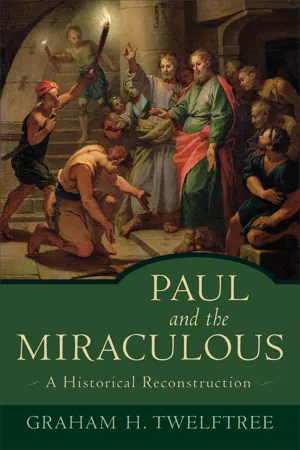
How can we explain the difference between the "miraculous" Christianity expressed in the Gospels and the nearly miracle-free Christianity of Paul? In this historically informed study, senior New Testament scholar Graham Twelftree challenges the view that Paul was primarily a thinker and reimagines him as an apostle of Jesus for whom the miraculous was of profound importance. Highlighting often-overlooked material in Paul's letters, Twelftree offers a fresh consideration of what the life and work of Paul might teach us about miracles in early Christianity and sheds light on how early Christians lived out their faith.
Information

1
Who Was Paul?
Who was Paul—the historical Paul? Tension between the Paul of history and the apostle of faith is already apparent in the New Testament. Most notably, although Luke portrays him as a great miracle worker,5 critics have concluded that his opponents at Corinth were able to deny his ability to perform miracles.6 Then, for example, the letter to the Colossians, probably not from Paul’s hand, if not betraying and subverting him,7 at least shows a figure remembered and redrawn for the needs of a later period without even the hint of miracle working on Paul’s part.
Which, if any, of these portraits best represents the historical Paul?8 Was Paul, as Luke would have us believe, a great miracle worker? Or, if we understand them, were his critics at Corinth correct, so that Colossians is more accurate in carrying no memory of Paul as a miracle worker or even as interested in the miraculous? Or, again, do Paul’s letters need to be read more carefully to recover some other relation that the historical Paul had to miracle working and the miraculous?
The critical study of Paul has been dominated by an interest in him as an intellectual and a theologian, not as a person involved in the miraculous or performing miracles. For Origen (c. 185–c. 254 CE), Paul “values reason above miraculous workings” (Cels. 3.46).9 Rudolf Bultmann (1884–1976) assessed Paul’s historical position in terms of being “the founder of Christian theology.”10 C. F. D. Moule (1908–2007), perhaps the most influential British New Testament scholar of the twentieth century, designated Paul “the prince of thinkers.”11 The result is that Paul is generally discussed in terms of being a thinker and considered “the first and greatest Christian theologian.”12 In particular, the last generation and more of Pauline studies, dominated by the so-called, but increasingly contested,13 New Perspective on Paul, gives the impression that Paul’s thinking was preoccupied with the law, and that he is to be understood primarily through the lens of this discussion.14 Even more recent studies do not contest this general perception.15
These various scholarly conversations about Paul, dominated by the assumption that he was primarily a thinker and a theologian, and the contrasting portraits of Paul in the New Testament raise the question of how he would have understood himself and how he would have been seen by those who knew him. Would they, along with Paul himself, have taken his work to be primarily that of a thinker and a theologian or of a practical missionary?
At least initially, Paul’s literary legacy certainly gives the impression of coming from the pen of a person who solves theological problems through careful thought and interaction with his literary traditions. But we have probably fallen into a trap by assuming that Paul’s literary achievements accurately characterize his accomplishments. For, as we will see, a closer reading of Paul’s letters, taking into account more than his literary activities—his life, his experiences, and his missionary accomplishments—reveals a different Paul. While not denying his genius and creative power as a theologian, to see him only or primarily as such is to caricature rather than describe him. Nearer the mark is the assertion by Adolf Deissmann (1866–1937) that “He is far more a man of prayer, a witness, a confessor and a prophet, than a learned exegete and close thinking scholastic.”16 Also, in an attempt to capture the essence of his ministry or his contribution to the history of Christianity, Heikki Räisänen suggests that Paul was “first and foremost a missionary, a man of practical religion who develops a line of thought to make a practical point, to influence the conduct of his readers.”17 Yet, even these turn out to be inadequate representations of Paul.
The question of how to describe Paul and his ministry and theology also confronts us when we take into account the apparent disconnect between the portraits of Paul and Jesus in the New Testament. On the one hand, Jesus is reported to have been a powerful and prolific miracle worker, giving this aspect of his ministry a high profile in his self-understanding and how he interpreted his mission. Yet, on the other hand, when we turn to the letters of Paul, not only does he show little interest in the pre-Easter ministry of Jesus but he also appears to say little or nothing of performing miracles in his own ministry. Paul offers no narrative of a miracle relating to his ministry; at best he only appears to hint at miraculous activity.18 Indeed, from a perspective broader than just the miraculous, Bultmann said, “I do not believe it is possible to state sufficiently sharply the contrast in the NT canon between the Synoptic Gospels on the one hand and the Pauline letters and later literature on the other.”19
How the ministry of Jesus became the religion of Paul is a central problem for students of Paul and the New Testament, as well as for all Christian theology.20 Although it is beyond the scope of this study to attempt solving the problem of the relationship between Paul and Jesus, by the end of our discussion it will be apparent that while Bultmann’s statement about the proclaimer becoming the proclaimed remains basically correct,21 Jesus and Paul had both less and more in common than is generally supposed. On the one hand, as I have attempted to demonstrate for Jesus,22 in relation to Paul, this study will show that the more we distance Paul from the miraculous, the less we understand him, his theology, and his mission. On the other hand, we will see that for Paul the miraculous was both broader and functionally different than for Jesus. We will also have evidence that earliest Christianity was much more deeply characterized by the miraculous than it is presently assumed to have been. Thus, through a discussion of the miraculous in relation to Paul, this study is an attempt to make a contribution to the understanding of the historical Paul. (It is to be noted that this is not an attempt to offer a complete sketch of the historical Paul, but only to argue for an essential part of that picture.) In turn, this study also attempts to contribute to the understanding of the relationship between the religion of Jesus and the religion of Paul. More broadly, this study is to be taken as a contribution to understanding the nature of earliest Christianity and the place and function of miracles in it.
1.1 Specific Issues
In relation to Paul and the miraculous—the focus of this study—what follows seeks to answer a series of six interrelated questions. (1) What was Paul’s experience of and his view of his involvement in miracles and the miraculous? Did he, for example, consider himself a miracle worker? Walter Schmithals says, “The Pauline epistles contain no sort of suggestion that Paul was such a miracle-worker, or that he practiced healing and exorcisms.”23 Paul then, as Bruno Bauer had put it, was fighting by means of word alone.24 For Paul, the true signs of an apostle were the hardships and the persecutions he endured.25
Nevertheless, as we will see, since the beginning of the scientific study of Paul there have been occasional statements made, and studies concluding, that Paul performed, or thought he performed, miracles. My aim is to examine the data in an attempt to contribute to and give a place to this small, though increasingly clear, voice that Paul considered himself involved in the miraculous. However, we will also find that Paul’s view of himself as a miracle worker and his perceived relationship to the miraculous is to be viewed quite differently from how Jesus saw himself.
Equally significant is the question: (2) How important did Paul consider miracle working, and what profile did he think it took in his ministry? Over against Ernst Haenchen, who concluded that miracles were not very significant to Paul, we have, for example, Jacob Jervell’s assertion that “miracles assume a quite central role in Paul’s preaching, almost to a greater degree than in Acts.”26 The related question is (3) what meaning or significance did Paul give to his miracles? This question arises from what Paul has written, but we are also prompted to read Paul carefully in light of Jesus seeing his miracles as having eschatological and salvific significance.
A further question relating to Paul himself is (4) if he understood his ministry involved conducting miracles, how does he relate such a power-based ministry to his theology of weakness, suffering, and the cross?27 Or, how can Paul write that he is a man of weakness, yet at the same time claim or be credited with works of power? Hence, we will go on to ask: (5) How does Paul relate the miraculous to other aspects of his theology and ministry? In doing so, we will test F. Gerald Downing’s assertion that Paul achieved “very little integration” of the miraculous with his message and lifestyle.28 Finally, if Paul thought he conducted miracles then (6) what kinds of miracles did he perform?
1.2 The Discussion So Far
If the major studies of Paul over the last century and more are a gauge, with some important exceptions (which I will discuss in a moment), there has been little interest in him in relation to the miraculous. Moreover, where the topic has been addressed, rarely and inadequately has it been shown what impact the miraculous should have on the interpretation of Paul’s life, theology, and mission. Taking into account Pauline studies of enduring significance,29 we begin with those in which the miraculous has a low profile or has been inadequately related to an overall assessment of Paul. In the next brief section I will piece together the results and implications of this survey.
(a) Little or no interest in miracles. Of the olympian figures in the scientific study of the New Testament who are celebrated in Albert Schweitzer’s masterly and readable Paul and His Interpreters: A Critical History (1912), we need only draw attention to two individuals who remain significant for Pauline studies, Ferdinand Christian Baur (1792–1860) of Tübingen and William Wrede (1859–1906) of Breslau.
Baur, who placed the critical study of early Christianity on sound methodological footings in allowing the New Testament texts to speak for themselves,30 concluded that Acts (with its miracle stories associated with Paul) was not ...
Table of contents
- Cover
- Title Page
- Copyright Page
- Dedication
- Contents
- Preface
- Abbreviations
- Part 1: Paul
- Part 2: Paul’s Inheritance
- Part 3: Paul’s Testimony
- Part 4: Paul’s Interpreters
- Part 5: Paul and the Miraculous
- Select Bibliography
- Ancient Writings Index
- Modern Author Index
- Subject Index
- Notes
- Back Cover
Trusted by 375,005 students
Access to over 1.5 million titles for a fair monthly price.
Study more efficiently using our study tools.
Frequently asked questions
Yes, you can cancel anytime from the Subscription tab in your account settings on the Perlego website. Your subscription will stay active until the end of your current billing period. Learn how to cancel your subscription
No, books cannot be downloaded as external files, such as PDFs, for use outside of Perlego. However, you can download books within the Perlego app for offline reading on mobile or tablet. Learn how to download books offline
Perlego offers two plans: Essential and Complete
- Essential is ideal for learners and professionals who enjoy exploring a wide range of subjects. Access the Essential Library with 800,000+ trusted titles and best-sellers across business, personal growth, and the humanities. Includes unlimited reading time and Standard Read Aloud voice.
- Complete: Perfect for advanced learners and researchers needing full, unrestricted access. Unlock 1.5M+ books across hundreds of subjects, including academic and specialized titles. The Complete Plan also includes advanced features like Premium Read Aloud and Research Assistant.
We are an online textbook subscription service, where you can get access to an entire online library for less than the price of a single book per month. With over 1.5 million books across 990+ topics, we’ve got you covered! Learn about our mission
Look out for the read-aloud symbol on your next book to see if you can listen to it. The read-aloud tool reads text aloud for you, highlighting the text as it is being read. You can pause it, speed it up and slow it down. Learn more about Read Aloud
Yes! You can use the Perlego app on both iOS and Android devices to read anytime, anywhere — even offline. Perfect for commutes or when you’re on the go.
Please note we cannot support devices running on iOS 13 and Android 7 or earlier. Learn more about using the app
Please note we cannot support devices running on iOS 13 and Android 7 or earlier. Learn more about using the app
Yes, you can access Paul and the Miraculous by Graham H. Twelftree in PDF and/or ePUB format, as well as other popular books in Theology & Religion & Biblical Criticism & Interpretation. We have over 1.5 million books available in our catalogue for you to explore.