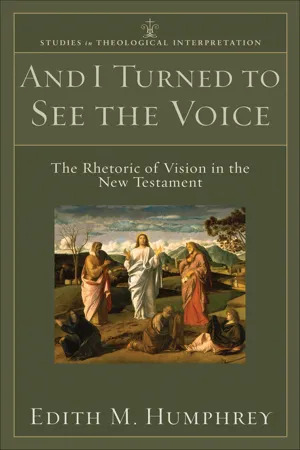
eBook - ePub
And I Turned to See the Voice (Studies in Theological Interpretation)
The Rhetoric of Vision in the New Testament
- 240 pages
- English
- ePUB (mobile friendly)
- Available on iOS & Android
eBook - ePub
And I Turned to See the Voice (Studies in Theological Interpretation)
The Rhetoric of Vision in the New Testament
About this book
Vision reports in the New Testament--Stephen's vision at his stoning, Paul's experience in the third heaven, John's apocalyptic visions on the isle of Patmos--pull readers and listeners into a dramatic and dynamic thought world. Author Edith M. Humphrey takes a literary-rhetorical approach to examine how word and image work together in understanding vision reports, demonstrating how biblical visions convey and reinforce messages that deeply affect readers. Visions, Humphrey believes, have not only been seen and heard but also can be transmitted as more than teaching. And I Turned to See the Voice uncovers a fascinating combination of beauty, potency, and mystery behind New Testament vision accounts.
Information
Topic
Theologie & ReligionSubtopic
Bibelkritik & -auslegung1
MAKING A CASE
Word Clinched by Vision
Classical Rhetoric and Vision in New Testament Texts
In dealing with New Testament texts that are straightforwardly polemical, it has become common to consider them in terms of Greco-Roman rhetoric on the assumption that at least some if not all of the first-century authors had a foot in two worlds—that is, they had a general knowledge not only of the Hebrew traditions but of the classical traditions as well. This is most demonstrable in the case of Luke, who knows well the Septuagint, that Hebrew Bible of the Diaspora, even while he addresses his ideal reader, “excellent Theophilus,” in a manner informed by classical bios and “history.” It is also true of Paul, a Jewish Roman citizen, who, in the estimation of most scholars, appears to have manipulated the conventions of the ancient rhetoricians. Given that Paul’s writings are designed to persuade and that Paul demonstrates an acquaintance with Greco-Roman strategies, it is not surprising that the first major study of a New Testament book in terms of classical rhetoric tackled his most polemical letter, Galatians.[1]
Following the first closely argued rhetorical analysis of a New Testament book, offered by Hans Dieter Betz,[2] students waited several years for a self-conscious methodological description of such a method. This was provided by George A. Kennedy, who outlined the immense potential of studying the New Testament documents in the light of classical rhetoric.[3] Kennedy’s pioneering book was followed by numerous studies, including the significant interventions of Burton Mack and Vernon Robbins, who, in Patterns of Persuasion in the Gospels,[4] introduced New Testament students to the classical “elaboration of the chreia,” that is, the schoolboy’s creative speech, constructed to elucidate and demonstrate the saying, or chreia, of a noteworthy person. Here New Testament students were reminded that rhetorical training was commonplace in the ancient world, and so it is plausible that the New Testament writers were acquainted with the conventions.
Since that time, Burton Mack’s little handbook Rhetoric and the New Testament has become the standard text by which religion and seminary students are introduced to this approach, for it elucidates the major themes, strategies, and modes of Greco-Roman rhetorical analysis and shows how these might be used in a study of various New Testament texts.[5] This handbook necessarily adapts and amplifies Kennedy’s original approach so that narratives as well as more directly polemical pieces may be read in terms of the classical conventions. The neophyte in rhetorical analysis is taught to establish boundaries for a passage that may be fruitfully subjected to a rhetorical analysis; to consider the sort of rhetoric (judicial, deliberative, epideictic)[6] that is at work in a given passage; to investigate the purpose of the rhetorical ploys (i.e., the creation of ethos, logos, and pathos) at various moments of the speech-act; to decide, within the argument of the passage, which “proofs” are advanced and to what end; and to ask how the passage contributes to the argument of its larger text. Those who have been influenced by Mack will also contrast New Testament argumentation with the classical modes and note where they diverge from their most apposite templates.
Questions and Debates
It is natural enough, in the wake of a new movement, that creative ventures should be accompanied by questions and disagreement. Some scholars, particularly those who believe that some of the New Testament writers were insulated from the larger culture, have even questioned whether Paul can be assumed to have known the conventions he putatively exploits. I. H. Marshall, for example, in his introduction of the New Testament to senior students, comments that “Paul’s letters . . . do not contain any significant evidence of a Greek education” and “his manner of argumentation is generally thought to reflect a rabbinic training.”[7] This view of Paul’s pedigree and especially of the scholarly consensus is a little unusual, and may reflect an overreaction against the current emphasis on a Hellenistic milieu for the New Testament. Few will follow Marshall’s implication that Paul is unmarked by classical rhetorical conventions, a claim that would put a significant brake on the rhetorical analysis of at least half the New Testament. Other questions have been frequently addressed to those who endorse the rhetorical approach, however. Are strategies designed to understand oral speeches applicable in the context of written epistles? What about the difficulty in determining a “rhetorical unit?” Is it not the case that we can easily confuse authorial intent with the readers’ perceptions? What are we to make of the lack of consensus regarding “species” of speech? Is it fair to hedge one’s bets by characterizing awkward passages as “mixed” in rhetorical genre? At what point does the heuristic value of these pursuits give way to a multitude of qualifications and debates?
Notwithstanding these concerns, it has seemed right to many New Testament scholars to continue this mode of inquiry so that rhetorical analysis is now thoroughly established in the arsenal of the exegete. Indeed, the movement is mature enough to have become self-reflective, for good or for ill.
If the fruit of rhetorical analysis has seemed abundant enough so that not a few are committed to the project, the connection of rhetoric with the vision-report is not so well demonstrated. To some it may seem bizarre to analyze the vision-report in terms of classical models since a vision-report would be an unusual component for formal argumentation in any of the three milieus, whether courtroom, assembly, or public gathering. However, to debate a point by reference to a reported vision is not so far a cry from, say, Plato’s compelling cave allegory or Lucian’s ironic visit to the Island of the Blessed in the Vera historia. A creative speaker might well use the vision-report as a building block in an argument if its significance were manifest to his designed audience. Consider the folk wisdom of the consummate “rhetorician” Tevye (Fiddler on the Roof), who convinces his wife Golde against the impending marriage of their oldest daughter to the village butcher. Faced with the task of changing his wife’s mind, Tevye relates a concocted “visitation” of his mother-in-law, who putatively has come back from the dead to disapprove the match and to suggest an alternative suitor. Tevye thus employs the vision-report as the major “proof” in his demonstrative speech, and so directs his wife to discover the most “pragmatic” course of action. This is, of course, a domestic and ironic example of the form that such rhetoric might take, but the New Testament documents are also, in some respects, Kleinliteratur. In the first-century world the genre of vision-report was a commonplace, ready-to-hand for the daring rhetorician, who might use it sincerely and not necessarily with a Tevyan “wink” to the audience.
Quintilian,[8] in outlining the strategies available to the aspiring rhetorician, describes the move known as demonstratio as the expression of the matter at hand with words so that it appears to be borne up “before the eyes” (res ante oculos) of the audience. Demonstratio[9] was part of the arsenal of the rhetorician and might be used to set forth in a vivid manner the statement of the case (narratio) or dramatically to confirm an argument. Given the wide-spread awareness of rhetoric in the ancient world and the commissive aspect of the gospel, we should not be surprised to discover that demonstratio plays an important role in the rhetoric of at least some New Testament writers. In Galatians 3:1 Paul speaks about his practice of “portraying” (προεγράφη)[10] Jesus Christ as crucified “before the eyes” (κατ᾿ ὀφθαλμοὺς) of his listeners. It would seem, then, that in the rhetoric of those for whom divine revelation was an important and authoritative factor, demonstratio sometimes assumed a peculiar shape—that of the reported vision.
At first glance, the student of classical rhetoric might assume that vision-report falls neatly into the category of “nontechnical or uninvented proofs.” However, Mack declares that such miraculous proofs “actually must have been invented,” so that their marshalling “must have been a challenging undertaking for early Christian authors.”[11] In a less skeptical vein, we may consider the framing of the vision-report as an integral part of argumentation that had to be artfully performed in order to have the desired effect. At this point invention and nontechnical proof come together, since within a worldview that is hospitable to the numinous, the vision could make its impact as a non-technical proof—a fact of the case—whereas the report requires invention. So then, we may consider the use of visionary narrative as a figure within an argument even where the vision-report is also appealed to as an authoritative “trump card.”
Two obvious passages from the New Testament corpus employ the vision-report as a means of completing an argument or bringing it to a full culmination: Paul’s “I know a person in Christ” passage, and Stephen’s “I see heaven opened.” In 2 Corinthians 12:1–10, Paul uses the “report” in an overt manner in order to bring a complex case to a striking conclusion; in Acts 7:55–56, the vision provides a narrative cap to Stephen’s interrupted speech, as well as a stunning climax to Luke’s martyrological and doxological narrative. In both cases, the openness of the vision-report is well suited to complexity, allowing Paul to bring home a two-pronged attack and permitting Luke to attend to both the drama of the immediate narrative and the greater purposes of his corpus. We begin with the most direct and explicit use of vision, 2 Corinthians 12.
Vision-Report as Climactic Argument: 2 Corinthians 12:1–10
In turning to this passage, we find ourselves in the midst of a closely debated section set within a letter that also is marked by academic controversy. Paul himself writes no full-blown apocalypses or vision-reports—despite the well-meaning efforts of a second- or third-century forger, by whose hand we have the so-called Apocalypse of Paul. Yet many of Paul’s letters, most notably 2 Corinthians, bear the imprint of the visionary traditions, using themes, forms, and ideas typically found in vision literature in ways that both engage and surprise the reader. Paul’s rhetoric in using such means is of necessity subtle, since it is governed as much by his reserve toward things normally construed as visionary as it is by his acceptance and experience of them. After all, his purpose in the letters is practical rather than speculative. So he mines his repository of resources, pulled from various sources—Hebrew Bible, second temple literature, Greco-Roman literature, and the cultural realities associated with these. In mustering these resources, he directs even visionary elements toward a careful and enticing presentation of how the body of Christ should live together in the light of the apocalypse par excellence that he declared to have been already revealed but has yet to be grasped fully.
Second Corinthians is not patently a literary unit to all scholars. The ongoing debate concerning its integrity and the sequence of its various parts as they relate to Paul’s ministry with the Corinthian church is well known. Whether or not an intelligent defense can be made for the book’s unity, it is not surprising that these thirteen chapters have been collected in a spot together within the Pauline corpus. Whatever their literary relationship, they are marked by a similar perspective—by the sense that the drama of the church in this world is interconnected with a reality that is not normally seen but opened (indeed, rendered present) to those who are in Christ, through the ministration of the Holy Spirit. As a complication, Paul finds himself in debate with those “super-apostles” who set great stock by personal visions and revelatory experiences. Thus he aims to pull his Corinthian flock back to a less elitist vision more centered on the One who has revealed God. As a result of competing contingencies, Paul’s depiction of things visionary is (to say the least) ambivalent, and the letter proceeds by both direct and polemically inverse references to visions of the unseen but ever-present heavenly world.
A quick flight over the letter shows that, despite all its textual complications, every part is informed by Christian visionary themes or by apocalyptic forms.[12] Paul begins by treating affliction and consolation (1:3–11) in terms of the consoling God “who raises the dead” (1:9) and in terms of a future hope (1:13–14). He goes on to tackle problems in Corinth by providing for them a dual stance: actions done “before the face of Christ” and in full knowledge of Satan’s “machinations” (2:10–11). Similarly, the apostolic ministry is depicted in dualistic terms (2:14–17) from the perspective of life and death, and perhaps with an echo of merkabah mysticism,[13] a practice not unrelated to that of the apocalyptic visionary. Chapters 3 and 4, drawing as they do on key revelatory moments in Israel’s history, are fully framed in apocalyptic terms (but see especially 3:7–18; 4:3–14), as will soon become apparent. In chapter 5 the future hope typically is disclosed in terms of both positive hope and judgment (5:1–10), and then the apostolic ministry is viewed from the perspective of Paul’s reformulated apocalyptic worldview (5:14–17). The thematically connected sections of 6:1–13 and 7:2–4 deal with the “Day” (now present) and the open heart and are punctuated by the textually controversial and decidedly apocalyptic discourse of 6:14–7:1. Paul’s subsequent discourse on repentance (7:5–16) is perhaps atypical for him, but its contrast of “godly” and “worldly” grief, and their diverse fruits of “salvation” and “death” (7:10–11), is clearly informed by an apocalyptic perspective. Chapters 8 and 9 discuss the collection, apostolic ministry (“the glory of Christ!” 8:23), and human giving in the light of the revealed gift of Jesus Christ (8:9), which is at the same time God’s “indescribable” gift (9:15). Chapter 10 describes Paul’s own apostolic rhetoric in terms of cosmic battle (10:3–6), and 11:2–3 employs the protological and eschatological imagery of virginity and the serpent (cf. Rev. 12). In contrast, Paul’s opponents are described as using an inverse apocalyptic discourse that obscures rather than reveals, and as having undergone a twisted transfiguration (μετασχηματίζεται, 2 Cor. 11:14) that corresponds diabolically to the transformation of the saints. While the “chaste virgin” has her high calling, these pseudo-ministers will reap their own end (τέλος, 11:15). As a climax to Paul’s argument, 12:1–10 employs the form of a vision-report with rhetorical flair and to surprising effect. Finally, the letter closes by relativizing notions of power and weakness through Paul’s underlying revelatory story of Christ (13:4).
It is clear, then, that the climactic vision-report of chapter 12 sits comfortably within the themes and concerns of the letter as a whole and within ...
Table of contents
- Cover
- Title Page
- Copyright Page
- Dedication
- Contents
- Series Preface
- Preface
- Introduction: Vision-Report as Artifact and Polemic
- 1. Making a Case: Word Clinched by Vision
- 2. Directing the Argument: The Power of Repetition within Narrative
- 3. Shaping the Narrative: Embryonic and Strategic Visions
- 4. Firing the Imagination: Visions with Embedded Propositions
- Conclusion: Toward a Hermeneutics of Imagination and Sympathy
- Notes
- Bibliography
- Index of Authors
- Index of Scripture and Other Ancient Writings
- Subject Index
Trusted by 375,005 students
Access to over 1.5 million titles for a fair monthly price.
Study more efficiently using our study tools.
Frequently asked questions
Yes, you can cancel anytime from the Subscription tab in your account settings on the Perlego website. Your subscription will stay active until the end of your current billing period. Learn how to cancel your subscription
No, books cannot be downloaded as external files, such as PDFs, for use outside of Perlego. However, you can download books within the Perlego app for offline reading on mobile or tablet. Learn how to download books offline
Perlego offers two plans: Essential and Complete
- Essential is ideal for learners and professionals who enjoy exploring a wide range of subjects. Access the Essential Library with 800,000+ trusted titles and best-sellers across business, personal growth, and the humanities. Includes unlimited reading time and Standard Read Aloud voice.
- Complete: Perfect for advanced learners and researchers needing full, unrestricted access. Unlock 1.5M+ books across hundreds of subjects, including academic and specialized titles. The Complete Plan also includes advanced features like Premium Read Aloud and Research Assistant.
We are an online textbook subscription service, where you can get access to an entire online library for less than the price of a single book per month. With over 1.5 million books across 990+ topics, we’ve got you covered! Learn about our mission
Look out for the read-aloud symbol on your next book to see if you can listen to it. The read-aloud tool reads text aloud for you, highlighting the text as it is being read. You can pause it, speed it up and slow it down. Learn more about Read Aloud
Yes! You can use the Perlego app on both iOS and Android devices to read anytime, anywhere — even offline. Perfect for commutes or when you’re on the go.
Please note we cannot support devices running on iOS 13 and Android 7 or earlier. Learn more about using the app
Please note we cannot support devices running on iOS 13 and Android 7 or earlier. Learn more about using the app
Yes, you can access And I Turned to See the Voice (Studies in Theological Interpretation) by Edith M. Humphrey, Bartholomew, Craig G., Green, Joel, Seitz, Christopher, Craig G. Bartholomew,Joel Green,Christopher Seitz in PDF and/or ePUB format, as well as other popular books in Theologie & Religion & Bibelkritik & -auslegung. We have over 1.5 million books available in our catalogue for you to explore.