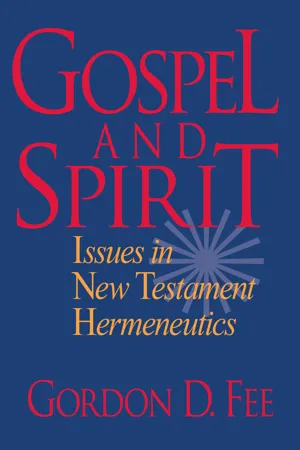
For those who believe the Scriptures are the inspired word of God with a message relevant for living today, nothing is more crucial than understanding sound principles of interpretation. Disagreement arises when people and groups differ over how one gets at that message and what that message is. In this collection of essays and lectures, Dr. Gordon Fee offers hermeneutical insights that will more effectively allow the New Testament to speak on its own terms to our situation today.
This is not a collection of subjective, theoretical essays on the science of interpretation; rather, these essays target issues of practical--and sometimes critical--concern to Evangelicals, Pentecostals, and anyone interested in letting the Bible speak to today's situation. Fee brings to the task what he himself advocates: common sense and dedication to Scripture. Readers already familiar with some of these essays, like "Hermeneutics and Common Sense: An Exploratory Essay on the Hermeneutics of the Epistles," will welcome its reappearance. Others will appreciate the challenge of essays such as "The Great Watershed--Intentionality and Particularity/Eternality: 1 Timothy 2:8-15 as a Test Case"--an essay defending the role of women in ministry--or "Hermeneutics and Historical Precedent--A Major Issue in Pentecostal Hermeneutics." Anyone wanting to wrestle with key issues in New Testament interpretation will want to read this book.
- 158 pages
- English
- ePUB (mobile friendly)
- Available on iOS & Android
eBook - ePub
About this book
Information
Topic
Theology & ReligionSubtopic
Biblical Studies1
HERMENEUTICS AND COMMON SENSE: AN EXPLORATORY ESSAY ON THE HERMENEUTICS OF THE EPISTLES
It has long been my conviction that the battle for inerrancy must be settled in the arena of hermeneutics. The basic differences that have emerged among evangelicals, for example, between those who believe in “limited” or “unlimited” inerrancy[1] are not textual, but exegetical and hermeneutical. Unfortunately, a good deal of name-calling and mud-slinging has gone on over theological definitions of inerrancy, while exegetical and hermeneutical imprecision abounds.
This conviction has been supported most recently—unwittingly to be sure—by Harold Lindsell’s The Battle for the Bible. Early on he inveighs against those who would “destroy the idea of biblical infallibility neatly by providing interpretations of Scripture at variance with the plain reading of the texts.”[2] Yet when he himself tries to resolve “the case of the missing thousand” (Num 25:9; 1 Cor 10:8), he does so with precisely the same kind of hermeneutical stance, that is, by abandoning “the plain reading of the texts” and inveighing against those who read Paul’s account “superficially” (pp. 167–69).[3]
The burden of this present essay is not necessarily to resolve the hermeneutical tensions highlighted by the battle for inerrancy. Nor does it aim to spell out the hermeneutical principles required by a belief in biblical inerrancy. Rather, the essay intends to be more foundational and to offer some suggestions in the area of common sense. The plea is for greater hermeneutical precision in order to answer the thorny question of how to move from the first to the twentieth century without abandoning the plain sense of the texts, on the one hand, and yet without canonizing first-century culture, on the other.
I have chosen to limit my remarks in this essay to the New Testament Epistles. The reason for this is twofold: (1) the problem of “cultural relativity” and its relationship to inerrancy is most often raised here. (2) Many of the battle lines in the current debate have been drawn over the issues of women’s role in the twentieth-century church. Here especially, hermeneutical precision—or at least consistency—has been lacking on both sides. Unfortunately, in an area where hermeneutics is in fact the key issue, some have taken such a rigid stance on the basis of their own hermeneutics that they have accused others of believing in an errant Bible because they do not hold to the same interpretation.
I. The Basic Problem
In his now famous article on “Biblical Theology” in the Interpreter’s Dictionary of the Bible, Krister Stendahl suggested the core of the hermeneutical problem today to be the contrast between “What did Scripture mean when it was written?” (the aim of historical exegesis) and “What does it mean to us today?” Historical exegesis, of course, is the culprit. By insisting that we go back to the then and there, many exegetes seemed less concerned with the here and now. Exegesis became a historical discipline, pure and simple; and the Bible seemed less a book for all seasons—an eternal word from God—and more like a book of antiquity, full of the culture and religious idiosyncrasies of another day. A new way of “hearing” Scripture was forced upon us. How is a statement spoken to a given historical context, in response to a specific historical problem, the word of God for us, whose context is so different? How, or when, does something that is culturally conditioned become transcultural?
These problems are especially acute for us in the evangelical tradition, where a real bifurcation has taken place. On the one hand, there are those who read the Epistles without a sense of the then and there. It is the eternal word, which is therefore always here and now. Yet in practice it works out a little differently. For example, many evangelicals consider the imperative to Timothy, “Use a little wine for the sake of your stomach” (1 Tim 5:23, RSV), to be culturally and specifically bound. Water was unsafe to drink, we are told, so Timothy was to take wine for medicinal reasons. All of this might be true, but many of the same Christians insist that men today should not have long hair, because “nature itself teaches us” this (although it is seldom recognized that short hair is “natural” only as the result of a non-natural means—a haircut!).[4] And we are never told how one arrives at such neat distinctions.
On the other hand, some of us who engage in historical exegesis do so at times with an uneasy conscience. We see a scholar like Ernst Käsemann engage in the same discipline with great expertise, but we are ill at ease with his “canon within the canon” (who decides on that inner canon?), which allows him to call the Gospel of John heterodox and say of Paul: “Being an apostle is no excuse for bad theology!” What is to keep us from the charge of picking and choosing when historical exegesis brings us face to face with statements and ideas that jar us in our twentieth-century ethos? How does the word spoken then and there, to which we are theologically committed, become a word to us today?
Because I am an exegete committed to the canon of Scripture as God’s word, I can neither reject exegesis (what it meant then) nor neglect hermeneutics (what does it say today).[5] But those of us who take such a stance have still further problems: (1) In the past three decades there has been a spate of literature, mostly by Roman Catholics, on the sensus plenior of Scripture, which is defined by R. E. Brown as “the deeper meaning, intended by God but not clearly intended by the human author, that is seen to exist in the words of Scripture when they are studied in the light of further revelation or of development in the understanding of revelation.”[6] Most evangelicals have avoided the term sensus plenior, since the concept of “development in the understanding of revelation” seems to leave the door open for the magisterium to define “God’s intentions”; nonetheless, evangelicals use such terms as “secondary sense” to function in the same way as sensus plenior. The problem has to do with both the legitimacy of sensus plenior and, allowing its legitimacy, finding the principles for determining deeper meanings. (2) Protestant theologians have sometimes tended to lay aside the results of historical exegesis by distinguishing between the explicit and the implicit in Scripture, and they have argued: “Therefore not only the express statements of Scripture, but its implication . . . must be regarded as the word of God.”[7] But again the rules or principles are seldom given as to how one finds the implications of the word of God.
I have neither the space nor the expertise to answer all the questions that I have raised, but we evangelicals must speak to them. So here are some suggestions. I begin by stating in detail what exegesis of the Epistles as epistles entails, and then move on to the implications.
II. Interpreting the Epistles[8]
Traditionally for most Christians the Epistles seem to be the easiest parts of the New Testament to interpret. They are looked upon as so many propositions to be believed and imperatives to be obeyed. One need not be skilled in exegesis to understand that “all have sinned,” or that “by grace are you saved through faith,” or that “if any one is in Christ, he is a new creation.” When we read, “Do all things without grumbling or questioning,” our difficulty is not with understanding, but with obeying. How, then, do the Epistles as epistles pose problems for interpretation?
The answer to that quickly becomes obvious when one leads a group of Christians through 1 Corinthians. “How is Paul’s opinion (e.g., 1 Cor 7:25: ‘I have no command from the Lord, but I give a judgment as one who by the Lord’s mercy is trustworthy,’ NIV) to be taken as God’s word?” some will ask, especially when they personally dislike some of the implications of that opinion. And the questions continue. How does the excommunication of the brother in chapter 5 relate to today’s church, especially when he can simply go down the street to another church? What is the point of chapters 12–14, if one is in a local church where charismatic gifts are not accepted as valid for the twentieth century? How do we “get around” the very clear implication in 11:2–16 that women should have a head covering when they are praying and prophesying?
It becomes clear that the Epistles are not as easy to interpret as is often thought. What principles, then, apply specifically to this genre? Here are some suggestions:
Let us begin by noting that the Epistles themselves are not homogeneous. Many years ago Adolf Deissmann, on the basis of the vast papyrus discoveries, made a distinction between “letters” and “epistles.”[9] The former, the “real letters” as he called them, were nonliterary, that is, not written for the public and posterity, but “intended only for the person or persons to whom [they were] addressed.” In contrast to this is the “epistle,” which is “an artistic literary form, a species of literature . . . intended for publicity.” Deissmann himself considered all the Pauline Epistles as well as 2 and 3 John to be “real letters.”
Although William M. Ramsay cautioned us not “to reduce all the letters of the New Testament to one or other of these categories”[10]—in some instances it seems to be a question of more or less—the distinction is nevertheless a valid one. Romans and Philemon differ from one another not only in content but also in the degree to which they are occasional. And in contrast with any of Paul’s letters, 1 Peter is far more an “epistle.”
Further distinctions must also be drawn. For example, on the one hand, Hebrews is, as A. M. Hunter said, “three parts tract and one part letter.”[11] But it is far more than a tract. It is an eloquent homily proclaiming the absolute superiority of Christ, interspersed with urgent words of exhortation. James, on the other hand, looks very little like a letter, but often very much like the wisdom literature of the Old Testament and Apocrypha, except that the wisdom literature is poetry and James is prose.
However diverse the Epistles might be, they nonetheless have one thing in common. They are occasional documents of the first century, written out of the context of the author to the context of the recipients. We are often, as it were, on one side of a telephone conversation and must piece together from this end what the other party is saying or what the problem is. Or as R. P. C. Hanson said of 2 Corinthians: “As we read it, we sometimes feel as if we had turned the [radio on] in the middle of an elaborate play: characters are making most lively speeches and events of great interest and importance are happening, but we do not know who exactly the speakers are and we are not sure exactly what is happening.”[12]
Moreover, all of this took place in the first century. Our difficulty here is that we are removed from them not only by so many years in time, and therefore in circumstances and culture, but also very often in the world of thought. Sound hermeneutics with regard to the Epistles, therefore, seems to require the following three steps:
1. The Original Setting
Understand as much as possible the original setting. The interpreter, if you will, must remove his or her twentieth-century bifocals, shedding the filter of twentieth-century mentality, and journey back into the first century. For the Epistles this has a double focus: (a) The interpreter must try as much as possible to reconstruct the situation of the recipients. That is, one must ask, how is this letter, or this section of the letter, an answer to their problems or a response to the recipients’ needs? In every case, a primary concern of interpretation is to try to hear what they would have heard. (b) One must try to live with the author and understand his mentality and his context. Above everything else the interpreter must try to understand what the author intended the recipients to hear.
A maxim of hermeneutics for the Epistles is: The correct meaning of a passage must be something the author intended and the readers could have understood. For example, it has often been suggested that the phrase “when the perfect comes” (1 Cor 13:10) refers to the completion of the canon of Scripture, and that therefore it points to the end of the first century as the time when charismatic gifts will cease. But surely that is altogether modern. Not only does the immediate context imply that the eschaton is intended (v. 12, “Now we see but a poor reflection as in a mirror; then we shall see face to face. Now I know in part; then I shall know fully, even as I am fully known,” NIV), but there seems to be no way either that Paul could have meant the completion of the canon, or that the Corinthians would have so understood him.
2. The Word of God in the Original Setting
Hear the word of God that is addressed to that situation. This, of course, will be very closely tied to the first principle, and sometimes they will be one. The point here is not that some parts of the Epistles are inspired and others are not, but rather that the recipients’ context often reflects a problem which needs correcting or a lack of understanding that needs enlightening. Our task is to discover (or “hear”) the word of God that was addressed to that situation, the word that called for the recipients’ obedience or brought them understanding.
3. The Word for Our Situation
Hear that same word as it is addressed to our situation. Understandably enough, most of us want to go directly to this step, that is, to have Paul speak directly out of the first century into ours. This is not to suggest that such may not or cannot happen, but the point is that very often the words of the Epistles are culturally conditioned by the first-century setting.[13] If these words are going to be God’s word to us, then we must first of all hear what God’s word was to the original recipients. By being aware of God’s message both to the first century and to us, we avoid two dangers. First, there is the danger that the words may never leave the first century. Some passages seem to address us, and some do not. If we have no one struggling with whether to join pagan neighbors at feasts in an idol’s temple, or no one denying the bodily resurrection, or if our culture does not insist on women’s heads being covered, or if we have no one drunk at the Lord’s Table or shouting (by the “Spirit”), “Jesus is cursed,” then the Epistles have historical interest at these points, but they scarcely address us.
The second danger is that the Epistles may never belong to the first century. In this case we suppose that every word comes directly to us. But sometimes that word is not God’s intended word to us! For example, if the intent of Paul’s word about partaking of the Lord’s Supper “unworthily” is to correct the abuse of divisiveness based on a sociology of rich and poor while at the Lord’s Table, then our ordinary application of that text to personal piety does not seem to be God’s intended word. What was being said to that situation had to do with an attitude, or lack of it, toward the Supper itself. By their division and gluttony some of the Corinthians were profaning the Supper, not “discerning the body,” missing the whole point of it all. Surely the twentieth-century Christian needs to hear that word, rather than a word about “getting rid of the sin in one’s life in order to be worthy to partake,” which is foreign to the point of the passage.
If we are to escape both of these dangers, then we must discover what God said to that setting, and it is that word which we must hear, even if we must hear it in a new setting or learn to recognize contemporary settings to which it should be addressed.
These principles may perhaps be best illustrated from a passage like 1 Corinthians 3:9b–17, which has been frequently misunderstood and misapplied, and has served as a theological battle ground for a controversy to which Paul is not speaking at all.
It takes no great skill to recognize that the context of 1 Corinthians 3:9b–17 is partisan strife in the church at Corinth, carried on in the name of wisdom. In 1:10–12 Paul says that Chloe’s people have told him all about the tendency to divide into cliques on the basis of favorite leaders. On either side of the immediate context (3:4–9a and 21–23) this strife is obviously still in view. Unless verses 9b–17 can be demonstrated to be a digression (and here they cannot), then one must assume them to speak directly to this problem.
Paul’s response to the strife among the Corinthians is twofold. His first great concern is theological—their sloganeering and dividing on the basis of human leaders reflect on their understanding of salvation, as if humans (especially people with great wisdom and eloquence) had something to do with it. So in 1:18–2:16 Paul reaffirms that salvation is God’s business from start to finish; and, as though deliberately to leave humans out of it, God wisely chose the foolishness of the cross as his means of accomplishing it, so that their trust (= “boast”) will be not in men but in God.
In chapter 3 Paul turns to the practical implications of the divisions. He begins with two analogies intended to show the role of the human ministers in salvation. The particulars in both analogies are closely related (Paul plants/lays the foundation; Apollos waters/others build the superstructure; the Corinthian churc...
Table of contents
- Cover
- Title Page
- Copyright Page
- Dedication
- Table of Contents
- Author’s Preface: On the Reasons for These Essays
- 1 Hermeneutics and Common Sense: An Exploratory Essay on the Hermeneutics of the Epistles
- 2 The Evangelical Dilemma: Hermeneutics and the Nature of Scripture
- 3 Normativeness and Authorial Intent: A Proposal Regarding New Testament Imperatives
- 4 The Great Watershed—Intentionality and Particularity/Eternality: 1 Timothy 2:8–15 as a Test Case
- 5 Hermeneutics, Exegesis, and the Role of Tradition
- 6 Hermeneutics and Historical Precedent: A Major Issue in Pentecostal Hermeneutics
- 7 Baptism in the Holy Spirit: The Issue of Separability and Subsequence
- 8 Laos and Leadership Under the New Covenant: Some Exegetical and Hermeneutical Observations on Church Order
- Back Cover
Trusted by 375,005 students
Access to over 1.5 million titles for a fair monthly price.
Study more efficiently using our study tools.
Frequently asked questions
Yes, you can cancel anytime from the Subscription tab in your account settings on the Perlego website. Your subscription will stay active until the end of your current billing period. Learn how to cancel your subscription
No, books cannot be downloaded as external files, such as PDFs, for use outside of Perlego. However, you can download books within the Perlego app for offline reading on mobile or tablet. Learn how to download books offline
Perlego offers two plans: Essential and Complete
- Essential is ideal for learners and professionals who enjoy exploring a wide range of subjects. Access the Essential Library with 800,000+ trusted titles and best-sellers across business, personal growth, and the humanities. Includes unlimited reading time and Standard Read Aloud voice.
- Complete: Perfect for advanced learners and researchers needing full, unrestricted access. Unlock 1.5M+ books across hundreds of subjects, including academic and specialized titles. The Complete Plan also includes advanced features like Premium Read Aloud and Research Assistant.
We are an online textbook subscription service, where you can get access to an entire online library for less than the price of a single book per month. With over 1.5 million books across 990+ topics, we’ve got you covered! Learn about our mission
Look out for the read-aloud symbol on your next book to see if you can listen to it. The read-aloud tool reads text aloud for you, highlighting the text as it is being read. You can pause it, speed it up and slow it down. Learn more about Read Aloud
Yes! You can use the Perlego app on both iOS and Android devices to read anytime, anywhere — even offline. Perfect for commutes or when you’re on the go.
Please note we cannot support devices running on iOS 13 and Android 7 or earlier. Learn more about using the app
Please note we cannot support devices running on iOS 13 and Android 7 or earlier. Learn more about using the app
Yes, you can access Gospel and Spirit by Gordon D. Fee in PDF and/or ePUB format, as well as other popular books in Theology & Religion & Biblical Studies. We have over 1.5 million books available in our catalogue for you to explore.