The temple in Jerusalem was both the center of ancient Israel's religious life and also an economic center for the nation.
In this groundbreaking study of the economic functions of the Jerusalem temple, Marty E. Stevens, who worked for fifteen years as a certified public accountant prior to getting a PhD in Old Testament, demonstrates that the temple acted as the central bank, internal revenue collector, source of loans, and even debt collector for ancient Israel. Applying a broad knowledge of temple-systems throughout the ancient Near East, Stevens sheds light on the roles played by various officials mentioned in Scripture and their tasks within the temple complex. Neither "Big Brother" nor "big business," the temple still served government and commerce in the course of conducting its religious functions. This fascinating book opens new avenues for understanding the Jerusalem temple and its impact on Israelite society.
eBook - ePub
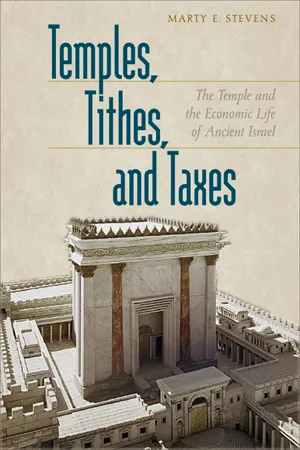
Temples, Tithes, and Taxes
The Temple and the Economic Life of Ancient Israel
- 222 pages
- English
- ePUB (mobile friendly)
- Available on iOS & Android
eBook - ePub
About this book
Information

Introductory Matters
This book is about the temple in Jerusalem in its role as the central religious and socioeconomic institution in ancient Israelite society. As the central sanctuary from the time of King Solomon through the time of Jesus, the Jerusalem temple played an important economic role in the community. But why would one even suspect that the Jerusalem temple has anything to do with economics? The cynic may answer, “Everything has to do with economics, even religion!” Certainly, there is some truth in that remark, since religious institutions must manage economic resources in their efforts to serve the community. In fact, some would say the major problem with religious institutions today is that they do not pay enough attention to their role as economic enterprises. But the connection between the Jerusalem temple and economics lies not in the overarching role of economics in society, but in the overarching role of the temple in society.
For most of Israel’s history, the political and religious authorities cooperated to govern the community in all spheres of life. The temple, therefore, functioned in ancient Israelite society as a central and centralizing institution. Concerned with matters far beyond the modern notion of “religion,” the Jerusalem temple played an important role in the economic life of the people and the nation. Yet very little attention has been paid to the economic role of the Jerusalem temple. Most scholarly discussion of the temple has focused on the development of Israelite religion and its relationship to neighboring cultures. Even if scholarship has acknowledged some impact of the temple on economic life, there has been no sustained attention to the question of how the temple functioned economically in ancient Israelite society. I intend to step into this gap.
Basic Terminology
It may be helpful to begin with a brief exploration of some basic terminology regarding ancient societies.[1]
Israel and Judah. The term “Israel” is fraught with multiple meanings—a person, a small geographic area in the eastern Mediterranean, an even smaller geographic area, a self-identified religious group. Likewise, “Judah” is both a person and a geographic area. According to the narrative in Genesis, the patriarch Abraham began his relationship with YHWH[2] when he was asked to leave his home and kindred and embark on a journey to “the land that I will show you” (Gen 12:1).[3] After a detour to Egypt, Abraham and Sarah settled in the land of Canaan and bore the miracle-baby they named Isaac (“laughter”). Isaac and Rebekah bore twins, Esau (“hairy”) and Jacob (“grabby”). As a grown man who had lived out his “grabby” character in Canaan and in Haran with his uncle Laban, Jacob wrestled with an angelman one night at the River Jabbok. The lasting result, besides a permanent limp, was that his name was changed to Israel, which may mean “he strives with God” (Gen 32:28). Later narratives and prophetic oracles used the name Israel to refer to the person of Jacob, the ancestor of the traditional twelve tribes, and to the tribal family that descended from the patriarch. The two names often appear in poetic parallelism: for example: “He (God) declares his words to Jacob, his statutes and ordinances to Israel” (Ps 147:19).
Geographically speaking, Israel was the name designating the entire area from Dan in the north to Beer-sheba in the south under the united monarchy of King David and his son, King Solomon. This is roughly the territory of the modern state of Israel. After the death of King Solomon, the united kingdom split into two kingdoms. The northern kingdom, from just north of Jerusalem to Dan, took the name Israel for its territory. When the northern kingdom was defeated and assimilated by Assyria in the eighth century, the remaining southern kingdom appropriated the name Israel, since they were the remaining on-site heirs to the Israelite identity. More broadly, Israel was the term used to refer to a religious community that came out of Egypt under the leadership of Moses and understood themselves to worship YHWH. This religio-ideological self-designation could be used regardless of geographic location or patriarchal genealogy. Even those who lived in the Diaspora (dispersion) could claim to be members of Israel.
Judah was the name of the southern kingdom formed after the death of King Solomon, from which the term “Jew” later derived. Judah was also the name of a person in the Old Testament, the fourth son of Jacob/Israel, who lent his name to the largest of the traditional twelve tribes.
Ancient Near East (ANE). The ANE is a broad descriptive title for the territories variously inhabited and controlled by the Medes, Persians, Babylonians, Assyrians, Hittites, Arameans, Elamites, Ammonites, Edomites, Moabites, Israelites, and others. Generally speaking, the ANE covers what has traditionally been known as Mesopotamia (modern Iran and southern Iraq), Assyria (northern Iraq and parts of Syria), and Syria-Palestine (modern Syria, Lebanon, Israel, and the Palestinian Authority). Sometimes the term Ancient Near East also includes all the ancient societies of the eastern Mediterranean basin, incorporating Greece and Egypt.
Time. Chronology is divided into two broad eras before and after a point called zero. There is no year zero, however. Previous convention designated these eras as B.C. (Before Christ) and A.D. (Anno Domini; Year of the Lord). Sensitivity to non-Christian populations in the world has led to the more recent designations of B.C.E. (Before the Common Era) and C.E. (Common Era). Of course, B.C.E. years count down toward zero, while C.E. years count up from zero. 1 B.C.E. immediately precedes 1 C.E. The numbering of centuries is always ahead of the actual date in years; for example, the sixth century encompasses the years 600–501 B.C.E. or 501–600 C.E.
In this study of the economic role of the Jerusalem temple we are mostly concerned with years B.C.E., since the First Temple was first constructed around 960 B.C.E. and was destroyed permanently in 70 C.E. Although the institution lasted for roughly a millennium, multiple structures served as the Jerusalem temple, and we even speak of time periods in reference to the various buildings. Thus the “First Temple,” constructed in the reign of Solomon in the tenth century B.C.E., was destroyed by the Babylonians in 587/6. These centuries are called the First Temple period. The “Second Temple” was (re)built beginning in 520 B.C.E., dedicated in 515 B.C.E., and finally destroyed in 70 C.E. by the Romans. Hence these centuries are the Second Temple period. King Herod undertook a major (re)building effort in the closing years of the first century B.C.E., resulting in what could legitimately be called the “Third Temple,” although it is usually included in the Second Temple period.
The years B.C.E. are often categorized in scholarship based on archaeological periods, such as the Bronze Age or the Iron Age. Sometimes it is more useful to categorize the centuries based on the dominant empires of the ANE, so we talk about the Neo-Babylonian period or the Persian period. The names of dynasties within these imperial reigns describe smaller segments of time, for example, the Achaemenid dynasty of the Persians or the 25th Egyptian dynasty. For ancient Israel, chronology was punctuated by the Exile, the devastating event of Babylonian deportation and destruction in 587/6 B.C.E. that lasted until the return of the exiles under King Cyrus of Persia in the 530s. Time periods are frequently designated, therefore, as preexilic (before 587/6), exilic (587/6 to 539), or postexilic (after 539).

Temple. Throughout the ANE, a temple was understood to be a focal point of the deity’s presence on earth. The divine dwelling place has many names, which can be rendered in English as house, temple, shrine, tabernacle, sanctuary, nave, and holy place. Despite its prominence in the biblical texts, there is no exclusive term for the Jerusalem temple. One would expect that such an important institution in the life of ancient Israelite society for a millennium would have an exclusive term for its designation, something like Temple with a capital T. No such exclusive term exists. The temple in Jerusalem is regularly called “house.” Throughout the ANE, the most common term for a temple was the “house” of the deity, the place of divine residence (Hebrew bayit when it stands alone or bêt when it is combined with another word to mean “house of”[4]). Biblical texts use the terms “house of YHWH” or the “house of God” (or the “house,” for short) to designate legitimate temples in Jerusalem, Bethel, and Shiloh. Perhaps even more surprising, “house” also refers to non-legitimate structures in Ephraim and Samaria. Temples devoted to deities other than YHWH, called “house of [deity name]” in the biblical texts, are located in Shechem, Samaria, Beth Shean, Philistia, Egypt, Assyria, and Babylon. So to call the Jerusalem temple “house of YHWH” or “house of God” used the same language as the temple in Ashdod, the “house of Dagon.” That is, the awe-inspiriting holiness of the site did not derive from the term “house,” but rather from the One who took up residence there, whether YHWH or any other god.
The other generic term for a temple in biblical texts is hêkāl. The word probably came into Hebrew under Mesopotamian influence from the Akkadian ekallu and the Sumerian É.GAL, “great house.” When the resident of the “great house” is divine, it is a temple; when the resident is a king, it is a palace. That is, there are plenty of examples in the biblical texts where the term hêkāl refers to a temple, usually the Jerusalem temple, and also refers to a royal palace. Again, there is no inherent holiness in the word hêkāl; holiness derives from the resident. When these two common terms appear in close proximity to describe one structure, the “house” (bayit or bêt) generally refers to the overall structure or complex, while the “temple” (hêkāl) refers to a large enclosed space located behind the altar. (See the discussion on the construction of the First Temple in chapter two.)
At this juncture one must note that both ancient Israelites and Mesopotamians conceived of the temple as a metaphorical, not a literal divine residence. Even when statues of the gods were present in temples to be clothed, fed, and bathed by temple personnel, the gods were not understood to be really dwelling, eating, and bathing. Rather, the statues were symbols of the god’s presence there. Everyone, or at least most people, knew that the deity’s real dwelling was in heaven.
Of course, the biblical texts go a step further than other ancient thinkers by mandating that “You shall never...
Table of contents
- Cover
- Title Page
- Copyright
- Contents
- Acknowledgments
- Abbreviations
- 1. Introductory Matters
- 2. Temple Construction
- 3. Temple Personnel
- 4. Temple Income
- 5. Temple Expenses
- 6. Temple as “Bank”
- 7. Concluding Matters
- Selected Bibliography
- Index of Names and Subjects
- Index of Foreign Words
- Index of Ancient Sources
- Notes
Trusted by 375,005 students
Access to over 1.5 million titles for a fair monthly price.
Study more efficiently using our study tools.
Frequently asked questions
Yes, you can cancel anytime from the Subscription tab in your account settings on the Perlego website. Your subscription will stay active until the end of your current billing period. Learn how to cancel your subscription
No, books cannot be downloaded as external files, such as PDFs, for use outside of Perlego. However, you can download books within the Perlego app for offline reading on mobile or tablet. Learn how to download books offline
Perlego offers two plans: Essential and Complete
- Essential is ideal for learners and professionals who enjoy exploring a wide range of subjects. Access the Essential Library with 800,000+ trusted titles and best-sellers across business, personal growth, and the humanities. Includes unlimited reading time and Standard Read Aloud voice.
- Complete: Perfect for advanced learners and researchers needing full, unrestricted access. Unlock 1.5M+ books across hundreds of subjects, including academic and specialized titles. The Complete Plan also includes advanced features like Premium Read Aloud and Research Assistant.
We are an online textbook subscription service, where you can get access to an entire online library for less than the price of a single book per month. With over 1.5 million books across 990+ topics, we’ve got you covered! Learn about our mission
Look out for the read-aloud symbol on your next book to see if you can listen to it. The read-aloud tool reads text aloud for you, highlighting the text as it is being read. You can pause it, speed it up and slow it down. Learn more about Read Aloud
Yes! You can use the Perlego app on both iOS and Android devices to read anytime, anywhere — even offline. Perfect for commutes or when you’re on the go.
Please note we cannot support devices running on iOS 13 and Android 7 or earlier. Learn more about using the app
Please note we cannot support devices running on iOS 13 and Android 7 or earlier. Learn more about using the app
Yes, you can access Temples, Tithes, and Taxes by Marty E. Stevens in PDF and/or ePUB format, as well as other popular books in Theology & Religion & Biblical Criticism & Interpretation. We have over 1.5 million books available in our catalogue for you to explore.