In this addition to the acclaimed Engaging Culture series, a highly respected author and Christian thinker offers a principled, biblical perspective on engaging political culture as part of one's calling.
James Skillen believes that constructive Christian engagement depends on the belief that those made in the image of God are created not only for family life, agriculture, education, science, industry, and the arts but also for building political communities, justly ordered for the common good. He argues that God made us to be royal stewards of public governance from the outset and that the biblical story of God's creation, judgment, and redemption of all things in Jesus Christ has everything to do with politics and government.
In this irenic, nonpartisan treatment of an oft-debated topic, Skillen critically assesses current political realities and helps readers view responsibility in the political arena as a crucial dimension of the Christian faith.
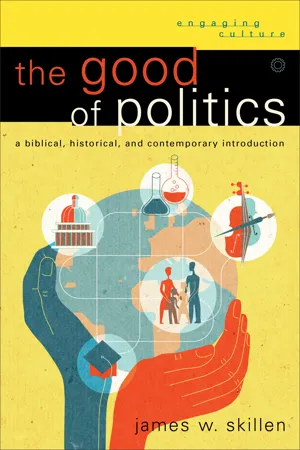
eBook - ePub
The Good of Politics (Engaging Culture)
A Biblical, Historical, and Contemporary Introduction
- 240 pages
- English
- ePUB (mobile friendly)
- Available on iOS & Android
eBook - ePub
The Good of Politics (Engaging Culture)
A Biblical, Historical, and Contemporary Introduction
About this book
Information
Topic
Theology & ReligionSubtopic
Christian Theology
1
God’s kingdom coming
The Messianic Promise
“Lord, are you at this time going to restore the kingdom to Israel?” (Acts 1:6). What a remarkable question! According to Luke, this was the last question ever put to Jesus. It came from the lips of his apostles just before he disappeared before their very eyes. Think of it: these disciples had been with Jesus for several years, including forty days after his death and resurrection, during which time he spoke with them “about the kingdom of God” (Acts 1:3). How could they have any more questions? Surely Jesus had explained everything they needed to know about his mission, the meaning of his death and resurrection, and their responsibilities from that time forward. But no, they were still unclear about Jesus’s relation to Israel and God’s promised kingdom. Jesus had taught them to pray, “Your kingdom come, your will be done, on earth as it is in heaven” (Matt. 6:10). But what exactly were they praying for, and when would God’s kingdom come on earth as it is in heaven?
Some of my Christian friends believe that the disciples misunderstood Jesus up to the very end. Jesus had not come to restore a political kingdom to Israel but to establish the church (a spiritual “kingdom”) and to save souls for eternity. The kingdom that was of concern to Jesus was something quite different from the one Israel had in mind. Apparently, the disciples would have to learn this after Jesus ascended to heaven and the Spirit had come to guide them in their evangelistic work.
Yet that is not the way Jesus responded to his disciples, according to Luke. Jesus did not reject their question as if it were beside the point and irrelevant to his mission. In fact, except for the question of timing, his response encouraged them to keep alive the question about Israel and God’s kingdom. As for timing, he told them, “It is not for you to know the times or dates the Father has set by his own authority” (Acts 1:7). But beyond that, the kingdom of God—a real kingdom—was indeed at the heart of everything Jesus preached and did during his life. He was born a son of Israel, he lived as a rabbi and prophet, and his deeds of healing the sick and forgiving sins trumpeted the arrival of Israel’s Messiah and God’s rule on earth.1
This is what Jesus’s mother prophesied even before he was born. “The Mighty One has done great things,” she sang in celebration. “He has brought down rulers from their thrones / but has lifted up the humble. / He has filled the hungry with good things / but has sent the rich away empty. / He has helped his servant Israel, / remembering to be merciful / to Abraham and his descendants forever, / just as he promised our ancestors” (Luke 1:49, 52–55). And the father of John (the baptizer of Jesus) prophesied with the same joy of hope fulfilled: “Praise be to the Lord, the God of Israel, because he has come to his people and redeemed them. He has raised up a horn of salvation for us in the house of his servant David . . . to show mercy to our ancestors and to remember his holy covenant, the oath he swore to our father Abraham: to rescue us from the hand of our enemies, and to enable us to serve him without fear in holiness and righteousness before him all our days” (Luke 1:68–69, 72–75).
So, there stood the disciples, a long time after they had first recognized Jesus as the Messiah of Israel, weeks after they had witnessed his death and resurrection, and yet . . . where was the kingdom of God? Why hadn’t Jesus rescued Israel from Rome and brought down Israel’s enemies from their thrones? When would every knee bow before the Messiah of Israel, the king of the earth, to fulfill God’s promises? How much longer would they have to wait?2
With the authority and assurance that always characterized him, Jesus answered by giving them their marching orders. Leave the timing in God’s hands, he told them. Here is what you need to know about me, about Israel, and about the kingdom of God: “You will receive power when the Holy Spirit comes on you; and you will be my witnesses in Jerusalem, and in all Judea and Samaria, and to the ends of the earth” (Acts 1:8). And then, suddenly, he was no longer there. Shocked, the disciples froze, unable to digest his words or to ask a follow-up question. But the follow-up came with the appearance of two men dressed in white: “Men of Galilee . . . why do you stand here looking into the sky? This same Jesus, who has been taken from you into heaven, will come back in the same way you have seen him go into heaven” (Acts 1:11).
Jesus, with the confident authority of a king whose domain runs to “the ends of the earth,” tells his disciples, who are thinking small (from within the confines of Roman-controlled Israel), that the Spirit of God will come upon them and send them out to Israel and far beyond Israel to proclaim Jesus the king and lord of all. As N. T. Wright says, “Luke stresses that the newly inaugurated kingdom claims as its sacred turf, not a single piece of territory, but the entire globe.”3 That is the message Jesus was asking his disciples to carry; that is what they were to bear witness to. And no sooner had he disappeared from their sight than messengers appeared in front of them to confirm, from on high, the authority of his message. The one who just ascended into heaven will return in God’s good time to put his feet on the earth again, and everyone will then understand (as John saw in a vision on Patmos) how God is fulfilling his promises to Israel: “‘Look, he is coming with the clouds,’ / and ‘every eye will see him, / even those who pierced him’; / and all peoples on earth ‘will mourn / because of him.’ / So shall it be! Amen. ‘I am the Alpha and the Omega,’ says the Lord God, ‘who is, and who was, and who is to come, the Almighty’” (Rev. 1:7–8). In his vision on Patmos, John heard the seventh angel sound his trumpet, followed by loud voices from heaven: “The kingdom of the world has become the kingdom of our Lord and of his Messiah, and he will reign for ever and ever” (Rev. 11:15). After John saw God’s final triumph over the beast, he heard the faithful singing the “song of God’s servant Moses and of the Lamb: ‘Great and marvelous are your deeds, / Lord God Almighty. / Just and true are your ways, / King of the nations. / Who will not fear you, Lord, / and bring glory to your name? / For you alone are holy. / All nations will come / and worship before you, / for your righteous acts have been revealed’” (Rev. 15:3–4).
Luke concludes the book of Acts with Paul living in Rome, where he “proclaimed the kingdom of God and taught about the Lord Jesus Christ” (28:31). The good news about Jesus that Paul and the other apostles were proclaiming, says Wright, “is the news of the kingdom of Israel’s god, that is, the message that there is no king but this god. More specifically, it is this Jewish message now crystallized as the news about Jesus, the Messiah, whom Paul announced as kyrios, Lord.”4 In the end, in other words, everyone and every nation, not just Rome and the enemies of the Jews, will find themselves at (or under) the feet of Christ Jesus, proclaiming God’s glory and the righteousness of his deeds.
But what did that mean for the disciples after Jesus ascended to heaven, and what does it mean for us today? If Jesus is the king of kings and not only the head of the church, then what does his ascension and invisible lordship have to do with the governing of modern states and nations? Did the early church answer these questions correctly? Did the Christian emperors of the late Roman Empire and the kings of medieval Europe get it right? What about the rulers of modern states, whether monocratic, aristocratic, democratic, or dictatorial?
Everything under His Feet
The picture that comes to mind most often when one hears the phrase “everything under his feet” is probably the picture of Jesus that John saw in his vision recorded in Revelation, a picture of triumph. The Lamb of God triumphs over sin and all the forces of evil arrayed against God. That is also what Paul described for the Corinthians. The end will come, wrote Paul, when the risen Christ “hands over the kingdom to God the Father after he has destroyed all dominion, authority and power. For he must reign until he has put all his enemies under his feet. The last enemy to be destroyed is death” (1 Cor. 15:24–26). These and several other passages in the New Testament quote or allude to Psalm 110: “The LORD says to my lord: ‘Sit at my right hand until I make your enemies a footstool for your feet.’. . . / The Lord is at your right hand; / he will crush kings on the day of his wrath. / He will judge the nations, heaping up the dead / and crushing the rulers of the whole earth. / He will drink from a brook along the way, / and so he will lift up his head” (vv. 1, 5–7).
This picture of retributive judgment, of a crushing triumph over the enemies of God, is not, however, the first and most basic picture the Bible presents when using the words “under his feet.” Recall Psalm 8, which refers to Genesis 1. The psalmist is reveling in the majesty of the Lord, whose glory reaches beyond the heavens. Overawed by that majesty and the wonder of all that God has created, the psalmist asks, “what is mankind that you are mindful of them, / human beings that you care for them?” He answers, “You made them rulers over the works of your hands; / you put everything under their feet” (Ps. 8:4, 6; see Gen. 1:26, 28). This is the psalm the author of Hebrews also quotes (2:6–8). In these passages we hear a positive celebration of the good order of creation, of God putting humans in charge of everything on earth, with no suggestion of divine retribution or of any destruction of enemies. God created humans, in their generations, to govern, develop, and care for the earth. The expression of putting everything under their feet tells us, in those contexts, of the responsibility men and women have been given to rule and develop the nonhuman creatures and, in the process, to cooperate with one another in nurturing and using their own talents. Men and women are royal stewards of the king of creation. This is a picture of the proper order of creation in which everything finds its place and is given its just due. The good order of creation situates humans under God—under God’s feet, on God’s earthly footstool, as Isaiah pictures it (66:1)—with a responsibility to do justice to the nonhuman creatures of the earth placed under their feet. This is not a picture of punishment or the destruction of enemies who have dishonored God and misdirected humans into pathways of death.
For this reason God’s acts of judgment in pulling down evil rulers and putting them under Christ’s feet do not aim to eliminate governments and every other kind of authority in creation but rather to restore and fulfill the good order of creation. Paul makes this clear in the verses that follow the ones quoted above from 1 Corinthians: “Now when it says that ‘everything’ has been put under him [Christ], it is clear that this does not include God himself, who put everything under Christ. When he has done this, then the Son himself will be made subject to him who put everything under him, so that God may be all in all” (15:27–28). Humans, forgiven of sin and restored to life in Christ, will find their proper place and responsibility once again under God. In other words, the Son’s act of submission to the Father is not the act of a defeated enemy, cast down by God. Rather, Christ’s submission reveals the humility of a servant, and the Father’s elevation of the Son to the position of supreme human ruler follows because of that faithful service through which the whole creation is reconciled to God. Explaining 1 Corinthians 15:20–29, Wright says, “This passage, the earliest Christian writing about the kingdom that we possess, retains the essential Jewish framework. Not only in the explicit biblical quotations, but in the entire sequence of thought, the point is that the creator god is completing, through the Messiah, the purpose for which the covenant was instituted, namely, dealing with sin and death, and is thereby restoring creation under the wise rule of the renewed human being.”5
Christ’s faithfulness unto death and his resurrection to life thus bring together both meanings of “everything under his feet.” God created humans to develop, fill, and govern the earth in his service until the work of their generations is completed, and God says, “Well done, good and faithful servants; enter into your reward.” This reflects the good order of creation. However, as the author of Hebrews says, even though the creator put everything under human feet, “at present we do not see everything subject to them” (2:8). The “not yet” is, in part, a consequence of the fact that the generations of the first Adam are still unfolding and have not yet completed their work. But the “not yet” is also due to human sinfulness. In their sin, all the generations of humankind together can never fulfill their vocation because they have turned away from faithful service to God and to one another and have brought disorder to creation. Nevertheless, says the author of Hebrews, human failure to serve faithfully as God’s vicegerents is not the last word in the story. For the author’s very next words are these: “But we do see Jesus, who was made lower than the angels for a little while, now crowned with glory and honor because he suffered death, so that by the grace of God he might taste death for everyone” (2:9). In other words, the Son of God, in response to humankind’s sinful defection, humbled himself to become one of us and to suffer death for our sake in order to redeem humans, thereby reconciling all things, properly reordered, to God.6
You can hear in this passage an echo of Paul in 1 Corinthians 15:27–28 and Philippians 2:5–11. The Son of God became human and “humbled himself by becoming obedient to death—even death on a cross! Therefore God exalted him to the highest place and gave him the name that is above every name, that at the name of Jesus every knee should bow, in heaven and on earth and under the earth” (Phil. 2:8–10). Jesus Christ is thus doubly honored in glorification. As the One who conquers sin and death, he puts every enemy of God under his feet, subjugating or destroying everything that stands against God’s creation purposes. And through his faithful service, Jesus restores the image bearers of God, male and female, to their rightful place in God’s good creation as royal stewards, under whose feet God originally placed everything.
But Jesus Said His Kingdom Is Not of This World
Even if we can find some basis in the Bible for arguing that earthly governance is part of what it means to be created in the image of God, didn’t Jesus say, “My kingdom is not of this world” (John 18:36)? Doesn’t that mean the kingdom Jesus is establishing is very different from any political order on earth? After all, the very next thing Jesus said was that if his kingdom were of this world, then “my servants would fight to prevent my arrest by the Jewish leaders. But now my kingdom is from another place” (v. 36). How, then, is it possible for human political life on earth to find its fulfillment in the kingdom Jesus is establishing “from another place”? Doesn’t an earthly political community, by its very nature, include fighting to defend itself? It looks as if there can be no connection between human political systems and the kingdom Jesus is establishing.
Keep in mind that in this passage in John’s Gospel, Jesus is standing before the Roman governor of Jewish territory (vv. 28–40). That governor, Pontius Pilate, finds himself in an uncomfortable position because the Jewish authorities have asked him to convict Jesus under Roman law as a criminal against Rome. They say Jesus is misleading people to believe that he is God’s chosen Messiah and thus the king of the Jews, something that should worry Rome. Pilate conducts a preliminary hearing of Jesus and concludes, to the contrary, that there is no reason to convict him. But the Jewish authorities are not satisfied with Pilate’s preliminary judgment. Under Roman jurisdiction, the Jewish leaders have no right to execute Jesus for a crime against Rome (v. 31). Of course, they are convinced that Jesus has broken laws of their own covenant by making claims about himself that only God can make, and thus they believe he should be put to death for blasphemy. Yet they hope Pilate will deliver the outcome they want by putting Jesus to death for treason against Rome. Pilate is not persuaded, but he goes back to have another conversation with Jesus because he would still like to satisfy the Jewish authorities.
Pilate then asks Jesus, “Are you the king of the Jews?” If Jesus answers yes, then of course Pilate will have the confession he needs to execute Jesus because a claim of kingship would challenge the rule of Caesar. If Jesus answers no, then he is no threat to Rome, and Pilate can turn him back to the Jews. But Jesus does not answer either yes or no. The answer he gives, that his kingdom is not of this world, is intended to show that his authority and his mission do not fit the categories of either Pilate or the Jewish leaders. Jesus did not come to challenge Rome on its own terms in order to try to take over the land of Israel or even the entire Roman Empire. His mission is not to try to gain control of a territory and hold onto it by force for as long as possible, the way ordinary rulers do. The kingdom that God sent him to establish is indeed different from the kinds of political systems with which we are familiar. But that does not mean the kingdom of God is unrelated to earthly politics. Jesus even says to Pilate, “You would have no power over me if it were not given to you from above” (John 19:11). In that way, Jesus acknowledges the legitimacy of Pilate’s position but does so on God’s terms, not on Rome’s terms. The mission of Jesus is to show both the Roman and the Jewish authorities that it is God alone who holds ultimate authority over them and holds them accountable to the terms of God’s kingdom.
With the Jewish leaders, Jesus has a different kind of disagreement. Their actions show they are willing to cooperate with Rome on Roman terms in order to try to get rid of a prophet who is challenging their authority and, in their eyes, committing blasphemy against God. However, they should not be cooperating with Rome in this way because their law calls them to acknowledge God alone as their supreme Lord. They shouldn’t be asking Pilate to judge a Jew with regard to his faithfulness to God’s covenant with Israel. Jesus has come to tell the Jewish people that God’s kingdom—the kingdom of heaven—is near. From Jesus’s point of view, the Jewish leaders should be listening to him as the authoritative prophet from God, not seeking Rome’s help to keep their own house clean.
The claim of Jesus that offended both the Jewish leaders and Pilate was that his authority came from another place, from God on high, and thus it had something directly to do with both Rome and Jerusalem. Pilate acknowledged no authority higher than the Roman emperor, who claimed to represent God on earth. If Jesus was correct, then he was indeed challenging the foundation of Caesar’s claim to authority. Of course, if Jesus was a fraud or was mistaken in his claim, then h...
Table of contents
- cover
- series page
- title page
- copyright page
- contents
- acknowledgments
- introduction
- part 1: the biblical drama
- part 2: key historical developments
- part 3: engaging politics today
- notes
- index
- back cover
Trusted by 375,005 students
Access to over 1.5 million titles for a fair monthly price.
Study more efficiently using our study tools.
Frequently asked questions
Yes, you can cancel anytime from the Subscription tab in your account settings on the Perlego website. Your subscription will stay active until the end of your current billing period. Learn how to cancel your subscription
No, books cannot be downloaded as external files, such as PDFs, for use outside of Perlego. However, you can download books within the Perlego app for offline reading on mobile or tablet. Learn how to download books offline
Perlego offers two plans: Essential and Complete
- Essential is ideal for learners and professionals who enjoy exploring a wide range of subjects. Access the Essential Library with 800,000+ trusted titles and best-sellers across business, personal growth, and the humanities. Includes unlimited reading time and Standard Read Aloud voice.
- Complete: Perfect for advanced learners and researchers needing full, unrestricted access. Unlock 1.5M+ books across hundreds of subjects, including academic and specialized titles. The Complete Plan also includes advanced features like Premium Read Aloud and Research Assistant.
We are an online textbook subscription service, where you can get access to an entire online library for less than the price of a single book per month. With over 1.5 million books across 990+ topics, we’ve got you covered! Learn about our mission
Look out for the read-aloud symbol on your next book to see if you can listen to it. The read-aloud tool reads text aloud for you, highlighting the text as it is being read. You can pause it, speed it up and slow it down. Learn more about Read Aloud
Yes! You can use the Perlego app on both iOS and Android devices to read anytime, anywhere — even offline. Perfect for commutes or when you’re on the go.
Please note we cannot support devices running on iOS 13 and Android 7 or earlier. Learn more about using the app
Please note we cannot support devices running on iOS 13 and Android 7 or earlier. Learn more about using the app
Yes, you can access The Good of Politics (Engaging Culture) by James W. Skillen in PDF and/or ePUB format, as well as other popular books in Theology & Religion & Christian Theology. We have over 1.5 million books available in our catalogue for you to explore.