eBook - ePub
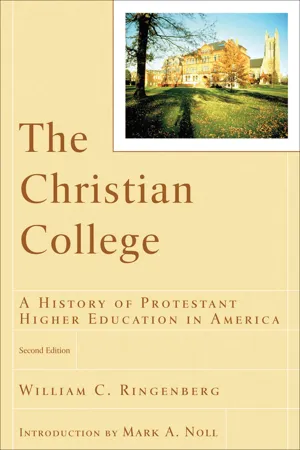
The Christian College (RenewedMinds)
A History of Protestant Higher Education in America
- 316 pages
- English
- ePUB (mobile friendly)
- Available on iOS & Android
eBook - ePub
The Christian College (RenewedMinds)
A History of Protestant Higher Education in America
About this book
When it first appeared in 1984 The Christian College was the first modern comprehensive history of Protestant higher education in America. Now this second edition updates the history, featuring a new chapter on the developments of the past two decades, a major introduction by Mark Noll, a new preface and epilogue, and a series of instructive appendixes.
Information
Topic
Theology & ReligionSubtopic
Higher Education1
The Colonial Period
The average American living in the late twentieth century finds it difficult to identify with the colonial period, for that era differs sharply from the present in many ways. The colonial population, even at its peak, never equaled 2 percent of today’s census; those few million colonists lived in only that small section of North America between the Atlantic Ocean and the Appalachian Mountains; they found it very difficult to travel even moderate distances except by water; and nearly everyone was a farmer, while almost no one worked in an industrial or service occupation.
Higher education, then and now, also offers a study in contrasts. Only a very small percentage of colonial young men enrolled in college (the colleges awarded only nine thousand baccalaureate degrees between 1642 and 1800);[1] the professors had acquired little training beyond their own undergraduate courses of study and they usually cultivated additional professional interests such as the ministry or medicine; the curriculum placed primary emphasis upon the study of Latin, Greek, and mathematics; and the colleges were more, rather than less, religious than was society in general (by 1800 only 7 percent of the population had joined a church, although approximately twice as many attended without formal membership).[2]
The Pervading Christian Purpose of Colonial Education
The Christian worldview, more than any other system of thought, dominated American intellectual development during the colonial period. As clergymen were the leading representatives of the intellectual class, it is not surprising that they, and the denominations that they represented, took the lead in founding colleges and instructing the students. While religious leaders founded institutions of higher learning primarily to educate future ministers, these colleges never operated solely as ministerial training seminaries. They also sought to provide culture and breadth of thought for the other leaders of society.
Regardless of the vocation for which a student was preparing, the colonial college sought to provide for him an education that was distinctly Christian. At Harvard the original goal of higher learning was “to know God and Jesus Christ which is eternal life (John 17:3), and therefore to lay Christ in the bottom as the only foundation of all sound knowledge and learning.” Yale in the early 1700s stated as its primary goal that “every student shall consider the main end of his study to wit to know God in Jesus Christ and answerably to lead a Godly, sober life.” Similarly, President Samuel Johnson of Columbia, in a 1754 advertisement, declared that the primary purpose of his college was “to teach and engage the children to know God in Jesus Christ and to love and serve him in all sobriety, godliness, and righteousness of life with a perfect heart and willing mind; and to train them up in all virtuous habits and useful knowledge as may render them creditable to their families and friends, ornaments to their country, and useful to the public Weal in their generations.” The Calvinist-related colleges probably promoted their religious goals more intensely than did the Anglican ones. Only Pennsylvania maintained primarily secular goals; perhaps it would have been more religious if the dominant denomination in its state, the Quakers, had desired during this early period to educate their clergymen. Even Pennsylvania experienced some Christian influence, however. For example, the first president was the Rev. William Smith, an Anglican clergyman who “gave the students all the Anglicanism the traffic would bear.”[3]
Although Massachusetts Bay was not the oldest colony in the new world, it was the first to establish a college. The unusually well-educated and spiritually earnest Puritans waited only six years to found Harvard primarily because they feared that if they delayed much longer they would risk leaving “an illiterate ministry to the churches when our present ministers shall lie in the dust.” Thirty-five of the university men in early New England, including a large majority of the Harvard founders, had attended Emmanuel College of Cambridge University. As a result, that “hot bed” of Puritanism became the institution after which Harvard modeled itself.
During the early years of Harvard, such a large percentage of its graduates entered the ministry that many referred to the college as “the school of prophets” and the students as “the sons of prophets.” By the eighteenth century, however, a growing number of New Englanders believed that Harvard was no longer the school where true prophets taught, but rather had become an institution which true prophets denounced. Among the leading denouncers were Increase Mather (Harvard president, 1685–1701) and his son Cotton Mather, who hoped to prevent Harvard from moving away from its original Calvinist orientation in an Arminian direction.
Even though Increase Mather was the most distinguished president to serve Harvard during the colonial period, he could not check the declining influence of the old faith. During the eighteenth century, Harvard not only moved away from Calvinism, but to and then beyond Arminianism toward a Unitarianism that became its most characteristic theological expression by the early nineteenth century.[4]
What the Calvinists could not maintain at Harvard they sought to establish at Yale. Although the citizens of Connecticut had long wished for a college of their own, the actual establishment of Yale in 1701 was considerably encouraged by the belief of many New England Calvinists that Harvard was slipping from the true path. Yale also experienced early challenges to its Calvinism; however, it dealt with these threats differently from Harvard. For example, in 1722 a rumor circulated that Rector (President) Timothy Cutler, Tutor Daniel Brown, and a handful of influential citizens in the New Haven community were beginning to accept Anglicanism. The trustees conducted an investigation which confirmed their worst fears. Subsequently, they dismissed both Cutler and Brown. Also, the board determined that the students should be taught Calvinist theology and none other, and that every officer of the college must publicly subscribe to the Westminster Confession of Faith and the Saybrook Platform of the Congregational churches in Connecticut before receiving an appointment. As a further effort to protect its students, Yale forbade them from attending Episcopal church services in New Haven. By contrast, a 1747 oath bill proposed at Harvard to impose Calvinism upon the members of that community failed to advance beyond the talking stage.[5]
While nine colonial colleges eventually appeared, to speak of them as a group is misleading because during most of the seventeenth century only Harvard existed, and until the generation before the American Revolution, only two more appeared (see table 1). Something must have happened, therefore, about the middle of the eighteenth century to stimulate the founding of six colleges during such a short period. More than any other factor, this active period of college founding is explained by the Great Awakening (or the First Great Awakening) of the 1730s and 1740s. This first major period of mass revivalism in American history swept through every colony and every denomination. As a result, several major religious groups which heretofore had not operated colleges quickly established such institutions in an effort to improve the quality of their increasing number of ministerial recruits. Therefore the Presbyterians founded Princeton; the Baptists, Brown; the Dutch Reformed, Rutgers; and the pro-revival Congregationalists, Dartmouth.[6]
Table 1. Colonial Colleges by Religious Affiliations[7]
| College | Founding date | Religious orientation |
| Harvard (MA) | 1636 | Puritan/Congregationalist |
| William & Mary (VA) | 1693 | Anglican |
| Yale (CT) | 1701 | Congregationalist |
| Princeton (NJ) | 1746 | New Light Presbyterian |
| Columbia (NY) | 1754 | Essentially Anglican |
| Pennsylvania (PA) | 1755 | Primarily secular |
| Brown (RI) | 1765 | Baptist |
| Rutgers (NJ) | 1766 | Dutch Reformed |
| Dartmouth (NH) | 1769 | New Light Congregationalist |
While the four new colleges understandably sympathized with the emotional faith which had helped give them birth, the two oldest colleges in the North reacted strongly against what they saw as the Awakening’s irrational approach to religion. The Harvard and Yale faculties recoiled particularly at the direct charges made against them by the leading preacher of the Awakening, the youthful and sometimes excessively exuberant itinerant minister George Whitefield. He charged, “As for the Universities, I believe it may be said, their light is become Darkness, Darkness that may be felt, and is complained of by the most Godly ministers.” Even worse, the Harvard and Yale students sometimes echoed the charges of Whitefield.[8]
The major theological controversy resulting from the Great Awakening was the question of whether experiential and emotional factors or rational factors should play the prominent role in religion. Many Presbyterians, particularly those in the South and West, accepted the New Light (e.g., pro-revival) position and consequently became increasingly dissatisfied with Harvard and Yale. A major related problem for them was that ministerial candidates who grew up in the East and attended colleges there hesitated to leave their native homes to assume ministerial responsibilities for the needy parishes in the Appalachian Mountain regions. Consequently, the need for ministers in the West was met by several Presbyterian academies, the most famous of which was Rev. William Tennent’s “Log College” at Neshaminy in Bucks County, Pennsylvania.
The Log College—actually a simple cabin “about twenty feet long and nearly as many wide,” as remembered by George Whitefield—and the twenty or thirty other academies that were modeled after it were apprenticeship institutions that in level of instruction operated somewhere between a grammar school and a college. Groups of students, especially ministerial candidates, would move in with a learned minister and study divinity and related subjects with him. The ministers who conducted these schools tended to be of the New Light persuasion and included such able figures as Samuel Davies, Samuel Finley, Jonathan Dickinson, and Aaron Burr. Gradually, however, William Tennent grew older and the supply of preachers being furnished by the other academies became inadequate; as a result the New Light Presbyterians sought an alternate means of training their future ministers. Thus by the mid-eighteenth century, both the western log colleges and the older established eastern colleges, for different reasons, were becoming increasingly unable to provide the type of training desired by the New Light ministers. Consequently, they founded Princeton.[9]
While Dartmouth developed into the school for New Light Congregationalists, it did not begin that way. It came into existence in 1754 as an institution for teaching American Indians. Its most famous early Indian students included Joseph Brant and Sampson Occum. Brant became a Mohawk chief, a colonel in the British army, and a Christian missionary who translated the Episcopal Prayer Book and part of the New Testament into Mohawk. Occum was a Mohegan who could speak fluent English and deliver stirring sermons. Eleazar Wheelock, the Dartmouth founder, sent Occum to England to raise funds, and his appearance in that country caused a major stir. Englishmen, who at this time were experiencing the Wesleyan revivals, were moved by the sight of a devout and persuasive Indian, seeking funds to convert and educate the members of his race in England’s leading colony. Consequently, when Occum and Nathaniel Whitaker, who accompanied him, returned in 1766, they brought with them more than £12,000 for the college. Although it was not the intention of Wheelock, the college quickly began to train many more whites than Indians, with the latter studying primarily in the preparatory department.[10]
The fact that the colonial institutions were religious in nature does not mean that they were private colleges in the modern sense of the term, for the twentieth-century distinction between public and private institutions did not exist in the colonial era. Although each of the three earliest colleges, Harvard, William and Mary, and Yale, was chartered by the established church in its colony, each also held a direct relationship to the state and served as the center for training civic as well as clerical leaders for its region. The governments in turn recognized the importance of the colleges and contributed significant amounts of financial aid to support them. For the most part, the colleges welcomed students and instructors of the several Protestant denominations, although usually they gave preference to members of the denomination sponsoring the college. Most of the new colleges founded in the mid-eighteenth century wrote into their charters specific provisions prohibiting denial of admission on the basis of religion. As a further reflection of their public nature, most of the new colleges named public officials as ex-officio members of their boards.[11]
If colonial higher education operated from a Christian foundation, it did so primarily because such an intellectual framework also characterized the European institutions that served as models for the colonial college founders. The essential characteristics of American church-related higher education can be seen as early as the fifth century in the palace, monastic, and cathedral schools, and during the Middle Ages in the continental universities and British universities and dissenting academies. In each of these periods, there was something about Christianity which stimulated people to inquire deeply about the nature and meaning of the universe.
The greatest influences on the colonial colleges, however, came from the universities of Cambridge and Oxford in England. The colonial colleges imitated the pattern of these two English institutions in several ways: religious groups largely controlled the institutions, the curriculum was narrow, the students resided as well as studied on the campus, higher education was primarily for the elite, and teaching youthful minds rather than discovering new knowledge was the primary purpose.[12]
During the eighteenth century, many of the new colleges looked more to the dissenting academies in Great Britain than to Cambridge and Oxford. Despite the vast emotional distance between the academies and the universities, they were very similar in structure and program. The academies came into existence in the late seventeenth century when following the period of Puritan rule the restored Parliament dismissed all non-Anglican faculty members from the universities. Some of the released faculty members attracted a group of sympathetic students and founded dissenting academies for the primary purpose of providing training for the ministers of such groups as the Congregationalists and the Presbyterians. The academies were smaller but often better institutions than the universities; their quality was unpredictable, however, varying widely depending upon the ability of the master. Where young men were able to study under an instructor like Philip Doddridge of Northampton, they probably received as good an education as was available anywhere in Great Britain at the time. The curriculum of the academies was broader than that of the universities and supplemented the primary emphasis upon ancient languages, philosophy, and theology with substantial work in mathematics, natural philosophy, and even English literature and public speaking. The founders of Princeton as well as those of the other Presbyterian schools that began in the South shortly after the Revolution knew well the work and nature of the dissenting academies and were strongly affected by them.[13]
Beginning in the eighteenth century, influences from Scotland became increasingly significant in shaping American higher education. The increasing number of immigrant Presbyterian ministers who filled the pulpits in Scotch-Irish commu...
Table of contents
- Cover
- Title Page
- Copyright
- Dedication
- Contents
- Preface to the Second Edition
- Preface to the First Edition
- Introduction: The Christian Colleges and American Intellectual Traditions
- 1. The Colonial Period
- 2. The Old-Time College
- 3. New Colleges and New Programs
- 4. The Movement toward Secularization
- 5. The Response to Secularization
- 6. The Reconstruction of Christian Higher Education after 1945
- 7. On to the Twenty-first Century
- Epilogue
- Appendix A
- Appendix B
- Appendix C
- Appendix D
- Appendix E
- Appendix F
- Appendix G
- Appendix H
- Notes
- Index
Trusted by 375,005 students
Access to over 1.5 million titles for a fair monthly price.
Study more efficiently using our study tools.
Frequently asked questions
Yes, you can cancel anytime from the Subscription tab in your account settings on the Perlego website. Your subscription will stay active until the end of your current billing period. Learn how to cancel your subscription
No, books cannot be downloaded as external files, such as PDFs, for use outside of Perlego. However, you can download books within the Perlego app for offline reading on mobile or tablet. Learn how to download books offline
Perlego offers two plans: Essential and Complete
- Essential is ideal for learners and professionals who enjoy exploring a wide range of subjects. Access the Essential Library with 800,000+ trusted titles and best-sellers across business, personal growth, and the humanities. Includes unlimited reading time and Standard Read Aloud voice.
- Complete: Perfect for advanced learners and researchers needing full, unrestricted access. Unlock 1.5M+ books across hundreds of subjects, including academic and specialized titles. The Complete Plan also includes advanced features like Premium Read Aloud and Research Assistant.
We are an online textbook subscription service, where you can get access to an entire online library for less than the price of a single book per month. With over 1.5 million books across 990+ topics, we’ve got you covered! Learn about our mission
Look out for the read-aloud symbol on your next book to see if you can listen to it. The read-aloud tool reads text aloud for you, highlighting the text as it is being read. You can pause it, speed it up and slow it down. Learn more about Read Aloud
Yes! You can use the Perlego app on both iOS and Android devices to read anytime, anywhere — even offline. Perfect for commutes or when you’re on the go.
Please note we cannot support devices running on iOS 13 and Android 7 or earlier. Learn more about using the app
Please note we cannot support devices running on iOS 13 and Android 7 or earlier. Learn more about using the app
Yes, you can access The Christian College (RenewedMinds) by William C. Ringenberg in PDF and/or ePUB format, as well as other popular books in Theology & Religion & Higher Education. We have over 1.5 million books available in our catalogue for you to explore.