Christianity Today 2014 Book Award Winner
Named one of Ten Outstanding Books of 2013 for Mission Studies, International Bulletin of Mission Research
This comprehensive introduction helps students, pastors, and mission committees understand contemporary Christian mission historically, biblically, and theologically. Scott Sunquist, a respected scholar and teacher of world Christianity, recovers missiological thinking from the early church for the twenty-first century. He traces the mission of the church throughout history in order to address the global church and offers a constructive theology and practice for missionary work today.
Sunquist views spirituality as the foundation for all mission involvement, for mission practice springs from spiritual formation. He highlights the Holy Spirit in the work of mission and emphasizes its trinitarian nature. Sunquist explores mission from a primarily theological--rather than sociological--perspective, showing that the whole of Christian theology depends on and feeds into mission. Throughout the book, he presents Christian mission as our participation in the suffering and glory of Jesus Christ for the redemption of the nations.
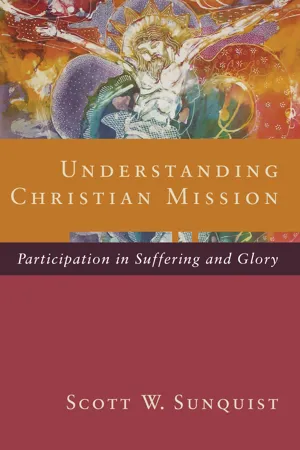
- 464 pages
- English
- ePUB (mobile friendly)
- Available on iOS & Android
eBook - ePub
About this book
Information
Topic
Theology & ReligionSubtopic
Christian MinistryPart 1
Suffering and Glory in History
The Mission Movement
We begin our study of missiology with history. We do this for three reasons. First, Christianity is one of the few historical or “secular”[37] religions that exists. God created, and with that creation time began. Beginning with God’s revelation to Abraham (a call to a specific family and a specific geographical location), Christian heritage is a clear break with local hierophanic[38] and cyclical faiths (which I describe below). God, in Christ, entered into this mundane world of sin and grace, of pain and joy, lifting up physical existence and redeeming time-bound life.[39] The physical world that moves from moment to moment, the place where time will “sweep [us] all away”[40]—this is the place of God’s redemption and therefore of Christian mission. Mission is through all of time and into all of creation.
In contrast to this view of time and history, most religions of the world, responding to human problems (pain, suffering, aging, death, injustice) find the answer in escape from the physical world. For example, in ancient Greek thought, the spiritual is superior to the physical. The realm of “idea” is superior to the realm of physical human life. Early Gnostic influences in Christianity were rejected again and again because they denigrated time and the physical world. The goal in most religions is to escape the physical world and to exist, even if in a semi-animated state, in the spiritual realm. Hinduism and Buddhism also denigrate the physical world, having as their goal escape from the endless cycle of suffering in this world.[41] If we can talk about holiness in Buddhism it would be to be “unattached” from this world and its desires. Thus, in most religions, this physical world, with its brokenness, suffering, decay, and death, is nothing but an endless cycle. There is no progress, no moving forward: only escape. Christianity radically critiques this cyclical view of reality. In the incarnation, God has entered time—and he therefore sanctifies historic events. Through the resurrection, he redeems time—by conquering evil in a specific place in a particular time. The incarnation itself is a divine shout of joy regarding this world of time and matter. History is meaningful and carries sacredness within it. The biblical texts tell a story—the story of God in his created world—the story of redemption, in time, moving toward a glorious goal, for all of the nations. As Newbigin expresses it, mission is to the end of time and to the end of the earth.[42]
My second reason for starting with history is that Christian mission, as an expression of the mission of God, is a process that takes place in history and therefore has historical dimensions and implications. Christian mission must respond to historical contexts as it speaks to historical contexts. Christianity roots the individual in a community in a particular context, and it does this by grafting the person into the vine of life. The elevation of the Christian from strictly secular and historical realities, so that the heart and mind are in Christ Jesus (Col. 3), makes it possible for the Christian to have a missional presence that has the power to transform this earthly existence. Complete identification with the secular (this world) means one has no critical distance and therefore no leverage with which to transform this world. Christian mission takes place in the world, it is for the world, but it is from God. Thus, Christian mission is both influenced by the historical and exists for the sake of influencing what is historical. Christian mission is not an otherworldly activity, in the sense that it provides a spiritual dimension that takes us out of, or raises us above, the daily grind. This would be more akin to Buddhist meditation or New Age spirituality as personal therapy. Christian mission is for the world that we believe God created, God loves, and God continues to redeem. Christians are invited to participate in this historical work of God in his creation.
Third, I begin with history because, quite obviously, we are not originating mission in the twenty-first century. We are participating with a long line of saints and sinners who have been more or less faithful to God in time and space. On one hand, we must recognize the great work of those in the past and find ways to build on this. On the other hand, we must make careful judgments about where our past participation in mission has not been faithful to God’s mission. We should always be searching for what has been done and what has been left undone as we step into the path of mission faithfulness. History is our context. Martyrs, apostles, and saints are our instructors. Mission is not merely an abstract theory that we discuss, that academics play with during scholarly conferences. Mission is also not something that we read from the Bible, as if the Bible were a modern set of missionary instructions. This is the mistake of much missionary literature today: the Bible is treated as a twenty-first-century handbook on mission and the Great Tradition of the saints, and the complex issues of the present are ignored.
I want to affirm that mission does not exist apart from the historical reality of Christ’s body speaking and acting in the world. What has gone on in the past centuries helps to explain where we are today. My focus in the first part of this book will be with recent history (the past five hundred years!), but I will also give an overview of themes from the first fifteen hundred years. The reason for my greater concern with recent centuries is self-evident: this history most directly influences our present reality. Earlier historical periods are no less important, of course, but many others have written that history at length.[43] I will move quickly through the earlier periods and then focus on the new mission theology and practice that began with the Jesuits in the sixteenth century. This more recent history reveals the issues, the struggles, and the themes that give context to our contemporary discussions on Christian mission. Two major themes begin in the sixteenth century that reveal why I begin my historical analysis there: globalization of Christianity and the Reformation (beginning in 1482).[44] European church divisions and globalization occurred almost concurrently. Therefore, I begin with the major trends in missionary activity during this period of great creativity in Christian theology, trends that were stimulated by early encounters with modernity and with other religions and cultures. This was a period when cultural and religious intolerance was finding its way toward greater tolerance. It was a period of empire building, rapidly growing technology, and cross-cultural encounters. It was also the period of early secularization and pluralism.[45] What could be more appropriate for today?
1
Ancient and Medieval Mission
Earliest Christianity developed without the privileges of political tolerance, cultural understanding, or translation into the common languages of the age. From the start, the followers of Jesus had a sense of mission and identity with Jesus, but they were a marginal group of Jewish outsiders speaking only Aramaic or Greek. Slowly the heartbeat of Jesus’s mission for all nations and languages pulsated in the body of Christ, crossing cultural and imperial barriers in Africa, Asia, and Europe. By the high Middle Ages, the missional impulse had developed communities of Jesus followers from China to Spain and from Scotland to Ethiopia.
Earliest Christianity: Suffering Missional Presence
Christian mission from the earliest centuries after the death, resurrection, and ascension of Jesus Christ was mission from a position of weakness. No kingdoms or princes supported the fledgling religious movement, which was often misunderstood as a sect of Judaism. Christians were ridiculed by the Jews for their insistence that Jesus was the Messiah, and they were criticized by the pagan Romans for being “atheists” (not worshiping the pagan gods or the “genius” of the emperor). We know now that Christianity grew in all levels of society (not just among the poor and disenfranchised), but more among women than among men.[46] Persecution both scattered the believers, sending them to establish new communities of Jesus followers, and strengthened the resolve of the believers. Suffering has a way of focusing one’s life and thoughts. It must not be forgotten that Christianity was born in suffering and oppression, inspired by a prophet who was identified with suffering (passio: to suffer). Small communities spread along trade routes, in port cities, and along the Old Silk Route that stretched from the Mediterranean all the way to old Cathay (China). Very soon followers of Jesus were in Gaul, Spain, Ethiopia, India, and present day Central Asia. There was no one center, no single strategy, but there was a united understanding that the message was about the meaning of Jesus for all people,[47] and the life of Jesus within his followers. In less than two hundred years the message was being spread in Syriac, Latin, Greek, and Aramaic.[48]
What kept the early Christians together when there was so little in the way of central structure or dominant authority? Earliest Christianity was movement with little institution. It was united by a common belief that Jesus Christ was raised from the dead and that his teaching and life was to be spread to all people. All people were to be united in worship of Jesus as Lord. Thus, both the call to mission and the call to worship kept Christians united across languages and empires.[49] Worship was a shared experience that involved common liturgical phrases and structures. The liturgy pointed to the life and work of Jesus and gave structure to basic beliefs about the person of Jesus and the triune nature of God. The early Jesus movement was persecuted and fragmented, but it retained great zeal for mission. Later, when Scriptures were becoming standardized, it was the liturgy that provided the standard for what was authentic Jesus material and what was not. The Bible was a much later standard.
The first major shift took place when these struggling missional and worshiping communities began to garner royal support. When kings and other rulers began to convert, mission theology was turned upside down. Abgar IX (who ruled 179–86), the Christian king of the Roman client kingdom of Osrhoene (the capital of which was Edessa); Tiridates the Great, the Armenian king (who converted to Christianity in 301); and Constantine the Great (who ruled 306–37) were three of the earliest Christian rulers. All were in western Asia and all ushered in a new age of missionary understanding. Since both Armenia and Osrhoene were client kingdoms, or bargaining properties for Rome and Persia, it is the later semi-converted Roman emperor Constantine who really set in motion a new understanding of Christian identity, and thus of Christian mission.[50] Suddenly, under the rule of one emperor, Christianity was transformed from persecuted minority cult to favored faith. This imperial support continued in the West (Europe) even when non-Christian tribes invaded from the north and the east. The story was very different in Asia, where imperial support waned and large intercultural faiths (Zoroastrianism, Hinduism, and later Islam) persecuted Christian communities. Christian mission looks very different when Christianity is a royally favored faith.
In Asia, the revival of the Zoroastrian religion with imperial support in Persia, followed by the rapid spread of Islam in western Asia, meant that Christian liturgical development, theology, and practice occurred in a contentious missional context. While Asian Christians struggled to survive in a hostile anti-Christian context, European Christians, with the support of the empire, developed their understanding of the church for about one thousand years without that type of pressure—without their earlier missional context. With Europe cut off from most of Africa and Asia, the missional story became the long process of converting Western culture, not sending missionaries to other regions of the world. As post-Constantinian Western society became more a part of the church (not necessarily more Christian), its connections to the outside world were cut by the expansion of Arab-Islamic culture. And when Christianity is not able to express itself missionally, to outsiders, it turns in upon itself. As Bosch says so clearly, “The Christian faith . . . is intrinsically missionary. . . . Christianity is missionary by its very nature, or it denies its very raison d’être.”[51]
Not only was this long period of ecclesial development in Europe almost devoid of missional context, it was also in a “Christendom” context that involved political and religious cooperation.[52] Thus mission turned inward, with the support and power of the state, as a movement to keep the church unified and pure. In the big picture of European history, Christian mission—which reaches out with the love of God in Jesus Christ to outsiders—was co-opted. To the east, in Zoroastrian and later Muslim Persia, Christians were further and further marginalized, and they lost the opportunity to witness outside of their community. European Christianity became Christendom; Asian Christianity was a melet community.[53] Both lost their purpose and promise for the larger society—entrapped by royal intervention in Europe and enclosed by melet structures in Asia.
Monasticism: Spirituality in Mission
In the Eurasian context of Christianity, roughly from the fourth through the fifteenth centuries, Christian mission was kept alive not from the ecclesial center but from the margins.[54] It was monastic movements of outreach, study, and renewal that continued the church’s mission. The rise of monasticism in the fourth century was in part a missional renewal movement: to tear the church away from its early captivity to worldly power and riches. Christians sought to find an appropriate way to continue the basic understanding of the spiritual life. And what was the basic way of understanding the spiritual life in the early church? The life in Christ is the life that imitates Christ. Both of these elements were foundational from long before the development of monasticism in the fourth through sixth centuries. Christians are, in an ontological sense, “in” Christ Jesus, living the life of Jesus Christ (in community) for the world. But Christians, on a secular level, are also persons who endeavor to imitate Christ: both working out their salvation and knowing that God is at work within them. The earliest noncanonical Christian writings were very clear that the Christian was to imitate Christ in humility, in preaching, and in care for the poor. Representative of this understanding is Ignatius’s exhortation to the Ephesians regarding their life as a witness:
Pray continually for the rest of humankind as well, that they may find God, for there is in them hope for repentance. Therefore allow them to be instructed by you, at least by your deeds. In response to their anger, be gentle; in response to their boasts, be humble; in response to their slander, offer prayers; in response to their errors, be steadfast in the faith; in response to their cruelty, be meek; do not be eager to imitate them. Let us show by our forbearance that we are their brothers and sisters, and let us be eager to be imitators of the Lord, to see who can be the more wronged, who the more cheated, who the more rejected, in order that no weed of the devil may be found among you, but that with complete purity and self-control you may abide in Christ Jesus physically and spiritually.[55]
Ignatius, greatly concerned in this letter for church order and unity, does not neglect the foundational concern of Christian witness through humility, gentleness, suffering, and identification with Jesus Christ. A slightly later writing, the apologetic work The Epistle to Diognetus,[56] expands on the purpose or genetic makeup of the church. Apologetic writings of the ancient church comprise some of the earliest theological literature: theology in defense of the faith or theology for outsiders, that they might come to faith. Theology develops on the missional edge of the church. The Epistle to Diognetus is a memorable and recognizable writing that identifies the missional presence and developing theology of the earliest Christians.
The incarnational principle of Christianity is evident in that Christians eat local food and dress like local people. However, although enculturated, Christians are not captive to any local culture.[57] Christians are a missional presence, pointing to the Kingdom. When this missional presence became normative and popular, many fled to deserts and caves to maintain their sacredness and Christlike detachment from the world (“suffer as strangers”). Continuing the passion of Christ was hard to imagine when society honored Christian bishops and priests.
When the emperor became tolerant and then supportive of the church, to the point of inviting the leaders to his palace in Nicaea, Christian humility and humiliation seemed to slip away. It was difficult to follow the lowly suffering Christ in an age of affluence and comfort. Therefore the taproot of monasticism—asceticism—started as a spiritual recovery. St. Anton...
Table of contents
- Cover
- Title Page
- Copyright Page
- Dedication
- Epigraph
- Contents
- Acknowledgments
- Preface
- Introduction
- Part 1: Suffering and Glory in History
- Part 2: The Suffering and Glory of the Triune God
- Part 3: The Suffering and Glory of the Church
- Appendix: Twentieth-Century Ecumenical Councils
- Bibliography
- Scripture Index
- Subject Index
- Notes
- Back Cover
Trusted by 375,005 students
Access to over 1.5 million titles for a fair monthly price.
Study more efficiently using our study tools.
Frequently asked questions
Yes, you can cancel anytime from the Subscription tab in your account settings on the Perlego website. Your subscription will stay active until the end of your current billing period. Learn how to cancel your subscription
No, books cannot be downloaded as external files, such as PDFs, for use outside of Perlego. However, you can download books within the Perlego app for offline reading on mobile or tablet. Learn how to download books offline
Perlego offers two plans: Essential and Complete
- Essential is ideal for learners and professionals who enjoy exploring a wide range of subjects. Access the Essential Library with 800,000+ trusted titles and best-sellers across business, personal growth, and the humanities. Includes unlimited reading time and Standard Read Aloud voice.
- Complete: Perfect for advanced learners and researchers needing full, unrestricted access. Unlock 1.5M+ books across hundreds of subjects, including academic and specialized titles. The Complete Plan also includes advanced features like Premium Read Aloud and Research Assistant.
We are an online textbook subscription service, where you can get access to an entire online library for less than the price of a single book per month. With over 1.5 million books across 990+ topics, we’ve got you covered! Learn about our mission
Look out for the read-aloud symbol on your next book to see if you can listen to it. The read-aloud tool reads text aloud for you, highlighting the text as it is being read. You can pause it, speed it up and slow it down. Learn more about Read Aloud
Yes! You can use the Perlego app on both iOS and Android devices to read anytime, anywhere — even offline. Perfect for commutes or when you’re on the go.
Please note we cannot support devices running on iOS 13 and Android 7 or earlier. Learn more about using the app
Please note we cannot support devices running on iOS 13 and Android 7 or earlier. Learn more about using the app
Yes, you can access Understanding Christian Mission by Scott W. Sunquist in PDF and/or ePUB format, as well as other popular books in Theology & Religion & Christian Ministry. We have over 1.5 million books available in our catalogue for you to explore.