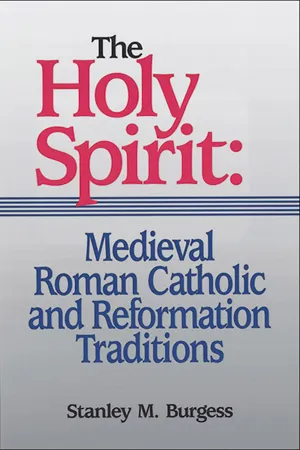
The Holy Spirit: Medieval Roman Catholic and Reformation Traditions (Sixth-Sixteenth Centuries) is the third in a series of three volumes devoted to the history of Christian pneumatology.
In the first volume, The Holy Spirit: Ancient Christian Traditions (formerly titled The Spirit and the Church: Antiquity), Stanley M. Burgess detailed Christian efforts from the end of the first century to the end of the fifth century A.D. to understand the divine Third Person. Volume 1 explored the tensions between the developing institutional order and various prophetic elements in the Church.
The second volume, The Holy Spirit: Eastern Christian Traditions, brought together a wealth of material on the Spirit from Eastern Christian traditions, a rich heritage often overlooked in Western Christianity. By exploring the various ways in which Eastern theologians understood the Third Person of the Trinity, volume 2 showed how modern Christians can gain a wider vision and fuller understanding of the workings of the Holy Spirit in history and in our own generation.
This concluding volume examines medieval Roman Catholic and Reformation attitudes toward the Holy Spirit beginning with the writings of medieval Catholic theologians from Gregory the Great and Bede to Aquinas and Bonaventure. Subsequent sections describe the contributions of influential women such Hildegard of Bingen, Birgitta of Sweden, and Catherine of Siena; "fringe" figures such as Joachim of Fiore and the Cathars; the magisterial reformers Luther, Zwingli, and Calvin; leading Catholic reformers such as Ignatius of Loyola; and the "radical reformers" Thomas Muntzer and Menno Simons.
- 272 pages
- English
- ePUB (mobile friendly)
- Available on iOS & Android
eBook - ePub
The Holy Spirit: Medieval Roman Catholic and Reformation Traditions
About this book
Information
Topic
Teología y religiónSubtopic
Historia del cristianismopart 1
THE CATHOLIC CHURCH IN THE EARLY MIDDLE AGES
(476–1100)
(476–1100)
Rome was sacked by the Goths in 410. This was the first time in history that Rome had fallen to an enemy, and the shock was great in the West. In 476 the last of the Roman-born emperors died—a year many historians now believe marks the political collapse of the Western empire.
The position of the church as an institution in society was profoundly affected by this demise of secular authority. In some border areas, Christianity was temporarily obliterated. In Italy, the papacy had to assume responsibility for maintaining political order and for averting famine. Gregory the Great, pope from 590 to 604, combined spiritual and political leadership. He administered the church’s extensive land holdings throughout Italy and supplied the needs of the poor in Rome and elsewhere. At the same time, he laid the foundations of the new structure of the medieval papacy that was to govern the western world after the wars and invasions of the sixth century.
Despite the chaos experienced throughout the western portion of the former Roman Empire, in the next two centuries Christianity reconquered areas lost and expanded rapidly into hitherto pagan regions. England was a prime example of the church’s success at this time of great confusion and intellectual darkness. The Venerable Bede, a simple monk from York, provides much of our evidence for the period in his Ecclesiastical History of the English People. But Bede wrote on many subjects. He was a church reformer, reacting against abuses that were introduced into the affairs of ecclesiastical and monastic institutions. He was also a masterful biographer, attempting to preserve the memory of the saints of his period.
Both Pope Gregory and the historian Bede write extensively about supernatural occurrences in their time. Today, scholars call this type of literature “hagiography.” Most critical scholarship assumes that the stories found in this literature of miracles, signs, and wonders are not credible. But the church grew dramatically, against enormous odds; and those pagans won to the Christian faith seem to have believed that the divine hand was reaching down to directly affect their lives and the lives of those around them. For them, stories of the miraculous were believable, and they relied on them to shore up their faith in very difficult times.

Gregory the Great
(540?–604)
(540?–604)
Biography
Regarded as the fourth and last Latin “doctor of the Western church” (preceded by Ambrose, Jerome, and Augustine), Gregory was the architect of the medieval papacy. An outstanding student of law, he held the important post of prefect of Rome from 573 onwards. About 574 he founded seven monasteries, and he became a monk at one of these (St. Andrew) in 575. In 579 he was made deacon and was sent by Pope Pelagius II to Constantinople as papal ambassador. About 586 he returned to St. Andrew, where he resided until 590, when he assumed the heavy burden of the papacy. He proved to be an able administrator, improving the quality of the clergy and promoting the monastic life. Among his most historic actions was the sending of Augustine (later of Canterbury) and about forty missionaries from his own monastery to convert the Anglo-Saxons.
Writings
Gregory’s greatest contribution, however, was his transmission of the wisdom of the ancient world to the Middle Ages. His writings include forty homilies on the Gospels (590–91),[1] twenty-two homilies on Ezekiel (593),[2] the Book of Morals (a commentary on Job emphasizing Christian ethics),[3] Pastoral Care (on the duties and qualities of bishops),[4] fourteen books of letters,[5] and the Four Books of Dialogues on the Lives and Miracles of the Italian Fathers and on the Immortality of the Soul (593–94).[6] The latter served as a model to most later medieval hagiographers.
The Holy Spirit
Commenting on the Song of Solomon, Gregory emphasizes the oneness of Jesus and the Holy Spirit. He states, “The perfumes of the anointing of the Lord are the virtues; the perfume of the anointing of the Lord was the Holy Spirit.” Jesus was anointed with the oil of the divine Spirit in the moment of his incarnation, Gregory reminds his readers. He did not become man first only to receive the Holy Spirit afterwards, but was incarnated through the mediation of the Holy Spirit. Thus he was anointed with divine oil from the moment of his incarnation as a man. The odor of the anointing perfume was the aroma of the Spirit of God, who both proceeded from the Son and remained in him as the incarnate Christ Jesus.[7]
In a homily on John 14:23–27 designed for use on Pentecost Sunday, Gregory deals with the role of the divine Paraclete.[8] The Spirit is called an advocate, because he intervenes before the Father’s justice on behalf of sinners with unutterable groanings (Rom 8:26). The Spirit also impresses Christians whom he fills to plead earnestly on behalf of sinners, even as he prepares a hope of pardon for those grieving over their sins. For this reason the divine Third Person is called a consoler: he lifts up the hearts of grieving sinners from sin and affliction.[9] Finally, the Holy Spirit also teaches all things. Thus a person must have not only a human teacher, but also an inner teacher who teaches individually; no one is truly instructed unless he or she is anointed by the Spirit of God.[10]
Gregory then deals with the Spirit’s coming on the day of Pentecost. His coming, in fiery tongues, brought to the disciples the knowledge of all languages. Flame was the medium of the Spirit’s revelation because God is an immaterial and indescribable fire (Heb 12:29), coming to kindle the hearts of the frigid and the materially minded with the love for God. Tongues were the shape revealed, because the tongue produces words, and whoever is touched by the Holy Spirit confesses the Word of God, his only-begotten Son. So the Spirit appeared in tongues of fire because he causes all he fills both to burn and to speak. In turn, godly teachers preach with fiery tongues out of love for God and inflame the hearts of their hearers.
The miracle of languages at Pentecost signified that the church, fitted with the same Spirit, was going to speak with the voice of all nations. According to Gregory, this was a reversal of the diffusion of languages at Babel. Whereas formerly the disciples had been afraid to speak openly of Christ even in their own language, now they began to proclaim him in a variety of languages.[11]
The divine Spirit was also revealed at different times both as a dove and as fire. This suggests to Gregory that neither guilelessness nor fervor alone is pleasing to God. Each heart touched by the divine Spirit must be holy as the Spirit is holy, and it must possess fiery zeal from the Spirit.[12]
Gifts of the Holy Spirit
Commenting on the book of Job, Gregory sees the gifts of the Spirit (the Isa 11 list) as armor against a variety of evils. Wisdom is to counter folly, intelligence eliminates stupidity, counsel mediates against rashness, courage conquers fear, knowledge extinguishes ignorance, piety reduces harshness, and the fear of the Lord eliminates pride.[13] Gregory understands the spiritual gifts listed in Isa 11 to be presented in descending order of significance. The greatest are wisdom and understanding, then counsel and might, then knowledge and piety, and finally the spirit of the fear of the Lord. The Christian should first climb the step of the fear of the Lord, then of knowledge and piety, and proceed up the ladder to the heights of wisdom and understanding.[14]
In another homily prepared for the day of Pentecost, Gregory again turns to the gifts of the Spirit. This time he selects the gift list provided by Paul in 1 Cor 12:8–11.[15] The Holy Spirit has chosen to adorn the heavens with these gifts (Job 26:13). They are the virtues of preachers. The apostles would never have ventured to stand up to the world around them unless the Spirit had strengthened them with spiritual giftings. Before the Spirit’s coming, they had trembled in fear of being discovered and persecuted. After receiving the Spirit, they rejoiced at being beaten, because they enjoyed an inner consolation of the Spirit.[16] Gregory exults in the wonder of Pentecost:
The Spirit filled a boy who played upon a harp and made him a psalmist (1 Sam 16:18), a shepherd and herdsman who pruned sycamore trees and made him a prophet (Amos 7:14–15), a boy given to abstinence (Dan 1:8), and made him a judge of mature men, a fisherman and made him a preacher (Matt 4:19), a persecutor and made him the teacher of the Gentiles (Acts 9:1–20), a tax collector and made him an evangelist (Lk 5:27–28).
Gregory concludes, “What a skillful workman this Spirit is! The Spirit’s very touch is teaching. It changes a human mind in a moment to enlighten it; suddenly what it was it no longer is, suddenly it is what it was not.”[17]
As the only-begotten Son is worthy of honor, so also is the Holy Spirit who came down from above to fill humans with divine presence and power.[18] And how do we know that there is a divine Spirit who is beyond the realm of sensory experience? Gregory argues in this manner: None of us can look directly at the rising sun—yet it still is there. We look at the mountains bathed in sunlight and know that the sun has risen. So too we cannot see the Son of righteousness himself, but we can see holy men and women who shine with virtues and gleam with miracles.[19]
Miracles in Gregory’s Time
Gregory the Great provides some of the clearest evidence available that, in the late sixth and early seventh centuries, the miraculous was not only anticipated but experienced frequently.[20] The heroes of his Four Books of Dialogues on the Lives and Miracles of the Italian Fathers and on the Immortality of the Soul,[21] for example, are men and women of God who possess the authority and power of the divine Spirit. Gregory understands that miracles were necessary in the early church to accomplish the work of evangelism. He feels they are also necessary in his own time for the conversion of pagans and the transformation of the Lombard heretics. Finally, he sees them as being provided by God to deepen the faith of those who are already baptized Christians. Gregory declares that the soul which is filled with the divine Spirit will be recognized easily by its miraculous powers and humility. Humility is necessary because some believe that they are filled with the Holy Spirit and refuse to be guided by another human being, thereby becoming teachers of error.[22] To keep humans humble, God sometimes withdraws the more sensational gifts, such as the spirit of prophecy.[23] God never, however, withdraws virtues such as humility, chastity, justic...
Table of contents
- Cover
- Title Page
- Copyright Page
- Table of Contents
- Abbreviations
- Acknowledgments
- Introduction
- Part 1: The Catholic Church in the Early Middle Ages
- Part 2: Catholic Scholastics in the High Middle Ages
- Part 3: Catholic Women in the High Middle Ages
- Part 4: The Heretic Fringe: Millenarians and Radical Dualists
- Part 5: Magisterial Reformers
- Part 6: Catholic Reformers
- Part 7: Radical Reformers
- Notes
- Glossary
- Bibliography
- Index of Names and Subjects
- Index of Biblical Citations
Trusted by 375,005 students
Access to over 1.5 million titles for a fair monthly price.
Study more efficiently using our study tools.
Frequently asked questions
Yes, you can cancel anytime from the Subscription tab in your account settings on the Perlego website. Your subscription will stay active until the end of your current billing period. Learn how to cancel your subscription
No, books cannot be downloaded as external files, such as PDFs, for use outside of Perlego. However, you can download books within the Perlego app for offline reading on mobile or tablet. Learn how to download books offline
Perlego offers two plans: Essential and Complete
- Essential is ideal for learners and professionals who enjoy exploring a wide range of subjects. Access the Essential Library with 800,000+ trusted titles and best-sellers across business, personal growth, and the humanities. Includes unlimited reading time and Standard Read Aloud voice.
- Complete: Perfect for advanced learners and researchers needing full, unrestricted access. Unlock 1.5M+ books across hundreds of subjects, including academic and specialized titles. The Complete Plan also includes advanced features like Premium Read Aloud and Research Assistant.
We are an online textbook subscription service, where you can get access to an entire online library for less than the price of a single book per month. With over 1.5 million books across 990+ topics, we’ve got you covered! Learn about our mission
Look out for the read-aloud symbol on your next book to see if you can listen to it. The read-aloud tool reads text aloud for you, highlighting the text as it is being read. You can pause it, speed it up and slow it down. Learn more about Read Aloud
Yes! You can use the Perlego app on both iOS and Android devices to read anytime, anywhere — even offline. Perfect for commutes or when you’re on the go.
Please note we cannot support devices running on iOS 13 and Android 7 or earlier. Learn more about using the app
Please note we cannot support devices running on iOS 13 and Android 7 or earlier. Learn more about using the app
Yes, you can access The Holy Spirit: Medieval Roman Catholic and Reformation Traditions by Stanley M. Burgess in PDF and/or ePUB format, as well as other popular books in Teología y religión & Historia del cristianismo. We have over 1.5 million books available in our catalogue for you to explore.