- 480 pages
- English
- ePUB (mobile friendly)
- Available on iOS & Android
eBook - ePub
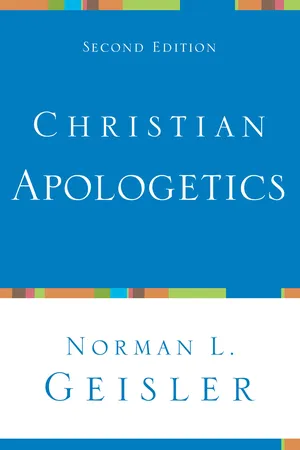
Christian Apologetics
About this book
World-famous apologist Norman Geisler offers a new edition of his bestselling apologetics text, which has sold consistently for over thirty years (over 125,000 copies sold). This edition has been updated throughout and includes three new chapters. It offers readers a systematic approach that presents both the reasons and the methods for defending the claims of Christianity. Topics covered include deism, theism, Christ's authority, and the inspiration of the Bible.
Information
Topic
Theology & ReligionSubtopic
Christian MinistryPart 1

METHODOLOGY
1
Agnosticism
There are various approaches to, or methods for, addressing the question of whether God exists—some positive and some negative. Perhaps the most widely used in the latter category is agnosticism. There are two basic kinds of agnostics: those who claim that the existence and nature of God are not known, and those who hold God to be unknowable. Since the first type does not eliminate all religious knowledge, attention here will center on the second.
The term agnosticism was coined by T. H. Huxley. It means literally “no-knowledge,” the negation of gnōsis (Gk. “knowledge”).[1] However, over a hundred years before Huxley the writings of David Hume and Immanuel Kant laid down the philosophical basis of agnosticism. Much of modern philosophy takes for granted the general validity of the types of arguments they set forth.
The Basic Arguments of Agnosticism
Immanuel Kant was a rationalist until he was “awakened from his dogmatic slumbers” by reading David Hume. Much of the rest of the modern world has had a similar experience.
The Skepticism of David Hume (1711–76)
Technically Hume’s views are skeptical, but they serve well the agnostic aim also. Hume set forth the basis of his position in the concluding lines of his famous Enquiry concerning Human Understanding: “If we take in our hands any volume; of divinity or school metaphysics, for instance; let us ask, Does it contain any abstract reasoning concerning quantity or number? No. Does it contain any experimental reasoning concerning matter of fact and existence? No. Commit it then to the flames: for it can contain nothing but sophistry and illusion.”[2] That is, any statement that is neither purely a relation of ideas (definitional or mathematical), on the one hand, nor a matter of fact (empirical), on the other hand, is meaningless. Of course, all statements about God fall outside these categories, and hence knowledge of God becomes impossible.
There Are Only Two Kinds of Propositions. At the basis of Hume’s conclusion that all meaningful propositions are reducible to two kinds is a radical empiricism that may be summarized as follows. All of our knowledge or ideas are derived either through sensation or by reflection on ideas (derived from sensation) in the mind. There is nothing in the mind that was not first in the senses. Furthermore, all sensations are experienced as “entirely loose and separate.”[3] Causal connections are made by the mind only after one has observed a constant conjunction of things in experience. All one really experiences is a series of unconnected and separate sensations. Indeed, there is no direct knowledge even of one’s “self,” for all we know of ourselves is a disconnected bundle of sense impressions. It does make sense, of course, to speak of connections among ideas, even necessary connections. But these are connections made only in the mind a priori or independent of experience. A posteriori (i.e., from experience) there are no known and certainly no necessary connections. All matters of experience imply a possible contrary state of affairs. For anything we experience in one way could be otherwise.
Causality Is Based on Custom. Many who believe in God are willing to admit that they have no direct knowledge of God but claim nonetheless to have access to the existence and nature of God via God’s effects or the things God has made or said. Hume’s epistemology (theory of knowledge), if true, would seem to eliminate this possibility as well. For, according to Hume, “all reasoning concerning matters of fact seems to be founded on the relation of cause and effect. By means of that relation alone can we go beyond the evidence of our memory and senses?”[4]
And knowledge of the relation of cause and effect is not a priori but arises entirely from experience. And the idea of a causal relation appears in the mind only after there has been an observation of constant conjunction in experience. That is, only when we observe death to occur after holding another’s head under the water for five minutes do we assume a causal connection. Once one event is observed to happen after another repeatedly, we begin to form the idea that one event happens because of the other. In brief, the idea of causality is based on custom.
Customary conjunction of events leads one to believe in or posit a connection between them. Of course, this connection cannot be known but is simply believed because of the repetition of the conjunctions. There is always the possibility of the post hoc fallacy—namely, that things happen after other events (even regularly) but are not really caused by them. For example, the sun rises regularly after the rooster crows but certainly not because the rooster crows. One can never know causal connections. And without a knowledge of the Cause of this world, for example, one is left in agnosticism about such a supposed God.
Knowledge of God by Analogy Is Highly Problematic. Hume believed that even if one were to grant that every event has a cause, nevertheless one cannot build any knowledge of God upon this fact because the analogy is weak at best. In his famous Dialogues concerning Natural Religion,[5] he contended that on such an analogy, the cause of the universe may be (1) different from human intelligence, since human inventions differ from those of nature; (2) finite, since the effect is finite and one need only infer a cause adequate for the effect; (3) imperfect, since there are imperfections in nature; (4) multiple, for the creation of the world looks more like a long-range trial and error product of many cooperating deities; (5) male and female, since this is how humans generate; and (6) anthropomorphic, with hands, nose, eyes, and so forth, such as the creatures of this cause have. Since no theist will admit that analogy leads to these anthropomorphic deities, it leaves us in skepticism about the nature of any supposed Cause of the world.
The Agnosticism of Immanuel Kant (1724–1804)
The writings of Hume had a profound influence on the thinking of Kant. Before reading them, Kant held a form of rationalism in the tradition of Leibniz. Gottfried Leibniz and Charles Wolfe believed reality was rationally knowable and that theism was demonstrable. They followed a long line of Western thinkers from Plato through Augustine, Anselm, and Aquinas, who held that there were proofs for the existence of God. It was the pen of Kant that put an abrupt end to much of this thinking in the philosophical world.
The Impossibility of Knowing Reality. On the one hand, Kant granted to the rational tradition of Leibniz that there was a rational, a priori dimension to knowledge—namely, that the form of all knowledge is independent of experience. On the other hand, Kant granted Hume and the empiricists their basic contention that the content of all knowledge came via the senses. The “stuff” of knowledge is provided by the senses, but the structure of knowledge is attained eventually in the mind. This creative synthesis solved the problem of rationalism and empiricism. However, the unhappy result of this synthesis is agnosticism, for if one cannot know anything until after it is structured by the a priori forms of sensation (time and space) and the categories of understanding (such as unity and causality), then there is no way to know what it really was before it was so structured, because there is no way to get outside one’s own being. That is, I can know what something is to-me but never what it is in-itself. Only appearance can be known, not reality. In Kant’s words, we know the phenomena but not the noumena. There is a great, impassable gulf between the real world and our knowledge of it; we must remain agnostic about reality. We know only that it is there; we can never know what it is.[6]
The Antinomies of Human Reason. There is another argument for Kant’s agnostic conclusion. Not only is there an unbridgeable gulf between knowing and being, between the categories of our understanding and the nature of reality, but there are also the inevitable contradictions that result once we begin to trespass the boundary line. In other words, when we take the necessary forms of sensation or categories of understanding, such as the principle of causality, and apply them to reality, we run headlong into unavoidable contradictions.[7]
There is, for instance, the antinomy of time. If we assume that the form of sensation known as time (the “when-ness” with which we time-bound creatures sense things) applies to reality, we must conclude the following contradictions. On the one hand, if the world had a beginning in time, then an infinity of moments must have elapsed before the world began. But this is impossible because an infinity of moments can never be completed. On the other hand, if the world did not have a beginning in time, then there must have been a time before time began—which is impossible. But either the world began in time or it did not, and both positions are impossible. Hence, by applying time to reality one eventuates necessarily in contradictions. And since contradictions do not yield knowledge, reality is unknowable.
Another antinomy concerns the category of causality. On the one hand, not every cause can have a cause, or else a series of causes would never begin to cause—which they, in fact, do. On the other hand, if everything had a cause, then there could not be a beginning cause, and the causal series must stretch back infinitely. But it is impossible that the series be both infinite and also have a beginning. Such is the impossible paradox resulting from the application of the category of causality to reality.
There is also the antinomy of contingency. We must posit that not everything is contingent; otherwise there would be no basis or condition for contingency. On the contrary, everything must be contingent, for necessity applies only to thought and not to things, since any state of affairs could be otherwise. But again, reality cannot be both contingent and necessary. The way to avoid such contradiction is to acknowledge that reason cannot know reality—namely, to be agnostic.
These arguments do not exhaust the agnostic’s arsenal, but they do lie at the heart of the contention that God cannot be known. However, even some who are unwilling to admit to the validity of these arguments opt for a more subtle form of agnosticism. Such is the case with the school of thought to which we turn our attention next: logical positivism.
The “Acognosticism” of A. J. Ayer (1910–89)
Following up on Hume’s distinction between definitional and empirical statements, Ayer offered the principle of empirical verifiability. This affirmed that in order for statements to be meaningful they must be either analytic (Hume’s “relation of ideas”) or synthetic (Hume’s “matter of fact”)—that is, definitional or empirical.[8] The former are devoid of content and say nothing about the world; the latter have content but tell us nothing about any alleged reality beyond the empirical world. Furthermore, the latter are only probable in nature and are never philosophically certain. They are useful in empirical and practical matters but not at all informative about reality in any metaphysical sense. This view we have labeled “acognosticism,” since it insists that all statements about reality are noncognitive.
All God-Talk Is Nonsense or Empty. The result of Ayer’s logical positivism is as devastating to theism as is traditional agnosticism. God is unknowable and inexpressible. It is even meaningless to use the term God. Hence, even traditional agnosticism is untenable, since the agnostic assumes that it is meaningful to ask the question whether God exists. For Ayer, the word God, or any transcendent equivalent, has no meaning. Hence, it is impossible to be an agnostic. The term God is neither analytic nor synthetic; that is, it is neither offered by theists as an empty, contentless definition corresponding to nothing in reality nor filled with empirical content, since “God” is allegedly a supra-empirical being. Hence, it is literally nonsense to talk about God.
It is true that Ayer later revised his principle of verifiability.[9] But even in advancing this form (which admitted the possibility that some empirical experiences are certain, such as single sensory experiences, and that there is a third kind of statement—namely, some analytic or definitional statements that are not purely arbitrary, such as his own principle of verifiability), he did not allow for the meaningfulness of God-talk. This third class would be neither true nor false nor factual but meaningfully definitional. However, Ayer believed that it was “unlikely that any metaphysician would yield to a claim of this kind,” even though he acknowledged that for “an effective elimination of metaphysics, it needs to be supported by detailed analyses of particular metaphysical arguments.”[10] In short, even a revised principle of empirical verifiability would make it impossible to utter meaningfully true statements about a transempirical reality such as God. There is no cognitive knowledge of God; we must remain “a-cog-nostic.”
“God” Is Inexpressible or Mystical. Following a tip from Wittgenstein’s Tractatus, Ayer held that while God might be experienced, such an experience could never be meaningfully expressed. Wittgenstein believed that “how things are in the world is a matter of complete indifference for what is higher. God does not reveal himself in the world.” For “there are indeed things that cannot be put in words. . . . They are what is mystical,” and “what we cannot speak about we must consign to silence.” If God could express himself in our words, it would indeed be “a book to explode all books,” but such is impossible.[11] Hence, not only is there no propositional revelation, but there are also no cognitively meaningful statements that can be made about any alleged or real transcendent being. Hence, whether one takes the more strict logical positivist’s principle of verifiability or even the broader Wittgensteinian linguistic limitations, God-talk is metaphysically meaningless.
To be sure, as Wittgenstein taught, language games are possible, even religious language games. God-talk can and does occur, but it is not metaphysical; it tells us nothing about the existence and nature of a being beyond this world. About this we must, because of the very necessary limitations of language, remain silent. In summary, for religious noncognitivists, such as Ayer and Wittgenstein, metaphysical acognosticism is the net result of language analysis.
It makes little difference to Christians or theists whether they cannot know God (as in Kant) or whether they cannot speak of God (as in Ayer). Both traditional agnosticism and contemporary acognosticism leave us in the same dilemma philosophically: there are no bases for making true statements about God.
Religious Beliefs Are Unfalsifiable. The other side of the principle of verifiability is that of falsifiability. Taking his cue from John Wisdom’s parable of the invisible gardener who is never seen or detected in any way, Antony Flew posed a challenge to believers as follows: “What would have to have occurred to constitu...
Table of contents
- Cover
- Title Page
- Copyright Page
- Contents
- Preface to the Second Edition
- Preface to the First Edition
- Abbreviations
- Part 1
- Part 2
- Part 3
- Notes
- Bibliography
- Index
Trusted by 375,005 students
Access to over 1.5 million titles for a fair monthly price.
Study more efficiently using our study tools.
Frequently asked questions
Yes, you can cancel anytime from the Subscription tab in your account settings on the Perlego website. Your subscription will stay active until the end of your current billing period. Learn how to cancel your subscription
No, books cannot be downloaded as external files, such as PDFs, for use outside of Perlego. However, you can download books within the Perlego app for offline reading on mobile or tablet. Learn how to download books offline
Perlego offers two plans: Essential and Complete
- Essential is ideal for learners and professionals who enjoy exploring a wide range of subjects. Access the Essential Library with 800,000+ trusted titles and best-sellers across business, personal growth, and the humanities. Includes unlimited reading time and Standard Read Aloud voice.
- Complete: Perfect for advanced learners and researchers needing full, unrestricted access. Unlock 1.5M+ books across hundreds of subjects, including academic and specialized titles. The Complete Plan also includes advanced features like Premium Read Aloud and Research Assistant.
We are an online textbook subscription service, where you can get access to an entire online library for less than the price of a single book per month. With over 1.5 million books across 990+ topics, we’ve got you covered! Learn about our mission
Look out for the read-aloud symbol on your next book to see if you can listen to it. The read-aloud tool reads text aloud for you, highlighting the text as it is being read. You can pause it, speed it up and slow it down. Learn more about Read Aloud
Yes! You can use the Perlego app on both iOS and Android devices to read anytime, anywhere — even offline. Perfect for commutes or when you’re on the go.
Please note we cannot support devices running on iOS 13 and Android 7 or earlier. Learn more about using the app
Please note we cannot support devices running on iOS 13 and Android 7 or earlier. Learn more about using the app
Yes, you can access Christian Apologetics by Norman L. Geisler in PDF and/or ePUB format, as well as other popular books in Theology & Religion & Christian Ministry. We have over 1.5 million books available in our catalogue for you to explore.