eBook - ePub
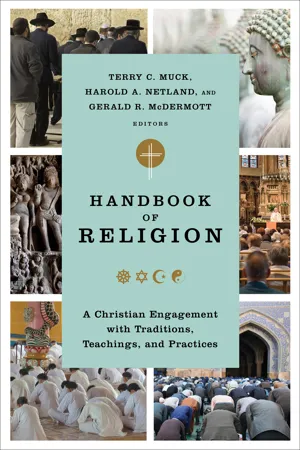
Handbook of Religion
A Christian Engagement with Traditions, Teachings, and Practices
- 832 pages
- English
- ePUB (mobile friendly)
- Available on iOS & Android
eBook - ePub
Handbook of Religion
A Christian Engagement with Traditions, Teachings, and Practices
About this book
This comprehensive handbook provides a Christian perspective on religion and its many manifestations around the world. Written by top religion scholars from a broad spectrum of Christianity, it introduces world religions, indigenous religious traditions, and new religious movements. Articles explore the relationship of other religions to Christianity, providing historical perspective on past encounters and highlighting current issues. The book also contains articles by adherents of non-Christian religions, offering readers an insider's perspective on various religions and their encounters with Christianity. Maps, timelines, and sidebars are included.
Information
Topic
Theology & ReligionSubtopic
Comparative Religion
1
The Christian Study of World Religion

This handbook is for Christians interested in non-Christian religions. The essays answer questions Christians ask about religions that are not their own. Christians ask questions about other world religions, indigenous religions, and new religious movements. For that audience—Christians interested in non-Christian religions—the following essays meet four needs.
The Need for Information
First, the essays provide Christian students with basic information about world religions. They answer questions about those religions that Christians might ask precisely because they are Christians. For the most part these essays do not look at the other religions theologically, at least in the traditional way Christian theology is conceived, but neither do they attempt to answer all questions for all people. They take a scholarly look at the non-Christian religions but from a Christian scholar’s point of view. What do I want or need to know about Hinduism? Or religion in China?
This approach makes this book unique among religious studies texts. In general, information about the world of religion that one finds in textbooks used by Christian students takes one of two approaches. The first is the religious studies approach, typified by the textbook I have used in my Introduction to World Religions class, which I have taught for twenty-five years: John and David Noss’s A History of the World’s Religions. This textbook and others like it attempt to present the teachings of the major world religions as narratives of the history, beliefs, and practices of those religions. Each of the chapters on Hinduism, Buddhism, Islam, and the others are presented without critique or favor. The focus is on “just the facts” with as little commentary as possible.
The second approach is the theological approach, illustrated by textbooks that describe not only what the other religions teach but also what is right and wrong with those religions from a Christian theological point of view. At their best, these textbooks discern God’s creative activity and intent in the whole world of religion, although it is an attempt that begins with the normative standards of classical Christian orthodoxy. Traditionally, we have considered this kind of study of religion “partisan,” while the Noss type of study has been considered “objective.”
In the past, “objective” has been considered “neutral.” More recently, however, postmodern philosophy has joined historic orthodox Christianity in affirming that when it comes to ultimate questions, there is no such thing as neutrality. In that sense, every account of religion, whether Christian or not, is “partisan.” To the extent that each account attempts to be fair to other religions, it is also “objective.” In this way of looking at things, “partisan” and “objective” are not mutually exclusive.
One is tempted to say that the essays in the book you hold in your hands are neither partisan nor objective, but it would be more accurate to say that they are both partisan and objective. They are partisan to the extent that they focus on questions Christians ask about other religions; they are objective in the sense that they present the best scholarly understandings of what the other religions teach. Indeed, we would hope that adherents of the religions covered can see themselves in the essays and agree with the way their teachings are presented. For many of the religions covered in this book, we have included what we call an “adherent essay,” an essay written by a scholarly member of the religion being discussed. We believe this is what all serious writing and thinking about religion in the coming decades must be—a combination of objective religious studies and partisan theology (or buddhology or vedology or whatever).
Seeing the Big Picture
Second, the essays in this handbook provide a realistic portrait of religion in our twenty-first-century, postmodern world. The picture they paint is of a religious world where world religions such as Christianity and Islam and Buddhism do not exist in their pure, theoretical forms but always in admixtures with older, indigenous forms of religion, and always tempered, influenced, and sometimes even combined with new religious movements. The world religions may span the globe and have the capacity to penetrate all cultures, but the forms they take are in turn heavily influenced by those cultures and the religions that already exist in them.
The anthropologist nonpareil Clifford Geertz brought this to our attention years ago when he studied Islam in the context of both Indonesia (Religions of Java) and the northern African country of Morocco (Islam Observed). He discovered Islam in both countries. Many if not most Muslims acknowledged the orthodoxy of both forms of Islam in that they adhered to the Qur’an, the Five Pillars, and the traditional orthodoxies of all Islamic expressions. But Geertz also discovered different “Islams.” The character and nature of Islamic expressions in each of these cultures produced an Islam that was easily distinguishable from its counterpart in the other country, sometimes to the extent that not all Muslims agreed to one another’s so-called orthodoxy.
When Christians ask questions about religions, they do well to start with the basics—the history, beliefs, and practices that typify each religion. The history of Buddhism is the same, up to a certain point, for Buddhists everywhere. A core set of beliefs characterize almost all Buddhists. And certain practices tend to run across Buddhist traditions and Buddhist cultures. But at a certain point historical backgrounds diverge, beliefs take on unique nuance depending on cultural setting, and practices can vary widely.
This handbook is based on the idea that for a scholar to understand any religious expression in a given geographical locale, he or she must understand at least the indigenous religion on which the culture was (and is) based, the world religion that has come to (usually) dominate, and the new religious movements that have (almost always) come to express the effects of modernity and postmodernity clashing with premodernity in that culture. We call this “doing a religious audit” of a particular culture. To understand Moroccan religion today, using this handbook, one would start by reading the essays on “Islam,” then the essays written on the “Religions of Africa,” and finally add studies of whatever African-initiated religions are growing in the Moroccan area. It is at the intersections of these three religious forces that most local expressions of religion are found today.
Radical Differentiation
Third, this handbook takes account of the radical differentiation of religion and religious practices in today’s world. Religion in the twenty-first century rarely exists in its premodern form, as part of an undifferentiated tribal culture, where beliefs and practices seem to be part of a seamless and largely unreflected-upon whole. But religion in the twenty-first century has also moved beyond the compartmentalized, often privatized, differentiated phenomena observed by modern sociologists such as Talcott Parsons and sociologists of religion such as Robert Bellah. Religion today is neither undifferentiated nor differentiated, if by differentiated we mean religion has its own little compartment alongside the political compartment, the economic compartment, the culture compartment, and so forth. Instead, religion today is radically differentiated. What do we mean by radically differentiated religion?

In the 1960s, University of Chicago sociologist Talcott Parsons wrote a book (The Evolution of Societies) in which he described a theory of social action that characterized modern Western societies. He suggested that four systems dominate: the political, economic, social, and cultural. He called such societies differentiated because social functions that before had been generalized across social groupings in the premodern age had become specializations in the modern age. In Parson’s theory of social action, he suggested that religion had become a specialty located within the cultural system. One of Parson’s students, Robert Bellah, focused his work on the religion dimension, writing the well-known essay “Religious Evolution” (1991 [1970]), in which he described in historical detail the increasing complexity, and accompanying differentiation, that characterized modern religion. More recently Bellah turned the basic ideas in his seminal essay into his magnum opus, Religion in Human Evolution: From the Paleolithic to the Axial Age (2011).
What we see happening in the years since Parsons did his seminal work is an increasing differentiation within each of his major social spheres—the political, economic, social, and cultural. Most interesting to us, however, is that the presence of religion, in the form of new religious movements, is evident in all these spheres, not just the cultural. We have political religious expressions (Hindutva, Christian Identity), economic religious expressions (Marxism, the prosperity gospel), and social religious expressions (Amish religion, the Moonies), as well as cultural expressions. Religion is everywhere and expresses itself in all the societal forms we can imagine. We call this ubiquitous presence of religion in all social forms “radical differentiation.”
Radical differentiation is seen most clearly in the section of the handbook devoted to new religious movements—we will say more about this phenomenon in that section.
Religious Identity
Fourth, this handbook by its structure and approach acknowledges the dynamic nature of religious identities in our complex, fluid world. Individual religious identities change and change often. A recent study by the Pew Forum on Religion and Public Life found that 44 percent of Americans had made a major religious change at some point in their life. Individuals in much of the world today are faced with unprecedented levels of freedom when it comes to religion. And even in cultures where such freedom does not yet exist (some of the Islamic world, for ...
Table of contents
- Cover
- Title Page
- Copyright Page
- Contents
- Preface
- Part 1: Introduction
- Part 2: World Religions
- Part 3: Indigenous Religions
- Part 4: New Religious Movements
- Part 5: Essays
- Contributors
- Index
- Back Cover
Trusted by 375,005 students
Access to over 1.5 million titles for a fair monthly price.
Study more efficiently using our study tools.
Frequently asked questions
Yes, you can cancel anytime from the Subscription tab in your account settings on the Perlego website. Your subscription will stay active until the end of your current billing period. Learn how to cancel your subscription
No, books cannot be downloaded as external files, such as PDFs, for use outside of Perlego. However, you can download books within the Perlego app for offline reading on mobile or tablet. Learn how to download books offline
Perlego offers two plans: Essential and Complete
- Essential is ideal for learners and professionals who enjoy exploring a wide range of subjects. Access the Essential Library with 800,000+ trusted titles and best-sellers across business, personal growth, and the humanities. Includes unlimited reading time and Standard Read Aloud voice.
- Complete: Perfect for advanced learners and researchers needing full, unrestricted access. Unlock 1.5M+ books across hundreds of subjects, including academic and specialized titles. The Complete Plan also includes advanced features like Premium Read Aloud and Research Assistant.
We are an online textbook subscription service, where you can get access to an entire online library for less than the price of a single book per month. With over 1.5 million books across 990+ topics, we’ve got you covered! Learn about our mission
Look out for the read-aloud symbol on your next book to see if you can listen to it. The read-aloud tool reads text aloud for you, highlighting the text as it is being read. You can pause it, speed it up and slow it down. Learn more about Read Aloud
Yes! You can use the Perlego app on both iOS and Android devices to read anytime, anywhere — even offline. Perfect for commutes or when you’re on the go.
Please note we cannot support devices running on iOS 13 and Android 7 or earlier. Learn more about using the app
Please note we cannot support devices running on iOS 13 and Android 7 or earlier. Learn more about using the app
Yes, you can access Handbook of Religion by Muck, Terry C., Netland, Harold A., McDermott, Gerald R., Terry C. Muck,Harold A. Netland,Gerald R. McDermott in PDF and/or ePUB format, as well as other popular books in Theology & Religion & Comparative Religion. We have over 1.5 million books available in our catalogue for you to explore.