eBook - ePub
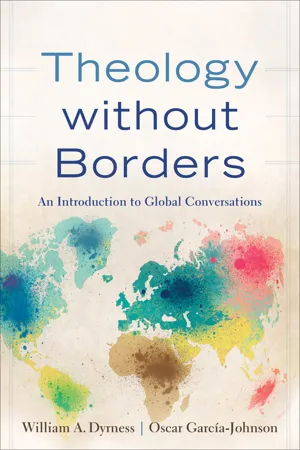
Theology without Borders
An Introduction to Global Conversations
- 192 pages
- English
- ePUB (mobile friendly)
- Available on iOS & Android
eBook - ePub
Theology without Borders
An Introduction to Global Conversations
About this book
Global theology represents one of the most important trends in theology today. What does it mean to do theology in a global context? How can Christian theology be understood as a conversation between different parts of the world and various streams of Christian history? This concise introduction explores the major issues involved in rethinking theology in light of the explosion of world Christianity. Combining the voices of a Western and a non-Western theologian, it integrates Western theological tradition with emerging global perspectives. This work will be of interest to theology and missiology students as well as church leaders and readers interested in the changing face of world Christianity.
Information
Topic
Theology & ReligionSubtopic
Christian Theology 1
Transoccidentalism and the Making of Global Theology
A Banana Republic Theologian
I was born in the Banana Republic, a name for Honduras coined at the end of the nineteenth century by the North Carolina novelist O. Henry in Cabbages and Kings. My early childhood was spent in the port of Tela, a coastal city very much like Coralio in the story by O. Henry. These two cities belong together in O. Henry’s satirical narrative but also in the story of my own ancestral roots and upbringing. My great-grandmother took refuge in Trujillo when fleeing with her children from an uprising headed by Augusto César Sandino in the mines of San Albino, Nicaragua. Since my childhood, I have been told that the mines of San Albino were home to my British ancestors, the very scene of Sandino’s founding insurrections against the Nicaraguan conservative forces in the first quarter of the twentieth century.
I got to meet my great-grandmother when she lived in the port of Tela, 150 miles west of her arriving point. We called her Mama Sara, and she died at the age of 108. A refined and articulate old woman, she tended to retreat in the precincts of San Albino. She enjoyed pomposity, abundance, and status in her lifetime as a member of the Europeans who came to the Americas to civilize the natives and improve their land. She certainly made sure that her family would appreciate its European pedigree, a distinctive heritage of a revered Western lineage distancing us from the local residents and Afro-Caribbeans. Memory and race were all she had left, for she lost her fortune and prestige when migrating to Honduras.
My mother, whose white father was from the southern United States and white mother was a British descendant, married a handsome trigeño (dark-skinned) man. My father was quite a Latin American representation of mestizaje, a blending of Amerindian, black, white, and Middle Eastern. Naturally, my grandmother never saw him as a fitting companion for a daughter with “pure” white blood. Nevertheless, my father managed to get hired by the prestigious United Fruit Company, a transnational Anglo-American banana industry company later to be known as Chiquita Banana. Being one of the two major companies that ruled the Honduran economy for several decades, by the 1920s the United Fruit Company had acquired over 650,000 acres of the most productive land along the Atlantic coast. La compañia (the company), as we used to call it, had control of railroads, ports, and key politicians, since bananas came to represent more than 80 percent of the nation’s exports during the first half of the last century.
O. Henry’s novel astutely anticipates the keen Anglo-American entrepreneurship and political maneuvering that had yet to be fully realized in the rich alluvial plains of Honduras’s Atlantic coast. O. Henry’s depiction is inviting.
Taken and retaken by sea rovers, by adverse powers and by sudden uprising of rebellious factions, the historic 300 miles of adventurous coast has scarcely known for hundreds of years whom rightly to call its master. Pizarro, Balboa, Sir Francis Drake, and Bolivar did what they could to make it a part of Christendom. . . .
The game goes on. The guns of rovers are silenced; but tintype man, the enlarged photograph brigand, the kodaking tourist and scouts of gentle brigade of fakirs have found it out, and carry on the work. The hucksters of Germany, France, and Sicily now bag its small chance across their counters. Gentleman adventurers throng the waiting rooms of its rulers with proposals for railroad and concessions. The little opera-bouffe nations play at government and intrigue until someday a big, silent gunboat glides into the offing and warns them not to break their toys.1
Due to my father’s employment status, I spent a good portion of my childhood and early adolescence living in designated areas built for the privileged middle to upper management, which were located at the borders of the banana plantations. The local people referred to this area as la zona Americana (the American zone). The name was well earned, for it represented a life at the margins of the Honduran population—an elitist and privileged margin, I might add. La zona Americana was furnished with all the commodities that one would expect of an upper-middle-class lifestyle in the States transplanted into a “third world country.”
La zona Americana was a geographical icon that inspired a sense of amazement and fueled the aspirations of many locals to somehow and someday belong to such a splendid society and culture: the Anglo-American culture. It goes without saying that life outside the borders of this American zone, in the banana plantations, was a very different scenario. Ironically, it so happened that my maternal grandmother (daughter of Mama Sara) lived in such a neighborhood, and I got to spend three months of every year in that unappealing place. No better words can depict the life in the plantations than those of Ramón Amaya-Amador, a banana bracero (manual laborer) himself who had a gift for words and angst for social change. His provocative novel Prisión verde (Green prison), published in 1950, partially captures the living conditions affecting workers in the banana plantation.
Among that miscellaneous [scenarios] of braceros and bananas, sunshine and plagues, sweat and machines, creeks and malaria, the haughty cry of foremen was heard, [as well as] the whistle of moles, and the supreme power of the gringos gabbling with overconfident pride. So, all day, the grueling working of the campeños [field workers] was suspended until nightfall, when with tired shaky legs they would leave the green banana prison to embed themselves in the prison of soulless, empty barracks.2
As the political horizon changed and the land concessions granted to la compañia were challenged by a different generation of national leaders in Honduras, it began to move operations back home. Between the 1970s and 1990s, banana production in Honduras fluctuated significantly due to a number of hurricanes damaging the plantations and the spread of Black Sigatoka fungus. Consequently, most of the transnational operations of la compañia began to leave the country, leaving thousands of acres of land and thousands of familias costeñas (coast-based families) in ruins, jobless, and poorer than ever. La compañia left Honduras to go back home, but those who stayed home remained imprisoned in extreme poverty. Thus the life of many Hondurans on the northern Atlantic coast became intolerable to the point of exile or death. Many embarked on a deadly journey north. Some left by plane and many others by train, but whatever the means, the journey was a potentially deadly one for los costeños as they trekked toward the United States of America.
This case illustrates quite well the point made by Juan González in his book Harvest of Empire: A History of Latinos in America.3 The harvest of Latin American immigrants González refers to is the result of the powerful Anglo-American companies’ manipulation of the economic, geographical, and political resources of Latin American nations for their own interests. Many immigrants—a harvest of empire—are coming to the United States, suggests González, on the very tracks built by the Anglo-American politico-economic machinery. My parents were part of this harvest.
After coming to the States and going through the acculturation process, I have had to come to terms with a question that sooner or later haunts every theologian who comes from a former European colony. It is the question of where exactly my home is when doing theological reflection: Do I choose to do theological reflection out of the privileged “American zone” or the unappealing “green banana prison”? Throughout this book you will notice this struggle expressed in moments of self-questioning, self-affirmation, and reimagination. By the end of this chapter, I hope you realize that these two “universes” coexist along the continuum of a theological imagination that transcends the dichotomous categories of the West and finds a home in the transoccidental horizon of the global Triune God.
The Politics of Locality in Theological Studies
What is the point of beginning this book on global theology with a narrative that, although representing some trends among Latin American people, lacks the kind of universal representation we typically find in a theological manuscript? This is a pertinent question, since biographical theology has formidable objectors in the West. From their point of view, self-deception and self-fictionalization (“theology only of the self”) might be reasons to dismiss this theological genre.4 Interestingly, this suspicion vanishes when they approach documents such as Augustine’s Confessions or Boethius’s De consolatione philosophiae. Undeniably, the politics of location—where we do theology from and why—tends to inform the delivery and reception of knowledge broadly speaking. In this regard, Willie Jennings, the African American Duke theologian, has much to say in his book The Christian Imagination. He thinks that “the story of race is the story of place. Geography matters for race as well as for identity, vision, and the hope of how one might live life.”5 Concurrently, stories of ethnicity and migrations may enrich theological elaboration with insights that could help the theological eye perceive what might otherwise be overlooked in the making of Christian theology, namely, imported ideas, histories, and epistemologies that construct Western typologies while communicating the message of the gospel in the majority world.
It is widely known that Western knowledge (its epistemology) has always been tied to particular Western geopolitics, which has been transmitted to the colonies and the world at large in the form of notions, practices, and utopias.6 Latin America and Africa, for instance, have been experimental grounds for the historical projects pursued by the West. On the positive side, the rhetoric and practices of Western modernity have led to moments of emancipations, but the price that has been paid is great: ethnocultural neglect, discursive misrepresentation, and geopolitical dominance. Acknowledging the fact that predominant Western theologies have been operating out of an imperial-colonial core, influential theologians and missiologists in recent years have assumed the task of identifying theological paths bold enough to understand and meet the challenges presented by the epistemological captivity of the West in the theological process. Arguably, the so-called global theology enterprise is one of those paths. The goal is to carry out theological discourse while immersed in a post- or non-Western globalized context.7 Not surprisingly, this global trend in theology faces resistance from both ends of the theological spectrum: both classical theologians (in fields such as history, systematics, ethics, biblical studies, and philosophy) and theologians from the margin (Liberationists, feminists, ethnicists, indigenists, etc.) tend to resist such projects. The former seek to retreat to the “golden age” of Western scholastics, while the latter are suspicious of this path as a new attempt to regulate (or recolonize) the theological diversity accomplished so far.
In an elementary yet constructive treatment of North American church involvement in global missions, Paul Borthwick acknowledges that pluralism, globalization, and territorialism are challenges Western Christianity faces.8 In the words of a Zimbabwean brother, “What you in the West call ‘globalization’ we call ‘Americanization.’”9 But this resistance to occidentalization exceeds the boundaries of the mission field; it has been fermenting in the theological establishment of the West for a while. Hence, Western...
Table of contents
- Cover
- Title Page
- Copyright Page
- Contents
- Preface
- 1. Transoccidentalism and the Making of Global Theology
- 2. Doing Theology Out of a Western Heritage: Gains and Losses
- 3. The Role of Indigenous Traditions in Christian Theology
- 4. God, Creation, and the Human Community
- 5. Jesus Christ and the Good News for the World
- 6. The Church in Global Context
- 7. The Christian Hope: Eschatology in Global Perspective
- Appendix: The Historical Traditions of the Church
- Bibliography
- Index
- Back Cover
Trusted by 375,005 students
Access to over 1.5 million titles for a fair monthly price.
Study more efficiently using our study tools.
Frequently asked questions
Yes, you can cancel anytime from the Subscription tab in your account settings on the Perlego website. Your subscription will stay active until the end of your current billing period. Learn how to cancel your subscription
No, books cannot be downloaded as external files, such as PDFs, for use outside of Perlego. However, you can download books within the Perlego app for offline reading on mobile or tablet. Learn how to download books offline
Perlego offers two plans: Essential and Complete
- Essential is ideal for learners and professionals who enjoy exploring a wide range of subjects. Access the Essential Library with 800,000+ trusted titles and best-sellers across business, personal growth, and the humanities. Includes unlimited reading time and Standard Read Aloud voice.
- Complete: Perfect for advanced learners and researchers needing full, unrestricted access. Unlock 1.5M+ books across hundreds of subjects, including academic and specialized titles. The Complete Plan also includes advanced features like Premium Read Aloud and Research Assistant.
We are an online textbook subscription service, where you can get access to an entire online library for less than the price of a single book per month. With over 1.5 million books across 990+ topics, we’ve got you covered! Learn about our mission
Look out for the read-aloud symbol on your next book to see if you can listen to it. The read-aloud tool reads text aloud for you, highlighting the text as it is being read. You can pause it, speed it up and slow it down. Learn more about Read Aloud
Yes! You can use the Perlego app on both iOS and Android devices to read anytime, anywhere — even offline. Perfect for commutes or when you’re on the go.
Please note we cannot support devices running on iOS 13 and Android 7 or earlier. Learn more about using the app
Please note we cannot support devices running on iOS 13 and Android 7 or earlier. Learn more about using the app
Yes, you can access Theology without Borders by William A. Dyrness,Oscar García-Johnson in PDF and/or ePUB format, as well as other popular books in Theology & Religion & Christian Theology. We have over 1.5 million books available in our catalogue for you to explore.