This book, widely regarded as groundbreaking since its publication over thirty-five years ago, sheds light on the more radical and prophetic roots of American evangelicalism and has challenged countless readers to rethink their evangelical heritage. It argues that nineteenth-century American evangelicals held a more mature vision of the faith, for they engaged demanding justice, peace, and social issues--a vision that was betrayed and distorted by twentieth-century neo-evangelicals. The book helps readers understand that the broader origins of American evangelicalism include the social justice concerns of today's church.
Featuring new historic photos and illustrations, this edition includes new introductory and concluding chapters and incorporates relevant updates. The previous edition was published as Discovering an Evangelical Heritage.
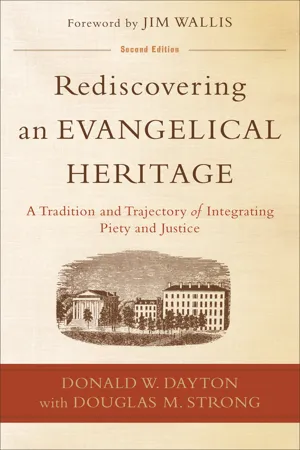
eBook - ePub
Rediscovering an Evangelical Heritage
A Tradition and Trajectory of Integrating Piety and Justice
- 208 pages
- English
- ePUB (mobile friendly)
- Available on iOS & Android
eBook - ePub
Rediscovering an Evangelical Heritage
A Tradition and Trajectory of Integrating Piety and Justice
About this book
Information
Topic
Theology & ReligionSubtopic
Christian Theology1
Jonathan Blanchard
The Radical Founder of Wheaton College
If there is a single symbol of modern evangelicalism, it is Wheaton College, situated just to the west of Chicago in the “All-American City” of Wheaton, Illinois. This school of about two thousand students is the most prestigious and perhaps the oldest of the “Christian colleges” that lie at the core of evangelical culture and tradition. The city of Wheaton is itself a mecca for evangelicals. Headquartered here and in the surrounding area are many of the publishers, independent mission boards, and interdenominational agencies that compose the network of evangelical life and activity. Also in Wheaton are the offices of the National Association of Evangelicals, an “ecumenical” organization founded in 1942 that, by the 1970s, drew together some thirty denominations in an evangelical counterpart to the National Council of Churches.
Closely associated with the post–World War II neo-evangelical renaissance of scholarship that spawned the National Association of Evangelicals, Fuller Theological Seminary in Pasadena, and Christianity Today, Wheaton College was the alma mater of many leaders of mid-twentieth-century neo-evangelicalism. Among these were Harold Lindsell, editor of Christianity Today; Edward J. Carnell, Fuller apologist and philosopher of religion; and Carl F. H. Henry, founding editor of Christianity Today. But the most famous alumnus of Wheaton College is evangelist Billy Graham, class of 1943. Through his position on the board of trustees and in other ways Graham was a dominant force in the life of the college—as in all of the evangelical world.

1974 Post American cover (highlighting Donald Dayton’s first serialized article, on Jonathan Blanchard)
Billy Graham rather consistently expressed what may be taken to be the position of the National Association of Evangelicals, Christianity Today, much of Wheaton College, and most of the evangelical world: that the primary mission of the church is the spiritual one of preaching a gospel of “personal salvation” through faith in the atonement of Christ. Social witness may be an extension of the life of the individual, regenerated person in society but should not be incorporated into the life of the church as a primary goal.
Graham expressed this position in a “clarification” issued early in 1973. When the peace negotiations in Paris broke down and the United States resumed its bombing of North Vietnam, a number of American churchmen appealed openly to the evangelist to use his friendship with President Richard Nixon to try to stop the bombing. In his response Graham said:
I am convinced that God has called me to be a New Testament evangelist, not an Old Testament prophet! While some may interpret an evangelist to be primarily a social reformer or political activist, I do not! An evangelist is a proclaimer of the message of God’s love and grace in Jesus Christ and of the necessity of repentance and faith. My primary goal is to proclaim the Good News of the Gospel of Jesus Christ. The basic problem of man is within his own heart. That is why evangelism is so important.1
This position is generally assumed to be what evangelicals have always believed. To some extent this is true. But while Billy Graham sometimes uses the language of repentance and faith to avoid questions of social responsibility, earlier generations of evangelicals understood that repentance involved turning from apathy into the heart of struggles for social reform. While Billy Graham contrasts the “New Testament evangelist” and the “Old Testament prophet,” earlier evangelicals combined these roles. One of the most significant figures of that earlier generation was Jonathan Blanchard, the founder of Wheaton College.
The central building on the Wheaton College campus is Blanchard Hall. At the top of a split winding staircase just inside the main entrance are two plaques honoring the men for whom the building is named. These men are Jonathan Blanchard and Charles A. Blanchard, father and son, the first and second presidents of Wheaton. These two men held the office for more than twenty and forty years, respectively. Together they guided Wheaton College through its first sixty-five years.
Each plaque contains a quotation that calls into question the evangelical perspective expressed by Billy Graham. On the plaque honoring Charles Blanchard is an affirmation of the reformist aspiration of youth.
The need of a developing nation is to increase in wisdom, righteousness and strength and to cast off whatever is inconsistent with that noble age to which youth aspires. Only that which is true and right can abide. (From an address on the Day of Prayer for Colleges, “The American College”)
More striking is the quotation on the plaque honoring Jonathan Blanchard, the founder of Wheaton College. It is taken from an address titled “A Perfect State of Society,” originally delivered before the Society of Enquiry during the commencement exercises of Oberlin College in 1839. (The significance of Oberlin will emerge later, in chaps. 4 and 5). The plaque reads:
Society is Perfect where what is right in theory exists in fact; where Practice coincides with Principle, and the Law of God is the Law of the Land.
This passage is the thesis of Blanchard’s address in which he treated “not so much the principles of the doctrines of Christ, as the form they will give society, when they have done their perfect work upon mankind.” Among the affirmations of Blanchard at Oberlin was that “every true minister of Christ is a universal reformer, whose business it is, so far as possible, to reform all the evils which press on human concerns.” Blanchard fully realized that one “cannot construct a perfect society out of imperfect men,” but argued that “every reformer needs a perfect state of society ever in his eye, as a pattern to work by, so far as the nature of his materials will admit.”
This somewhat utopian vision was grounded in a doctrine of the kingdom of Christ reflected in the Wheaton College motto, “For Christ and his Kingdom.” Blanchard understood the kingdom of God as “Christ ruling in and over rational creatures who are obeying him freely and from choice, under no constraint but that of love” and argued that what “John the Baptist and the Saviour meant when they preached the ‘kingdom of God’” was “a perfect state of society.” He opposed those who emphasized that such a kingdom is not to be sought in this world, insisting that though “this kingdom is not of this world, it is in it.” Carrying this affirmation to its logical conclusion, Blanchard warned against both those who “locate Christ’s kingdom in the future to the neglect of the present” and those who seek “to construct a local heaven upon earth, . . . thus shutting out the influences and motives of eternity.”
Prompted by this vision of a “perfect state of society” and compelled by obedience to Christ’s command to “seek ye first the kingdom of God,” Blanchard was propelled into a life of reform that climaxed in the founding of Wheaton College. His life was so dominated by reform that upon his death the Political Dissenter commented that “in the death of Dr. Jonathan Blanchard, American reformers have lost one of their foremost leaders. No more fearless voice ever rang out on the platform, or from the pulpit. No keener or more valiant pen has been wielded against popular wrongs, and in defense of unpopular truth.”
Born in Vermont in 1811 and a graduate of Middlebury College, Blanchard studied theology at Andover Theological Seminary. There he came under the influence of Theodore Weld (for the significance of Weld, see chap. 3) and became, in the words of the Dictionary of American Biography, a “violent abolitionist.” When the administration of Andover tried to stop his antislavery work, Blanchard withdrew and spent a year in Pennsylvania working as an agent for the American Anti-Slavery Society. (Agents were “agitators” who traveled around lecturing and organizing local chapters of abolitionists.) Blanchard endured mob violence, threats on his life, and other forms of abuse in this work. He then finished his education at Lane Theological Seminary in Cincinnati, where he continued his abolitionist activities. Upon graduation he was called to pastor Cincinnati’s Sixth Presbyterian Church, a congregation widely known as the “nigger church” for its abolitionism. In spite of Blanchard’s reformist orientation, the church added during his seven-year pastorate some five hundred members to the original one hundred twenty.
Blanchard’s commitment to reform soon propelled him into an important leadership role among the abolitionists. He held office in the Ohio Anti-Slavery Society. In 1843 he was elected to the American vice presidency of the World’s Anti-Slavery Convention in London. In 1845 he was called upon to represent the Cincinnati Abolition Society by debating against N. L. Rice the affirmative of the proposition that “slaveholding is in itself sinful and the relationship between master and slave a sinful relationship.” This debate, in Cincinnati’s largest auditorium and lasting several days, was widely advertised and published in a five-hundred-page book that went through several editions. This work is so important for understanding the abolitionist movement that several twentieth-century publishers reprinted it as a major resource for black studies programs.
After this debate Blanchard carried his reform ideas and work into education. For twelve years he served as president of Knox College in Galesburg, Illinois. After controversy forced his resignation, he was offered the presidency of a half dozen other colleges, but he eventually accepted the position at Wheaton. This school had actually been started in 1848 as Illinois Institute by the Wesleyan Methodists, an abolitionist body that had split from Methodism in 1843 over the question of slavery. (See chap. 7 for a discussion of the Wesleyan Methodists.) A few years later the Congregationalists joined the Wesleyans in support of the young institution, and when the Wesleyans failed to muster sufficient financial support, the college was rechartered in 1860 under Congregational control.
This change was made only after a covenant that Wheaton would continue Wesleyan reform principles. These were expressed in an advertisement for the college that appeared in 1859, vowing to preserve “the testimony of God’s word against slave-holding, secret societies and their spurious worships, against intemperance, human inventions in church government, war, and whatever else shall clearly appear to contravene the kingdom and coming of our Lord Jesus Christ.” Jonathan Blanchard was one person whom all could agree upon to be president of the college. His reformist temperament promised the continuation of the ideals upon which Wheaton was to be established. Blanchard accepted the invitation, and, as he put it himself, “I came to Wheaton in 1860, still seeking ‘a perfect state of society’ and a college ‘for Christ and his Kingdom.’” And to Wheaton he gave the rest of his life.
Blanchard grounded his vision for the Christian college in the prophetic texts of Scripture. He pointed to the “schools of the prophets” where the “ancient people of Jehovah sent up their youth to learn the pure principles and practical application of his law.” In those schools, according to Blanchard, the “truth of God” was explained to young “prophets” who were to see that this truth was “faithfully applied to correct the follies and the errors of the nation.”
Blanchard’s position on reform can best be understood through an examination of the Cincinnati debate. He affirmed the radical equality of the slaves in these words: “I rest my opposition to slavery upon the one-bloodism of the New Testament. All men are equal, because they are of one equal blood.” He argued that slavery was a sin to be immediately abolished and suggested that church discipline be brought to bear upon those who held slaves or supported the institution of slavery. He did not view the question of slavery as an individual matter of personal purity, but insisted that “slave-holding is not a solitary, but a social sin,” deserving attack on all fronts.
But we must also understand the position of his opponent, N. L. Rice. Though Blanchard attempted to brand him an advocate of slavery, Rice insisted that he, too, was an abolitionist, but committed to gradual abolition and “colonization” (sending the slaves back to Africa). He feared that the radical abolitionists were pushing too hard and were “upturning the very foundations of society in order to abolish slavery.” He expressed concern for the “spiritual welfare” of slaves and slaveholders. He argued that if Southern ministers should become abolitionist, they would be expelled and all would be left without the “preaching of the gospel.” Rice was concerned that the minister not move too far ahead of his congregation.
Blanchard insisted that Rice’s position made his “religion . . . the religion of a privileged class” by perpetuating an evil system. Blanchard maintained that the churches and individual Christians must radically identify with the oppressed and wished after his death to be remembered only as “one who having humbly striven in all things to follow his Lord, like Him, also has been faithful to His poor” (Blanchard’s final words in the Cincinnati debate).
Controversy still rages over whether the abolitionists were misguided fanatics or clear-sighted moral reformers. Earlier historiography dismissed them and bewailed their tendency to bring into the arena of public policy moral absolutes that could not be accommodated to the compromises of political solutions. Sensitized by the 1960s, scholars in the 1970s took a more sympathetic look at the abolitionists and discovered one of the most profound reform movements in American history—a movement that was largely grounded in evangelical Christianity.
But whatever modern American historians may decide about the abolitionists, it is clear that Blanchard was completely on their side. He called the abolitionists “honest, simple-hearted, and clear-sighted; but few of them dwellers in high places; who take up the truth and the cross with it, to bear both after Christ.” Indeed, he went so far as to identify the early Christians as “a poor despised set of abolitionists who were everywhere accused of ‘uprooting society’ to get rid of its evils, and ‘turning the whole world upside down’ to correct its errors and reform its abuses.”
The debate between Blanchard and Rice was not between an abolitionist and a proslavery defender of the status quo, but between two divergent strategies for the elimination of slavery. Rice viewed Blanchard as an extremist upsetting the gradual process of amelioration of slavery effected by the preaching of the gospel, while Blanchard viewed Rice as a compromising equivocator unwilling to act on the radical implications of the gospel. To use more modern terminology, it would appear that Jonathan Blanchard, the founding president of Wheaton College, was, at least on the issue of slavery, a radical rather than a liberal.
2
Reform in the Life and Thought of Evangelist Charles G. Finney
Jonathan Blanchard, however, was not a lone voice for reform in his age. He was part of a much larger movement that combined the roles of “New Testament evangelist” and “Old Testament prophet.” Wheaton College was only one manifestation of a revival movement that reached back to the pre–Civil War evangelism of Charles G. Finney, the father of modern revivalism. The Blanchards were among his disciples, and Wheaton College understood itself to stand in his succession. As late as the 1940s and ’50s, V. Raymond Edman, Wheaton’s fourth president, called the evangelical world back to Finney as “the most widely known and most successful American revivalist.”1 Edman’s book Finney Lives On carried an endorsement by Billy Graham.
Charles Grandison Finney, however, was greater than either the secular caricature of a ranting, hellfire evangelist or the evangelical images of a deeply spiritual preacher given totally to the “saving of souls.” In the words of American historian Richard Hofstadter of Columbia University, he “must be reckoned among our great men.”2 Though first and foremost an evangelist, Finney’s work and the way he understood the gospel “released a mighty impulse toward social reform”3 that shook the nation and helped destroy slavery.

Charles Grandison Finney: President of Oberlin College, revivalist, social reformer
Born in 1792 in Connecticut, Finney was reared in central New York in what has come to be known as the “burned over district”—so called because “revival fires” so often swept the area. After two years of education in a Connecticut academy, he returned to upstate New York to study, and eventually to practice, law. Well on his way to a successful legal career, Finney began to study the Bible to better understand law-book references to Mosaic legi...
Table of contents
- Cover
- Title Page
- Copyright Page
- Contents
- Acknowledgment
- A Note about Editions of This Book
- Foreword
- Introduction to the Second Edition (2014)
- Preface to the Reprint of the First Edition (1988)
- Prologue to the First Edition (1976)
- 1. Jonathan Blanchard
- 2. Reform in the Life and Thought of Evangelist Charles G. Finney
- 3. Theodore Weld
- 4. The Lane Rebellion and the Founding of Oberlin College
- 5. Civil Disobedience and the Oberlin-Wellington Rescue Case
- 6. Arthur and Lewis Tappan
- 7. Orange Scott, Luther Lee, and the Wesleyan Methodists
- 8. The Evangelical Roots of Feminism
- 9. Anointed to Preach the Gospel to the Poor
- 10. Whatever Happened to Evangelicalism?
- Epilogue to the First Edition (1976)
- Conclusion to the Second Edition (2014)
- Bibliography
- Notes
- Back Cover
Trusted by 375,005 students
Access to over 1.5 million titles for a fair monthly price.
Study more efficiently using our study tools.
Frequently asked questions
Yes, you can cancel anytime from the Subscription tab in your account settings on the Perlego website. Your subscription will stay active until the end of your current billing period. Learn how to cancel your subscription
No, books cannot be downloaded as external files, such as PDFs, for use outside of Perlego. However, you can download books within the Perlego app for offline reading on mobile or tablet. Learn how to download books offline
Perlego offers two plans: Essential and Complete
- Essential is ideal for learners and professionals who enjoy exploring a wide range of subjects. Access the Essential Library with 800,000+ trusted titles and best-sellers across business, personal growth, and the humanities. Includes unlimited reading time and Standard Read Aloud voice.
- Complete: Perfect for advanced learners and researchers needing full, unrestricted access. Unlock 1.5M+ books across hundreds of subjects, including academic and specialized titles. The Complete Plan also includes advanced features like Premium Read Aloud and Research Assistant.
We are an online textbook subscription service, where you can get access to an entire online library for less than the price of a single book per month. With over 1.5 million books across 990+ topics, we’ve got you covered! Learn about our mission
Look out for the read-aloud symbol on your next book to see if you can listen to it. The read-aloud tool reads text aloud for you, highlighting the text as it is being read. You can pause it, speed it up and slow it down. Learn more about Read Aloud
Yes! You can use the Perlego app on both iOS and Android devices to read anytime, anywhere — even offline. Perfect for commutes or when you’re on the go.
Please note we cannot support devices running on iOS 13 and Android 7 or earlier. Learn more about using the app
Please note we cannot support devices running on iOS 13 and Android 7 or earlier. Learn more about using the app
Yes, you can access Rediscovering an Evangelical Heritage by Donald W. Dayton,Douglas M. Strong in PDF and/or ePUB format, as well as other popular books in Theology & Religion & Christian Theology. We have over 1.5 million books available in our catalogue for you to explore.