Outreach 2018 Recommended Resource of the Year (Leadership)
A Top Ten Book for Parish Ministry in 2017, Academy of Parish Clergy
The practice of ministry requires pastors and Christian leaders to serve as moral theologians in their communities. Ministers must preach about morally challenging texts, teach about moral issues and conflicts, offer moral counsel, and serve as an example regarding the shape of faithful Christian life. Grounding pastoral ethics in spiritual formation and spiritual disciplines, this book provides tools for facing the day-to-day demands and seizing the opportunities of being a moral teacher. An essential text for practical ministry courses.
eBook - ePub
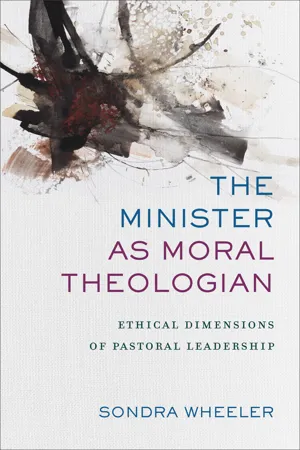
The Minister as Moral Theologian
Ethical Dimensions of Pastoral Leadership
- 160 pages
- English
- ePUB (mobile friendly)
- Available on iOS & Android
eBook - ePub
About this book
Information
Topic
Theology & ReligionSubtopic
Christian Ministry1
The Minister as Ethicist
Ethics between the Lines
Despite the title of this chapter, I realize that the great majority of those who answer a call to Christian ministry have not set out to become ethicists. Most will serve in churches (or hospitals or schools or some other setting) devoted to the praise of God, the proclamation of the kingdom, and the meeting of human needs, not in the academy. So it would not make sense to try to equip all pastors for, say, teaching the history and philosophical foundations of Christian moral thought or explaining Thomas Aquinas’s insights regarding the elements of freedom and constraint in human acts. (Although, for what it’s worth, this is fascinating and important stuff.) I aim to resist the temptation that besets all academics to try to excite everyone else about the aspects of their disciplines that interest them.
Instead, I want to take seriously the tasks and the needs of those who are called to pastoral ministry or chaplaincy, recognizing that the finer points of moral theory and the more technical aspects of ethics may be of little immediate use to them. Yet the minister is probably the only professional practitioner of Christian ethics most congregants will ever get to know, a fact that has many implications for the practice of ministry. And if you suppose that such a description does not apply to you, I would like to make the case that all who perform the routine tasks of ministry will be doing moral theology—the exposition of how their theological commitments shape their lives in the world—every day, whether they think of it that way or not.
To begin with the most obvious, those of you who serve in churches (and in other ministry settings as well) act as ethicists in preaching. You convey judgments about what is central and important in forming and living a Christian life by choosing which biblical texts to preach on and by choosing what to emphasize within a given passage. You also teach by default in what texts you ignore or actively avoid, choosing to offer a topical sermon on the week in which a particularly challenging passage comes up in the lectionary. You teach ethics explicitly through what you say about passages that raise moral issues but also tacitly through what you assume or leave unsaid—as, for example, when a minister breezes past the advice in 1 Peter for slaves and women to imitate Christ by accepting the unjust authority placed over them (2:18–3:6) without stopping to deal with analogous modern instances of injustice in police misconduct or domestic abuse. You serve as an ethicist through what you preach about perennial moral problems (violence, oppression, infidelity, greed) as well as in the problems you avoid naming or addressing at all. And whatever moral issues you choose to address from the pulpit, you teach central lessons in Christian ethics by how you talk about those who hold other points of view.
Apart from preaching, ministers in any setting teach in one form or another. This activity, too, always includes aspects of ethics, whether intended or not. Simple matters, like which church groups or subjects are deemed worthy of your teaching time, are full of implications about who and what is most important in the life of the community. Furthermore, not only the content but also the method you use in teaching carries lessons in Christian ethics. What sources do you draw upon in coming to understand a topic, and which have the most weight? How do you reckon with differences between those sources? How do you use the authority of the classroom, and how do you draw out and make use of the ideas and experiences of others? All these practical decisions offer moral lessons in themselves. In the Christian education of adolescents and adults, as in preaching, much is conveyed just through which topics are addressed and which are set aside either as unimportant or as too difficult to handle. If you do take on topics that are painful or disputed, then how you approach these areas will be as important as what you say about them. Especially instructive is how you deal with moral disagreement in the society at large, in the church, and within your particular community. How much real ambiguity do you allow for in making moral judgments about complex matters? How tentative or provisional are the positions offered on such issues? In matters of controversy, to what extent do you open the possibility that your view rather than your opponent’s might be incorrect? All such attitudes and presuppositions fall under the broad sweep of ethics, which includes habits of heart and mind as well as norms of behavior.
Woven into and underneath all discussions of ethics in the church is an underlying issue of central significance. What is the relationship between Christian faith and moral life? Is Christian life simply a matter of trusting in “the righteousness of God through faith in Jesus Christ” (Rom. 3:22), so that Christian ethics begins and ends with throwing oneself at the foot of the cross? Or conversely, does it all depend on one’s behavior, so that (as the letter of James suggests) true religion is “to care for widows and orphans in their distress” (1:27)? Does that mean we need not worry too much about what—or whether—we believe? Or is the relationship between faith and morality more complicated than either of these texts taken alone can indicate? Some answers to these questions, however unformed, are implied by the patterns and practices of a community. How and to what extent are ethical questions taken up in the proclamation and instruction of a given congregation? How are these matters related to its core theological commitments? The day-to-day life of a Christian organization embodies an ethical viewpoint and a sort of unspoken moral theology. By the nature of the enterprise, all Christian teachers, and thus all ministers, are also teachers of ethics.
While preaching and teaching Sunday school are clearly activities peculiar to religious communities, the giving of care and counsel may seem like one of the services that ministers provide in common with many other professionals. Psychiatrists, psychologists, clinical social workers, marriage therapists, and even the emerging specialty of “life coaches”—all are among those who offer support, advice, and therapeutic assistance to individuals, couples, and families in a variety of situations. These professionals are trained in a variety of disciplines and possess a range of skills. They represent diverse methods, approaches, and schools of thought, as indeed clergy may bring different levels of training and experience and different tools, resources, and theoretical frameworks to their work in pastoral care and counseling. What makes ministers and pastoral counselors distinct as a group from other caregivers is that they are grounded in part in some religious tradition and receive part of their authority from that tradition.
This foundation means that pastoral counselors are not neutral in their work but represent a particular, theologically informed view of the world and of the human being. They do not begin their encounters with people seeking help from a position of agnosticism about what is true and important, and they cannot adopt a posture of indifference to these commitments or their implications when counselees step into the pastor’s study. Judgments about good and evil, conduct that is worthy of praise or blame, and paths that lead to human flourishing or impoverishment all depend on what is real and true about human beings and the world they inhabit. For this reason, the counseling activities of ministers always have ethical aspects to them. A minister cannot simply accept uncritically whatever life goal or strategy parishioners offer and neutrally set about helping them to achieve the proffered aims by whatever means come to hand. Rather, the minister must engage with the counselee in the work of discernment, of coming to moral clarity and judgment, and must call the person to faithfulness in this work as an aspect of discipleship.
Let me hasten to acknowledge that the Christian faith is not uniform. There are significant differences in theological interpretation and resultant moral judgments among the various Christian traditions and indeed within them. Nor is it even the case that two people who subscribe to the identical statement of faith will always come to the same ethical judgment in a particular case. The point here is merely that in a community of faith, life choices and decisions are recognized as moral decisions; they are aspects of living out one’s faith and not merely matters of personal taste or preference. They are, therefore, fit matters for discussion, subject to ethical evaluation and critique, possibly calling for affirmation or even for reproach. This is true whether the congregant (or even the pastor!) wishes to deal with morality directly or not.
Sometimes, of course, congregants come explicitly seeking moral counsel. Other times they may come seeking permission to follow a course of action that has obvious ethical problems. Occasionally they come having already decided upon such a course and want help in carrying it out. (“Please help me tell my wife that I am leaving her for my girlfriend so she doesn’t get too upset”—an actual example!) And then there are the times people do not come, but you and those around them desperately wish they would. If you are a pastor—a word that, after all, means “shepherd”—what do you do when a parishioner proposes or undertakes some patently outrageous course of conduct? Or conversely, when someone in your care grieves and agonizes over some moral decision that cannot be made any more faithfully than it already has been? At least some of the time, to be a pastor is to offer more than what we commonly call “moral support”: it is, with all humility and some trembling, to offer moral guidance.
The final category of what I have called “ethics between the lines” in ministry is the subtlest and in many ways the most challenging of all. It comes of the fact that, whether you like it or not, fairly or unfairly, as a minister you are taken as a model—an exemplar of a faithful Christian life. There is a potent opportunity as well as a serious responsibility in this: many have been inspired to greater practical faithfulness by the Quaker saying, “Let your life speak.” But of course, in a broader sense your life is speaking all the time, especially if you are the visible leader of a community. The question is, what is it saying? And because communication always depends on both members in the exchange, what your behavior is taken to say will never be fully in your control, nor will your actions always be interpreted generously or even reasonably.
If as a pastor you are seen doing something, others may twist this as permission to serve their own agenda, even if the circumstances are not really comparable. (“Even the minister drinks. Get off my back about a couple of shots on the way home from work! I’m fine to drive!”) If you have had a bad day and a splitting headache, and you snap at a parishioner who is being domineering in a meeting, it is not just your conduct in that moment that will be subject to criticism. Your leadership and even your calling may be questioned. More broadly still, moral failures that become known are taken not only to reflect badly upon ministers but also to cast doubt on the faith they represent, as we have seen in the public scandals over sex and money that have plagued the church over the past few decades. Finally, and deepest of all, beyond the requirement of modeling faithful discipleship day to day, there are some occasions—at the Communion Table or beside a penitent or at the bedside of the dying—where the minister’s role is nothing less than to embody the presence of Christ. It is not obvious how those who serve in ministry can take the weight of this role seriously without self-deception or collapse.
By now I hope I have made clear why ministers cannot avoid doing ethics as part of their ordinary work. As a pastor, you function as an ethicist in a variety of ways, and in some way in almost every activity you undertake, if only as an example whose conduct will be taken as a standard by members of your congregation. If you serve in another kind of institution, in a school or in a hospital, in the military or as a chaplain for police and firefighters, the particular shape of your ministry may change, but it will still include the elements of proclamation and instruction, giving counsel and modeling discipleship. Whether or not this was part of your plan, having entered into ministry, you are the moral theologian in residence for the community you serve.
The Church as a Moral Community
Every human being of ordinary mental capacity over the age of seven or eight is “doing ethics,” at least in the basic sense of making choices that have moral dimensions. Similarly, all Christians can be said to be “doing moral theology” in that they are living out some version of a Christian life, whether they are reflecting on it or not. But ministers are a special instance of this general truth because they have undertaken to lead a congregation or some other Christian community. Such a role draws upon all three dimensions of moral existence: what one understands, what one does, and who one is. It includes the formal leadership of worship and instruction and the administration of the church as an organization. It also includes the informal aspects of personal presence and example, the building of relationships, and the modeling of a shared life. Formal and informal aspects of ministry are intertwined, and both are vital to effectiveness. Leadership involves a delicate dance of speaking and listening, influencing others and being influenced by them, and developing the common ethos that makes an organization healthy and effective. This is true even in secular organizations, the government, or for-profit enterprises, whose leaders must forge a common purpose and a shared commitment to it in order to accomplish their goals. But a church is a distinct case in that a church must be a moral community in the deepest sense in order to retain its identity as a witness to the gospel and a sign of the reign of God.
To be a moral community in this comprehensive sense is first of all to be grounded as a place of theological reflection. It is to be rooted in study, thought, and prayer about the practical implications of Christianity’s central claim: that God has acted in the life, death, and resurrection of Jesus of Nazareth to redeem and reclaim the world as God’s own. Most Christian traditions send their prospective pastors for extensive education to equip them to lead such reflection, training them in tools of biblical analysis and the history and structure of Christian thought. But the role of a minister is not properly to study and reflect for the community in the sense of doing it on their behalf. Rather, it is to invite all members of the community into the shared work of reflection, a dimension of loving God with one’s whole mind that is part of the first and greatest commandment (Mark 12:30 and parallels). Christians are those gripped by an extraordinary story: how God in Jesus has followed us even into flesh to break the cycle of sin and death that holds us and the whole creation captive. How does this astonishing act grasp our lives and open us to new possibilities? What does a life set free from fear and futility look like? If the whole of Christian existence can be summed up as loving God and our neighbors, how do we discern together the concrete shape of love in our own time and place? These are not questions only for the ordained but for all who are members of the body of Christ in the world.
From this foundation the other aspects of life as a moral community arise. The people nurtured into Christian faith are also gathered in prayerful attention concerning the particular gifts and calling of this community of faith and of the individuals who compose it. This Spirit-guided work of learning to see the world as God intends it, and to recognize one’s place in bringing that world to light, is what the tradition calls moral discernment. Together in worship and prayer, in the study of Scripture and the study of the world they are called to serve, with the help of the Holy Spirit, Christians seek to know their vocation and respond to God’s call. But the path of faithfulness is often challenging. The ongoing communal task of growing into people who have the skills and the character to fulfill their vocation is the long work of moral formation, and it has countless dimensions. We are shaped by all we see and hear—by the stories we treasure and the examples we lift up, by the lives of the saints and the steady disciplines of prayer and worship, where we learn to give up our illusions of control and remember with gratitude that God reigns. And we are formed by the company we keep: the friendships we nurture and the unlikely companions God gives us for the journey, the people God bestows on us who support or challenge, comfort or irritate us, the concrete and particular neighbors we are given to love and to learn from.
The deep, subtle shaping of how we see ourselves and the world, of what we hope for and imagine, what we love and trust and fear—all of this is part of sustained participation in a community of faith. This formation of character bears its most visible fruit in the mission and ministry of the congregation, but it also shows itself in the internal conversation that guides and propels that ministry, the conversation about the shape of a faithful life and the demands of discipleship. Such conversation is essential to the ongoing health and vitality of the congregation, for without it even once-vibrant missional programs tend to become matters of rote, based on “we’ve always done in that way” and not on the present gifts of the church or the actual needs of the wider community it serves. And apart from the constant renewal of vision and the continuing incorporation of new members with their ideas, gifts, and challenges, churches do not survive the changes that time brings within and outside their walls. Part of seeking a renewed vision and call is grappling with the issues of the day that confront us and trying to find a way forward that is faithful, bearing witness to the good news of God’s love and the truth of God’s reign over a broken and self-destructive human world.
This means that to be itself, the church must be a place of continuing moral conversation, a community where it is safe to struggle with confusion and disagreement, because what unites us is stronger than what might divide. The truth is that our unity is not a choice but a fact: it is the result of what God has freely done for all of us in common, and it knits us together whether we like it or not. We are sisters and brothers, kin by divine fiat, and we can no more exclude and ignore those we are sure are wrong (as they likely are equally sure about us!) than we can stop inviting Uncle Al to family weddings just because we find him so disagreeable. But we also cannot avoid unpleasantness by dodging real conversations, keeping things on a polite and superficial level where we do not offend but also do not truly engage one another. We need to talk with one another about what is true and important in how we live our daily lives: what is at stake in the promises we keep or break, in the way we earn our money and how we use it, and what it might mean to be a Christian and a citizen. In these and a hundred other arenas, we are giving testimony about what we actually believe and love, hope for or fear, and we need to probe together how that testimony conforms to what we say in church on Sunday morning. To abandon that aspect of the church’s common life is to settle for being something less than the church, a place of comfort without accountability, of service to the members rather than service to God, who calls the church into being as a living light to the world.
To sustain such a conversation is not easy, and it is not for the fainthearted, for it involves not just observation and discussion of issues in the abstract but also encouragement in the challenging discipline of learning to conform the witness of our lives to the witness of the gospel. It means learning to listen as well as to speak, to suspend certainty on matters about which we hold firm and passionate convictions so that we may be open to learning from others. And when that learning leads to the realization that we or someone else has turned aside from the path of faithfulness, then the community becomes the place of reform and reconciliation, where the wanderer is invited to repentance, forgiveness, and restoration. If this sounds uncomfortable, time consuming, and socially awkward, it frequently is. It is also deeply counter...
Table of contents
- Cover
- Title Page
- Copyright Page
- Dedication
- Contents
- Acknowledgments
- Introduction
- 1. The Minister as Ethicist
- 2. Preaching on Morally Difficult Texts and Occasions
- 3. Teaching about Moral Issues
- 4. Giving Moral Counsel
- 5. Serving as a Moral Example
- Further Reading
- Index
- Back Cover
Trusted by 375,005 students
Access to over 1.5 million titles for a fair monthly price.
Study more efficiently using our study tools.
Frequently asked questions
Yes, you can cancel anytime from the Subscription tab in your account settings on the Perlego website. Your subscription will stay active until the end of your current billing period. Learn how to cancel your subscription
No, books cannot be downloaded as external files, such as PDFs, for use outside of Perlego. However, you can download books within the Perlego app for offline reading on mobile or tablet. Learn how to download books offline
Perlego offers two plans: Essential and Complete
- Essential is ideal for learners and professionals who enjoy exploring a wide range of subjects. Access the Essential Library with 800,000+ trusted titles and best-sellers across business, personal growth, and the humanities. Includes unlimited reading time and Standard Read Aloud voice.
- Complete: Perfect for advanced learners and researchers needing full, unrestricted access. Unlock 1.5M+ books across hundreds of subjects, including academic and specialized titles. The Complete Plan also includes advanced features like Premium Read Aloud and Research Assistant.
We are an online textbook subscription service, where you can get access to an entire online library for less than the price of a single book per month. With over 1.5 million books across 990+ topics, we’ve got you covered! Learn about our mission
Look out for the read-aloud symbol on your next book to see if you can listen to it. The read-aloud tool reads text aloud for you, highlighting the text as it is being read. You can pause it, speed it up and slow it down. Learn more about Read Aloud
Yes! You can use the Perlego app on both iOS and Android devices to read anytime, anywhere — even offline. Perfect for commutes or when you’re on the go.
Please note we cannot support devices running on iOS 13 and Android 7 or earlier. Learn more about using the app
Please note we cannot support devices running on iOS 13 and Android 7 or earlier. Learn more about using the app
Yes, you can access The Minister as Moral Theologian by Sondra Wheeler in PDF and/or ePUB format, as well as other popular books in Theology & Religion & Christian Ministry. We have over 1.5 million books available in our catalogue for you to explore.