Understanding Dante's spiritual masterpiece
Dante's Divine Comedy is widely considered to be one of the most significant works of literature ever written. It is renowned not only for its ability to make truths known but also for its power to make them loved. It captures centuries of thought on sin, love, community, moral living, God's work in history, and God's ineffable beauty. Like a Gothic cathedral, the beauty of this great poem can be appreciated at first glance, but only with a guide can its complexity and layers of meaning be fully comprehended.
This accessible introduction to Dante, which also serves as a primer to the Divine Comedy, helps readers better appreciate and understand Dante's spiritual masterpiece. Jason Baxter, an expert on Dante, covers all the basic themes of the Divine Comedy, such as sin, redemption, virtue, and vice. The book contains a general introduction to Dante and a specific introduction to each canticle (Inferno, Purgatorio, and Paradiso), making it especially well suited for classroom and homeschool use.
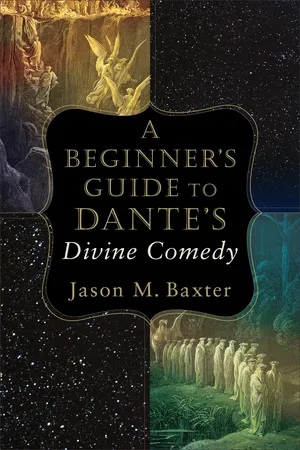
- 224 pages
- English
- ePUB (mobile friendly)
- Available on iOS & Android
eBook - ePub
A Beginner's Guide to Dante's Divine Comedy
About this book
Information
Topic
Teología y religiónSubtopic
Teoría de la crítica literariaPart 1: Inferno
1
Zooming In and Zooming Out: How to Read Inferno
(Inferno 1–2)
From Architecture to Nightmare: Reflecting on Inferno 1
Although the Comedy is, as I have argued, a poem of impeccable order, the poet is careful to make sure that our first impression is not of the poem’s architecture but of its emotional power. In Inferno 1 we are immediately seized and carried away by some of the most gripping and dramatic imagery of the Comedy. Later, Dante will get philosophical (Purg. 25), talk about the moral principles that make up the boundary lines within hell (Inf. 11), and argue fine points of doctrine (Par. 2). But the reader of Inferno 1 doesn’t feel he has stepped into a classroom; he has walked into the world of dreams.
The whole of Inferno 1 is an extraordinary poetic achievement in its ability to create the feeling of a nightmare. The reader feels the pilgrim’s irrational fear, as if both were locked in a terrible dream. And yet the poet insists that his pilgrim is not sleeping. In fact, it was sleep that got him into the dark wood in the first place:
I cannot well recall how I came there.
I was so full of sleep at the time,
I abandoned the true way. (Inf. 1.10–12)
How he got there, he does not know, but he can remember clearly the disoriented terror that came over him, like a child who has woken up from a bad dream and can’t remember where she is. The poem dramatically begins by recalling the memory of that restless and disorienting experience:
Midway in the journey of our life
I found myself in the midst of a dark wood—
the true way was lost.
Ah! How hard to tell!
How savage, harsh, and difficult was this wood,
so much so that in my mind my fear returns.
It is so bitter that death is barely worse.
But to treat the good that I found there
I will speak about the other things I saw. (Inf. 1.1–9)
After the introductory lines, the dreamlike narration continues: the pilgrim wanders through a vague landscape; he sees a hill that is illumined by sunlight on its crown; he stoutly resolves to climb the hill, but then his way is blocked by three strange beasts who refuse to give way; and, finally, having come to the point of absolute desperation, he sees a stranger walk out of the shadows and begs him for help. Again, like a story unfolding within a dream, the narrative seems so rich and full of meaning that it’s difficult to pin it down to a single interpretation, and this elusiveness of meaning is in part how Dante gives Inferno 1 its psychological power. Meaning keeps slipping through your fingers.
Dante also uses harsh words to reinforce rhetorically this sense of fear and confusion. For example, listen to the Italian words in verses 4–5: esta selva selvaggia (a wood “savage, dense, and harsh”) has a roughness communicated by sibilant syllables, but then the poet stacks up a number of adjectives (the wood is selvaggia e aspra e forte, 1.5). This is a rhetorical device called “polysyndeton,” the stacking up of conjunction upon conjunction, as if rhetorically approximating a breathless description: “It was savage and dense and harsh . . .”
Dante also uses two similes to help convey the desperation of the pilgrim’s first moments:
And like one who, with labored breath,
just escaped from the sea onto the shore,
turns toward the dangerous waters and stares,
just so did my mind, still in flight,
turn back to gaze at the pass
that never yet let out a man alive. (Inf. 1.22–27)
Many of my readers will have had a brush with death, perhaps in a car, in which you saw how close you were to having your life ended. Likewise, Dante describes a swimmer immersed in water so rough and stormy that he doubts he will escape drowning. But somehow, against all odds, the swimmer makes it to shore, completely drained of all energy and strength. He stands up wearily and looks back at the raging water. In this way, the poet says, the pilgrim turned to look back at the wood that “never yet let out a man alive” (1.27).
When the weary pilgrim slowly turns and looks up, he sees the “mountain of delight” (Inf. 1.77). Along with him, the reader feels a momentary surge of hope. The pilgrim sees the peak, whose “shoulders / [are] now clothed by the rays of the sun” (1.16–17). His fear is momentarily calmed, and he resolves to climb to safety: “I took up the way again through the deserted slope, / in this way: the firm foot was always lower down” (1.29–30). Commentators explain that the mountain is covered in shale-like scree: every time the pilgrim takes a step up, his planted foot slides down. And so, though the pilgrim has good aspirations, the way up is not easy. Then he meets a wild beast: a leopard, which refuses to give way. You can imagine the pilgrim yelling at it, intimidating it, trying to frighten it away, but the beast simply refuses to move. Then a lion appears and roars so loud that “it seemed that the air trembled because of him” (1.48). Finally, a skinny, mongrel wolf, hungry and mangy, forces the pilgrim back down the hill. This is when Dante’s second simile comes. The pilgrim is like
he who wins with joy,
but then the moment arrives, and he loses all,
and then is miserable and weeps in all his thoughts. (Inf. 1.55–57)
Anyone who has experienced bitter loss knows the feeling. Dante was on the verge of achieving, through sweat and labor, a real good that his heart desired, the radiance and bliss of a mountaintop experience—and just as he thought he was near enough to grasp it, it slips through his fingers and is gone. His heart burns for the memory of what could have been.
And so we have a dreamlike landscape, with action described with the psychological intensity of a nightmare; we hear about the pilgrim’s fear, good intentions, obstacles, and failure. We feel Dante’s poetry deeply. But in terms of what it means, Dante has left us in the dark: What is this wood? What is the “mountain of delight”? What are the three beasts? Why can’t Dante overcome them? And why is it Virgil who comes to save the pilgrim? Why not Saint Patrick? Or Aristotle? Or an angel? Dante’s poem is like a journey whose horizons continually recede even as you approach them.
Dante and Wonder: How to Read Inferno
Although many of the details are meant to initially elude us, we can still note that, even from the first canto, Dante has begun to coach us in how to read his poem. There are at least two lessons. The first is that the reading experience of the Comedy works on multiple levels; we can, for example, get inside the poem and see with the pilgrim’s eyes, or we can zoom out, considering the scene from the author’s perspective. When these two views overlap, as in Inferno 1, we sense a distinct dramatic irony. The very words of the lost pilgrim in Inferno 1, unbeknownst to him, are expressed and framed in those groups of threes and tens the author built into his poetry. Thus, from the author’s perspective, God is very close and present through the fabric of the poem, even if the character speaking within that poetry is blind to him in whom he lives and moves and has his being (Acts 17:28).
The second lesson is that, although we can consider the poem from that zoomed-out perspective, we have to begin with our immediate reading experience—that is, how Dante’s rich and sensuous poetry evokes in us a complicated range of responses (horror, awe, pity, contempt, glee, relief, dread, reverence, and fear). For this reason, it would have been a great mistake to have begun an introduction to the Comedy by outlining the moral system that accounts for the architecture of Dante’s imaginative world. Beginning with an explanation of the “system” would erect a philosophical or theological scaffolding that could obscure the experience of reading the poetry. Indeed, Dante’s most original achievement lies not so much in coming up with that hierarchical order of sins and virtues as in his ability to give flesh to that system of thought, to create a series of individual literary experiences to illustrate those thoughts. This insight should guide how we read the Comedy: we have to begin by being moved by the sensible and the sensuous in Dante’s poem, and then proceed to a discussion of the tradition of thought that, like a skeleton, informs it.
On a similar note, scholars have had a lot to say about the role of allegory in the Comedy,1 and it is certainly true that you find many allegorical moments: like the three beasts in Inferno 1, the tempestuous winds in Inferno 5, or the highly symbolic dreams of Purgatorio (all discussed below). Allegorical figures are scattered throughout the poem. At the same time, Dante wants the poem to feel real, intense, and personal. The pilgrim is not an allegorical figure but a man who has powerful interior responses. This is what is meant by Dante’s “realism.”
The Comedy (and Inferno in particular) is the great poem of interiority, and it is this interiority that popular culture overlooks. In the popular imagination, Inferno is a place of fire with a bunch of demons with pincers. The truth is, Dante himself identifies interiority as the essential component of his pilgrim’s journey: “And I, I alone, / was there, arming myself to endure the war, / both of the way and of the pity of it” (Inf. 2.3–5). Dante’s language here is powerful: he, he alone (e io sol uno), was making interior preparations for the “war” (la guerra). Here, he prepares himself not just for the hardships of the journey but also for a war of pietate (pity). Obviously, along the way, the pilgrim will encounter difficult landscapes and malicious demons. Along the way, he will suffer extreme fatigue, breathless from arduous climbs. He will experience fear when he thinks he has been abandoned. He will suffer despair when the demons block his forward progress. He will be lied to, chased, screamed at, insulted, threatened, and confused. In the end, he will emerge from hell, his face covered with grime and stained by tears (Purg. 1.95–99, 127–29). But even more than these physical trials, the pilgrim will have to undergo feats of the interior life. He will have to undertake a journey of interiority: something he, and he alone, must do. This explains the mystery of why the poet says, “Io sol uno,” even though Virgil is standing right next to him, having just rescued him from miserable isolation!
Inferno, then, is the poem of interiority. It aims to crack the crusty shell of the heart and gain access to its secret, guarded places. It aims to use horror, wonder, and terror as ways to create afresh the possibility for transformation; or, to change the image, Dante’s poetic violence is meant to melt down the hard heart so that it can be reforged into something new. Not surprisingly, then, the Comedy is packed full of “wonder” words: the pilgrim has visions of the nuovo and novitade (the frightfully new and bizarre); that which is strano, orribile, and full of stupore (strange, horrifying, and that which causes stupor); the pilgrim stops to ammirare (wonder) and stare at the mirabile and maraviglia (the miraculous and the marvelous). Words like this appear hundreds of times throughout the poem.2 In Dante, these “wonder” words refer to instances of the bizarre, the harrowing, the unexpected, the previously inconceivable: severed heads, disemboweled bodies, backs broken by huge rocks. There are poisonous forests made up of “eerily strange,” gnarled trees (Inf. 13.15), which resound with whispers; there is the “strange” experience (31.30) of the looming giants, who fill the pilgrim with fear; and there are the mangled bodies of the schismatics, or the headless Bertrand de Born. All of these visions are so startling that Dante can barely believe his eyes (28.113–20). The pilgrim, because his heart is opened up by these phenomena of surprise and fear, desires to stare fixedly (21.22) and to “inebriate” his eyes (29.2). These scenes of wonder are important for Dante, because admiratio (wonder) produces the desire to “look closely at” (mirari). As Mary Carruthers has pointed out, in the ancient world, rhetoricians worried that their audiences could become ...
Table of contents
- Cover
- Title Page
- Copyright Page
- Contents
- Acknowledgments
- Introduction
- Part 1: Inferno
- Part 2: Purgatorio
- Part 3: Paradiso
- Conclusion
- Notes
- Index
- Back Cover
Trusted by 375,005 students
Access to over 1.5 million titles for a fair monthly price.
Study more efficiently using our study tools.
Frequently asked questions
Yes, you can cancel anytime from the Subscription tab in your account settings on the Perlego website. Your subscription will stay active until the end of your current billing period. Learn how to cancel your subscription
No, books cannot be downloaded as external files, such as PDFs, for use outside of Perlego. However, you can download books within the Perlego app for offline reading on mobile or tablet. Learn how to download books offline
Perlego offers two plans: Essential and Complete
- Essential is ideal for learners and professionals who enjoy exploring a wide range of subjects. Access the Essential Library with 800,000+ trusted titles and best-sellers across business, personal growth, and the humanities. Includes unlimited reading time and Standard Read Aloud voice.
- Complete: Perfect for advanced learners and researchers needing full, unrestricted access. Unlock 1.5M+ books across hundreds of subjects, including academic and specialized titles. The Complete Plan also includes advanced features like Premium Read Aloud and Research Assistant.
We are an online textbook subscription service, where you can get access to an entire online library for less than the price of a single book per month. With over 1.5 million books across 990+ topics, we’ve got you covered! Learn about our mission
Look out for the read-aloud symbol on your next book to see if you can listen to it. The read-aloud tool reads text aloud for you, highlighting the text as it is being read. You can pause it, speed it up and slow it down. Learn more about Read Aloud
Yes! You can use the Perlego app on both iOS and Android devices to read anytime, anywhere — even offline. Perfect for commutes or when you’re on the go.
Please note we cannot support devices running on iOS 13 and Android 7 or earlier. Learn more about using the app
Please note we cannot support devices running on iOS 13 and Android 7 or earlier. Learn more about using the app
Yes, you can access A Beginner's Guide to Dante's Divine Comedy by Jason M. Baxter in PDF and/or ePUB format, as well as other popular books in Teología y religión & Teoría de la crítica literaria. We have over 1.5 million books available in our catalogue for you to explore.