- 224 pages
- English
- ePUB (mobile friendly)
- Available on iOS & Android
eBook - ePub
About this book
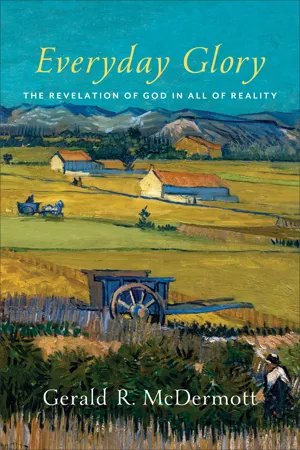
How do we know and speak about God's relation to this world? Does God reveal himself through his creation? This book recaptures a Christian vision of all reality: that the world is full of divine signs that are openings into God's glory. Bringing together insights from some of the tradition's greatest thinkers--Edwards, Newman, and Barth--Gerald McDermott resurrects a robust theology of creation for Protestants. He shows how and where meaning can be found outside the church and special revelation in various realms of creation, including nature, science, law, history, animals, sex, and sports.
Information
Topic
Teologia e religioneSubtopic
Teologia cristiana 1
Recovering a Lost Vision
Most people in the world wander through life without seeing its full meaning. Christians know its meaning but often miss the embedded meaning in the world all around them. They know that God created the world and that he will bring the world to an end. Some know that the end will not take his people to a heaven in the sky but to a renewed world right here. But most Christians have been trained not to see the meaning of the innumerable parts of this world, or the meaning of the world itself. They have been conditioned to see beyond the earth and its heavens to a realm fundamentally removed from what they can see. They miss the glory of the Lord that is all around them—in this world and these heavens—which the seraphim extolled to Isaiah (Isa. 6:3) and the great liturgies proclaim: “Heaven and earth are full of your glory!”
Let me try to illustrate how we can see and not see at the same time. Try staring at the four dots in the picture on the previous page for 30–60 seconds.1 Next close your eyes, and then look at a bright wall. You will see an image of “the glory of God in the face of Jesus Christ” (2 Cor. 4:6 ESV). Of course this is only an image and not the refulgent glory. Yet it demonstrates my point: the glory of the Lord is right in front of us, but we usually don’t see it.
Disenchantment
This gap between perception and reality was not always so large. For millennia the cosmos had seemed to most men and women to be a source of wonder, an infinitely complex mystery with unsearchable beauties and intriguing harmonies. They believed the universe was a sign with meaning, but that the meaning was often missed. As the twelfth-century theologian Hugh of St. Victor wrote,
The whole sensible world is like a kind of book written by the finger of God—that is, created by divine power—and each particular creature is somewhat like a figure, not invented by human decision, but instituted by the divine will to manifest the invisible things of God’s wisdom. But in the same way that some illiterate, if he saw an open book, would notice the figures, but would not comprehend the letters, so also the stupid and “animal man” who “does not perceive the things of God” may see the outward appearance of these visible creatures, but does not understand the reason within.2
By the “animal man,” Hugh probably meant a person who sees nothing of God’s glory, or else has a sense of a Creator but does not let it affect him or her. But in the beginning of this quote Hugh spoke for millions in the church who have seen God’s glory through “the things that have been made,” as Paul put it (Rom. 1:20). They not only sensed something beautiful in the glories of the world around and above and in them but also sensed something of what Hugh called “God’s wisdom” in and through the creatures he made. They resonated with Jesus’s saying that the lilies of the field and the birds of the air showed that God would provide for his people, since God provided for the lilies and the birds and yet loved his people even more (Matt. 6:26–30). And if God was speaking through lilies and sparrows, they surmised, then he was probably also speaking through wine and bread and vines and lights, as his connections to those things
suggested.
suggested.
But in the modern age fewer Christians have been able to see messages like this in the creation. They have been affected by two things: growing secularism, which refuses to acknowledge that we and the world are the creation of God, and certain theologies that discount even believers’ abilities to discern meaning in the creation.
We’ve all heard about the first cause of Christians being less able to understand the meaning of creation—secularism and its gradual disenchantment of the world. We have heard from historians and sociologists that as more and more people became convinced that the world’s origin could be explained by science, the cosmos came to be regarded as a predictable machine made by God. Then, when faith in God dissolved, it was seen as a cold universe arising from randomness and therefore inimical to lasting personhood and love.3
Most of us learned in college history classes that this disenchantment of the world started with “the Copernican revolution,” which made humanity the center and measure, replacing the infinite God with finite man, broken in his relationships and partial in his vision. It made sense to us that moderns started to turn their focus from what was beyond limit (God) to what they could know within their limits (human beings and their nearby world). If we took a bit of philosophy in college, we learned that the German philosopher Immanuel Kant (1724–1804) limited knowledge even further by arguing that we could never know things as they really are, either God or things closer to us, but only our own thoughts about God and things. We might have also read about the Danish philosopher Søren Kierkegaard (1813–55) and his so-called leap of faith (a term he probably never actually used). But there is little doubt that he persuaded generations of readers that they must leap over reason and this world to get to ultimate truth. (It is unfortunate if this is all they gained from Kierkegaard, for he rightly stressed the flip side of reason’s inability to know the Triune God—namely, the soul’s capacity for communion with the Triune God in its “subjective,” or personal, knowledge.) University students in the last few decades often felt reinforced by Kierkegaard in what they already had intuited, both from their own experience and the atmosphere at most universities, that reason cannot prove God or say anything certain about God other than that his existence is doubtful.
There is also what could be called a denominational difference. The sixteenth-century Protestant Reformers argued that late medieval Catholic theology had too much confidence in reason. Luther and Calvin insisted that Roman theologians of their day failed to recognize sufficiently that reason, like every other part of the human person, was tainted by the fall and therefore could not be relied upon to see in the creation anything truthful about God. Since reason was a gift of nature and not grace, Protestants tended to conclude that the world of nature is fundamentally different from the sphere of grace, so that the beauties of the world have no fundamental or primary relation to the beauty of God. Even if they do, sin has so damaged our eyesight that we cannot see that relation rightly. In fact, our sin-damaged eyes are not capable of seeing anything about the true God from reason and nature alone. But more important for Protestants, God has shown us everything we need to know in the Bible, and the main story there is about salvation and especially justification. According to the Protestant Reformers,4 too many Catholics had misused the creation to argue for what Luther called a “theology of glory,” which assumed that they could know what was important to know about God through reason and nature alone. Luther proposed that the only way to know the true God was through the cross of Jesus Christ. Protestants generally agreed with Luther’s approach to God and the cross, as did many Catholic theologians in the next centuries. But while Catholics continued to sustain a robust theology of creation, Protestants tended to let their understanding of creation become eclipsed by their overwhelming emphasis on redemption. Some even went so far as to claim that there is no such thing as revelation through the creation.
It didn’t help matters that the formidable trinity of the long nineteenth century—Darwin, Marx, and Freud—seemed to confirm Western culture’s growing disenchantment of the world. However much some Christians labored to reconcile macroevolution with God’s creative work, Charles Darwin (1809–82) persuaded millions that God was not needed to begin or sustain the world. Karl Marx (1818–83) told moderns that God talk is merely a drug (“the opiate of the masses”) enabling the weak to cope with their economic and social hardships. Sigmund Freud (1856–1939) pointed not at society as Marx did but at inner desire, claiming that religion is wish fulfillment. Like Marx, Freud insisted it was only the weak who need religion. For all three of these modern “prophets,” the world was no longer a beautiful mystery created by a glorious God but an arena for the survival of the fittest (Darwin) or for the exploitation of the proletariat (Marx) or for conflict between the superego and the id (Freud).
While Christians rejected the atheism of these three thinkers, many agreed with parts of their projects. Some Christians accepted the new creation story of natural selection but said God initiated and perpetuated that process. Most Christians sympathized with Marx’s concern for the downtrodden and recognized the evil of economic exploitation, especially by one class against another. Many Christians also saw Freud as opening up the ways that sin works in child-parent relations and in the depths of the unconscious. Yet by training Christian attention on how nature might have originated species, on the manner in which history and human nature colluded to produce economic oppression, and on the ways that inner human nature was conflicted, these thinkers made it more difficult for Christians to see the glory of God in nature. Besides, Darwin faulted the church’s literal interpretation of creation, Marx protested the church’s acceptance of class differences, and Freud decried the church’s teaching about sexual sin. Christians couldn’t help wondering whether the church might be wrong about creation too. Perhaps the medieval church’s assumption that nature speaks in a variety of ways was just another illusion that secular prophets were dispelling.
More recently, the New Atheists have claimed to lend the authority of science to the world’s disenchantment. Richard Dawkins is probably the most famous of this new tribe. In his book The Blind Watchmaker (1986) he tried to refute the argument for God from the apparent design of the universe. In 2006 he published The God Delusion, which claimed that the more one uses reason to understand science, the more one sees that there is no God. When reason looks at the stars above, the earth beneath, and the soul within, one finds not God, he claimed, but final randomness and meaninglessness. The world does not care, and love is something we imagine but that is finally ephemeral. This conclusion should not surprise us, Dawkins said in a BBC documentary: “Why should it be anything other than bleak? I mean, there is no caring about the universe. Why should there be? Why should the universe care about what happens to us?”5
Most Christians do not pay great attention to Dawkins and his ilk. As Alister McGrath and David Bentley Hart showed, these new skeptics are astonishingly ignorant of basic philosophy and theology.6 For example, they typically treat the Christian God as one more being in a world of beings; such a conception is radically alien to the God and metaphysics of the Bible. Scripture’s God is Being itself and in fact beyond being, so that all beings and all the world are in him. As Paul put it to the Athenian philosophers on Mars Hill, “In him we live and move and have our being” (Acts 17:28 ESV). The New Atheists tend to conceive of God as the seventeenth- and eighteenth-century deists did, as a finite being who created the world with its laws of nature and then sat back to observe it and occasionally intervene.7
Yet there is a way in which the New Atheists affect Christians. They concentrate on moral evil, which they think disproves a good God, for he does not stop the greatest human evils such as the German Holocaust, the Soviet Gulag, and the Cambodian Killing Fields. They delight in exposing the vicious killing of nonhuman nature, “red in tooth and claw,”8 where life seems to require death on a regular basis. What appear to be innocent animals are routinely attacked and killed with savagery by bigger animals. Then they ask how a good and loving God could have invented such a vicious system of nature.
Christians know there are good replies to these ob...
Table of contents
- Cover
- Title Page
- Copyright Page
- Dedication
- Contents
- Preface
- Acknowledgments
- Abbreviations
- Illustration
- 1. Recovering a Lost Vision
- 2. The Bible
- 3. Nature
- 4. Science
- 5. Law
- 6. History
- 7. Animals
- 8. Sex
- 9. Sports
- 10. World Religions
- 11. A New World
- Appendix
- Scripture Index
- Subject Index
- Back Cover
Trusted by 375,005 students
Access to over 1.5 million titles for a fair monthly price.
Study more efficiently using our study tools.
Frequently asked questions
Yes, you can cancel anytime from the Subscription tab in your account settings on the Perlego website. Your subscription will stay active until the end of your current billing period. Learn how to cancel your subscription
No, books cannot be downloaded as external files, such as PDFs, for use outside of Perlego. However, you can download books within the Perlego app for offline reading on mobile or tablet. Learn how to download books offline
Perlego offers two plans: Essential and Complete
- Essential is ideal for learners and professionals who enjoy exploring a wide range of subjects. Access the Essential Library with 800,000+ trusted titles and best-sellers across business, personal growth, and the humanities. Includes unlimited reading time and Standard Read Aloud voice.
- Complete: Perfect for advanced learners and researchers needing full, unrestricted access. Unlock 1.5M+ books across hundreds of subjects, including academic and specialized titles. The Complete Plan also includes advanced features like Premium Read Aloud and Research Assistant.
We are an online textbook subscription service, where you can get access to an entire online library for less than the price of a single book per month. With over 1.5 million books across 990+ topics, we’ve got you covered! Learn about our mission
Look out for the read-aloud symbol on your next book to see if you can listen to it. The read-aloud tool reads text aloud for you, highlighting the text as it is being read. You can pause it, speed it up and slow it down. Learn more about Read Aloud
Yes! You can use the Perlego app on both iOS and Android devices to read anytime, anywhere — even offline. Perfect for commutes or when you’re on the go.
Please note we cannot support devices running on iOS 13 and Android 7 or earlier. Learn more about using the app
Please note we cannot support devices running on iOS 13 and Android 7 or earlier. Learn more about using the app
Yes, you can access Everyday Glory by Gerald R. McDermott in PDF and/or ePUB format, as well as other popular books in Teologia e religione & Teologia cristiana. We have over 1.5 million books available in our catalogue for you to explore.