- 221 pages
- English
- ePUB (mobile friendly)
- Available on iOS & Android
eBook - ePub
About this book
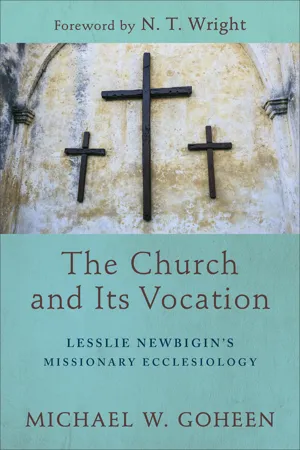
Lesslie Newbigin, one of the twentieth century's most important church leaders, offered insights on the church in a pluralistic world that are arguably more relevant now than when first written. This volume presents his ecclesiology to a new generation. Michael Goheen clearly articulates Newbigin's missionary understanding of the church and places it in the context of Newbigin's core theological convictions. Suitable for students as well as church leaders, this book offers readers a better understanding of the mission of the church in the world today. Foreword by N. T. Wright.
Information
Topic
Theology & ReligionSubtopic
Christian Ministry1
The Biblical Story as Universal History
To rightly approach Lesslie Newbigin’s missionary ecclesiology, we must begin where he always began: with Jesus Christ revealed in the gospel.1 “If it is really true that God has done what the Gospel tells us that he has done . . . it must, it necessarily must become the starting point and controlling reality of all thought.”2 Anyone who would consider Newbigin’s understanding of any issue, including ecclesiology, must begin with Jesus Christ as he is revealed in the gospel.
Near the end of his life Newbigin lamented that in the ecumenical tradition “we have used the word ‘gospel’ without giving as much attention as we need to the question of what exactly we mean by that word.”3 Certainly the ecumenical tradition is not the only Christian body to be guilty of this charge; the evangelical tradition is likewise culpable. And this is no small oversight. The way we implicitly understand the gospel has enormous implications for the way we comprehend the whole Christian faith. This includes our conception of the church and its mission. Moreover, when we do not attend to what we mean by the word “gospel,” its content is filled, by default, with meaning more derived from our theological traditions than from what Jesus meant when he proclaimed the good news of the kingdom or from Paul’s restatement of the gospel of Jesus in light of the crucifixion and resurrection.
Jesus and the Biblical Story
The gospel can only be understood in terms of a reciprocal relationship between the central events of the life, death, and resurrection of Jesus Christ and the whole of the biblical story.4 Newbigin expresses it thus: “The reading of the Bible involves a continual twofold movement: we have to understand Jesus in the context of the whole story, and we have to understand the whole story in the light of Jesus.”5 This means we need constantly to move back and forth between two mutually dependent approaches to open up the content of the gospel. On the one hand, we begin with Jesus Christ and his life, death, resurrection, ascension, and gift of the Spirit as the clue to faithfully understanding and reading the biblical story. On the other hand, we articulate the biblical story as the context for rightly understanding Jesus Christ and the central redemptive-historical events surrounding his advent in history.
Newbigin’s own approach proceeds in this way. In his 1948 talk to the Amsterdam Assembly of the World Council of Churches, Newbigin poses the question, “What is the Gospel?” which he answers by quoting Jesus’s announcement in Mark 1:14: “In the New Testament the earliest and simplest statement of the Gospel is ‘the time is fulfilled and the Kingdom of God is at hand.’”6 To properly understand this announcement of good news, one must look both to what comes before in the Old Testament writings and to what follows in the New Testament record. He then proceeds in his talk to outline this narrative context in terms of five headings: creation, fall, election, redemption, and consummation. Similarly, in his William Belden Lectures at Harvard fourteen years later, he says:
As a starting point for this study, I take the words with which, according to our most ancient records, Jesus opened his public ministry. “After John was arrested,” so the gospel of Mark tells us, “Jesus came into Galilee, preaching the gospel of God, and saying, ‘The time is fulfilled and the Kingdom of God is at hand; repent and believe the gospel’”—believe, that is to say, this piece of good news which is now announced. What is the good news? It is that the time is fulfilled and the Kingdom of God is at hand.7
We must look backward and forward to ask what is being fulfilled and how it is being fulfilled. We first inquire into the background of the coming of Christ: the Old Testament. This is made up of three “presuppositions of Christ’s revelation”: creation, sin, and election.8 Then, second, we go to the New Testament record, which announces the present arrival and the future consummation of the kingdom of God as the end of universal history.9
In both cases Newbigin begins with Jesus’s announcement of the good news of the coming of the kingdom: “the centre of his teaching was himself, the claim, that is to say, that in him the Kingdom of God had come.”10 This announcement of something that is happening demands a response—either faith and full allegiance or unbelief and rejection. But what was the meaning of this remarkable announcement? The kingdom of God breaking into the world in Jesus is about the goal of cosmic history. That goal is about the renewal of creation, which stands at the beginning of universal history. To embrace the good news in faith is to be invited into the Bible as a story of cosmic history. And so, moreover, the kingdom of God can only be understood in terms of the content of that story: creation, sin, election, redemption present in the work of Christ and the Holy Spirit, and consummation. This narrative content sets the context for understanding the good news.
This biblical narrative is a story of cosmic history. And that insight, expressed and stressed by Newbigin repeatedly, has significant implications for the gospel and for the mission of God’s people. In one remarkable statement, Newbigin summarizes a number of themes that lie at the heart of his understanding of the Christian faith:
If we take the Bible in its canonical wholeness, as we must, then it is best understood as history. It is universal, cosmic history. It interprets the entire story of all things from creation to consummation, and the story of the human race within creation, and within the human race the story of the people called by God to be the bearers of the meaning of the whole, and—at the very centre—the story of the One in whom God’s purpose was decisively revealed by being decisively effected. It is obviously a different story from the stories that the world tells about itself.11
In this statement there are four important interrelated themes that will set the agenda for the remaining chapters of this book. First, the Bible is universal history that narrates the true story of the whole world from creation to consummation. Second, a central thread in the biblical narrative is that God has chosen a people to be the bearers of the end and meaning of this story. Third, at the center of the story, Jesus reveals and accomplishes the end and therefore the purpose of universal history. Fourth, this cosmic story is comprehensive and so is incompatible with all other cultural stories. Biblical story, election of a people to mission, the gospel of Jesus, and a missionary encounter with culture—these four themes form the heart of Newbigin’s thought. And in this framework we see just what he means by a missionary church and just how central the people of God are to his understanding of the Christian faith.
The Bible Is a Story
For Newbigin, the essential form of the Bible is a narrative: “It is essentially a story that claims to be the story, the true story both of the cosmos and of human life within the cosmos.”12 When he refers to the essential form of Scripture as a narrative, Newbigin is not referring to a literary genre. The Bible is in the form of a story, but it “contains, indeed, much else: prayer, poetry, legislation, ethical teaching, and so on. But essentially it is a story.”13 The overarching structure of the Bible is a historical narrative into which all other literary genres may be fitted. This all-encompassing story is indeed narrated in the historical books of the Bible, and the historical literary genre plays its own unique role in the canon, alongside the other literary genres, in forming God’s people into a faithful community. Yet story forms the all-embracing framework and context into which all the books of the Bible find their place. The narrative of God’s redemptive work is like the skeleton of a body, which gives the basic shape, while the various books are like the organs and body parts, which find their place and play their unique role within th...
Table of contents
- Cover
- Endorsements
- Title Page
- Copyright Page
- Dedication
- Contents
- Foreword
- Preface
- Introduction
- 1. The Biblical Story as Universal History
- 2. The Good News of the Kingdom and the Missionary Church
- 3. The Missionary Church and Its Vocation in the World
- 4. The Missionary Church and Its Life Together
- 5. A Missionary Encounter with Culture
- 6. A Missionary Encounter with Western Culture
- 7. Lesslie Newbigin’s Legacy for Today
- Index
- Back Cover
Trusted by 375,005 students
Access to over 1.5 million titles for a fair monthly price.
Study more efficiently using our study tools.
Frequently asked questions
Yes, you can cancel anytime from the Subscription tab in your account settings on the Perlego website. Your subscription will stay active until the end of your current billing period. Learn how to cancel your subscription
No, books cannot be downloaded as external files, such as PDFs, for use outside of Perlego. However, you can download books within the Perlego app for offline reading on mobile or tablet. Learn how to download books offline
Perlego offers two plans: Essential and Complete
- Essential is ideal for learners and professionals who enjoy exploring a wide range of subjects. Access the Essential Library with 800,000+ trusted titles and best-sellers across business, personal growth, and the humanities. Includes unlimited reading time and Standard Read Aloud voice.
- Complete: Perfect for advanced learners and researchers needing full, unrestricted access. Unlock 1.5M+ books across hundreds of subjects, including academic and specialized titles. The Complete Plan also includes advanced features like Premium Read Aloud and Research Assistant.
We are an online textbook subscription service, where you can get access to an entire online library for less than the price of a single book per month. With over 1.5 million books across 990+ topics, we’ve got you covered! Learn about our mission
Look out for the read-aloud symbol on your next book to see if you can listen to it. The read-aloud tool reads text aloud for you, highlighting the text as it is being read. You can pause it, speed it up and slow it down. Learn more about Read Aloud
Yes! You can use the Perlego app on both iOS and Android devices to read anytime, anywhere — even offline. Perfect for commutes or when you’re on the go.
Please note we cannot support devices running on iOS 13 and Android 7 or earlier. Learn more about using the app
Please note we cannot support devices running on iOS 13 and Android 7 or earlier. Learn more about using the app
Yes, you can access The Church and Its Vocation by Michael W. Goheen in PDF and/or ePUB format, as well as other popular books in Theology & Religion & Christian Ministry. We have over 1.5 million books available in our catalogue for you to explore.