Outreach 2020 Recommended Resource of the Year (Cross-Cultural and Missional)
Veteran missionary-scholar Roberta King draws on a lifetime of study and firsthand mission experience to show how witness through contextualized global arts can dynamically reveal Christ to all peoples. King offers the global church biblical foundations, historical pathways, theoretical frameworks, and effective practices for communicating Christ through the arts in diverse contexts. Supplemented with stories from the field, illustrations, and discussion questions, this textbook offers innovative and dynamic approaches essential for doing mission in transformative ways through the arts. It also features a full-color insert of artwork discussed in the book.
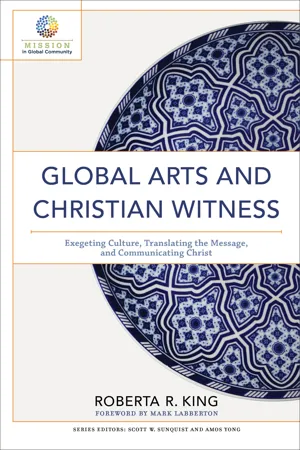
eBook - ePub
Global Arts and Christian Witness (Mission in Global Community)
Exegeting Culture, Translating the Message, and Communicating Christ
- 288 pages
- English
- ePUB (mobile friendly)
- Available on iOS & Android
eBook - ePub
Global Arts and Christian Witness (Mission in Global Community)
Exegeting Culture, Translating the Message, and Communicating Christ
About this book
Information
Topic
Theology & ReligionSubtopic
Christian MinistryPart 1
Foundations in Global Arts and Christ-Centered Witness
1
Negotiating Faith and Culture
All roads lead to worship, but how does one get there?
Witness and the arts require negotiating faith and culture. In our heightened globalizing world of the twenty-first century, we are always engaging in witness in contrasting cultural contexts. The global arts form what anthropologists call expressive culture. In this chapter, we begin by addressing the dynamics of expressive culture and their critical significance in contextualizing the Christian faith. We then develop a model of the global arts engaging in dialogue and witness and introduce creative contextualization as a dynamic means for witnessing to Christ via the global arts. With peoples coming together in new ways, everyone from around the world can perform on the same stage. Although understanding and community building are desired goals, they rarely happen. Cultural dynamics play critical roles in fostering deep understanding, as we will see later in the chapter. We turn first to a global festival to initiate discussion of the cultural dynamics embedded within diverse contexts.
My Story: Encountering the Global Arts in Fez, Morocco
There they were, standing, singing out their religious texts, dancing, and performing on the same global stage in Fez, Morocco! From the Sufi tradition, the Al Kindi Ensemble with Sheikh Hamza Shakour and the Munshidins—popularly referred to as the whirling dervishes, of the Damascus Mosque in Syria—shared the stage with the Tropos Byzantine Choir of Athens, Greece. Craig Adams’s Gospel Ensemble, the Voices of New Orleans, shared the stage with Faiz Ali Faiz and his Sufi ensemble from Pakistan, performing Qawwali songs. There was Ghada Shbeir singing second-century Christian songs in the Syriac language—considered by many to be the Aramaic language spoken by Jesus—juxtaposed with the exotic Tuareg singing of the Tartit Women’s Ensemble from Mali, traditionally considered Muslim. The list seemed to go on forever. Oh, yes! Even American opera singer Jessye Norman was there, singing “Swing Low, Sweet Chariot,” Duke Ellington’s “Lord’s Prayer,” and “Amazing Grace.” That one really got me as she sang out, “that saved a wretch like me.” I found myself deeply touched and silently weeping as I sat in this Muslim setting.
What was going on? I was astounded to encounter such a dizzying array of musicians (both instrumentalists and singers) performing their faith traditions from the “nations” before the twenty-first-century world—a world full of easy travel, heritage tourism, and digital media. I was even more astounded to see how the peoples drawn literally from around the world experienced the events with great relish and longings for spirituality. How could this be? Christians and Muslims were performing and putting their spirituality and worship practices on visual and sonic display for all the world to see. Indeed, they were on stage, each bearing witness to and sharing their faith tradition, singing in their vernacular languages, incorporating their local expressive cultural arts and practices in configurations that integrated music, poetry, dance, cultural instruments, and appropriate sacred dress in ways that revealed their faith and their spiritual engagement.
It was June 2008. The annual Fez Festival of Sacred Music in Morocco was taking place in a transnational setting, with a goal to bring all the world together as it focused on the three Abrahamic faith streams. Sacred musics from different areas of the world had been taken out of their local worship settings and put on the global stage. I have to admit that I was confused at what was taking place. There I was, out of my comfort zone in a nation reportedly 99 percent Muslim and less than 1 percent Christian and Jewish.1 The memories of September 11, 2001, and ongoing Gulf conflicts still lay fresh in our minds and psyches. Ultimately, I was astounded at how the world is on the move. No longer a dreamed-for vision, “all the earth and all the peoples” was a reality occurring in our midst. What was going on?
My mind wandered back to John Piper. He became a hero for a number of us Christian artists and musicians in the late twentieth century. Piper boldly proclaimed, “Mission exists because worship doesn’t.”2 Here I was in Morocco, experiencing something much different. The Fez Festival defies Piper’s axiom. Although I understood what Piper was getting at, I had always wanted to tweak his statement. Here at Fez, it was happening right before my very eyes and ears as I related with peoples from the far corners of the world. They were sharing how they worshiped at home in their local contexts.
We run the danger of assuming that when we share Christ through worship arts, we are doing so on a blank canvas of sinful people who have no religion or faith. I doubt that has ever been true. A brief search throughout the Old Testament narrative shows that peoples are always worshiping something or someone, most often idols and false gods. In reality, we need to acknowledge that all the world is worshiping; thus, witness exists to bring about Christian worship that honors and glorifies Jesus Christ. Indeed, the nations are already at worship, drawing available art forms from their cultural contexts to negotiate faith and culture. As I looked on, experienced it, and took in more of the Fez events, the foreignness of how the Christian faith appears in non-Western contexts became overwhelming. Have we been too shortsighted? Too blind to what is happening before our very eyes and ears? This has remained one of the major roadblocks in sharing Christ among “all the peoples of the earth.” Historically, Christians have shared a message close to their own hearts and brought Western psalms, hymns, and spiritual songs to other countries, resulting in transferring Western cultural Christianity.3 This has led to a number of problems, especially the foreignness of the gospel and its perceived lack of relevance to peoples within their own cultural contexts. How do diverse peoples experience God within their own cultural contexts? How does one go about evoking meaningful and profound interaction with the God of the universe in ways that resonate in a person’s inner regions?4 How does one negotiate faith and culture?
Cultural Dynamics
Culture involves more than one first realizes. Understanding what culture is and how people live together within their cultural contexts is multifaceted and requires examination of key dynamics. Here we consider competing definitions of culture and three integral dimensions at work within culture that affect our interactions with people.
Conflicting Definitions of Culture
Everyone knows what culture is—or so they think. Yet we find a plethora of definitions of culture, especially in a globalizing world where the distinctions are becoming more and more blurred. When it comes to the global arts, people often speak of “high” culture when referencing the elite and “low” culture when referring to the masses and popular culture. High culture most commonly refers to the set of cultural products, mainly in the arts, held in the highest esteem by a culture. It is the culture of an elite such as the aristocracy or intelligentsia. In the West, classical music is considered high culture. Many of the performances at the Fez Festival were drawn from Western and Middle Eastern high classical art traditions.
In contrast to high culture, low culture is studied as popular culture in everyday parlance and commonly applies to the masses of less-well-educated peoples. It is made up of a different set of products. These may include gossip magazines, reality television, popular music, escapist fiction, and more. I have often heard popular culture (low culture) referred to as “lowbrow” in contrast to “highbrow” culture,5 that is, Western classical music. Significantly, popular-culture studies encompass the entirety of ideas, perspectives, attitudes, memes, images, and other phenomena that are within the mainstream of a given culture. In transnational settings, such as the Fez Festival, multiple boundaries of high and low blur and seem to almost vanish. People appear to be coming mostly for the experience. At Fez 2008, after each of the discrete religious traditions performed onstage, we watched and listened to attempts at merging the performance traditions into new configurations, resulting in fairly awkward attempts to create a “hybrid culture”6 that mixed elements from two or more cultures. While studies of high and low culture are helpful and provide understanding of what is happening within each of these realms in the twenty-first century, they are limited in helping us proceed in relation to Christian witness. We need to move beyond initial, surface-level labels such as high and low culture.
To move into deeper understandings of people functioning within culture, we can draw from cultural anthropology. Paul Hiebert, noted missiologist and anthropologist, offers a helpful definition: culture is “the more or less integrated system of beliefs, feelings, and values created and shared by a group of people that enable them to live together socially and that are communicated by means of their systems of symbols and rituals, patterns of behavior, and the material products they make.” This definition allows us to move beyond looking mainly at cultural products into considering how people construct culture that fosters living together in community. We know that humans, as social creatures, “depend on one another for survival and a meaningful existence.”7 They thus work at creating shared understandings between themselves, which are foundational to human relationships. Hiebert underscores that human relationships “need a common language and some consensus on beliefs and worldview for communication and coordinated action. Ultimately, their culture is the home in which they live together.”8 People feel comfortable when they have a more or less integrated, coherent way of looking at things. Nevertheless, cultures are always changing, especially as groups and individuals within cultures hold different beliefs, views about their world, and values. “The rich, for example, see things differently from the poor and one ethnic group may view the world differently from another. . . . Different communities in the same society struggle to control the society.”9 Each group at the Fez Festival, for example, was performing in the ways in which they felt at home as they approach...
Table of contents
- Cover
- Endorsements
- Series Page
- Title Page
- Copyright Page
- Dedication
- Contents
- Illustrations
- Series Preface
- Foreword
- Acknowledgments
- Prelude
- Part 1: Foundations in Global Arts and Christ-Centered Witness
- Part 2: Encountering Christ through Global Arts
- Part 3: Engaging Peoples for Christ via Global Arts
- Postlude
- Webography
- Bibliography
- Index
- Photo Insert
- Back Cover
Trusted by 375,005 students
Access to over 1.5 million titles for a fair monthly price.
Study more efficiently using our study tools.
Frequently asked questions
Yes, you can cancel anytime from the Subscription tab in your account settings on the Perlego website. Your subscription will stay active until the end of your current billing period. Learn how to cancel your subscription
No, books cannot be downloaded as external files, such as PDFs, for use outside of Perlego. However, you can download books within the Perlego app for offline reading on mobile or tablet. Learn how to download books offline
Perlego offers two plans: Essential and Complete
- Essential is ideal for learners and professionals who enjoy exploring a wide range of subjects. Access the Essential Library with 800,000+ trusted titles and best-sellers across business, personal growth, and the humanities. Includes unlimited reading time and Standard Read Aloud voice.
- Complete: Perfect for advanced learners and researchers needing full, unrestricted access. Unlock 1.5M+ books across hundreds of subjects, including academic and specialized titles. The Complete Plan also includes advanced features like Premium Read Aloud and Research Assistant.
We are an online textbook subscription service, where you can get access to an entire online library for less than the price of a single book per month. With over 1.5 million books across 990+ topics, we’ve got you covered! Learn about our mission
Look out for the read-aloud symbol on your next book to see if you can listen to it. The read-aloud tool reads text aloud for you, highlighting the text as it is being read. You can pause it, speed it up and slow it down. Learn more about Read Aloud
Yes! You can use the Perlego app on both iOS and Android devices to read anytime, anywhere — even offline. Perfect for commutes or when you’re on the go.
Please note we cannot support devices running on iOS 13 and Android 7 or earlier. Learn more about using the app
Please note we cannot support devices running on iOS 13 and Android 7 or earlier. Learn more about using the app
Yes, you can access Global Arts and Christian Witness (Mission in Global Community) by Roberta R. King, Sunquist, Scott W., Yong, Amos, Scott W. Sunquist,Amos Yong in PDF and/or ePUB format, as well as other popular books in Theology & Religion & Christian Ministry. We have over 1.5 million books available in our catalogue for you to explore.