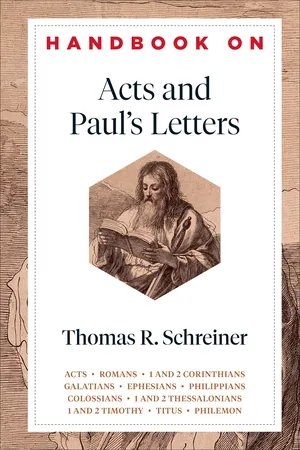
Leading biblical scholar Thomas Schreiner provides an easy-to-navigate resource for studying and understanding the Acts of the Apostles and the Pauline Letters. This accessibly written volume summarizes the content of each major section of the biblical text to help readers quickly grasp the sense of particular passages.
This is the first volume in the Handbooks on the New Testament series, which is modeled after Baker Academic's successful Old Testament handbook series. Series volumes are neither introductions nor commentaries, as they focus primarily on the content of the biblical books without getting bogged down in historical-critical questions or detailed verse-by-verse exegesis. The series will contain three volumes that span the entirety of the New Testament, with future volumes covering the Gospels and Hebrews through Revelation. Written with classroom utility and pastoral application in mind, these books will appeal to students, pastors, and laypeople alike.
eBook - ePub
Handbook on Acts and Paul's Letters (Handbooks on the New Testament)
- 462 pages
- English
- ePUB (mobile friendly)
- Available on iOS & Android
eBook - ePub
Handbook on Acts and Paul's Letters (Handbooks on the New Testament)
About this book
Information
Chapter one
The Acts of the Apostles
Introduction
Author and Date
In the book of Acts we are not told the identity of the author, nor are we told when Acts was written. It is quite clear, however, that it was written by the same person who wrote the Gospel of Luke. A number of reasons could be listed, but I will restrict myself to three: (1) Both books are addressed to Theophilus (Luke 1:3; Acts 1:1). (2) Acts refers to “the first narrative” (1:1), and that is obviously the Gospel of Luke. (3) The table illustrates some common themes that conclude the Gospel of Luke and are picked up at the beginning of Acts.
| Theme | Texts |
| Proof of Jesus’s resurrection | Luke 24:1–43; Acts 1:3 |
| Promise of the Spirit | Luke 24:49; Acts 1:4–5, 8 |
| Waiting in Jerusalem | Luke 24:52–53; Acts 1:4 |
| Commission to proclaim the gospel | Luke 24:47–48; Acts 1:8 |
| Jesus’s ascension | Luke 24:51; Acts 1:9–11 |
The bridge between the end of Luke and the beginning of Acts shows the hand of the same author at work.
Theophilus knew the author, but how can we know who wrote the Gospel of Luke and Acts? It isn’t my purpose to delve into this matter in detail, but we derive the conclusion from tradition and the internal evidence in Acts—the famous “we” passages, where the author of Acts traveled with Paul (Acts 16:10–16; 20:5–15; 21:1–12; 27:1–28:16). From the earliest times the early church agreed that Acts was written by Luke. It is quite unlikely that this tradition was invented, for when we read the NT, Luke plays a nearly invisible role. In fact, he only appears in three verses (Col. 4:14; 2 Tim. 4:11; Philem. 24). The only reason we notice Luke when reading those verses today is because we know the tradition that Luke wrote a gospel and the book of Acts. Luke’s fame did not lead the early church to identify Luke as the author. It was just the opposite: Luke became famous because the tradition identified him as the author. The “we” passages of Acts, though not altogether determinative, also lead us to Lukan authorship. By a process of elimination in studying the “we” passages in Acts, Luke is shown to be the most likely author.
The date of the Acts of the Apostles is a much more difficult matter. It is tied up with how we date the Gospels, since Acts was clearly written after Luke. Also, most scholars think that Luke used Mark when writing his Gospel, and so the date is linked with a thicket of issues we can’t explore here. I believe there are good reasons to think that the Gospels were written early enough so that Acts was written in the 60s, before the destruction of the temple in Jerusalem in AD 70. Perhaps Luke completed Acts before Paul was freed from prison (Acts 28:30–31). On the other hand, it is also possible that Acts was written in the 70s or 80s. In any case, the interpretation of the book remains the same, whatever date we assign.
Structure and Central Themes
There are a number of different ways to structure Acts. Here are three possibilities.
Major Persons
| Peter | 1:1–12:25 |
| Paul | 13:1–28:31 |
Geography
| Jerusalem | 1:1–8:3 |
| Samaria and Coastal Regions of Palestine | 8:4–11:18 |
| South Galatia | 11:19–15:35 |
| Philippi, Thessalonica, Berea, Athens, Corinth, and Ephesus | 15:36–19:20 |
| Jerusalem and Rome | 19:21–28:31 |
Summary Statements
| 6:7 | “So the word of God spread, the disciples in Jerusalem increased greatly in number, and a large group of priests became obedient to the faith.” |
| 9:31 | “So the church throughout all Judea, Galilee, and Samaria had peace and was strengthened. Living in the fear of the Lord and encouraged by the Holy Spirit, it increased in numbers.” |
| 12:24 | “But the word of God flourished and multiplied.” |
| 16:5 | “So the churches were strengthened in the faith and grew daily in numbers.” |
| 19:20 | “In this way the word of the Lord flourished and prevailed.” |
| 28:30–31 | “Paul stayed two whole years in his own rented house. And he welcomed all who visited him, proclaiming the kingdom of God and teaching about the Lord Jesus Christ with all boldness and without hindrance.” |
The outline below is overly simplistic and uses some modern categories, but it helps us get a big picture of Acts.
Outline
| The gospel spreads in Jerusalem | 1:1–6:7 |
| The gospel spreads in Judea, Samaria, and Galilee | 6:8–9:31 |
| The gospel spreads to the gentiles | 9:32–12:24 |
| The gospel spreads to what now is Turkey | 12:25–16:5 |
| The gospel spreads to Europe | 16:6–19:20 |
| The gospel spreads from Jerusalem to Rome | 19:21–28:31 |
The first structure presented above clearly doesn’t work, since the book isn’t fundamentally about Peter and Paul. In fact, Peter doesn’t even appear in Acts 7, and he plays a minor role in chapters 8–9. The geographical structure is more promising but not very illuminating, and to be honest, is a bit boring. No structure is without faults, but I believe the summary statements in the third table nicely structure the book. The summary statements fit well with the theme of the book, which is found in 1:8, “But you will receive power when the Holy Spirit has come on you, and you will be my witnesses in Jerusalem, in all Judea and Samaria, and to the end of the earth.”
The summary statements in the table are marked to denote three themes. First, the bold in the summary statements notes the geographical spread of the gospel. In Acts 1:8 we see that the gospel begins in Jerusalem, then spreads to Judea, to Samaria, and then goes to the ends of the earth. If we look at the bold in the summary statements, we see that the only two summary statements that mention geography are in 6:7 and 9:31. In 6:7 the first part of the promise in 1:8 is fulfilled: the gospel spreads in Jerusalem. These chapters center on the Jerusalem temple, and the gospel is proclaimed in Jerusalem and in the temple courts. The prophecy of Isaiah begins to be fulfilled here, “For instruction will go out of Zion and the word of the LORD from Jerusalem” (Isa. 2:3; cf. Mic. 4:2). The second summary statement in Acts 9:31 records the extension of the gospel to Judea, Galilee, and Samaria. We are not told much about how the gospel spread in Judea and Galilee, but the spread of the gospel to Samaria indicates that Judea and Galilee have also been reached. Later we will consider why it is so important that Samaria is included here.
Three other comments about the structure of 1:1–9:31 should be noted. First, why does the encounter with Stephen in 6:8–8:4 occur after the summary statement in 6:7, especially since Stephen was martyred in Jerusalem? Moreover, Stephen was appointed as one of the seven chosen to serve in 6:1–6, and so placing the story of his death (6:8–8:4) after the summary statement about the gospel spreading in Jerusalem seems to break up the narrative. I suggest that the story of Stephen’s speech and death are placed after the summary statement in 6:7 because Stephen’s death “scattered” the disciples “throughout the land of Judea and Samaria” (8:1), and “those who were scattered went on their way preaching the word” (8:4; cf. 11:19). Stephen’s speech and martyrdom, in other words, became the impetus for the gospel being proclaimed outside Jerusalem in Judea, Samaria, and Galilee. It is the catalytic event for the spread of the gospel outside Jerusalem.
Second, why is the conversion of Paul (9:1–30) placed before the second summary statement (9:31) since Paul’s ministry was mainly to the gentiles and to the Jews in the diaspora? In a sense the conversion of Paul seems to complete reaching the Jews in Jerusalem and Judea, Galilee, and Samaria. It is crucial to see that this observation is being made from the Lukan narratival perspective, from the way Luke crafts the story. Certainly Jewish Christians continued to preach the gospel in Jerusalem and in Judea, Galilee, and Samaria after Paul’s conversion, but Luke doesn’t continue to rehearse that story after the conversion of Paul. Thus, the conversion of Paul represents a significant shift in redemptive history. From that point on, the Lord guides Peter (10:1–11:18) and commissions Paul to proclaim the good news about Jesus to the gentiles.
Third, this brings us to our final observation. Why are geographical references missing in the summary statements after 9:31? We noticed that 1:1–6:7 centers on Jerusalem, and 6:8–9:31 focuses on Judea, Samaria, and Galilee, but in the summary statements that follow, geographical references are absent. There is no need to mention specific locales because, from 9:32 on, the gospel goes to the gentiles to the ends of the earth, which includes the farthest reaches of the world. Every locale in Acts from this point on represents the spread of the gospel as it goes to the “end of the earth” (1:8). The word of the Lord emanating from Jerusalem was going to all nations (Isa. 2:2–3; Mic. 4:1–2). It is fitting, then, that the book ends with Paul in Rome, not because Rome is the ends of the earth, but because it symbolizes that the church was carrying out Jesus’s mission to go to the ends of the earth, even by bringing the gospel to the capital of the Roman Empire. Thus Rome becomes a new launching point for mission.
The second feature of the summary statements is highlighted in italics. We see in three of the summary statements that the church grew by the word of the Lord or the word of God (6:7; 12:24; 19:20). The content of the word is “the kingdom of God,” and the kingdom focuses on Jesus Christ (28:31). The church in Acts grows and expands by the power of the word, which is a way of saying that “the gospel . . . is the power of God for salvation” (Rom. 1:16). Here is the place to make a very important observation. The message of salvation in Acts, the message that has an inherent power, is the message of the end-time kingdom. Some have said that the kingdom isn’t important in Acts in comparison to the Gospels, but this judgment is mistaken. The word “kingdom” isn’t used often, but the theme of the kingdom actually plays a central role in the book. The kingdom frames the entire book, for after Jesus’s ascension when he met with the apostles for forty days, he spoke to them “about the kingdom of God” (Acts 1:3). And the book closes, as was just noted, with Paul “proclaiming the kingdom of God” (28:31).
Furthermore, it is imperative to see that the kingdom centers on Jesus Christ. In the last story of the book, as Paul explains the gospel to the Jews while under house arrest in Rome (cf. Acts 28:16, 23), he “testified about the kingdom of God,” which means that he “tried to persuade them about Jesus from the Law of Moses and the Prophets” (28:23). The kingdom and the gospel of Jesus Christ, the gospel Paul proclaimed in Rome to Jewish Christians, were not two different messages. The kingdom promises of the OT were fulfilled in Jesus Christ, in his death and resurrection. The close connection between gospel, kingdom, and the message about Jesus Christ is confirmed by Acts 8:12. When Philip was in Samaria, he “proclaimed the good news [euangelizomenō] about the kingdom of God and the name of Jesus Christ.” Furthermore, when Luke summarized Paul’s three months of preaching in Ephesus, he says that he was “persuading them about the kingdom of God” (19:8). Similarly, Paul described his ministry among the Ephesians as “preaching the kingdom” (20:25). The word of the Lord, which has such power, is the gospel, the message of the kingdom, the good news about Jesus Christ.
The third theme in the summary statements (presented in the summary statement chart above), indicated by the underlined statements, is the growth of the gospel, the expansion of the word. Two words stand out for the growth of the church: increase (auxanō) and multiply (plēthynō), and in the chart immediately below they are italicized.
| 6:7 | “the word of God continued to increase, and the number of the disciples multiplied greatly” (ESV) |
| 12:24 | “But the word of God increased and multiplied” (ESV). |
| 19:20 | “So the word of the Lord continued to increase” (ESV) |
We see these same two words, increase and multiply, in the LXX creation account where God says to the human race: “Be fruitful [auxanesthe] and multiply [plēthynesthe]” (Gen. 1:28 ESV). The creation mandate is being fulfilled in a distinctive manner in the gospel. Human beings were created to rule the world for God, and the rule over the world is restored through the gospel of Jesus Christ. As the gospel spreads, God’s rule over human beings is restored. The remarkable “number” of those who are converted is noted in two summary statements (Acts 6:7; 16:5), and the growth in numbers is recorded elsewhere in the book as well, as the table below shows.
Church Growth in Acts
| Text | Reference to Growth |
| 2:41 | “That day about three thousand people were added to them.” |
| 2:47 | “Every day the Lord added to their number those who were being saved.” |
| 4:4 | “But many of those who heard the message believed, and the number of the men came to about five thousand.” |
| 5:14 | “Believers were added to the Lord in increasing numbers—multitudes of both men and women.” |
| 6:1 | “In those days, as the disciples were increasing in number . . .” |
| 9:35 | “So all who lived in Lydda and Sharon saw him and turned to the Lord.” |
| 9:42 | “And many believed in the Lord.” |
| 11:21 | “The Lord’s hand was with them, and a large number who believed turned to the Lord.” |
| 11:24 | “And large numbers of people were added to the Lord.” |
| 14:1 | “A great number of both Jews and Greeks believed.” |
| 17:4 | “Some of them were persuaded and joined Paul and Silas, including a large number of God-fearing Greeks, as well as a number of the leading women.” |
| 17:12 | “Consequently, many of them believed, including a number of the prominent Gr... |
Table of contents
- Cover
- Half Title Page
- Series Page
- Title Page
- Copyright Page
- Dedication
- Contents
- Series Preface
- Author’s Preface
- Abbreviations
- 1. The Acts of the Apostles
- 2. Romans
- 3. 1 Corinthians
- 4. 2 Corinthians
- 5. Galatians
- 6. Ephesians
- 7. Philippians
- 8. Colossians
- 9. 1 Thessalonians
- 10. 2 Thessalonians
- 11. 1 Timothy
- 12. 2 Timothy
- 13. Titus
- 14. Philemon
- Scripture and Ancient Writings Index
- Subject Index
- Back Cover
Trusted by 375,005 students
Access to over 1.5 million titles for a fair monthly price.
Study more efficiently using our study tools.
Frequently asked questions
Yes, you can cancel anytime from the Subscription tab in your account settings on the Perlego website. Your subscription will stay active until the end of your current billing period. Learn how to cancel your subscription
No, books cannot be downloaded as external files, such as PDFs, for use outside of Perlego. However, you can download books within the Perlego app for offline reading on mobile or tablet. Learn how to download books offline
Perlego offers two plans: Essential and Complete
- Essential is ideal for learners and professionals who enjoy exploring a wide range of subjects. Access the Essential Library with 800,000+ trusted titles and best-sellers across business, personal growth, and the humanities. Includes unlimited reading time and Standard Read Aloud voice.
- Complete: Perfect for advanced learners and researchers needing full, unrestricted access. Unlock 1.5M+ books across hundreds of subjects, including academic and specialized titles. The Complete Plan also includes advanced features like Premium Read Aloud and Research Assistant.
We are an online textbook subscription service, where you can get access to an entire online library for less than the price of a single book per month. With over 1.5 million books across 990+ topics, we’ve got you covered! Learn about our mission
Look out for the read-aloud symbol on your next book to see if you can listen to it. The read-aloud tool reads text aloud for you, highlighting the text as it is being read. You can pause it, speed it up and slow it down. Learn more about Read Aloud
Yes! You can use the Perlego app on both iOS and Android devices to read anytime, anywhere — even offline. Perfect for commutes or when you’re on the go.
Please note we cannot support devices running on iOS 13 and Android 7 or earlier. Learn more about using the app
Please note we cannot support devices running on iOS 13 and Android 7 or earlier. Learn more about using the app
Yes, you can access Handbook on Acts and Paul's Letters (Handbooks on the New Testament) by Thomas R. Schreiner, Gladd, Benjamin L., Benjamin L. Gladd in PDF and/or ePUB format, as well as other popular books in Theology & Religion & Biblical Criticism & Interpretation. We have over 1.5 million books available in our catalogue for you to explore.