- 352 pages
- English
- ePUB (mobile friendly)
- Available on iOS & Android
eBook - ePub
About this book
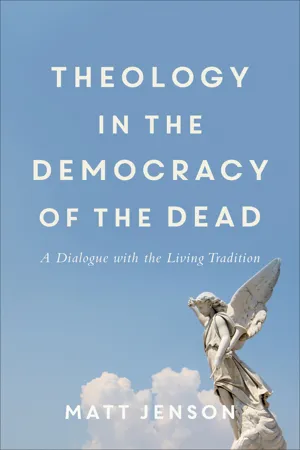
G. K. Chesterton wrote, "Tradition means giving votes to the most obscure of all classes, our ancestors. It is the democracy of the dead." This book pays homage to major theologians of the Christian tradition that tell the history of theology. Matt Jenson engages in charitable yet critical exposition and dialogue with eleven select thinkers, offering a lucid, synthetic account of their theology with a view to ongoing systematic theological issues. He engages directly with core primary texts and treats individual theologians in greater depth and nuance than most overview textbooks.
Information
Topic
Teologia e religioneSubtopic
Teologia cristiana1
A King or a Fox?
Irenaeus of Lyons and the Theology of Scripture
When I was a boy, I had a strategy for avoiding things I did not want to hear and see. I would put my hands over my ears, close my eyes, chew my tongue, and drone, confident that this, too, would pass. Really, it’s a perfect approach to the scary bits in movies, and it correctly estimates the formative power of images and sounds for good or ill. It cannot, though, be applied to all appearances of evil. Some must be faced head on. Otherwise, one may meet the fate of Pliny’s ostriches, who “imagine, when they have thrust their head and neck into a bush, that the whole of their body is concealed.”1 The problem is not so much the parochialism of buried heads but the comical—and dangerous—illusion that the rest of one’s body is safe from attack.
So it is as one encounters theological disagreement (leaving aside for the moment whether that disagreement is legitimate or heretical). One may bury one’s head or, like the younger me, stop one’s ears and close one’s eyes, but that response serves only to expose one’s flank to attack. What, then, are we to make of the apostle Paul’s counsel to Timothy? “O Timothy, guard the deposit entrusted to you. Avoid the irreverent babble and contradictions of what is falsely called ‘knowledge,’ for by professing it some have swerved from the faith” (1 Tim. 6:20–21). The metaphors seem at first glance to work at cross-purposes. Timothy is to “guard” the deposit of faith, to defend it against attackers and ensure its safekeeping in the church. Surely this means a fight, should false teachers seek to rob the church of its treasure. Yet Paul suggests it is best to “avoid” the fatuous volleys of these teachers, perhaps on the principle that the best way to get false teachers to go away is to ignore them.
Therapists speak of fight and flight as default mechanisms for handling conflict. While Paul’s counsel of avoidance may often be the tack to take, the church can avoid false teachers for only so long; at some point, direct engagement is called for, with flight being exchanged for fight. In what follows, we’ll consider Irenaeus, a second-century bishop and apologist, and his approach to false teaching in the church. Irenaeus saw a change in the weather and battened down the hatches of the faith against a Gnosticism threatening to sink the church’s ship. But in guarding the faith, he neither pretended the threat was illusory nor reduced the faith to the size of an answer to the Gnostics’ question. Every apologist knows the temptation to fit the defense of the faith to the mold of one’s opponent, but a temptation it is, and a Procrustean one resulting in a curtailed faith. Irenaeus’s tack is different. He confidently begins his response to the Gnostics by laying bare their variegated myths, trusting that exposition alone will do much of his work. From there, he elegantly lays out a vision of the Christian faith and, indeed, the world as seen through the lens of the apostolic preaching. In the end, “his chief concern is positive; the response far exceeds the stimulus.”2
A Very Brief Life
Though this summary of his life is brief, Irenaeus himself lived to a ripe old age (as, so he strangely thought, did Jesus).3 Born around AD 130, he died around the turn of the century. The details about his life, though, are scant. We know he knew Polycarp (d. 155/156) in his youth, and he may have been from Smyrna (İzmir, in modern Turkey), where Polycarp was bishop.4 Given that Polycarp knew the apostles and had been appointed bishop by them, Irenaeus stands only one generation removed from the apostles, which grants him significant authority as he demonstrates the apostolic preaching.
From Smyrna, Irenaeus went west, likely spending time in Rome receiving instruction. He may have been taught by Justin Martyr, whose thought Irenaeus followed at a number of points. He eventually arrived in the region of Gaul, in Lyons, a major city at the meeting of the Rhone and Saône Rivers.5 The church was young there, having first emerged mid-century, but it had quickly come under attack. In 177 Irenaeus went on a mission to Rome, carrying a letter to Pope Eleutherus from Lyons on behalf of a group of Montanists from Asia Minor. When he returned, the ninety-year-old bishop Pothinus was in prison, where he died. Irenaeus succeeded him, becoming bishop of Lyons and Vienne.6
Aside from his answer to Marcion and the Gnostics, to which we will return, the other major event in Irenaeus’s bishopric was the Quartodeciman controversy, a debate between the churches in Asia Minor and Rome regarding the dating of Pascha (or Easter). The churches in Asia Minor kept it on Nisan 14, following Jewish custom; but Victor, bishop of Rome (189–198), demanded it be kept the following Sunday, the day of the resurrection, threatening excommunication to those who disobeyed.7 Irenaeu...
Table of contents
- Cover
- Endorsements
- Half Title Page
- Title Page
- Copyright Page
- Dedication
- Contents
- Acknowledgments
- Abbreviations
- Introduction
- 1. A King or a Fox?
- 2. The Word Who Became Flesh
- 3. “The Lovely Things Kept Me Far from You”
- 4. “That Most Biblical of Theologians”
- 5. Faith Seeking Understanding—or Understanding Seeking Faith?
- 6. “St. Thomas of the Creator”
- 7. “One Little Word Shall Fell Him”
- 8. “What Do You Have That You Did Not Receive?”
- 9. The Beauty of Holiness
- 10. A Pietist of a Higher Order
- 11. “The Happiest Theologian of Our Age”
- Bibliography
- Scripture Index
- Subject Index
- Back Cover
Trusted by 375,005 students
Access to over 1.5 million titles for a fair monthly price.
Study more efficiently using our study tools.
Frequently asked questions
Yes, you can cancel anytime from the Subscription tab in your account settings on the Perlego website. Your subscription will stay active until the end of your current billing period. Learn how to cancel your subscription
No, books cannot be downloaded as external files, such as PDFs, for use outside of Perlego. However, you can download books within the Perlego app for offline reading on mobile or tablet. Learn how to download books offline
Perlego offers two plans: Essential and Complete
- Essential is ideal for learners and professionals who enjoy exploring a wide range of subjects. Access the Essential Library with 800,000+ trusted titles and best-sellers across business, personal growth, and the humanities. Includes unlimited reading time and Standard Read Aloud voice.
- Complete: Perfect for advanced learners and researchers needing full, unrestricted access. Unlock 1.5M+ books across hundreds of subjects, including academic and specialized titles. The Complete Plan also includes advanced features like Premium Read Aloud and Research Assistant.
We are an online textbook subscription service, where you can get access to an entire online library for less than the price of a single book per month. With over 1.5 million books across 990+ topics, we’ve got you covered! Learn about our mission
Look out for the read-aloud symbol on your next book to see if you can listen to it. The read-aloud tool reads text aloud for you, highlighting the text as it is being read. You can pause it, speed it up and slow it down. Learn more about Read Aloud
Yes! You can use the Perlego app on both iOS and Android devices to read anytime, anywhere — even offline. Perfect for commutes or when you’re on the go.
Please note we cannot support devices running on iOS 13 and Android 7 or earlier. Learn more about using the app
Please note we cannot support devices running on iOS 13 and Android 7 or earlier. Learn more about using the app
Yes, you can access Theology in the Democracy of the Dead by Matt Jenson in PDF and/or ePUB format, as well as other popular books in Teologia e religione & Teologia cristiana. We have over 1.5 million books available in our catalogue for you to explore.