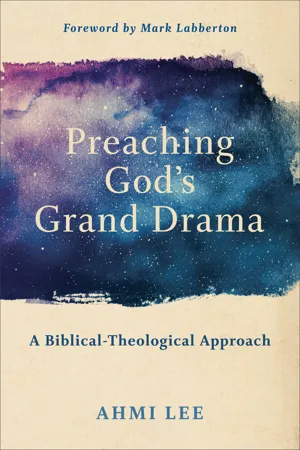
- 192 pages
- English
- ePUB (mobile friendly)
- Available on iOS & Android
eBook - ePub
About this book
How can preachers preach biblically faithful sermons that move listeners to positive action? An author on the cutting edge of contemporary homiletics and theology offers a fresh approach to preaching that helps listeners see themselves as actors in God's grand drama. Ahmi Lee presents a unifying "third way" in homiletical approaches (i.e., theodramatic) that reimagines the preacher's role in relation to the Bible, the congregation, and the world. The book not only helps students understand various preaching models but also is relevant to working preachers who want to critique and improve their approach. Foreword by Mark Labberton.
Information
Topic
Theology & ReligionSubtopic
Christian Ministry1
The Traditional Homiletic
Truth Mined, Truth Proclaimed
The rich heritage of Christian preaching reaches back to Old Testament prototypes of preachers like Noah, who was called a “preacher of righteousness” (2 Pet. 2:5), and Moses, who as a messenger participated in God’s mission. It carries a weighty legacy of great Old Testament prophets like Deborah, Isaiah, Jeremiah, and Hosea, who delivered God’s burning message of judgment and the promise of redemption to their contemporaries. Christian preaching reaches its glorious pinnacle in Jesus Christ, the incarnate God, whose very being “preaches” truth and grace to all with no partiality. Christian preaching follows in the footsteps of courageous disciples and apostles of faith—like Mary Magdalene, who first announced the joyful news of Jesus’s resurrection, and Peter, who interpreted the miracle of tongues at Pentecost as a fulfillment of God’s sovereignly ordained events that included Jesus’s crucifixion and exaltation.
The heritage of preaching overflows with inspiring stories from the patristic era, when the ministry of the Word flourished through the works of preachers like Ambrose, Basil the Great, Augustine of Hippo, and John Chrysostom, who urged people to understand God rightly. Within this heritage is a treasury of missionary narratives of the Dominicans and Franciscans in the Middle Ages, who spoke against the vices of their time and challenged people to pursue godliness and live holy lives for the common good of society. The story of the church’s preaching also includes the dramatic upheaval of the Reformation era, the blossoming season of the pulpit during the Renaissance, and the tumultuous eras of modernity and postmodernity characterized by radical shifts in thinking about reason, progress, and ways of being. The richness and complexity of the heritage of the pulpit extends far beyond what can be recounted here.
Notwithstanding the vast array of people and styles of preaching throughout history, one particular oratorical approach rose in favor to take prominence. Ironically referred to as the traditional homiletic, this theory and practice of preaching does not so much represent the rich heritage of Christian preaching as demonstrate how parts of the legacy have been emphasized and practiced over time. Bearing the nickname “three-points-and-a-poem,” traditional preaching is typically discursive and follows a well-recognized form in which one central idea is supported by a few subpoints and punctuated by an emotionally appealing illustration. Despite some variances of form, traditional sermons are generally propositional, deductive, and didactic. And whatever else may be said about preaching’s purpose, it is foundationally a ministry of teaching timeless, divine truths from Scripture in a structured, linear manner. Concerning this model of preaching, Lucy Rose notes, “One of the longest-standing, dominant voices at the homiletical table is traditional or classical theory that is grounded in homiletical rhetoric. . . . Throughout the nearly two thousand years of Christian preaching, traditional theory has shifted its boundaries and its emphases; yet much has remained the same.”1
This chapter examines the so-called traditional homiletic and four metaphors that represent its most prominent traits. These metaphors (discussed below) are the Herald, Banking Transfer, Golden Key, and Still-Life Picture. It needs to be noted that the metaphors and the label “traditional” are limited at best because they do not account for the fecund diversity of theological and homiletical perspectives, orientations, styles, and practices throughout the church’s history. Also, they are not exhaustive or precise but serve only to highlight salient characteristics often associated with the traditional model. In this sense, the metaphors sketch a “homiletical caricature” of sorts: some pronounced features and peculiarities of what has been considered “traditional” preaching are laid out for the ease of recognizing the abiding assumptions and practices of the pulpit. As is the purpose of caricature, these metaphors draw attention to the conspicuous markers of the Western pulpit and critique what is found lacking or perhaps needs more nuancing in light of preaching’s rich legacy. Despite the clear limitation, the common term traditional homiletic and its variants in preaching literature (e.g., traditional model, traditional preaching) underscore the prevailing patterns of how preaching has been and continues to be understood, taught, and practiced.
This chapter lays the groundwork for the following chapter, which examines another approach to preaching—namely, conversational preaching, which is a reaction against the shortcomings of the traditional model. The first two chapters demonstrate the need for a third approach to preaching that draws from the strengths of both models while also addressing their weaknesses.
Four Metaphors: Key Assumptions of the Traditional Homiletic
Herald
Few metaphors more effectively capture the traditional preacher’s understanding of the ministry of the Word than the herald metaphor. The imagery originates in the New Testament, with the Greek verb kēryssō appearing sixty-one times (e.g., Matt. 3:1; Acts 8:5; Rom. 10:8; 2 Tim. 4:2). The rich imagery of the herald metaphor involves three elements that pertain to the core convictions of the traditional homiletic.
First, the metaphor points to God as the external message-giver in a communication that involves the church. The source of the message is a self-communicating God who graciously discloses himself because he desires to be known. The traditional preacher’s confidence rests on this God who has spoken and acted in history and whose nature is to be light, whose mission is to reveal and make himself accessible to us. Divine revelation is thus not only the sine qua non for preaching but also the sure footing that enables the preacher to stand and boldly claim to know something. The traditional preacher would say, “We can know God because God has made himself known!” The sermon’s effectiveness rests on the divine authority of the message.
Second, the herald metaphor paints the preacher as an emissary elected, equipped, and commissioned by God to make his will known. As glorious as it is to be a spokesperson for the King of kings, the herald is merely a messenger whose task is to faithfully pass on an entrusted message to a designated audience. The task demands that messengers not get in the way of the message and hence put aside their own ideas and biases, which could hinder others from hearing God’s voice clearly. The herald must therefore be a pure channel that only transmits God’s words to those who need to hear them. With the herald’s great responsibility, however, also comes a great promise: God does not send out the messenger empty handed. Along with the Word to be shared, God confers authority, gifting, and anointing to his representative.
Third, the herald metaphor assumes that the congregation listens as willing recipients of the sermon. Since the preacher speaks on behalf of God, the congregation is expected to eagerly lean in to hear what the herald proclaims, to receive the word with humility, and to comply. Because God knows exactly what his people need to hear, the hearer’s appropriate response to the sermon is openness and trust in both the message itself and the one who was sent by God to share it.
Banking Transfer
Another metaphor that represents the operating assumptions of the traditional homiletic is the banking transfer. This metaphor illustrates the traditional preacher’s conception of preaching as a pedagogical activity that deposits knowledge in a unidirectional manner from the minister to the congregation.2 Throughout history, numerous homileticians have offered their two cents about the purpose of the pulpit. Among countless words generated on this topic, one simple term has occupied the homiletical spotlight from the church’s infancy: teach.
The link between preaching and teaching was forged early on. Even by the end of the first century, Christian preaching had cast itself as “a style of homileō-ing that exhorted listeners to live into the moral claims of the gospel while also offering theological teaching.”3 As the church continued to expand and encounter challenges of religious syncretism, the need to define Christian truths and doctrines and defend them against heresy and apostasy grew. So church leaders taught believers about the meaning of core Christian practices (e.g., worship, baptism, Eucharist) and about what is biblically sound. In such an environment, preaching was associated with salubrious instruction that guides people in ethical living informed by the gospel.
It was Augustine who formally equated preaching and pedagogy in what is widely considered the first homiletical manual, De doctrina christiana (On Christian Doctrine or Teaching Christianity). Augustine, drawing on his oratory background and applying the words of Cicero to preaching, states that the purpose of a sermon is to teach (docere), to delight (delectare), and to move (movere) listeners so they can do what is good and avoid what is bad in order to love God and neighbor. Of these three goals, Augustine deems the responsibility of educating listeners the most basic: “Instructing is a matter of necessity, delighting a matter of charm, and moving them a matter of conquest.”4 As a trained rhetorician, Augustine is well aware of the persuasive power of human words. His high theological view of divine beauty leads to his insistence that a sermon’s form and style matter in pleasing hear...
Table of contents
- Cover
- Endorsements
- Half Title Page
- Title Page
- Copyright Page
- Contents
- Foreword
- Acknowledgments
- Introduction
- 1. The Traditional Homiletic
- 2. The Conversational Homiletic
- 3. A Critique of the Conversational Homiletic
- 4. A Dramatic Approach to Theology
- 5. The Shape of a Theodramatic Homiletic
- 6. Four Perspectives at Play within a Theodramatic Homiletic
- Index
- Back Cover
Trusted by 375,005 students
Access to over 1.5 million titles for a fair monthly price.
Study more efficiently using our study tools.
Frequently asked questions
Yes, you can cancel anytime from the Subscription tab in your account settings on the Perlego website. Your subscription will stay active until the end of your current billing period. Learn how to cancel your subscription
No, books cannot be downloaded as external files, such as PDFs, for use outside of Perlego. However, you can download books within the Perlego app for offline reading on mobile or tablet. Learn how to download books offline
Perlego offers two plans: Essential and Complete
- Essential is ideal for learners and professionals who enjoy exploring a wide range of subjects. Access the Essential Library with 800,000+ trusted titles and best-sellers across business, personal growth, and the humanities. Includes unlimited reading time and Standard Read Aloud voice.
- Complete: Perfect for advanced learners and researchers needing full, unrestricted access. Unlock 1.5M+ books across hundreds of subjects, including academic and specialized titles. The Complete Plan also includes advanced features like Premium Read Aloud and Research Assistant.
We are an online textbook subscription service, where you can get access to an entire online library for less than the price of a single book per month. With over 1.5 million books across 990+ topics, we’ve got you covered! Learn about our mission
Look out for the read-aloud symbol on your next book to see if you can listen to it. The read-aloud tool reads text aloud for you, highlighting the text as it is being read. You can pause it, speed it up and slow it down. Learn more about Read Aloud
Yes! You can use the Perlego app on both iOS and Android devices to read anytime, anywhere — even offline. Perfect for commutes or when you’re on the go.
Please note we cannot support devices running on iOS 13 and Android 7 or earlier. Learn more about using the app
Please note we cannot support devices running on iOS 13 and Android 7 or earlier. Learn more about using the app
Yes, you can access Preaching God's Grand Drama by Ahmi Lee in PDF and/or ePUB format, as well as other popular books in Theology & Religion & Christian Ministry. We have over 1.5 million books available in our catalogue for you to explore.