- 208 pages
- English
- ePUB (mobile friendly)
- Available on iOS & Android
eBook - ePub
About this book
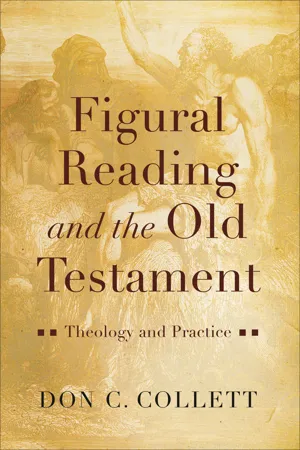
Don Collett, an experienced Old Testament scholar, offers an account of Old Testament interpretation that capitalizes on recent research in figural exegesis. Collett examines the tension between figural and literal modes of exegesis as they developed in Christian thought, introduces ongoing debates and discussions concerning figural readings of Scripture, and offers theological readings of several significant Old Testament passages. This book will work well as a primer on figural exegesis for seminarians or as a capstone seminary text that ties together themes from courses in Bible, exegesis, and theology.
Information
Part 1
Frameworks
1
Biblical Models for Figural Reading
To recover the Old Testament’s foundational significance for figural reading, it is helpful to begin by revisiting the early church’s approach to the inner relations between creation, providence, and figural reading. In this chapter I will explore interpretive models the Old Testament provides for illuminating the inner logic of figural reading, beginning with the creation narratives of Genesis 1–2. Of special interest will be the integrated character of the two creation accounts (1:1–2:3 and 2:4–25) and the providential character of history set forth in the second account (2:5–7). Along with the affiliative character of providence at work in the second account, the first creation account sets up an ordering of time that is fundamental for the construction of figural relationships between disparate temporal contexts in Scripture. Failure to reckon with the figural ordering of time inherent in the creation narratives forms the basis for the modern charge that figural reading ignores the importance of historical context for biblical interpretation. I argue that such an objection typically presupposes a particular understanding of biblical history as linear movement, a presupposition out of sync with Scripture’s own presentation of the character of history. Over against this, the figural and liturgical ordering of time in the two creation accounts discloses a “rule” for reading the relation of word (verbum) and thing (res) in creation, providence, and prophecy that is foundational for the way Scripture delivers its theological sense.
Creation and Providence
The patristic tradition differentiated the account of “scriptural days” in Genesis 1:1–2:3 from the “human days” of 2:4–25. This reading suggests that the first creation account (scriptural days) focuses on the days of creation as created archetypes that illumine and govern the original order of creation. The first toledot, or generational formula, in 2:4 introduces the second creation account (human days), focusing on the creation of Adamkind in the context of God’s providential ordering of creation—that is, the construction of human history as a providentially ordered reality.1 The early church’s approach to the human days of Genesis 2:4–25 is confirmed by the function of its toledot, which also structures the larger Mosaic Torah.2 The use of the toledot formula in Genesis 2:4 reflects an instance of what might be called “canonical intentionality”—that is, a hermeneutical guideline that has been intentionally placed at the beginning of the series of toledot formulae in Genesis to help future readers understand its theological function within the larger framework of Israel’s Torah. According to Dennis Olson, the generalized character of Genesis 2:4 “makes it clear that the meaning of ‘toledot’ is not restricted to actual physical offspring. It has been generalized to designate the carriers of the promise and blessing of God into succeeding generations. Thus the inclusion of Moses in the toledot formula in Numbers 3:1 is meaningful and appropriate, even if perhaps secondary and redactional.”3 Viewed from this perspective, the use of the generational formula in Genesis not only is intended to constrain our reading of the book of Genesis but also serves as a hermeneutical guideline for reading Israel’s Torah and the history of Adamkind as a whole.
But just how does the generational formula accomplish this function? While a proper answer has multiple dimensions,4 one aspect that has not received much discussion is the toledot’s focus on the providential character of human history. This focus underscores the foundational theological significance of providence and “providential affiliation” for the figural ordering of time in creation and redemption.5 In order to grasp this function, it is helpful to reflect on the function of the first toledot in Genesis 2:4. In both Genesis and the larger Mosaic Torah, the toledot introduces not merely the genealogy of physical offspring that follows it but also the entire literary section that extends up to the beginning of the next toledot marker.6 Thus, for example, the toledot of Terah begins in Genesis 11:27 and does not end with the report of his death in Genesis 11:32 but with the toledot of Ishmael in Genesis 25:12. A study of the toledot formula in Genesis also reveals that its use may be categorized into one of two types: the opening of a genealogical list of the father it mentions (5:1; 10:1; 11:10; 25:12; 36:1; 36:9) or the opening of a narrative passage (2:4; 6:9; 11:27; 25:19; 37:2).7
Sarah Schwartz helpfully observes that “when the toledot formula is followed by a genealogical list, there is full compatibility between the phrase’s literal meaning and its function. This is because the basic meaning of the word toledot is ‘children’ so its natural function is to introduce a list of the father’s descendants. However, when the formula is followed by a story rather than a genealogical list, the word toledot cannot be easily interpreted as ‘descendants.’”8 In addition to highlighting the semantic range and adaptability of the toledot formulae in Genesis, this also helps explain the unique hermeneutical function of the first toledot marker. In the toledot “the heavens and the earth” of Genesis 2:4, the name of an ancestor is not followed by either a genealogy of actual physical offspring (cf. 5:1; 10:1; 11:10; 25:12; 36:1; 36:9) or a narrative about the sons of the ancestor (cf. 6:9; 11:27; 25:19; 37:2).9 In other words, while the toledot in Genesis 2:4 broadly resembles what might be called the “narrative” rather than the “genealogical” class of toledot formulae, its anomalous form sets it apart from these two broad classes. This suggests that the first toledot’s unique theological function is to open up a window on the story of Adamkind.10 The distinctive focus on the creation of humanity in the second creation account is also evident from the fact that the Hebrew term for Adam or Adamkind (אדם) occurs only twice in Genesis 1:1–2:3, though it occurs over twenty times from Genesis 2:4 onward.11 Schwartz rightly observes that “the toledot formula of heaven and earth’s focus on their own creation hints at the main subject of the narrative to follow: the creation of the world, which places humankind and what befalls it at its center.”12
The theological function of Genesis 2:5–7 within the first toledot of Genesis is also instructive. Genesis 1:2 and 2:5 both follow an ancient literary convention; they describe the effects of God’s ordering of things in creation (1:2) and providence (2:5) in contrast to conditions that had prevailed previously. Genesis 1:2 provides a description of the world, not before it was created but before it was formed, in contrast to the formed state of things whose description follows.13 In seeing the contrast between creation in its unformed (1:2) and formed (1:3–31) state, readers comprehend the effect of divine speech in forming the unformed world better than if the finished state had simply been presented without this contrast. In Genesis 2:5, the twofold absence of rain and Adamkind points to the absence of a providential link between wild growth and rain, on the one hand, and cultivated growth and Adamkind, on the other hand. Genesis 2:6–7 then address this twofold deficit by the twofold provision of rain and the creation of Adamkind to till the earth: “Now no wild shrub of the field had yet appeared in the earth, and no cultivated plant of the field had yet sprouted, for the LORD God had not caused it to rain upon the earth, and there was no man to work the ground. But a rain cloud began to come up from the earth and began to water the whole surface of the ground. And the LORD God formed man of dust from the ground and breathed into his nostrils the breath of life; and the man became a living soul.”14 By having a description of what the state of the earth was like before the LORD (YHWH) sent rain or created humankind, we are in a better position to understand the importance of providence for the history of creation.15
The canonical effect of placing Genesis 2:5–7 at the outset of the first toledot is to teach us that the constancy of the created order testified to in Genesis 1:1–2:3 is sustained through time by the divine establishment of providential links or “affiliations” between rain and wild growth and between human life and cultivated growth. Human agricultural life and existence are made possible by the constancy of this divinely established order (cf. 8:22). Unlike the Priestly account,16 the second creation account does not focus on the ordering of creation by divine speech but on the significance of this affiliative ordering for the flourishing or fruitfulness of human life and existence (cf. 1:28).17 Thus at the outset of the Old Testament’s account of creation, Genesis 2:5–7 underscores the theological significance of God’s provi...
Table of contents
- Cover
- Half Title Page
- Title Page
- Copyright Page
- Dedication
- Contents
- Abbreviations
- Introduction
- Part 1: Frameworks
- Part 2: Exegesis
- Part 3: Assessment
- Bibliography
- Scripture and Ancient Writings Index
- Author Index
- Subject Index
- Back Cover
Trusted by 375,005 students
Access to over 1.5 million titles for a fair monthly price.
Study more efficiently using our study tools.
Frequently asked questions
Yes, you can cancel anytime from the Subscription tab in your account settings on the Perlego website. Your subscription will stay active until the end of your current billing period. Learn how to cancel your subscription
No, books cannot be downloaded as external files, such as PDFs, for use outside of Perlego. However, you can download books within the Perlego app for offline reading on mobile or tablet. Learn how to download books offline
Perlego offers two plans: Essential and Complete
- Essential is ideal for learners and professionals who enjoy exploring a wide range of subjects. Access the Essential Library with 800,000+ trusted titles and best-sellers across business, personal growth, and the humanities. Includes unlimited reading time and Standard Read Aloud voice.
- Complete: Perfect for advanced learners and researchers needing full, unrestricted access. Unlock 1.5M+ books across hundreds of subjects, including academic and specialized titles. The Complete Plan also includes advanced features like Premium Read Aloud and Research Assistant.
We are an online textbook subscription service, where you can get access to an entire online library for less than the price of a single book per month. With over 1.5 million books across 990+ topics, we’ve got you covered! Learn about our mission
Look out for the read-aloud symbol on your next book to see if you can listen to it. The read-aloud tool reads text aloud for you, highlighting the text as it is being read. You can pause it, speed it up and slow it down. Learn more about Read Aloud
Yes! You can use the Perlego app on both iOS and Android devices to read anytime, anywhere — even offline. Perfect for commutes or when you’re on the go.
Please note we cannot support devices running on iOS 13 and Android 7 or earlier. Learn more about using the app
Please note we cannot support devices running on iOS 13 and Android 7 or earlier. Learn more about using the app
Yes, you can access Figural Reading and the Old Testament by Don C. Collett in PDF and/or ePUB format, as well as other popular books in Theology & Religion & Biblical Criticism & Interpretation. We have over 1.5 million books available in our catalogue for you to explore.