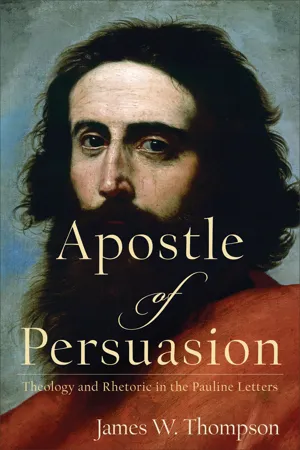
- 320 pages
- English
- ePUB (mobile friendly)
- Available on iOS & Android
eBook - ePub
About this book
This book is the culmination of a career of researching and teaching Paul's letters. Highly respected senior New Testament scholar James Thompson offers a unique approach to Pauline theology, focusing on Paul's attempts to persuade his audience toward moral formation. Thompson recognizes Paul as a pastor who brought together theology and rhetoric to encourage spiritual formation in his communities. Attempts to find total consistency in Paul's writings fail, says Thompson, because Paul's persuasive tactics changed depending on the situation he was addressing.
Information
1
The Rhetoric of Paul’s Letters
Although the letter is a common means of overcoming the distance between the sender and the recipient in both Greco-Roman and Jewish literature, Paul is the one who made the letter the primary mode of communication. In the presence of his converts, he is a man of the spoken word, but in his absence, he writes letters (cf. 2 Cor. 10:10–11). While letters are embedded in the narrative, prophetic, and apocalyptic works in the Old Testament and Jewish literature, with Paul they become a new form of literature and a model for both canonical writings and the Christian literature of subsequent generations. Paul dictates letters, assuming that they will be read orally to an assembled congregation, maintain contact with his converts, reiterate earlier teaching, correct misunderstandings, and shape the behavior of his community. As the substitute for Paul’s presence and the continuation of his earlier instruction, the letters play a vital role in his goal of presenting a blameless people to God at the parousia. This goal requires that he demonstrate his affection for his readers and respond to danger, often with extended theological arguments.
Interpreters have agreed with the author of 2 Peter, however, that Paul’s letters are “hard to understand” (2 Pet. 3:16; cf. 2 Cor. 1:13). In the past century, scholars have recognized that a key to the interpretation of Paul’s letters is the identification of the genre in which he speaks. While both Paul and his opponents identify his communications as epistles (cf. 2 Cor. 7:8; 10:9–10), the unresolved question is the relationship between Paul’s epistles and the literary conventions of his time. Today scholars debate whether Paul’s letters conform to the conventions of ancient epistles or of ancient rhetoric.
Epistolography and the Letters of Paul
A new era in the study of Paul’s letters began with the publication of two books by Adolf Deissmann, Bible Studies and Light from the Ancient East.1 Deissmann examines ancient papyrus letters and demonstrates that Paul’s letters conformed to conventions of his time. The identification of the author and sender at the beginning of the letters is parallel to the beginning of a Hellenistic letter, and the expression of grace (charis) is a Christian adaptation of the customary greeting (chairein). Deissmann and others suggest that the introductory thanksgivings also conformed to ancient letter writing.2 Like Paul’s correspondence, ancient letters also concluded with greetings from acquaintances.
While Deissmann’s discoveries demonstrate parallels between the frame of Paul’s letters and the letter-writing conventions of his time, they do not provide significant insight into the body of the letters. In the 1970s, scholars examined other papyrus letters further in order to determine the generic characteristics of the body of the Pauline letter, observing other conventions in ancient correspondence.3 The disclosure form (“I want you to know”; “I do not want you to be ignorant”) at the beginning of the body of Paul’s letters (cf. Rom. 1:13; 2 Cor. 1:8; Phil. 1:12) also marked the beginning of the body of some ancient letters. Ancient letters also commonly included a request introduced by parakalō (“I appeal to you”), which consistently appears in Paul’s letters.4 Besides these characteristics, however, scholars were unable to draw significant parallels between the body of the ancient papyrus letter and the body of the Pauline letter.5 Recent studies have also shown that the thanksgiving at the beginning of the letter was rare among ancient letters,6 and none involved gratitude for the readers’ moral formation. Unlike Paul’s letters, the papyrus letters were brief and private, not instruments for teaching and moral formation.
Since the 1980s, scholars have examined the ancient literary theorists and the model letters they provided, comparing them to Paul’s letters. A handbook on letter writing, De elocutione, written between the third and first centuries BCE and falsely attributed to Demetrius of Phalerum,7 offers an excursus on writing in the “plain style.” The handbook then lists twenty-one types of letters, giving an example of each.8 Centuries later (between the fourth and sixth centuries CE), a handbook attributed to Libanius (Epistolary Styles) defines the letter as a written conversation with someone who is absent and lists forty-one types of letters. Scholars have identified several of these letter types with Pauline letters. Pseudo-Demetrius’s model of a friendly letter, for example, expresses the kind of intimacy with the recipient that is common in Paul’s letters. The model of a commendatory letter recalls recommendations in Paul’s letters (cf. Rom. 16:1–2). The consoling type also has points of contact with Pauline letters (cf. 1 Thess. 4:13–5:11). The apologetic type has been proposed as the letter type of Galatians, and Libanius mentions the paraenetic letter, which Abraham Malherbe proposes as the literary genre of 1 Thessalonians.9 However, while Paul’s letters have points of contact with these epistolary types, they cannot be identified with any of them, for Paul’s letters are much longer than the ancient examples. Indeed, several of these epistolary types appear in single Pauline letters, making the identification of the Pauline letter with any of them problematic.10
Paul’s letters have points of contact with other types of letters as well. Official letters, like Paul’s correspondence, were written by an authoritative person to a community and intended for wider dissemination. As in Paul’s letters, the senders indicated their authority, adding the title and position of responsibility, and often provided the names of cosenders. The authors issued directives, made announcements, and indicated that the message was intended for a distinct audience, all of whom were responsible to comply with the instructions.11
The philosophical letter also offers some parallels. In the first century CE, philosophers employed the letter as an instrument for philosophical instruction. The letters of Plato and Aristotle were significant models. Letters were a means for philosophers to maintain contact with, and disseminate their teachings to, followers in distant places.12 Several of the letters of Epicurus have survived in which the philosopher presented his philosophy. Preserved in Diogenes Laertius are letters epitomizing his philosophy (to Herodotus), summarizing his meteorology and his morality (Diogenes Laertius, Lives 10.34–83). A letter could include personal communications, teaching, or responses to attacks.13
Scholars have also shown parallels between Pauline correspondence and Seneca’s letters to Lucilius. These letters contain Seneca’s philosophy and consist of philosophical teaching followed by moral exhortation. Seneca presents his moral progress as an example for his pupil to follow.
While one may observe the parallels between Paul’s correspondence and ancient letters, his letters do not fit into any category.14 They contain the personal warmth of the friendly letter, the authoritative quality of the official letter to multiple recipients, the extended presentation of his teaching comparable to the philosophical letter, and the hortatory dimension of the paraenetic letter. Within his letters are commendations (Rom. 16:1–2), expressions of consolation (1 Thess. 4:13–18), and mediation (Philemon), all of which have points of contact with ancient letters. These are only partial parallels, however. Nothing in ancient letter writing corresponds to the authoritative voice of Paul, who speaks not only for himself but also for God. He not only offers moral advice, like that of Seneca to Lucilius, but also declares the will of God (cf. 1 Thess. 4:3). In the letters in which he needs to assert his authority, he identifies himself as an apostle sent by God.15
Letters that respond ...
Table of contents
- Cover
- Half Title Page
- Title Page
- Copyright Page
- Dedication
- Contents
- Abbreviations
- Introduction
- 1. The Rhetoric of Paul’s Letters
- 2. Paul and the Pharisaic Tradition
- 3. Where Christian Theology Began
- 4. Paul’s Ethos and His Theology
- 5. First Thessalonians
- 6. Christology and Persuasion
- 7. Greco-Roman Values and the Theology of the Cross
- 8. The Theology of the Cross and Justification by Faith
- 9. Romans, the Righteousness of God, and the Defense of Paul’s Ministry
- 10. “Seek the Things That Are Above”
- 11. Pauline Theology and Rhetoric in the Pastoral Epistles
- Conclusion
- Bibliography
- Name Index
- Scripture and Ancient Sources Index
- Subject Index
- Cover Flaps
- Back Cover
Trusted by 375,005 students
Access to over 1.5 million titles for a fair monthly price.
Study more efficiently using our study tools.
Frequently asked questions
Yes, you can cancel anytime from the Subscription tab in your account settings on the Perlego website. Your subscription will stay active until the end of your current billing period. Learn how to cancel your subscription
No, books cannot be downloaded as external files, such as PDFs, for use outside of Perlego. However, you can download books within the Perlego app for offline reading on mobile or tablet. Learn how to download books offline
Perlego offers two plans: Essential and Complete
- Essential is ideal for learners and professionals who enjoy exploring a wide range of subjects. Access the Essential Library with 800,000+ trusted titles and best-sellers across business, personal growth, and the humanities. Includes unlimited reading time and Standard Read Aloud voice.
- Complete: Perfect for advanced learners and researchers needing full, unrestricted access. Unlock 1.5M+ books across hundreds of subjects, including academic and specialized titles. The Complete Plan also includes advanced features like Premium Read Aloud and Research Assistant.
We are an online textbook subscription service, where you can get access to an entire online library for less than the price of a single book per month. With over 1.5 million books across 990+ topics, we’ve got you covered! Learn about our mission
Look out for the read-aloud symbol on your next book to see if you can listen to it. The read-aloud tool reads text aloud for you, highlighting the text as it is being read. You can pause it, speed it up and slow it down. Learn more about Read Aloud
Yes! You can use the Perlego app on both iOS and Android devices to read anytime, anywhere — even offline. Perfect for commutes or when you’re on the go.
Please note we cannot support devices running on iOS 13 and Android 7 or earlier. Learn more about using the app
Please note we cannot support devices running on iOS 13 and Android 7 or earlier. Learn more about using the app
Yes, you can access Apostle of Persuasion by James W. Thompson in PDF and/or ePUB format, as well as other popular books in Theology & Religion & Biblical Criticism & Interpretation. We have over 1.5 million books available in our catalogue for you to explore.