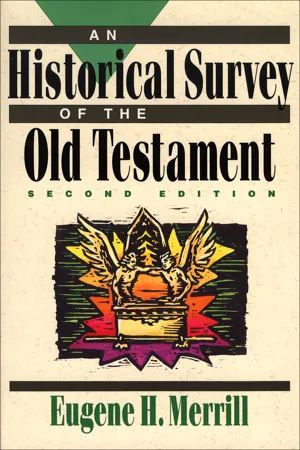
For more than thirty-five years, students have used Eugene H. Merrill's An Historical Survey of the Old Testament as a comprehensive but concise study of the first thirty-nine books of the Bible.
Assured of the accuracy of the Old Testament, Merrill approaches it as God's revelation to the world through Israel, his chosen people. This historical structure provides the basic framework for his text, which is enriched by
· insights from the history of the Middle East;
· geographical backgrounds;
· archaeological perspectives; and
· cultural, religious, and social points of view.
Introductory material examines the nature of the Old Testament and its literary genres, recounting a history of challenges to its credibility. Subsequent chapters isolate each epoch covered by the Old Testament, from creation to the postexilic period. Hebrew words are set in a linguistic context. A short review of intertestamental history is also included.
- 352 pages
- English
- ePUB (mobile friendly)
- Available on iOS & Android
eBook - ePub
An Historical Survey of the Old Testament
About this book
Information
1
Foundations for Study of the Old Testament
The fullest understanding of any book depends in part on knowledge of its author, purpose, and overall theme. It helps to have this knowledge before reading a book in its entirety.
This is particularly true of the Old Testament, for the uniqueness of its authorship and contents renders it especially vulnerable to misunderstanding. Many of the literary criteria applied to other works are simply not sufficient to make plain the true nature of this most important composition. For example, how many books consist in turn of thirty-nine separate books, written over a period of one thousand years by perhaps forty writers? How many claim dogmatically to be special revelation from God? How many speak of a people whose entire complex history is interwoven with miraculous, divine intervention, a history whose fundamental purpose is to provide not mere information but truth? In short, any book that has survived for well over two thousand years and has, more than any other literature, revolutionized the course of human history must be approached with more than usual care. It must be addressed with full consideration of its importance as literature, to say nothing of its character as the Word of God. Thus, the study of the Old Testament must be preceded by a review of the introductory materials essential to an intelligent and thorough appreciation of its nature and content.
TABLE 1
The Books of the Old Testament
| Hebrew Arrangement | Protestant Arrangement |
| Torah | Pentateuch |
| Genesis | Genesis |
| Exodus | Exodus |
| Leviticus | Leviticus |
| Numbers | Numbers |
| Deuteronomy | Deuteronomy |
| Nebi’im | History |
| Joshua | Joshua |
| Judges (and Ruth) | Judges |
| Samuel | Ruth |
| Kings | 1 Samuel |
| Isaiah | 2 Samuel |
| Jeremiah (and Lamentations) | 1 Kings |
| Ezekiel | 2 Kings |
| The Twelve | 1 Chronicles |
| 2 Chronicles | |
| Ezra | |
| Nehemiah | |
| Esther | |
| Kethubim | Poetry |
| Psalms | Job |
| Job | Psalms |
| Proverbs | Proverbs |
| Ruth (if not with Judges) | Ecclesiastes |
| Song of Songs | Song of Songs |
| Ecclesiastes | |
| Lamentations (if not with Jeremiah) | |
| Esther | |
| Daniel | |
| Ezra-Nehemiah | |
| Chronicles | |
| Major Prophets | |
| Isaiah | |
| Jeremiah | |
| Lamentations | |
| Ezekiel | |
| Daniel | |
| Minor Prophets | |
| Hosea | |
| Joel | |
| Amos | |
| Obadiah | |
| Jonah | |
| Micah | |
| Nahum | |
| Habakkuk | |
| Zephaniah | |
| Haggai | |
| Zechariah | |
| Malachi |
The Book Itself
The Contents of the Old Testament
The Old Testament is that collection of sacred writings that, virtually since the time of their composition, have been considered by the Jews to be Scripture. The Christian church of the first century recognized the Old Testament Scriptures as its source of doctrine and ethics, and when its own literature, the New Testament, was composed, it was added to the Old Testament; both together became accepted as God’s Word written. From these earliest times, the two together have been known as the Bible (Greek biblion, or “book”). Even before the Christian era, the Jews recognized a threefold division in the Old Testament: the Law (Torah), the Prophets (Nebi’im), and the Writings (Kethubim).[1] In the process of translation from the original Hebrew to the various vernaculars, the Jewish division of the Old Testament has basically been followed, though the order of the books has varied, but it has become customary among Protestants to speak of a fivefold rather than threefold division in the English versions. They designate the first section Pentateuch (Greek Pentateuchos, or “five scrolls”), which corresponds to the Hebrew division Torah. These are the five books ascribed to Moses. The second division is that of History, twelve books of generally anonymous authorship included in the Hebrew division known as the Prophets, or, more specifically, Former Prophets, because they were thought to have been written by early (pre-ninth-century) men who were prophets or at least had the prophetic gift. The third section, Poetry, consists of five books characterized by literature of a poetic or philosophical nature. David and Solomon were their authors for the most part, though some were composed by lesser known or anonymous individuals. The fourth division is the Major Prophets, so called because they are lengthy and were the product of well-known prophets or men with the prophetic gift. These consist of five books, two written by the same man (Jeremiah). Finally, there is the collection of twelve books known as the Minor Prophets, or, in the Hebrew Bible, simply “The Twelve.” These are not designated minor because they are relatively less important than the major but because they are generally much shorter. For example, Isaiah contains sixty-six chapters, and Obadiah, one.
There is a numerical pattern in the total books of each of the sections: five Law, twelve History, five Poetry, five Major Prophets, and twelve Minor Prophets, a total of thirty-nine in all. The Hebrew Old Testament contains only twenty-two books (or twenty-four, if Ruth and Lamentations are counted separately), but in many cases these books consist of two or more of the books in the English versions. For example, the twelve books of the Minor Prophets in English are included in only one book in the Hebrew, which reduces the Hebrew total by at least eleven. And the books of Samuel, Kings, and Chronicles are not broken up, a factor that reduces the Hebrew total by three more.
The names of the various sections should not lead one to conclude that the sections embrace only materials suggested by the names. Just because the first part is called “The Law” does not mean that it contains nothing but laws or rules or ritual. Law per se makes up only a part of the Pentateuch; there are also history, poetry, and prophecy. Likewise, there are law, poetry, and prophecy in the historical books; law, history, and prophecy in the poetic books, and so on. The names assigned to the sections indicate that the major themes or emphases of the sections are of one kind or another.
The historical period embraced by the Pentateuch is from the creation (date unknown) to the beginning of the conquest of Canaan by the Israelites at the end of the fifteenth century B.C. The historical books continue the history from ca. 1400 to ca. 420 B.C., the time of the composition of Chronicles. The poetic books follow no particular historical order but reflect practically every age of Israel’s history from the beginning to the end. It is not incorrect to say, however, that Hebrew poetry and wisdom literature flourished at the time of the United Kingdom under David and Solomon, because well over half of the poetic writings were compiled by these two men alone. The major prophets lived and ministered in the period from ca. 740 to 540 B.C., and the minor prophets occupied a longer span, from ca. 800 to 450 B.C. It is clear, then, that many of the prophets were contemporaries and in some instances probably were close friends.
The Composition of the Old Testament
The question must inevitably arise as to the process of selection of the various books that make up the Old Testament. This is especially true in light of the fact that there were other documents written in the historical period of the Old Testament, some possibly by the biblical writers themselves.[2] How did the early Hebrews know which of these should be included in their Scriptures and which should not? How can one be sure that the books now in the Old Testament should be there? What would happen if archaeologists should suddenly discover another book written by Jeremiah, for example, and subsequently lost? Would it find its way into the Bible or should it be rejected, though other writings of Jeremiah are accepted? These and similar questions indicate some of the problems involved in the area of biblical study known as the canonicity of the Scriptures. Of the entire collection of ancient documents, which should be and are in truth the very Word of God?
The word canon comes from the Hebrew qaneh, which means “reed” or “rod.” The qaneh was the reedy plant that grew beside marshy waters, the stalk of which was often used by the ancients as a measuring stick because of its length and straightness. It was a criterion by which the short could be distinguished from the long, or the crooked from the straight. In time it signified any standard by which anything could be measured, specifically, the standard by which the authenticity or spuriousness of a literary document could be evaluated. When applied to the Scriptures, a book was canonical or not depending on its adherence to certain well-defined principles. Most of these were more or less arbitrary, but are nevertheless valid when considered together.
Jewish scholars, some even before the time of Christ, agreed that for any document to be canonical it must have been written before 400 B.C. or thereabouts.[3] This, of course, is one of the reasons why Jews of the first century A.D. rejected the New Testament as Scripture. Also, they held that a document, to be Scripture, must have been written by a prophet or an individual who at least had the prophetic gift. Moses, the first writer, was a prophet, and, it was maintained, no prophet ever arose after Malachi, the writer of the latest book of the Old Testament.[4] Therefore, until God should see fit to raise up a new prophet, there could be no new additions to the Scriptures. Moreover, for a writing to be canonical, it had to be extant. This meant that even if a prophet had written other documents than those included in the Old Testament, if those writings had been lost and never recovered before the “close” of the canon (ca. 400 B.C.), they could not have been Scripture. The reasoning was that it was not believable that God should inspire a man to write Holy Writ and then not be able or care to preserve it. Once a Scripture was written, it was for the benefit of every subsequent age, not just the age in which it was written. If it could meet only the immediate needs of the generation in which it was compiled, it must not be Scripture; it lacked the timelessness that is a characteristic of true Scripture.
Perhaps the most important canonical criterion, however, was inspiration.[5] Any literature not written under the supernatural influence of the Spirit of God was automatically excluded from consideration in the canon, even if it met all the other qualifications. This was much more nebulous than the other standards, but it was at the same time the most important. There came to be a very early and universal consensus among Jewish religious leaders in regard to this matter of inspiration, and though the ways and means by which they ascertained the existence or nonexistence of inspiration cannot be determined today, nobody who accepts the supernatural character of the Old Testament would seriously question their opinions and conclusions in the matter. Further attention will be paid to this crucial question in the next section.
Apparently, the books of the Old Testament were canonized as soon as they were written, or very shortly after.[6] For instance, Joshua, the immediate successor to Moses, recognized not only that his predecessor wrote the Pentateuch but also that it was the authoritative Word of God (Josh. 1:7–8; 22:5, 9). In effect, Joshua and his generation canonized the books of Moses. Similarly, the other books of the Old Testament were accorded recognition as Scripture in following generations, though their recognition as such may not have been as immediately forthcoming as in the case of the Pentateuch. It seems reasonably clear, however, that by the time of the third century B.C., at the latest, all of the books now recognized as Old Testament Scripture were in the canon. There is no convincing basis to the commonly held argument that the development of the canon was a very slow and uncertain matter, not achieving its final form until the end of the first century A.D. or later.[7]
The Nature of the Old Testament
The most honest evaluation of the Old Testament that can be made, on the basis of both internal and external evidence, is that it is the inspired Word of God. Up to the present day, critics have taken issue with this conclusion, but its truthfulness has never been successfully assailed. Since its inception, the Old Testament has been subjected to attacks of all kinds, and reams of apologetic materials have been written to defend the Book in the face of all this criticism. The essential and inescapable question that critics and traditionalists alike must settle is simply this: Is the Old Testament the verbally inspired Word of God, or is it not?
Sincere and honest men of all generations have taken pen in hand to prove that the Bible teaches its own inspiration, and their labors are commendable, but this approach is assailed, and rightly, as a form of theological circular reasoning in the contemporary conflict. The basic issue today is not so much whether the Bible claims to be inspired, for even its most radical critics admit this, but whether the Bible can be believed when it teaches such a doctrine concerning itself. If the Bible is inspired, then any statement that it makes even with regard to its own inspiration must be believed; if, however, the Bible is not inspired, then every statement it makes, including any about its inspiration, is suspect. An uninspired Bible certainly cannot make authoritative statements about its own nature. Even if the words of Jesus and the apostles teach that the Old Testament is inspired (which they certainly do),[8] how can one be sure that Jesus and the apostles actually said such things unless he first of all believes that the Old and New Testaments are inspired? In short, one must first believe a priori, on the basis of faith, that the Bible is inspired, and only then can he believe with confidence what it says about its inspiration as well as matters other than its inspiration. This should not be disturbing to the believer. In the final analysis, all the great truths of Christian theology rest on a foundation of faith. It is no more irrational to accept the doctrine of inspiration by faith than it is to accept any of the other doctrines of the Christian message, all of which must be taken on that bas...
Table of contents
- Cover
- Title Page
- Copyright Page
- Contents
- Preface
- Preface to the First Edition
- 1. Foundations for Study of the Old Testament
- 2. In the Beginning
- 3. The Founding Fathers
- 4. Creation of a Nation
- 5. The Theocratic Foundation
- 6. Conquest and Conflict
- 7. An Age of Greatness
- 8. A House Divided
- 9. Catharsis Before Calamity
- 10. Return and Renewal
- Bibliography
- Index of Subjects
- Index of Authors
- Index of Scripture
- Maps
- Notes
- About the Author
- Back Cover
Trusted by 375,005 students
Access to over 1.5 million titles for a fair monthly price.
Study more efficiently using our study tools.
Frequently asked questions
Yes, you can cancel anytime from the Subscription tab in your account settings on the Perlego website. Your subscription will stay active until the end of your current billing period. Learn how to cancel your subscription
No, books cannot be downloaded as external files, such as PDFs, for use outside of Perlego. However, you can download books within the Perlego app for offline reading on mobile or tablet. Learn how to download books offline
Perlego offers two plans: Essential and Complete
- Essential is ideal for learners and professionals who enjoy exploring a wide range of subjects. Access the Essential Library with 800,000+ trusted titles and best-sellers across business, personal growth, and the humanities. Includes unlimited reading time and Standard Read Aloud voice.
- Complete: Perfect for advanced learners and researchers needing full, unrestricted access. Unlock 1.5M+ books across hundreds of subjects, including academic and specialized titles. The Complete Plan also includes advanced features like Premium Read Aloud and Research Assistant.
We are an online textbook subscription service, where you can get access to an entire online library for less than the price of a single book per month. With over 1.5 million books across 990+ topics, we’ve got you covered! Learn about our mission
Look out for the read-aloud symbol on your next book to see if you can listen to it. The read-aloud tool reads text aloud for you, highlighting the text as it is being read. You can pause it, speed it up and slow it down. Learn more about Read Aloud
Yes! You can use the Perlego app on both iOS and Android devices to read anytime, anywhere — even offline. Perfect for commutes or when you’re on the go.
Please note we cannot support devices running on iOS 13 and Android 7 or earlier. Learn more about using the app
Please note we cannot support devices running on iOS 13 and Android 7 or earlier. Learn more about using the app
Yes, you can access An Historical Survey of the Old Testament by Eugene H. Merrill in PDF and/or ePUB format, as well as other popular books in Theology & Religion & Biblical Criticism & Interpretation. We have over 1.5 million books available in our catalogue for you to explore.