The relationship between divine sovereignty and the human will is a topic of perennial theological dispute and one that is gaining increased attention among contemporary evangelicals.
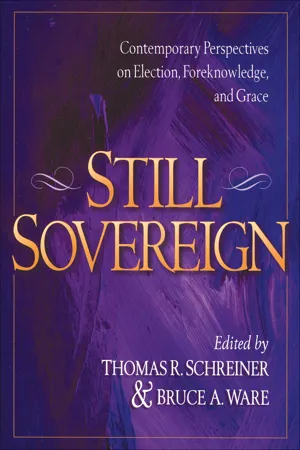
In Still Sovereign, thirteen scholars write to defend the classical view of God's sovereignty. According to the editors, "Ours is a culture in which the tendency is to exalt what is human and diminish what is divine. Even in evangelical circles, we find increasingly attractive a view of God in which God is one of us, as it were, a partner in the unfolding drama of life. . . . In contrast, the vision of God affirmed in these pages is of one who reigns supreme over all, whose purposes are accomplished without fail, and who directs the course of human affairs, including the central drama of saving a people for the honor of his name, all with perfect holiness and matchless grace."
The fourteen chapters of Still Sovereign (originally part of the two-volume, The Grace of God, the Bondage of the Will) are divided into three parts. Part 1 offers fresh exegesis of the biblical texts that bear most directly on the doctrines of election, foreknowledge, and perseverance of the saints. Part 2 explores theological and philosophical issues related to effectual calling, prevenient grace, assurance of salvation, and the nature of God's love. The final section applies the doctrines of election and divine sovereignty to Christian living, prayers, evangelism, and preaching.
eBook - ePub
Still Sovereign
Contemporary Perspectives on Election, Foreknowledge, and Grace
- 356 pages
- English
- ePUB (mobile friendly)
- Available on iOS & Android
eBook - ePub
Still Sovereign
Contemporary Perspectives on Election, Foreknowledge, and Grace
About this book
Information
Topic
Theology & ReligionSubtopic
Biblical Studies
1
The Sovereignty of God: Case Studies in the Old Testament
RAYMOND C. ORTLUND JR.
Does the Old Testament teach the sovereign freedom of God in his dealings with man, as classical Calvinism affirms?[1] The purpose of this chapter is to argue afresh that the Old Testament does indeed contain such teaching. It is not the purpose of this chapter to explore the profound mystery of divine sovereignty interfacing with human responsibility.[2] I aim rather to demonstrate that passages in the Old Testament can be shown to be agreeable with the confidence of Calvinism that, from his position of absolute supremacy, God rules over all things in a way which necessarily precludes his being limited by creaturely factors.
In pursuing this aim I am in no way insinuating a denial of the reality of human responsibility. Rather, I wish to follow Holy Scripture in its strong affirmation of the ultimacy of God over and in all things, including authentic human responsibility. I will leave to others the further question as to how divine sovereignty and human responsibility dovetail in such a way that the moral significance of human agency is safeguarded while, at the same time and in a deeper sense, human agency in no way whatever limits the freedom and efficacious power of God or renders uncertain the fulfillment of his eternal decrees. I believe that reality does indeed disclose the infallibly effectual unfolding of God’s will through responsible human agency, and I have a few thoughts on how such a wonder might make sense; but here I intend only to ground the doctrine of God’s sovereignty in the bedrock of several specific Old Testament passages. For all who accept the biblical text as their major premise in theological thought, any other questions subsequently raised must be considered in the clear and glorious light of the doctrine of God’s unfrustrated sovereignty, once it is established exegetically.
The collections of essays entitled Grace Unlimited and The Grace of God, the Will of Man together devote only one chapter to the Old Testament.[3] Regrettably, this chapter overlooks conspicuous Old Testament declarations of God’s sovereignty. For example, no mention is made of God’s decision to bypass Esau in favor of Jacob or of the hardening of Pharaoh’s heart, both of which are important in Paul’s New Testament exposition of the sovereign ways of God. Reading this essay, one would never know that the Old Testament declares:
“Who gave man his mouth? Who makes him deaf or mute? Who gives him sight or makes him blind? Is it not I, the LORD?” (Exod. 4:11)
“I form the light and create darkness,
I bring prosperity and create disaster;
I, the LORD, do all these things.” (Isa. 45:7)
Why, O LORD, do you make us wander from your ways
and harden our hearts so that we do not revere you? . . .
No one calls on your name
or strives to lay hold of you;
for you have hidden your face from us
and made us waste away because of our sins.
Yet, O LORD, you are our Father.
We are the clay, you are the potter;
we are all the work of your hand. (Isa. 63:17; 64:7–8)
Who can speak and have it happen,
if the Lord has not decreed it?
Is it not from the mouth of the Most High
that both calamities and good things come? (Lam. 3:37–38)
His dominion is an everlasting dominion;
his kingdom endures from generation to generation.
All the peoples of the earth are regarded as nothing.
He does as he pleases
with the powers of heaven
and the peoples of the earth.
No one can hold back his hand
or say to him: “What have you done?” (Dan. 4:34–35)
Such striking testimonies to God’s supremacy over us, which not only invite theological exploration but also demand bowed heads and humbled hearts, are disregarded in the Arminian presentation. Moreover, the discussion that is offered lacks the exegetical demonstration necessary to give the argument persuasive force. My point in making this critical observation is simply to explain why this chapter will not respond directly to the Old Testament argumentation put forward in Grace Unlimited and The Grace of God, the Will of Man. There is little to respond to.
I intend to show that the Old Testament contains passages which must, by any reasonable interpretative standard, be accepted as teaching a divine sovereignty operative in human life that is individual (rather than merely corporate), salvific (rather than merely historical), and effectual (rather than contingent).[4] Let us consider three such texts.[5]
Psalm 139
Psalm 139 is divided into four paragraphs of six verses each. In verses 1–6, David affirms God’s intimate knowledge of him. In verses 7–12, he affirms God’s ubiquitous presence with him. In verses 13–18, he affirms God’s sovereign creation of him. And in verses 19–24, David responds to God’s love with open-hearted consecration. It is important to bear in mind that, as David composes this psalm, his life is at risk. He has taken a stand for God, but powerful and villainous people are opposing him for it. Their hatred of God leads them to hate David and threaten his very life, as may be surmised from verses 19–22. He does not yet know what will become of him, but his response is to flee by faith to God. There, in God’s presence, David takes stock of his life. “What do I have going for me? What can I count on right now?” And he finds assurance in the truths that God knows him searchingly, that God is with him universally, and that God created him sovereignly. Rather than feel threatened by such a God, David draws strength from his loving care and is renewed within to fight on.
Our interest here lies in the first and third paragraphs. Firstly then, in verses 1–6, David prays, “God, you know me.”
O LORD, you have searched me
and you know me. (v. 1)
In Job 28:3 the verb translated “search” is used of miners digging down into the earth. In Judges 18:2 it is used of explorers spying out a land. In Proverbs 25:2 it is used of kings inquiring into the depths of an intellectual problem. In an analogous sense, God has searched through David with the result that he knows him thoroughly. It is evident from verse 23, moreover, that David is not threatened by this all-knowing God. He gladly opens his heart to and finds reassurance in God’s penetrating scrutiny of his soul.
When the risen Lord appeared to the apostle John to address the seven churches of Asia Minor, he revealed himself as one “whose eyes are like blazing fire . . . who searches hearts and minds” (Rev. 2:18, 23). He began his message to each of the seven churches with the words, “I know.” And in the Book of Acts God is twice described as the “Heartknower” (Acts 1:24; 15:8).[6] In the letter to the Hebrews we read that “nothing in all creation is hidden from God’s sight. Everything is uncovered and laid bare before the eyes of him to whom we must give account” (Heb. 4:13). Therefore, what David affirms with regard to himself in Psalm 139 is no less true for all of God’s people. The psalm is paradigmatic of the ways of God.
You know when I sit and when I rise;
you perceive my thoughts from afar. (v. 2)
Before a word is on my tongue
you know it completely, O LORD. (v. 4)
In verse 2a David acknowledges that his outward behavior lies exposed before God, while in 2b David extends the divine knowledge even to his inner life, his secret thoughts, motives, and desires. God knows it all “from afar.” In verses 7–12 David makes the point that God is always present with him. The distance in view in verse 2, then, must be not spatial but temporal, as this word is also used in Isaiah 22:11, 25:1, and 37:26. Long before any impulse wells up from within David’s psyche, long before David himself knows what his next mood or feeling will be, long before he knows where his train of thought will eventually lead, God perceives it all.
Verse 4 makes the same point, only reinforcing it with respect to the very words coming out of David’s mouth. Before David said “Before,” God knew it. Before he said “a,” God knew it. Before he said “word,” and so on. God is never caught by surprise or thrown off balance by David. God also knows what David’s enemies are going to plot against him before they themselves know. No one gets a step ahead of this omniscient God, and David drinks this truth in as his theological fountain of youth.
You hem me in—behind and before;
you have laid your hand upon me. (v. 5)
In the first line of this verse David uses a strong word, weakly rendered “hem in” by the New International Version. This verb is frequently used in the Old Testament of an army laying siege to a city, as when Joab besieged Rabbah (1 Chron. 20:1). David is confessing his vivid awareness of God’s unrelenting attentions bombarding the fortress of his soul from all sides. Wherever he turns, David is confronted by the all-seeing eyes of God. As a result, God has David under his control, as the second line implies. All David can do is yield. And neither may David’s enemies touch him, unless God allows it.
Such knowledge is too wonderful for me,
too lofty for me to attain. (v. 6)
Now David concludes, with relief and joy, that he is no match for this all-knowing God. Is it not interesting how David presses his theology to the limit, seeking reassurance that no conceivable extremity of distress could possibly push him out beyond the range of God’s watchful care? David’s whole point in verses 5–6 is that he cannot surprise God, he cannot anticipate God, he cannot move ahead of God. And so he collapses in a sort of glad defeat, overwhelmed by this inescapable and loving God. Everywhere he turns, every thought he thinks, every fear he dreads, David encounters God, and he joyfully surrenders.
How then can God be thought of as one who responds to man, in an Arminian sense?[7] If God exercises such foreknowledge of us as we see in Psalm 139, then in what ultimate sense is God in a position of responding to us? How can we limit God’s choices or impose conditions upon him? And more to the point exegetically, for what purpose is David reviewing the truth of God’s intimately personal omniscience? To draw strength from this God who never loses sight of him, who understands what he is thinking and how he is feeling right now and who is always far out ahead of David’s current situation. Divine foreknowledge, one of the very things some Arminians seem anxious to minimize by qualifications, David glories in. There is more at variance between Arminianism and Calvinism than theological formulation. These systems also represent two disparate sets of values and affections. Arminianism rejoices in human autonomy and divine limitation, while Calvinism rejoices in human dependence and divine all-sufficiency.
Then, in verses 13–18, David prays, “God, you made me.”
For you created my inmost being;
you knit me together in my mother’s womb.
I praise you because I am fearfully and wonderfully made;
your works are wonderful,
I know that full well. (vv. 13–14)
The emphatic word in the first line of verse 13 is “you.” Behind, in, and through the natural process of fetal development, God himself was at work on David: “You made me.”[8] To separate the work of God from the secondary causes and processes he employs to accomplish his will is highly artificial biblically and quite unnecessary logically. However events emerge and transpire, they are “your works,” according to verse 14. The Arminian impulse, so quick to distinguish the human from the divine in the unfolding of events—to guard the autonomy of human agency, presumably—seems a curiously misplaced concern. David feels no such urgency in his interpretation of reality, as one can see here. Indeed, it is the very presence of God within events which David finds reassuring.
David also confesses that God created his “inmost being.” The usage of this word (e.g., Prov. 23:16, “my inmost being will rejoice”; Ps. 73:21, “my spirit was embittered”) suggests that this is David’s psyche, his inner man responding freely to the realities of his experience. And David is saying that God created and shaped this very capacity for perceiving, thinking, and feeling. The only instrument David has for connecting with reality is David, and God crafted even that. Although his inner reflexes are authentic and morally significant—as their appearance in the psalm implies, to say nothing of biblical teaching generally—they cannot be thought of as functioning autonomously, for God made them by his own sovereign act to begin with. God and David, then, cannot be equal players in the operation of reality, however divine sovereignty and human responsibility interact.
My frame was not hidden from you
when I was made in the secret place.
When I was woven together in the depths of the earth,
your eyes saw my unformed body.
All the days ordained for me
were written in your book
before one of them came to be. (vv. 15–16)
The New International Version’s rendering of verse 16 obscures the force of the text, as if it were declaring that the total number of days in David’s life were recorded in God’s book.[9] But that is not what the Hebrew suggests, nor is it as relevant to David’s controlling purpose in the psalm. That God has ordained the number of days David will live is not unimportant, but David’s actual point is more profound. The Revised Standard Version interprets the Hebrew text more plainly:
. . . in thy book were written, every one of them,
the days that were formed for me,
when as yet there was none of them.[10]
David is affirming that God wrote the script of his life in the great book of God’s intentions before the actual events began to unfold, indeed, before David was even born. And, mixing his metaphors, David also says that the days of his life were formed or shaped, suggesting the action of a potter shaping clay. He means that his life, considered not only as a whole but also right down to his daily experience, was determined (what other word fits?) ahead of time.[11] And why does David make this point? Because it assures him that he is not here in this present danger by chance. He is living out God’s will and plan for his life, and this faith gives David godly poise in the face of danger.
This deserves a moment’s reflection. David is thinking his way down to the bedrock of his existence, where his faith can find rest. The distressing hostilities around him threaten both body and soul. Everything around him swirls in uncertainty. He could lose his nerve. So what does he need right now? Certainty. It would not make sense for David to appeal to a contingency as he searches for a place to stand. It does make sense that David is reaching out to hold fast to that which stands immovable. And in his soul’s quest, where does David land? On God’s sovereignty, shaping the events of his personal life day by day and foreordaining even his present emergency. That puts it into a completely new, theocentri...
Table of contents
- Cover
- Title Page
- Copyright Page
- Contents
- Abbreviations
- Contributors
- Preface
- Introduction
- Part 1 Biblical Analyses
- Part 2 Theological Issues
- Part 3 Pastoral Reflections
- Index of Persons
- Index of Subjects
- Index of Scripture
- Notes
- Back Cover
Trusted by 375,005 students
Access to over 1.5 million titles for a fair monthly price.
Study more efficiently using our study tools.
Frequently asked questions
Yes, you can cancel anytime from the Subscription tab in your account settings on the Perlego website. Your subscription will stay active until the end of your current billing period. Learn how to cancel your subscription
No, books cannot be downloaded as external files, such as PDFs, for use outside of Perlego. However, you can download books within the Perlego app for offline reading on mobile or tablet. Learn how to download books offline
Perlego offers two plans: Essential and Complete
- Essential is ideal for learners and professionals who enjoy exploring a wide range of subjects. Access the Essential Library with 800,000+ trusted titles and best-sellers across business, personal growth, and the humanities. Includes unlimited reading time and Standard Read Aloud voice.
- Complete: Perfect for advanced learners and researchers needing full, unrestricted access. Unlock 1.5M+ books across hundreds of subjects, including academic and specialized titles. The Complete Plan also includes advanced features like Premium Read Aloud and Research Assistant.
We are an online textbook subscription service, where you can get access to an entire online library for less than the price of a single book per month. With over 1.5 million books across 990+ topics, we’ve got you covered! Learn about our mission
Look out for the read-aloud symbol on your next book to see if you can listen to it. The read-aloud tool reads text aloud for you, highlighting the text as it is being read. You can pause it, speed it up and slow it down. Learn more about Read Aloud
Yes! You can use the Perlego app on both iOS and Android devices to read anytime, anywhere — even offline. Perfect for commutes or when you’re on the go.
Please note we cannot support devices running on iOS 13 and Android 7 or earlier. Learn more about using the app
Please note we cannot support devices running on iOS 13 and Android 7 or earlier. Learn more about using the app
Yes, you can access Still Sovereign by Schreiner, Thomas R., Ware, Bruce A., Thomas R. Schreiner,Bruce A. Ware in PDF and/or ePUB format, as well as other popular books in Theology & Religion & Biblical Studies. We have over 1.5 million books available in our catalogue for you to explore.