- 348 pages
- English
- ePUB (mobile friendly)
- Available on iOS & Android
eBook - ePub
About this book
A practical approach to church planting that uses cultural and experiential data to facilitate the founding of new churches in unreached areas of the world.
Information
Topic
Theology & ReligionSubtopic
Christian MinistryPart One
The Christian
and
the Christian Mission
and
the Christian Mission
1
The Heart of the Christian Mission
The church is a storm center of contemporary society. Communists have viewed it as a chain anchoring the proletariat to the past. Secularists think of it as a vestigial organ without which society and individuals could function just as effectively, or more so. Liberals often see the church as fulfilling its purpose when it permeates society and loses its separate identity. Most conservative Christians, on the other hand, are convinced that the church is at the heart of the divine purpose for the present age and view growth as one of its major responsibilities.
Adding to the confusion occasioned by these diverse views, theologians distinguish the visible church and the invisible church, the church militant and the church triumphant, and the universal church and local churches. Missiologists write about the indigenous church, the responsible church, older and younger churches, sending and receiving churches, and national and nativistic churches. Church analysts talk about formal and informal churches, traditional and innovative churches, and structured and unstructured churches.
We should make it clear at the outset that when we use the word “church,” we may be referring to that universal body which is built upon the foundation of the apostles and prophets, which is composed of all true Christian believers, and of which Christ is the head. Or we may be referring to any duly constituted local body of Christian believers who corporately engage in worship and witness, and who serve each other and the world in accordance with the Word of God. From a biblical point of view, these are the only entities that can rightly be called “church.”
The thesis of this chapter is simple: The primary mission of the church and, therefore, of the churches is to proclaim the gospel of Christ and gather believers into local churches where they can be built up in the faith and made effective in service; thus new congregations are to be planted throughout the world. Of course there are many other important tasks to be carried out by Christian believers both individually and corporately. But few of these objectives will be realized unless new believers are constantly being added to local churches, unless new local churches are being added to the universal church, and unless existing churches are growing up into the fullness of him who is their head.
The Divine Plan for the Church
Countless pages have been written on the place of the church and its mission in the plan of God.1 It can be demonstrated from the biblical record that God was not taken by surprise when Adam sinned. God had a prior plan that provided a way whereby humans could be reconciled and restored to fellowship with him. As an integral part of that plan God chose Abraham and his descendants as a people through whom the world would be blessed (Gen. 12:1–3). In one sense they failed, but the plan did not fail. Neither the continued provincialism of the Jewish people nor their ultimate rejection of the Messiah could obstruct the divine purpose. Rather, “by their transgression salvation has come to the Gentiles” (Rom. 11:11b). Believing Gentiles have been made “fellow heirs and fellow members of the body, and fellow partakers of the promise in Christ Jesus through the gospel” (Eph. 3:6). And “this was in accordance with the eternal purpose [lit., purpose of the ages] which [God] carried out in Christ Jesus our Lord” (Eph. 3:11).
As Paul makes abundantly clear, the present arrangement whereby Jew and Gentile alike become members of a spiritual body by faith in Christ does not mean that the promises to Israel as a nation have been nullified. Certainly not. The blindness of their eyes and the hardness of their hearts are partial and temporary until the “fulness of the Gentiles has come in.” Then “all Israel will be saved” (Rom. 11:25–26). Israel will still have her day!
In the meantime the present age constitutes a unique period of history. It can correctly be called the church age. When our Lord was ministering on earth, he prophesied that he would build his church and that the gates of Hades would not overpower it (Matt. 16:16–18). When he died on the cross, he provided for the church, giving himself in death that the church might be born and grow (Eph. 5:25). Now that he is in heaven, he is sanctifying or calling out the church and preparing it for its final presentation (Eph. 5:26–27). When he comes again, he will gather the church to glorify it in the presence of the Father (1 Thess. 4:13–18; Rev. 4–6).
Various metaphors describe the church in its relation to Christ. It is his building—“built upon the foundation of the apostles and prophets, Christ Jesus Himself being the corner stone” (Eph. 2:19–21). It is his spiritual body—“the fulness of Him who fills all in all” (Eph. 1:23; see also 1 Cor. 12:12–13). It is, as it were, his bride—the object of his love and provision (Eph. 5:25–33).
The church, then, is not an afterthought in the mind of God. He planned for it in eternity past and provided for it in the death and resurrection of his Son (Eph. 1:19–23). And the Son prepared for its formation and development by instructing his followers as to their mission and empowering them by his Spirit (Acts 1:4–8). The church and the churches have no friend like their Lord! If Christians are to love what their Lord loves, they must love the church—and the churches! In the final analysis, Christology is closely allied with ecclesiology. When we inquire into a person’s faith, we do well to ask what that individual thinks of Christ and his church!
The Great Commission
If there is any lingering doubt as to the central task to which Christ calls his people, it should be dispelled by an inquiry into the nature of the final command of Christ and the result of obedience to that command on the part of the early believers. Not that the Great Commission is overlooked! Perhaps no single passage of Scripture is more widely used to challenge Christians to faithfulness to their primary task than is Matthew 28:16–20:
But the eleven disciples proceeded to Galilee, to the mountain which Jesus had designated. And when they saw Him, they worshiped Him; but some were doubtful. And Jesus came up and spoke to them, saying, “All authority has been given to Me in heaven and on earth. Go therefore and make disciples of all the nations, baptizing them in the name of the Father and the Son and the Holy Spirit, teaching them to observe all that I commanded you; and lo, I am with you always, even to the end of the age.”
Despite its widespread use as a challenge, however, exhorters seldom take the time to exegete the passage carefully and compare it with parallel passages. As a result, the essence and method of mission are often lost in exhortations to undertake it!
It is important to recognize that the one who issued the Great Commission is the risen Christ to whom all authority (exousia) has been given. (The Holy Spirit will provide the power or might [dynamis] to fulfil the command [Acts 1:7–8].) The commission itself is clearly related to Christ’s authority by the word “therefore.” Two meanings are possible: (1) all authority is behind the command; and (2) those commanded to go can do so in the assurance that all authority belongs to Christ. Both are true. Though the former meaning is usually assumed in this case, the latter should not be overlooked.
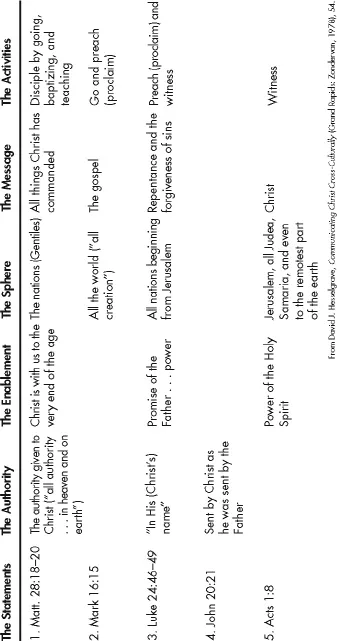
Figure 1
Complementary Statements of the Great Commission
Complementary Statements of the Great Commission
The word which is translated “go” is a participle in the original and not an imperative. A literal translation would be “going” or “as you go.” But that should not be allowed to blunt the force of the word. The same construction is found in Acts 16:9: “Come over [lit., coming over] to Macedonia and help us.” Obviously, if Paul does not “come,” he cannot “help”! And if we do not “go,” we cannot accomplish our mission. On the other hand, the emphasis is not on the going but on the reason for going.
“Make disciples” is the sole imperative and the central activity enjoined in the Great Commission. To make converts and believers is certainly involved. But faith and discipleship can never be divorced. Obedience is required, not just on the part of the one who brings the gospel message, but also on the part of the one who receives it. Converts and believers as popularly conceived might do their own thing, so to speak. But disciples obviously must do the will of their Master.
“Of all the nations” has reference to the Gentiles, who, as we have seen, are now to be brought into the church on the same basis as are the Jews. Previously our Lord had sent his disciples to “the lost sheep of the house of Israel” (Matt. 10:6). Gentiles had not been included. Why? Because God was still dealing with Israel as a people. Christ had not been rejected and crucified. All was not ready. But following the crucifixion and the resurrection, the gospel could go to the Gentiles also.
“Baptizing them in [or, into] the name . . .” has reference to the means or method by which disciples are made. In the original, “baptizing” is a participle which derives imperatival force from the main verb. Converts are to be baptized into [eis] the name of the Father, and the Son, and the Holy Spirit. This implies that they come into the ownership of the Triune God.
“Teaching them to observe all that I commanded” is parallel to the former participial construction. Disciples are made by a process of baptizing and teaching. And what is to be taught? All that Christ commanded. For we live by “every word that proceeds out of the mouth of God” (Matt. 4:4).
“Lo, I am with you always . . . .” No one who is sent, and goes, goes alone. Christ himself will accompany his servants to the ends of the earth and until the consummation of the age.
Though the most complete and oft-quoted statement of the Great Commission is found in Matthew 28, parallel passages should not be overlooked. They serve to underscore its central motifs (see figure 1). A comparison of these varied statements of the Great Commission clearly shows that they are neither redundant nor contradictory. They are complementary.
In an effort to make a case for a social understanding of the Christian mission, some interpreters have concluded that the Johannine statement (John 20:21) takes precedence over the Synoptic statements. These interpreters say that our Lord’s use of the phrase “as the Father has sent Me” indicates that our commission is to continue the ministry that he began in the world. Of course, there is a sense in which we are to continue his ministry. But these interpreters quickly move on to the passage in Luke 7:19–23 where John the Baptist sent his disciples to ask Jesus if he indeed was the one who was to come (i.e., the Messiah). Jesus’ answer was concise and clear: “Go . . . tell John . . . how that the blind see, the lame walk, the lepers are cleansed, the deaf hear, the dead are raised, to the poor the gospel is preached” (KJV). This, these interpreters say, is the work that we are to carry on. And so, putting the other statements of the Great Commission aside, they place the ministries of healing and social betterment, and the struggle for justice, at the very heart of our mission.
Now there can be no question but that believers are created in Christ for good works (Eph. 2:10) and that they are to “do good unto all men, especially unto them who are of the household of faith” (Gal. 6:10 KJV). And if one is disposed to say that all things that believers are commanded of God to do constitute their mission in the world, there is a sense in which we can agree. But to say that good works constitute the Great Commission, or the heart of our mission, or that the Johannine statement supersedes the Synoptic statements, is to fly in the face of sound exegesis and clear thinking. Neither the grammar nor the context of John 20:21 will support it. Furthermore, in Luke 7 Jesus was clearly substantiating his messiahship by reference to that miraculous ministry which John, familiar as he was with Old Testament prophecy, had been openly anticipating. The passage as such does not constitute a divine mandate for the continuing exercise of miracles, for the attempt to reproduce them as nearly as possible by the application of medicine, or for social and political redress.
In sum, the Johannine statement of the Great Commission does not change the direction of the statements in the Synoptic Gospels. Rather, it underscores the necessity of going into the world to disciple the nations by preaching, baptizing, and teaching. To allow any understanding of mission to obscure the proclamatory, sacramental, and didactic responsibility of the church is to put the knife to the heart of the Christian mission. To substitute other activities for those distinctly specified by our Lord is to attempt a heart transplant—one that sooner or later will certainly be rejected.2
Pentecost
The event that initially expanded Christianity was Pentecost. The fact is that the early Christians did not inspire themselves to carry out the Great Commission by reminding each other of its provisions and cruciality. Rather, the Holy Spirit came upon those early believers and transformed them into witnesses even as the Lord had promised. According to Acts 1:8, he had told them that when the Holy Spirit came upon them, they would (1) receive needed power or strength, (2) testify regarding the Christ whom they had seen and heard and in whom they believed, and (3) go to Jerusalem, Judea, Samaria, and the ends of the earth. After the Holy Spirit came, they discovered experientially that the Holy Spirit is also the missionary Spirit. He carried out the commission in and through them.3
And what was the result? Luke informs us that following Pentecost “the Lord was adding to their number day by day those who were being saved” (Acts 2:47). Later, when the Jerusalem disciples were scattered by persecution, they “went about preaching the word” (Acts 8:4). After this persecut...
Table of contents
- COVER PAGE
- TITLE PAGE
- COPYRIGHT PAGE
- DEDICATION
- CONTENTS
- FOREWORD TO THE REVISED EDITION
- FOREWORD TO THE FIRST EDITION
- PREFACE
- PART ONE: THE CHRISTIAN AND THE CHRISTIAN MISSION
- PART TWO: THE CHRISTIAN LEADER AND THE CHRISTIAN MISSION
- PART THREE: THE SENDING CHURCH AND THE CHRISTIAN MISSION
- PART FOUR: THE EMERGING CHURCH AND THE CHRISTIAN MISSION
- PART FIVE: THE SENDING CHURCH AND THE CHRISTIAN MISSION (CONTINUED)
- BIBLIOGRAPHY
Trusted by 375,005 students
Access to over 1.5 million titles for a fair monthly price.
Study more efficiently using our study tools.
Frequently asked questions
Yes, you can cancel anytime from the Subscription tab in your account settings on the Perlego website. Your subscription will stay active until the end of your current billing period. Learn how to cancel your subscription
No, books cannot be downloaded as external files, such as PDFs, for use outside of Perlego. However, you can download books within the Perlego app for offline reading on mobile or tablet. Learn how to download books offline
Perlego offers two plans: Essential and Complete
- Essential is ideal for learners and professionals who enjoy exploring a wide range of subjects. Access the Essential Library with 800,000+ trusted titles and best-sellers across business, personal growth, and the humanities. Includes unlimited reading time and Standard Read Aloud voice.
- Complete: Perfect for advanced learners and researchers needing full, unrestricted access. Unlock 1.5M+ books across hundreds of subjects, including academic and specialized titles. The Complete Plan also includes advanced features like Premium Read Aloud and Research Assistant.
We are an online textbook subscription service, where you can get access to an entire online library for less than the price of a single book per month. With over 1.5 million books across 990+ topics, we’ve got you covered! Learn about our mission
Look out for the read-aloud symbol on your next book to see if you can listen to it. The read-aloud tool reads text aloud for you, highlighting the text as it is being read. You can pause it, speed it up and slow it down. Learn more about Read Aloud
Yes! You can use the Perlego app on both iOS and Android devices to read anytime, anywhere — even offline. Perfect for commutes or when you’re on the go.
Please note we cannot support devices running on iOS 13 and Android 7 or earlier. Learn more about using the app
Please note we cannot support devices running on iOS 13 and Android 7 or earlier. Learn more about using the app
Yes, you can access Planting Churches Cross-Culturally by David J. Hesselgrave in PDF and/or ePUB format, as well as other popular books in Theology & Religion & Christian Ministry. We have over 1.5 million books available in our catalogue for you to explore.